

Madrid
The community of Madrid is located in the centre of the Iberian Peninsula and Central Plateau. The capital of the same name is a municipality of nearly seven million people the overwhelming majority of the community’s inhabitants. The city, the EU’s second largest, covers an area of around 606 km2 (234 square miles), which is about 7.5% of the 8,028 km2 (3,100 square miles) area of the entire community. It is a landlocked region and province bounded to the south and east by Castilla-La Mancha and to the north and west by Castile et León.
Blessed with a variety of different habitats the area is rich in wildlife. The existence of Iberian lynx in the area between the Cofio and Alberche rivers is testament to the biodiversity of the area. Taking advantage of the orography, there are several reservoirs and local dams, with the Santillana reservoir being the largest. The major river system is that of the Tagus.
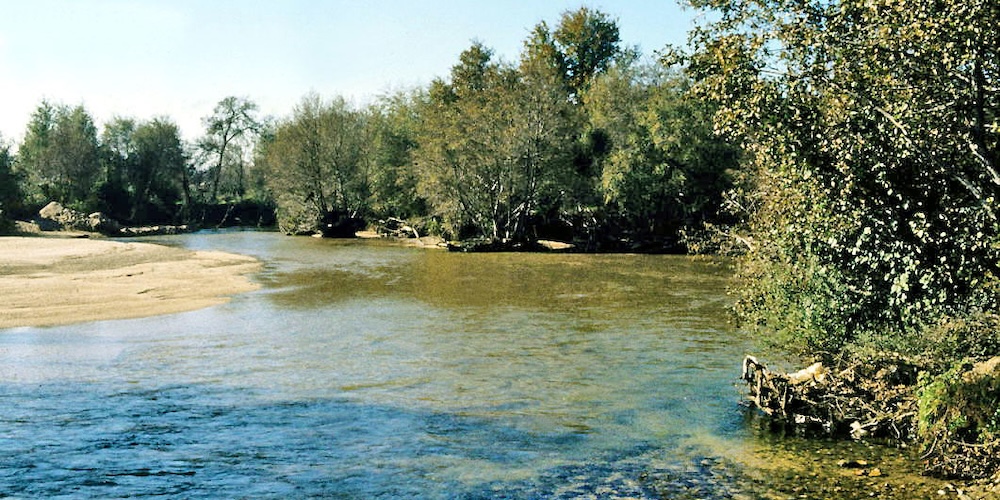
Río Alberche, Villa del Prado – ©LBM1948 CC BY-SA 4.0 via Wikimedia Commons
The Madrid region features a climate marked by dry summers, while average temperature varies with altitude, marking different climate subtypes. Most of the region has a climate intermediate between a hot-summer Mediterranean climate and a cold semi-arid climate, with a dry summer and a moderate to low amount of rain primarily distributed throughout the rest of the year (in the case of the capital, roughly an equinoctial pattern of precipitation maximums), as well as summer temperature averages over 22 °C (with daily maximums consistently surpassing 30 °C in July and August). The capital has a cold semi-arid climate and, in the west, it borders the Mediterranean climate. The areas at a higher altitude close to the Sierra de Guadarrama feature a colder climate. It is the European capital with the lowest average annual precipitation.
Birding Madrid
The wildlife in Madrid, undoubtedly to the surprise of many, can be considered as arguably the best of any capital city in Europe! The province includes extensive (mainly Scot’s pine and Pyrenean oak) forest cover flanking the Sierra de Guadarrama mountains to the northwest, large areas of holm oak dehesa habitat to the north and west, extensive rolling agricultural areas from the northeast round to the southwest, several notable rivers with numerous gravel pits, a few other lakes and reservoirs, and a substrate varying from acidic granite to calcareous chalk and even gypsum. As a result, it is not difficult to imagine why the diversity of habitats, and consequently species, is so high.
Birds are obviously a major part of this diversity, and despite being at the geographical centre of Spain, are very varied. In fact, almost 45% of the region’s area is categorised as qualifying under IBA standards, ranking as the second highest proportion (after Extremadura) in Spain! Three of these IBAs follow the Sistema Central mountain chain which runs along the whole northwest border, one covers the El Pardo park area northwest of the capital, two others mainly agricultural areas in the east, and the last follows the courses of the Henares, Jarama and Tajo (Tagus) rivers in part, approximately from Madrid capital southwards.
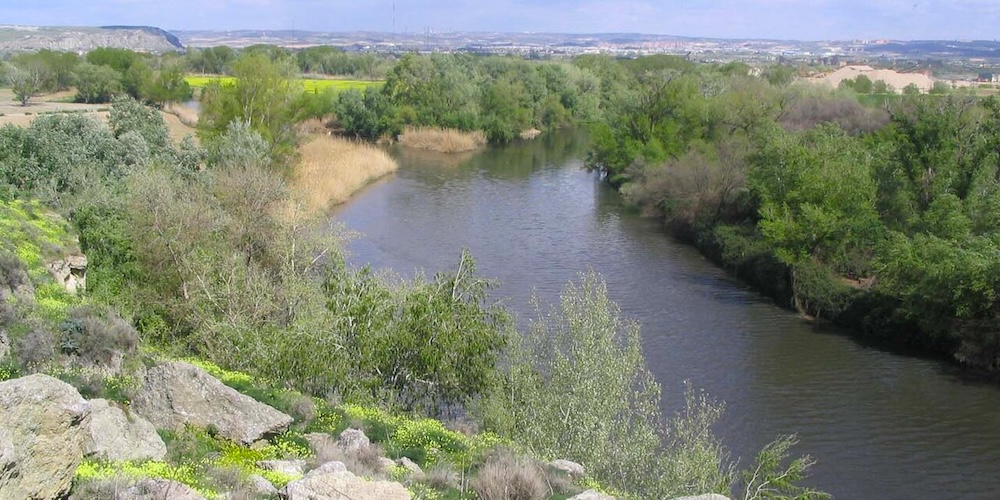
Desembocadura del río Manzanares en el Jarama – ©Miguel303xm CC BY-SA 2.5 via Wikimedia Commons
The list of endangered and threatened species is notable, and includes Black Stork, Spanish Imperial Eagle (c.30 pairs), Eurasian Black Vulture (more than 50 pairs), Lesser Kestrel, Great Bustard (more than 700 pairs) and Little Bustard. The first three of these are mostly found in the north & west, with the remaining three mostly in agricultural areas of the east, all along with a host of other species.
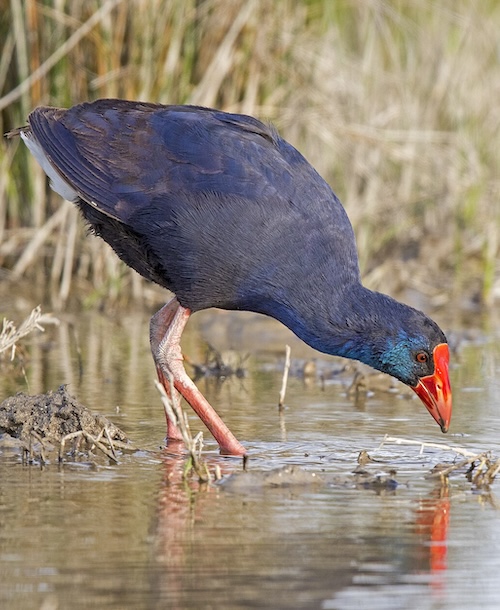
Notable wetland species, mainly concentrated in the Parque Regional del Sureste (roughly Titulcia to Rivas-Vaciamadrid), include breeding Purple Heron, Cattle & Little Egrets, Black-crowned Night Heron, Little Bittern, Red-crested Pochard, Purple Swamp-hen (here at its northern limit in inland Spain), Great Reed Warbler, Eurasian Penduline Tit and feral Red Avadavat. There are also good numbers of duck, Coot and Lesser Black-backed & Black-headed Gulls (with occasional rarities) that overwinter, especially in the south. The river valley cliffs in there are also noted for several species, including resident Peregrine, Eurasian Eagle Owl, Black Wheatear and Red-billed Chough amongst others, along with probably the highest concentration of White Storks, although these can all be found in other parts of the province too (though are sometimes rare).
The agricultural areas and associated habitats are notable for the remarkable concentration of Great Bustards, especially in the area north of the airport between Talamanca de Jarama, Ajalvir and Torrejón del Rey, but Little Bustards, Montagu’s Harrier, Lesser Kestrel, Red-legged Partridge, Stone-curlew, Black-bellied and Pin-tailed Sandgrouse, Great Spotted Cuckoo, European Bee-eater, European Roller, Calandra, Greater Short-toed and Crested Larks, Tawny Pipit, Spectacled Warbler, Spanish Sparrow and Corn & Cirl Buntings are also to be found, albeit in very small numbers for some species.
Scrubby and wooded habitats, found almost throughout the province, from lowland riverside to mid-altitude mountain foothills, including rocky outcrops and river valleys, support a very wide range of species. This is perhaps best exemplified by the El Pardo area, to the northwest of Madrid and either side of the village of the same name and to the northwest (though most is fortunately strictly inaccessible). These include Black & Red Kites, Spanish Imperial, Short-toed & Booted Eagles, Long-eared and Eurasian Scops Owls, Eurasian & Red-necked Nightjars, Eurasian Green Woodpecker (ssp. sharpie), Thekla & Wood Larks, Woodchat & Southern Grey Shrikes, Melodious, Dartford, Subalpine, Sardinian & Western Orphean Warblers, Firecrest, Crested Tit, Short-toed Treecreeper, Blue Rock Thrush, Rock Bunting, European Serin, Hawfinch, Eurasian Golden Oriole and Iberian Azure-winged Magpie.

Mt Peñalara – ©Miguel303xm CC BY-SA 2.5 via Wikimedia Commons
The remaining notable suite of species are those of mid- and upper-level montane areas, some of which are found here at the extreme southern edge of their respective distributions. These include European Honey-buzzard, Eurasian Griffon & Eurasian Black Vultures, Golden Eagle, Water Pipit, White-throated Dipper, Alpine Accentor, Bluethroat, Black Redstart, Rufous-tailed Rock Thrush, Bonelli’s Warbler, Iberian race Pied Flycatcher, Ortolan Bunting and Citril Finch. A number of these are readily found in the Puerto de Navacerrada area, but also in other mountain passes and high-altitude areas including the Lagunas de Peñalara area above the Puerto de los Cotos.
Moreover, such sought-after species as Spotless Starling, Eurasian Hoopoe, Eurasian Crag Martin, Red-rumped Swallow, Common Nightingale, Common Stonechat, Black-eared Wheatear, Zitting Cisticola, Eurasian Tree & Rock Sparrows and Common Raven are also present and many more species to delight the visiting birdwatcher!
-
John Muddeman
| john@spainbirds.com
http://www.iberianwildlife.com/john-muddeman.htm
-
Number of bird species: 334
(As at April 2026)
-
Avibase
PDF ChecklistThis checklist includes all bird species found in Madrid , based on the best information available at this time. It is based on a wide variety of sources that I collated over many years. I am pleased to offer these checklists as a service to birdwatchers. If you find any error, please do not hesitate to report them. -
eBird
PDF ChecklistThis checklist is generated with data from eBird (ebird.org), a global database of bird sightings from birders like you. If you enjoy this checklist, please consider contributing your sightings to eBird. It is 100% free to take part, and your observations will help support birders, researchers, and conservationists worldwide.

-
Where to Watch Birds in Northern & Eastern Spain
| By Ernest FJ Garcia & Michael Rebane | Bloomsbury Publishing | 2017 | Edition 3 | Paperback | 384 pages, 30 b/w illustrations, 125 b/w maps | ISBN: 9781472936752 Buy this book from NHBS.com
-
Madrid Bird Watching
WebpageA group for all those interested in discovering birds and nature in Madrid. We will meet regularly to explore sites within and close to Madrid and look for some of the amazing species that inhabit this part of the World.
-
Madrid Parks n& Gardens
WebsiteSatellite ViewCasa de Campo, El Retiro Park and Madrid Río are Madrid’s best known green areas, but almost every neighbourhood in the city has its own park, square or community garden in which to go for a walk or do a bit of exercise. -
NP Sierra de Guadarrama National Park
InformationSatellite ViewSierra de Guadarrama National Park (in Spanish: Parque Nacional de la Sierra de Guadarrama) is a national park in Spain, covering nearly 34,000 hectares, the fifth largest in Spain's national parks system. -
NR Sierra de Hoyo de Manzanares
InformationSatellite ViewThe Sierra de Hoyo or Sierra de Hoyo de Manzanares is a mountain chain located in the northwest of the Community of Madrid (Spain), near the Sierra de Guadarrama.
-
eBird
SightingseBirding This Month
-
Half-day bird photography tour near Madrid
Local GuideExperience the bird life around Madrid. Photograph rare species from hides and receive personal tips on light, behavior, and camera settings from a professional. -
SpainBirds
Local Tour OperatorRemarkably, the excellent birdwatching opportunities in Madrid remain virtually unknown to many birders. However, during a full day’s guiding one can see Great and Little Bustards in the agricultural areas of the North-East, Eurasian Black Vultures and Citril Finches in the Guadarrama mountains, or even Spanish Imperial Eagle...
-
2018 [08 August] - Ed O'Hara
PDF ReportOnce again I spent a family holiday in Madrid, with my wife and daughter. -
2023 [09 September] - Ed O'Hara
PDF Report...After an hours drive we reached Navacerrada , a mountain village some 1900 m above sea level. We stopped at a nearby bridge and from the car park we picked up our first birds... -
2025 [04 April] - Carlos Sanchez
PDF Report...We stopped at Laguna de el Campillo en route to Almagro, one of several disjunct national park sites in the outskirts of Madrid, for our first introductory birding. We spotted our first Sardinian Warbler, Common Nightingale, and Great Tit in the wooded thickets by the road, while the large lake held Ruddy Shelduck and Common Pochard. The sheer cliffs rising to our left had quite a few Rock Sparrow and Black Redstart... -
eBird
Recent ReportsRecent Trip Reports Madrid
-
Madrid Nature Destination
WebpageGeneral info -
MadridBirding
Instagram PageMadrid Birding | Jake Threadgould -
Netherlands Birding Tours
WebsiteMadrid is a perfect destination to combine city sightseeing and birding. Madrid is very good for birds of prey, especially for Spanish Imperial Eagle (only 150 pairs worldwide, 24 in Madrid), Golden Eagle, Black vulture (over 1.000 pairs worldwide) and Griffon vultures. Other relevant birds like Black stork (12 pairs), Great Bustard (around 800 birds), Little Bustard, Black-bellied Sandgrouse (over 12 pairs), Stone Curlew, Azure Magpie, Black Wheatear, Purple Swamphen, Red Kite, Black-shouldered Kite (few pairs) can be seen