Galicia
The autonomous community of Galicia is a region in northwest Spain covering 29,574.42 km2 11,418.75 square miles) and has a population of around 2.75 million people. Its component provinces are A Coruña, Lugo, Ourense and Pontevedra. Its administrative capital is Santiago de Compostela, although the largest city is Vigo with around 300,000 residents. It is bordered by Portugal to the south, the Spanish regions of Castile et León and Asturias to the east, and the Atlantic Ocean to the north and west. It has over a thousand miles of coastline. There are a number of offshore islands and islets, among them Cíes Islands, Ons, Sálvora, Cortegada Island, which together form the Atlantic Islands of Galicia National Park, and the largest and most populated, A Illa de Arousa.
A remarkable feature of Galicia is the presence of many fjord-like indentations on the coast, estuaries that were drowned with rising sea levels after the ice age. These are called rías and are divided into the Rías Altas, and the Rías Baixas. The rias are important for fishing, and make the coast an important fishing area. The spectacular landscapes and wildness of the coast attract great numbers of tourists. The coast of this green corner of the Iberian Peninsula is also known as the A Costa do Marisco – ‘The Seafood Coast’.
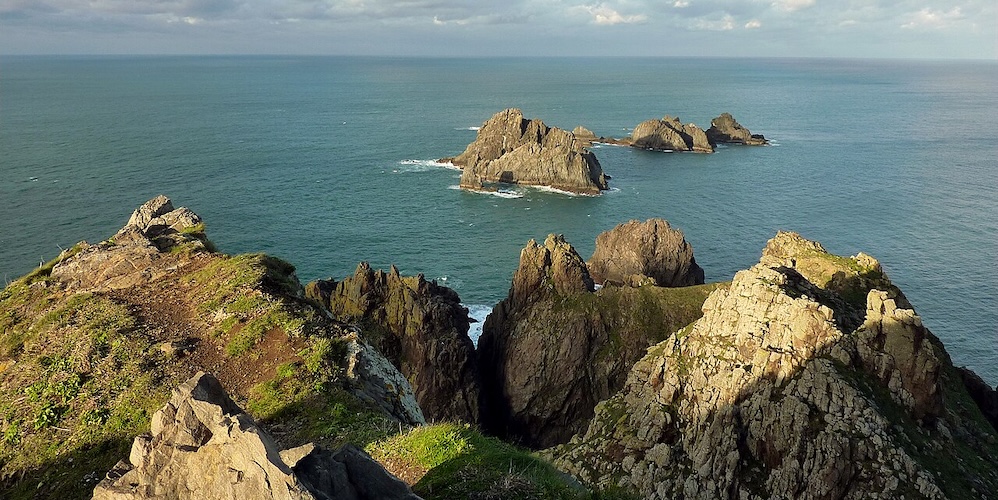
Cabo Ortegal – ©Adbar CC BY-SA 3.0 via Wikimedia Commons
The interior has a hilly landscape composed of relatively low mountain ranges, usually below 1,000 metres, and without sharp peaks, but they do rise up to as high as 2,000 metres in the eastern mountains. The highest point is Trevinca at almost 7,000 feet. There are many rivers, and the region is known as the ‘country of a thousand rivers’. Most, although not all, run down relatively gentle slopes in narrow river valleys, though at times their courses become far more rugged.
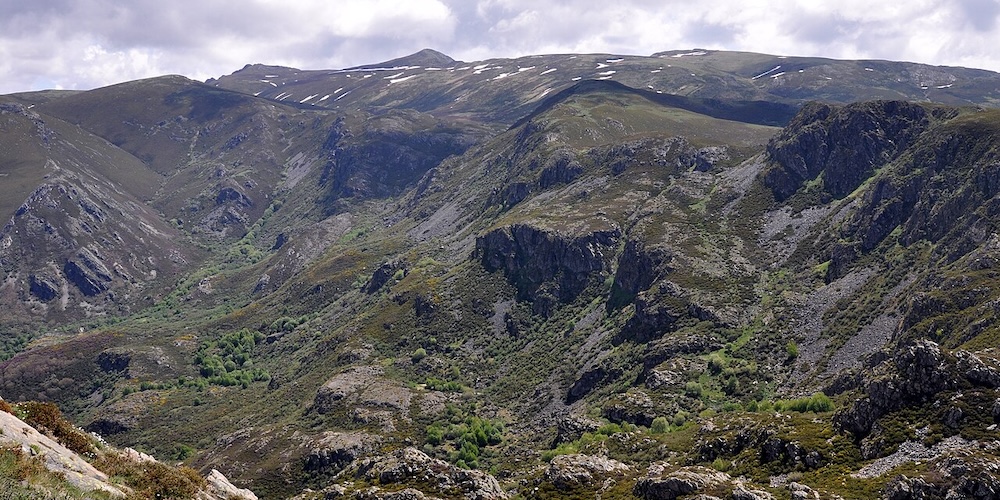
Macizo de Trevinca – ©Rahico CC BY-SA 4.0 via Wikimedia Commons
The largest is the river Miño, poetically known as Father Miño, and with its affluent, the Sill, has created a spectacular canyon. Most of the rivers in the inland are tributaries of this river system. Other rivers run directly into the Atlantic Ocean or the Cantabrian Sea, and most have short courses. Only the Navia, Ulla, Tambre, and Tambre have courses longer than 60 miles. Many rivers have been dammed, creating reservoirs and power generation.
Birding Galicia
Galicia has preserved a few of its dense Atlantic forests where wildlife is commonly found. It is relatively unpolluted, and its landscape composed of green hills, cliffs and rias is very different from what is commonly understood as Spanish landscape. Inland, the region is less-populated and suffers from migration to the coast and the major cities of Spain. There are few small cities and many small villages. The terrain is made up of several low mountain ranges crossed by many small rivers.
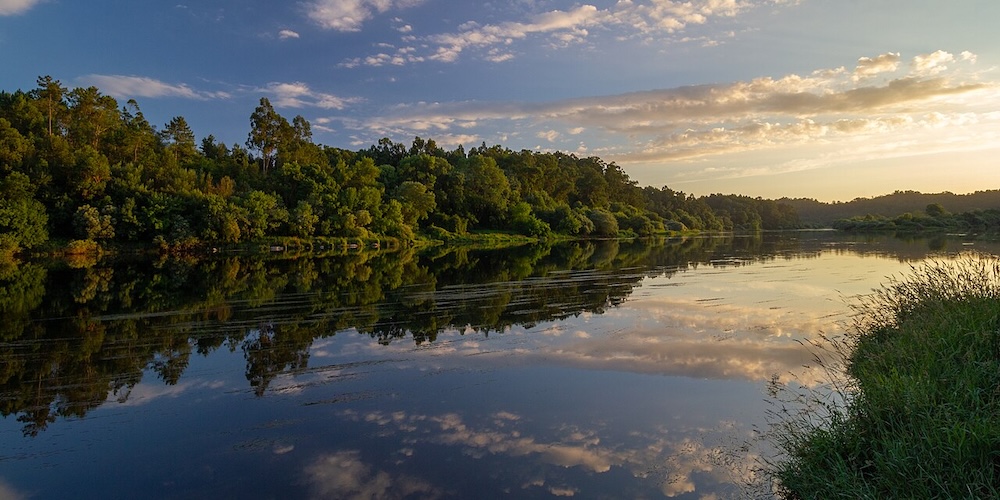
Miño River – ©Alejandro Piñero Amerio CC BY-SA 4.0 via Wikimedia Commons
Deforestation is a problem in many areas, as is the continual spread of the eucalyptus tree, imported for the paper industry. Non-native plantation makes up most of the forested areas. Fauna, most notably the European Wolf, have suffered because of the actions of livestock owners and farmers. However, the wolf population is still the largest in western Europe. The native deer species have declined because of hunting and development. Other environmental issues include gas flushing by maritime traffic, pollution from fish hatcheries on the coast, overfishing, and the highest incidence of forest fires in Spain, in spite of the wetter Galician climate.
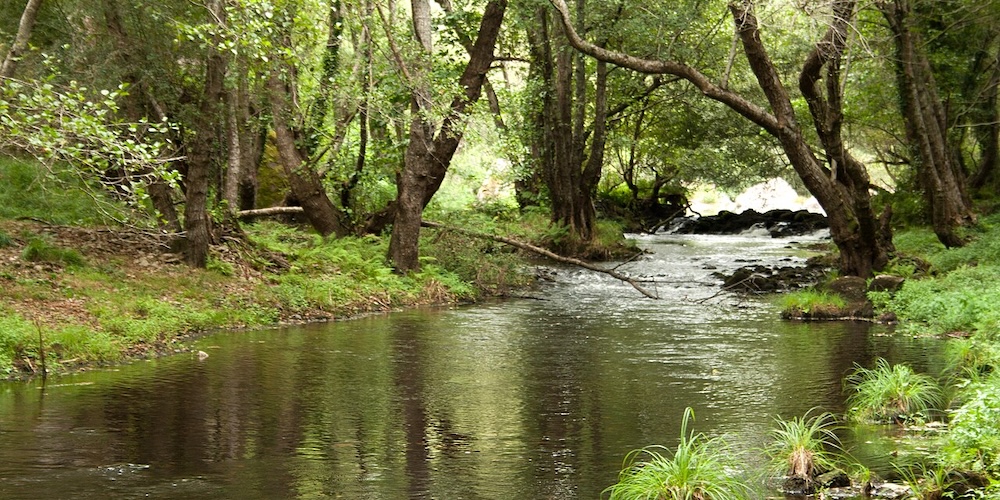
Umia River – ©Iago Pillado CC BY-SA 3.0 via Wikimedia Commons
Several migration routes pass through Galicia and there are a number of environmentally protected areas and special protection areas for birds. The low population levels, difficult to farm terrain in the rural hinterland and the wetter climate does mean that there are still areas which are good for wildlife including birds.
-
Wikipedia
GNU Free Documentation License
https://en.wikipedia.org/wiki/Galicia_(Spain)
-
Number of bird species: 461
(As at April 2026)
-
Avibase
PDF ChecklistThis checklist includes all bird species found in Galicia , based on the best information available at this time. It is based on a wide variety of sources that I collated over many years. I am pleased to offer these checklists as a service to birdwatchers. If you find any error, please do not hesitate to report them. -
eBird
PDF ChecklistThis checklist is generated with data from eBird (ebird.org), a global database of bird sightings from birders like you. If you enjoy this checklist, please consider contributing your sightings to eBird. It is 100% free to take part, and your observations will help support birders, researchers, and conservationists worldwide.

-
Where to Watch Birds in Northern & Eastern Spain
| By Ernest FJ Garcia & Michael Rebane | Bloomsbury Publishing | 2017 | Edition 3 | Paperback | 384 pages, 30 b/w illustrations, 125 b/w maps | ISBN: 9781472936752 Buy this book from NHBS.com
-
NP Atlantic Islands National Park
WebpageSatellite ViewIn addition to the Cíes Islands, the National Park includes the islands of Ons, Sálvora and Cortegada. -
Natural Areas
WebsiteSatellite ViewThere are several natural areas and natural parks in each province. We are only going to give some information about five of them -
Natural Parks of Galicia
WebpageSatellite ViewDiscover the 6 Natural Parks of Galicia -
Protected Birdlife Reserve (ZEPA)
WebpageSatellite ViewThe ZEPA birdlife reserves are distributed both along the coast and in mountain areas. These spaces, together with several other birding areas all over our territory, are meeting points for birdwatchers. -
Ramsar sites
WebpageSatellite ViewGalicia has acknowledged a total of five areas: the Complexo intermareal Umia - O Grove; A Lanzada, Punta Carreirón e Bodeira lagoon; Ortigueira and Ladrido estuaries; its beach complex, the Corrubedo lagoon and dunes; the Valdoviño lagoon and dunes; the Eo River estuary.
-
eBird
SightingseBirding This Month
-
Birding Galicia
Local Tour OperatorWe like designing tailor-made birding tours for our customers according to their birding and nature objectives, available time and season. Thus we usually guide trips to different areas in the NW Spain.
-
Identifying Birds
WebpageStarting to identify birds is not difficult. You start by acquiring a range of skills that allow you to discriminate between a series of more or less similar species and, above all, to learn how to look for the field characteristics that enable you to rule out certain species. -
Protected Areas in Galicia
WebsiteGalicia is a patchwork of landscapes, where an endless number of places of natural interest unfold. There are several reasons for this: first of all, the wide strip of coast and continental areas; secondly, the great variations in altitude; thirdly, the contrasts in climate which give rise to biogeographic differences, and lastly, its lengthy history throughout which men and women have toiled, completely changing the landscape.
-
Amadeo Antonio Pombo Eirín - Aves de Baldaio
BLOGLast updated 2013 -
Amadeo Antonio Pombo Eirín - Aves de la Mariña Lucense
BLOGLast updated 2008 -
Antonio Sandoval - Aves de la ría do Burgo
BLOGLast updated 2020 -
Aves del golfo
BLOGLast updated 2013 -
Manuel Sobrino Senra - El Naturalista Cojo (The Lame Naturalist)
BLOGMy name is Manuel Sobrino Senra, I live in A Guarda, and if I am lame. I move in a wheelchair since birth. But this circumstance has never prevented me from enjoying my great passion: nature. The trick is to recognize and accept your limitations. Because no need to walk to appreciate the fragile beauty of a flower in spring; because to marvel at the flight of a hawk indefatigable just look towards high in the sky for a few minutes.