

Castilla-La Mancha
Castilla-La Mancha is an autonomous community in the region of Spain, comprising the provinces of Albacete, Cuidad Real, Cuenca, Guadalajara and Toledo. The administrative centre is the city of Toledo. This landlocked region in the southern half of Spain is bordered by Castile-y-León, Madrid, Aragon, Valencia, Murcia, Andalusia, and Extremadura. It covers 15% of the nation, an area of 79,563 km2 (30,719 square miles) but has a population of just 2,105,000 people.
It occupies the greater part of the vast plain known as the Submeseta Sur, separated from the Submeseta Norte and its neighbouring state of Castilla-y-Lyon by the mountain range known as Sistema Central. The west-to-east Montes de Toledo range cuts across the meseta separating the (northern) Tagus and the (southern) Guadiana drainage basins. In the southeast is the ridge of the Sierra Morena, the southern border of the Meseta Central and the region’s border with Andalusia.
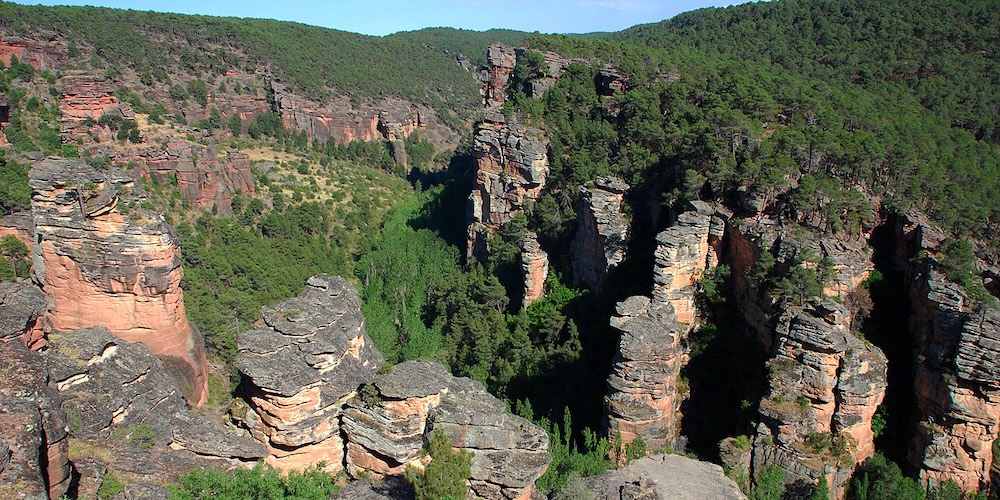
Barranco de la Hoz – ©José Felipe Ortega CC BY-SA 2.0 via Wikimedia Commons
Castilla–La Mancha is divided into five principal watersheds. The Tagus, Guadiana, and Guadalquivir drain into the Atlantic Ocean and the Júcar and Segura into the Mediterranean Sea.
The predominant climate in Castilla–La-Mancha is the hot summer mediterranean climate, while the cold semi-arid climate is also significant occupying most of the provinces of Toledo and Albacete. The warm summer mediterranean climate can also be found, especially in the north of the community. To a lesser extent, there is the presence of an oceanic climate along the border with Aragon. Summer is hot and dry, often exceeding 30 degrees centigrade, and temperatures above 35 are common. In winter, the temperature often drops below zero, reducing frosts on clear nights and very occasional snow on cloudy nights. The region is part of dry Spain and precipitation is generally scarce. Overall, it rarely surpasses 16 inches per year, although the mountainous areas are much higher and the plains much lower.

Sierra Morena – ©NacionAndaluza CC BY-SA 4.0 via Wikimedia Commons
The region’s economy is dominated by agriculture, which employs more than 10% of the active workforce. Although the soils are dry, agricultural activities have been based on the production of wheat, grapes and olives. And it has some of the most extensive vineyards in Europe, covering almost 2 million acres. Other significant crops are garlic, black truffle and saffron, as well as pistachios. Animal husbandry plays a lesser part, mostly with pigs, goats and a small number of cattle, the latter producing dairy products.
Energy production is becoming increasingly important, both with wind and solar farms playing an increasingly important role in the economy.
Birding Castilla-La Mancha
Vast, wild and nowhere nearly so well known as Extremadura or Andalucia, Castilla-La Mancha has everything a birder could want in southern Spain and the excitement of exploring a territory so seldom visited. This region is known as ‘Africa in Spain’, and has an aura of romantic adventure very hard to find in other parts of Europe. Impressive mediterranean areas, the best wetlands of inland Spain, ancient forests and endless steppes are the reasons behind such natural riches. Moreover, the isolation of many large areas of the region help to preserve its wildlife.
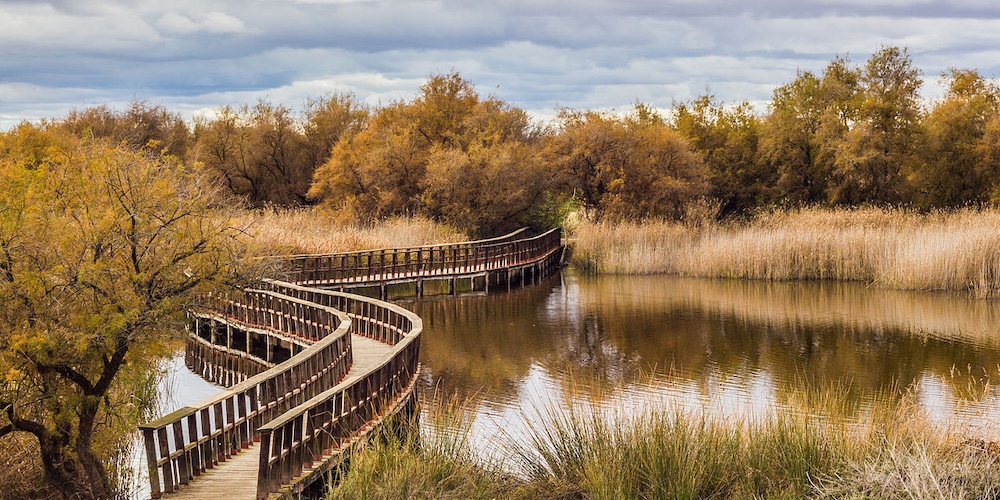
Mancha Húmeda Wetland – ©Enrique__ CC BY 2.0 via Wikimedia Commons
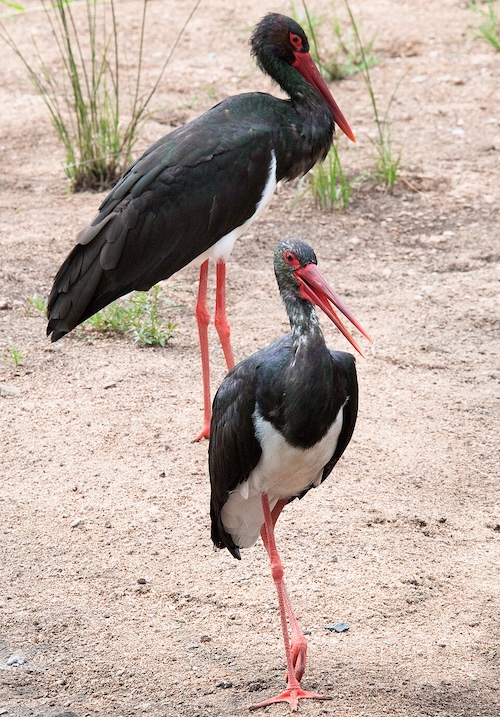
Over 350 birds have been identified by the few birders that have visited this ancient region of Spain (the homeland of the most famous medieval knight, Don Quixote de La Mancha). What is more, among the species that can be found here include many of the most sought-after in Europe including: Black Stork, Spoonbill, Squacco Heron, Marbled Duck, White-Headed Duck, Black Vulture, Spanish Imperial Eagle, Black-Shouldered Kite, Lesser Kestrel, Purple Swamphen, Collared Pratincole, Common Crane, Great & Little Bustard, Pin-Tailed & Black-Belied Sandgrouse, Great Spotted Cuckoo, Iberian Woodpecker, White-Rumped Swift, Roller, Black Wheatear, Azure-Winged Magpie and Hawfinch, to mention but a tasty few.

Parque Nacional de Cabañeros – ©LBM1948 CC BY-SA 4.0 viaWikimedia Commons
This region is the main stronghold for the endangered Imperial Eagle (150 breeding pairs, 38% of the total in Spain), the White-Headed Duck, Stone Curlew (33% of Spain’s), Little Bustard and Pin-Tailed Sandgrouse (22% of the total in Spain just in the Ciudad Real province) and Black Vulture, with the densest colony in Spain settled in Cabañeros National Park with 200 breeding pairs in just 12.000 Hectares.

Tablas de Daimiel – © García Armentano CC BY-SA 3.0 ES via Wikimedia Commons
If there is a place where birders can enjoy some of the last great events of Europe like watching dozens of White-Headed Ducks together in Daimiel, thousands of Little Bustards and Pin-Tailed Sandgrouse clouding up the skies of Calatrava, or watching several Imperial Eagles soar at the same time over La Mancha dehesas; that place is Castilla-La Mancha – the region where everyone can feel like being the ultimate explorer of the old and wild Spain.
-
Cabañeros National Park
InformationSatellite ViewThe second National Park of the region (Castilla-La Mancha is the only region in Spain with 2 National Parks) houses the best representation of Mediterranean Forest in the whole country. An outstanding habitat for large ungulates, the park also host impressive populations of avian predators like Golden & Imperial Eagles, Short-Toed & Booted, Red & Black Kite (very common in winter/summer), Montagu’s Harrier, Black-Shoulder Kite. It is especially important for Black Vulture (the second biggest colony in the world, with about 200 pairs) in the area called ‘la raña’ - the flatlands - that due to its similarity to the African open spaces is known as the Spanish Serengeti. The park and its surroundings is very little explored can be a highly rewarding experience for birder s who may fmake unexpected inds such as a White-Rumped Swift over the Sierras or a flock of Red-Footed Falcons hawking for big insects in the grasslands of the park. -
Castrejón Reservoir
Satellite ViewNear Toledo town lies a reservoir surrounded by sandy cliffs and cultivated area where Purple Swamp Hen, Bonelli’s Eagle, Eagle Owl, Golden Oriol, Bee-eaters, Black-eared Wheatear and waders and ducks on migration can be seen. Ospreys and Eurasian Spoonbills are usual visitors. -
Cultivated areas near Guadalajara and Henares River
Open fields where Great and Little Bustards are all year around, Black-bellied Sandgrouse, Lesser Kestrels, Bee-eaters and Montagu -
La Mancha Húmeda (Wetlands Biosphere Reserve)
Satellite ViewA string of natural and artificial lagoons of varying salt composition in the driest and flattest part of the region at the limits of the provinces of Toledo, Ciudad Real, Albacete & Cuenca. It is host to a very rich aquatic birdlife with healthy populations of White-Headed Duck, Red-Crested Pochard, Purple Swamphen, Bearded Tit, Gull-Billed Tern (breeding here), and exceptional passage and overwinter of other waterfowl (Garganey, Pintail, Tufted Duck) and waders (Eurasian Curlew, Temminck’s Stint, etc.). It is surrounded by excellent steppies with Great & Little Bustard and both Sandgrouses, many birdwatchers also visit to spot rarities like Lesser Flamingo or the Ross’s Gull. -
La Mancha Steppes
Located throughout the hinterland of the provinces of Toledo, Ciudad Real, Albacete & Cuenca, these very well preserved fields are the last havens for steppe birds in all the South of Spain. Although there are countless areas in good state of conservation in the region that are known as La Mancha Steppes, there are two that stand out over all the rest. The Special Protected Area Steppes of Eastern Albacete and the adjoining Petrola-Corral Rubio lagoon complex, with breeding Flamingoes, White-Headed Duck and even records of Cream-coloured Courser. The Special Protected Area of the Calatrava Steppes is a place for Great & Little Bustard, Stone Curlew, Pin-Tailed & Black-Belied Sandgrouse, Calandra & Greater Short-Toed Lark all year long. This spot is also the only place in Western Europe where an amazing event can be enjoyed every winter, when up to two thousand Little Bustards & Pin-Tailed Sandgrouse can be watched feeding together and responding in identical way facing changes in their environment. In the Calatrava Steppes birdwatchers can also be surprised by the numbers of some of the most sought after birds of Europe, like Spanish Imperial Eagle, Black-Shouldered Kite and Great Spotted Cuckoo. -
Las Tablas de Daimiel National Park
InformationSatellite ViewOne of the best places in Spain for birdwatching despite the threat to the park from lack of water. This hot spot is a national protected area where many species of birds breed (in 2013 82 species bred here, 2 more than in Doñana National Park). Sought after species include: Glossy Ibis, Spoonbill, 8 species of Egrets, Marbled Duck, Ferruginous Duck, Red-Crested Pochard, White-Headed Duck, Red-Knob Coot, Collared Pratincole, Moustached & Savi’s Warblers, Bearded Tit. The endangered sub-species of Reed Bunting (whitherby) breed inside the boundaries of the park. A visit to the surrounding areas will give views of other nesting species like Great & Little Bustard, Stone Curlew, Pin-tailed & Black-belied Sandgrouse, European Roller and some well-preserved colonies of Lesser Kestrel. Non-breeding birds in the park include Gull-Billed Tern, Black Tern and the rare White-Winged Tern. The park is also very rich in nocturnal species including Scops, Little, Long-Eared and Eagle-Owl. A night excursion in the area following the Guadiana river should turn up Red-Neck Nightjar. -
Parque Natural del Alto Tajo
WebsiteSatellite ViewBased in Guadalajara province, its impressive landscape of cliffs and gorges is the perfect habitat for Griffon & Egyptian Vulture, Golden Eagle or the grand night hunter, the Eagle-Owl. -
Sierra de Cuenca Range
Satellite ViewNice landscapes dominated by the cliffs and pine trees forest where Bonelli's Eagle is well present and Ring Ouzel overwinter in low numbers. Other interesting species are Griffon Vulture, Red-billed Chough, Crag Martin, Crossbill, Black Redstart and Subalpine Warbler. We suggest to visit the Hoces de Beteta, Uña lagoon, Tragacete and the spot known as Las Majadas near El Tobar reservoir. -
The Volcanic Fields of Calatrava
The Volcanic Fields of Calatrava are the large triangle of ancient volcanoes and lagoons formed by hydromagmatic explosions – in fact the only volcanic lagoons found in Western Europe - host an incredible diversity of bird species, sought after species include: Red-billed Chough, Black Stork, Glossy Ibis, Spoonbill, Squacco Heron, Purple Heron, Ferruginous Duck, White-Headed Duck, Purple Swamphen, Great & Little Bustard, both Sandgrouse, and Golden & Spanish Imperial Eagle. -
Valle de Alcudia Natural Park
InformationSatellite ViewLocated in the south of the Ciudad Real province, just on the border with Andalucia & Extremadura, this amazing boundless space is the last home of the Wolf and the Iberian Lynx in Castilla-La Mancha. Comprising the castilian part of Sierra Morena, avian life includes amazing populations of the Big 5 Raptors (Black & Griffon Vultures, Golden, Imperial & Bonelli’s Eagles) plus other bonus birds such as Alpine & White-rumped Swifts, Egyptian Vulture, Short-Toed Eagle, Goshawk, Black Stork, Black Wheatear, Sylvia warblers, Rock & Cirl Buntings and Hawfinch. Depopulated and almost without road infrastructure, this beautiful part of the ancient Spain is considered to be the most isolated area of Western Europe.
-
Vicente Malagãn Sanroma
| vicente@naturaindomita.com
https://naturaindomita.com/en/
-
Number of bird species: 359
(As at May 2026)
-
Avibase
PDF ChecklistThis checklist includes all bird species found in Castilla-La Mancha , based on the best information available at this time. It is based on a wide variety of sources that I collated over many years. I am pleased to offer these checklists as a service to birdwatchers. If you find any error, please do not hesitate to report them. -
eBird
PDF ChecklistThis checklist is generated with data from eBird (ebird.org), a global database of bird sightings from birders like you. If you enjoy this checklist, please consider contributing your sightings to eBird. It is 100% free to take part, and your observations will help support birders, researchers, and conservationists worldwide.

-
Where to Watch Birds in Northern & Eastern Spain
| By Ernest FJ Garcia & Michael Rebane | Bloomsbury Publishing | 2017 | Paperback | 384 pages, 30 b/w illustrations, 125 b/w maps | ISBN: 9781472936752 Buy this book from NHBS.com
-
Costa Blanca Bird Club
WebsiteThe Costa Blanca Bird Club (CBBC) was set up around 2005 in response to the many requests of the UK Expats who wished to continue bird-watching whilst in Spain. -
SEO Talavera
WebsiteGrupo local SEO Talavera (Talavera de la Reina) Toledo -
Sociedad Albacetense de Ornitología
Facebook PageArticles, observations etc…
-
BR Mancha Húmeda Wetland
InformationSatellite ViewMancha Húmeda is a Spanish wetland area which was designated a Biosphere reserve... -
NP Las Tablas de Daimiel
InformationSatellite ViewHabitats in Las Tablas de Daimiel National Park and identification guide for the 269 species of birds recorded there up to now… -
NP Nacional Park Nacional de Cabañeros
InformationSatellite ViewCabañeros National Park is located in the center of the Iberian Peninsula, between the provinces of Ciudad Real and Toledo and included in the Montes de Toledo. -
NR Lagunas de Ruidera Natural Park
InformationSatellite ViewThe string of lagoons, plus the man made Peñarroya reservoir, are connected by falls, small streams and subterranean flows, stretching for 20 kilometres (12 mi), flowing from southeast to northwest. The entire system runs through the valley of the Upper Guadiana River... -
Sierra Morena
InformationSatellite ViewThe Sierra Morena is one of the last habitats of the endangered Iberian lynx. Other charismatic animals of the region include the Iberian wolf (2019 declared extinct regionally by the Large Carnivore Initiative for Europe), Wild boar, Red deer, the Spanish imperial eagle and the Golden eagle. Among the amphibians, wells and ponds in many areas of the range provide a habitat for the near-threatened Iberian ribbed newt. -
Viajes por Castilla-La Mancha
WebpageSatellite ViewThere is a bird watching observatory in the southern area of the Longar Lagoon
-
eBird
SightingseBirding This Month
-
FEATURED
Natura Indomita
Local Tour OperatorGuided Birding & Natural History Tours in Central & Southern Spain. A great variety of habitats in a very short distance: Mediterranean Forest, the best Wetlands inland Spain, the unique Volcanic Lagoons found in Western Europe and the best Steppes in all the Iberian Peninsula. All of them teeming with an impressive and rich wildlife. Tours in the land of the Iberian Lynx, the Spanish Imperial Eagle, the White-Headed Duck and the Pin-Tailed Sandgrouse… -
Iberian Wildlife Tours
Tour OperatorThe La Mancha area is notable in inland Spain for attracting migrants, from Black Stork, European Honey-buzzard and Common Crane... -
Julian Sykes Wildlife Holidays
Facebook Page...the wetlands of La Mancha will hold good numbers of Greater Flamingos, wildfowl, waders and usually a few surprises along with a visit to the Gigantes (Windmills) on the 'Ruta de Don Quixote'. One of the week’s highlights will be a memorable half day in the little-known reserve of Los Cabañeros, a haven for birds (especially raptors) and mammals, as we traverse this 'Serengeti of Spain' in special vehicles getting us to the more remote inaccessible areas of this National Park. -
Oretani Wildlife
Local Tour OperatorOretani Wildlife offers tailor made birding and wildlife tours and all inclusive packages in Castilla la Mancha and central Spain. Experience the Sierra, Steppe and Wetlands of this exciting region with some of the best birding and wildlife available… -
Spainbirds
Tour OperatorWe've now been working for seven seasons on what started out as a small project called "Spainbirds". Since then our website has been constantly moving on with the times, taking on new challenges and responding to the increasing demands of an ever more numerous travelers. Fruit of all these endeavours is this new version, more useful and participative, which we now offer you on the net… -
Valencia Birding
Tour OperatorWe design and provide tailor-made guided bird watching day-trips, breaks and Bird Watching Holidays in Spain, for individuals, couples and small groups. -
Wild Andalucia
Tour OperatorEagles, Vultures, Sandgrouses, Bustards and many Iberian top birds
-
2017 [05 May] – Chris Durdin & Pau Lucio
PDF ReportThe occelated lizard on the rock was still soaking up the sunshine when two Egyptian vultures flew low overhead. At the same time a cuckoo was calling and the intense blue of beautiful flax Linum narbonense studded the surroundings – altogether a lovely mix. -
2025 [05 May] - Carlos Sanchez
PDF Report...In the afternoon, we explored one of the saline lakes that dot the plains of Castilla-La Mancha. In spring, these ponds are very busy with the commotion of thousands of nesting waterbirds...
-
Abucia Maria Casa Rural
AccommodationAbuela Mar
-
Juan José Lucas López - Blog de campo y minerales
BLOGBlog in which I talk about my outings, both in the geological field and in the forest. -
Rafa Torralba Zapatero - El Nido de Rafa
BLOGPhotoblog -
Un Paseo Manchego
BLOGEste es un BLOG INDIGNADO, porque otro mundo más justo y más humano, es posible. Ecología, ornitología, fauna, flora, denuncias, costumbres, escapadas, viajes, aves, orquídeas, lepidópteros,…