

Aragon
Aragon is a region (autonomous, community) in the northeast of Spain. It borders France in the north, Castile-La Mancha, Castile et Leon, La Roca and Navarre in the west, with the regions of Catalonia and Valencia to the east. It is made up of three similar-sized provinces: Huesca, Zaragoza and Teruel, which are divided into 33 counties. It has a population of around 1,352,000 people, with slightly over half living in the region’s administrative capital, Zaragoza City. It covers an area of 47,720 km2 (18,420 square miles) of diverse terrain. From permanent glaciers in the Pyrenees to verdant valleys, rich pasture lands and orchards, through to the arid steppes of the central lowlands. It is also home to many rivers, most notably the River Ebro, Spain’s largest river in volume, which runs west-east across the entire region through the province of Zaragoza.
There are two main types of climate in Aragón, a Semi-arid climate and an Oceanic climate with several microclimates throughout the entire community. From the High mountain Alpine climate of the central Pyrenees to the north, with perpetual ice (glaciers), to the Humid subtropical climate (which is very common in Huesca’s lower altitude areas) to the steppe or semi-desert zones, such as the Monegros Desert, passing through the intense continental climate of the Teruel-Daroca area and the Mediterranean climate in the southern areas bordering Castilla La Mancha and the Valencian Community.
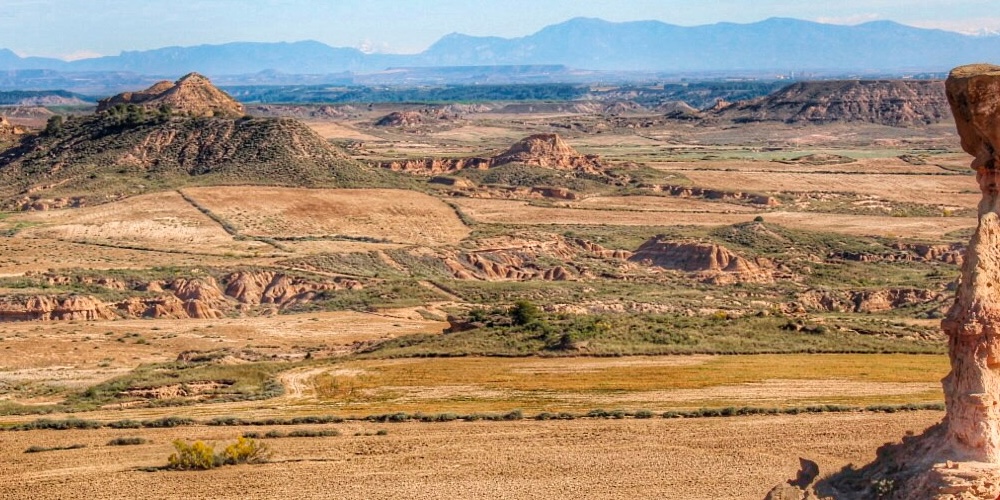
Monegros Desert – ©Chisquio CC BY-SA 4.0 via Wikimedia Commons
Rainfall is mostly low, with much of Aragon placed in a bowl of low ground between the Pyrenean mountain range to the north and the Sistema Ibérico mountain range to the south, cut off from maritime air masses. This situation means that the rain falls mainly in the higher areas, and that the temperature range features large contrasts, with cold winters and hot summers, as typical of continental climates.
Temperatures are very dependent on the altitude. In the Ebro Valley the winters are relatively moderate, but in summer temperatures can exceed 40 °C in the central areas. In mountain areas winters are long and rigorous, average temperatures can be up to 10 °C lower than in the valley. The two most important winds of Aragon are the cierzo and the bochorno or levant. The first is a cold and dry wind that crosses the Ebro Valley from northwest to southeast and that can become quite strong. The second is a warm wind coming from the south-east. The vegetation follows the oscillations of relief and climate.
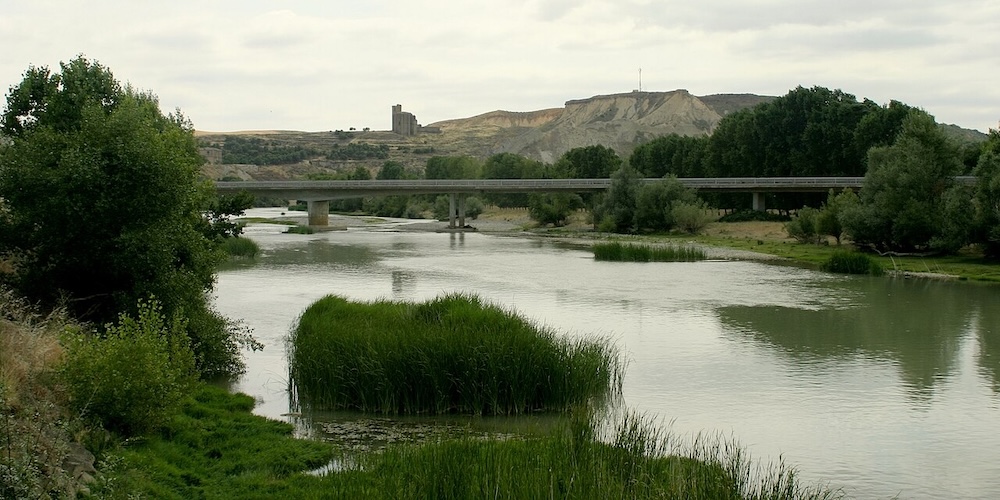
Ebro Valley – ©A.www.viajar24h.com CC BY 2.0 via Wikimedia Commons
There is a great variety, both in natural vegetation and in crops. In the high areas there are forests (pines, firs, beech trees, oaks), bush and meadows, and in the central Ebro Valley, evergreen oak and juniper are the most common trees.
Birding Aragon
Protected natural spaces are managed through the region by Red Natural de Aragón, including national parks, natural parks, nature reserves, biosphere reserves and other protected natural areas. Aragon has just one national Park; the Ordesa y Monte Perdido National Park, it is in the Pyrenees in the comarca of Sobrarbe, and occupies an area of over 15,600 ha, with another 4,000+ha of the peripheral area also protected. Theren is a Biosphere Reserve at Ordesa-Viñamala and four other natural parks: the Moncayo Natural Park covering over 11,000 ha; the Sierra y Cañones de Guara Natural Park of over 80,000 ha if mone includes its peripheral area of protection; the Posets-Maladeta Natural Park with nearly 39,000 ha of peripheral area of protection, and the Valles Occidentales Natural Park with over 30,000 ha if both include peripheral areas. There are also three nature reserves.

Ordesa y Monte Perdido National Park – ©Moahim CC BY-SA 4.0 via Wikimedia Commons
Aragon is an excellent ornithological destination, giving one the opportunity to observe most of Spain’s avifauna in the four most characteristic habitats of the Iberian Peninsula; Alpine peaks and meadows, Mediterranean forest mixed with spectacular limestone rock cliffs, semi-arid steppes and inland lakes, all of them in a relative short distance from each other.
The untamed Pyrenees; especially the high valleys as Ordesa, Hecho or Benasque, hold most of the difficult alpine specialities such as Alpine Accentor, Snow Finch & Wallcreeper, and one can enjoy the magnificent forest of beech and fir and spectacular rock cliffs.
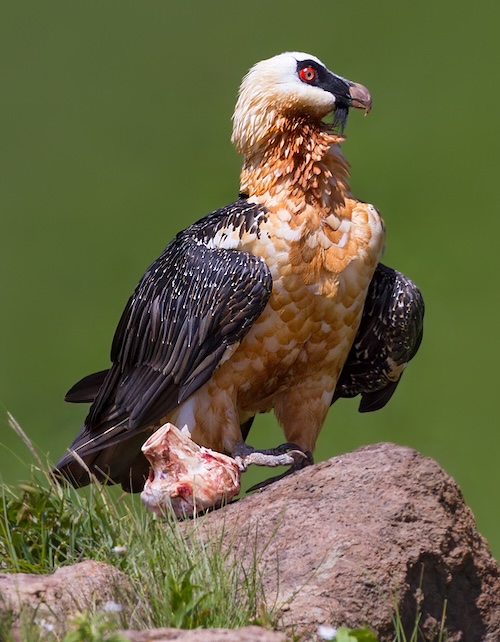
The exciting pre-Pyrenees of Aragon of the Sierra de Guara, Riglos, or San Juan de la Peña are wild and sparsely populated. However, they densely populated with birds of prey and Mediterranean birds such as wheatears, thrushes, buntings, warblers, bee-eaters and many more. The Sierra de Guara is a real Lammergeier sanctuary holding the highest known density of this magnificent bird, as well as Egyptian and Griffon Vultures. Here, too one can find alpine birds such as Wallcreeper or Alpine Accentor to observe at close range from late autumn to early spring.

Egyptian Vulture – ©Dubi Shapiro
ThenInland the steppes of the Monegros and Belchite dotted here and there with salt
lakes, are an arid but fascinating contrast. They are home to perhaps the most Spanish avifauna: raptors, bustards, sandgrouse and larks.
-
Monegros
InformationSatellite ViewThis is a semi-desert area occupying an extensive plain of around 70,000 hectares, with some seasonal lagoons. It is covered with an interesting steppe vegetation. It is an excellent area to observe Great Bustard (32 individuals). There is also a big population of other species, like Stone Curlew, Pin-tailed Sandgrouse, Black-bellied Sandgrouse, Dupont's Lark, Lesser Short-toed Lark. -
Spanish Pyrenees
InformationSatellite ViewThis mountainous barrier, that separates France from Spain, is made up of high mountains, extensive pine forests, streams, and green mountain meadows, and is especially recommended for its abundance of birds of prey. One can see Golden, Short-toed, Booted and Bonelli's Eagles; Montagu's Harrier; Red & Black kites, Peregrine and Hobby; and the magnificent Lammergeier, which here has one of its two last strongholds in the entire continent. Other interesting avian species are: Ptarmigan, Capercaille, Dotterel, Tengmalm's Owl, Black Woodpecker, Crag Martin, Water Pipit and Dipper. Apart from bird species, it is remarkable for the presence of Pyrenean Chamois and Red Deer. This area is probably one of the last refuges in Europe of the Boreal Linx and the Brown Bear.
-
Josele J. Saiz
HUESCA - Spain | jjsv@boletas.org
Website
-
Number of bird species: 414
(As at April 2026)
-
Avibase
PDF ChecklistThis checklist includes all bird species found in Aragón , based on the best information available at this time. It is based on a wide variety of sources that I collated over many years. I am pleased to offer these checklists as a service to birdwatchers. If you find any error, please do not hesitate to report them.

-
A Birdwatching Guide to The Pyrenees
| By Jacquie Crozier | Arlequin Press | 1998 | Paperback | 87 pages, 8 colour plates, illustrations, maps | ISBN: 9781900159753 Buy this book from NHBS.com -
Finding Birds in North Spain
| By Dave Gosney | Easybirder | 2017 | 40 pages | ISBN: 9781907316104 Buy this book from NHBS.com -
Guía de Aves de Aragón [Guide to the Birds of Aragon]
| By Javier Blasco Zumeta | Editorial Prames | 2014 | Paperback | 319 pages, colour photos, colour illustrations | (Text is Spanish) ISBN: 9788483214237 Buy this book from NHBS.com -
Where to Watch Birds in Northern & Eastern Spain
| By Ernest FJ Garcia & Michael Rebane | Bloomsbury Publishing | 2017 | Paperback | 384 pages, 30 b/w illustrations, 125 b/w maps | ISBN: 9781472936752 Buy this book from NHBS.com
-
List of Protected Natural Spaces in Aragon
InformationSatellite View -
NP Ordesa y Monte Perdido National Park
InformationSatellite View...raptors like the golden eagle, the bearded vulture, the griffon vulture, hawks, and the Eurasian eagle-owl... -
NR Reserva Natural de los Galachos de La Alfranca de Pastriz
InformationSatellite View…nesting colony of Black-crowned Night Heron etc…
-
eBird
SightingseBirding This Month
-
Barcelona Birding Point
Tour OperatorBarcelona Birding Point is a global birding travel agency created with the aim of providing quality guided birding and wildlife tours. -
Birding Aragon
Local Tour OperatorThe Birding Aragon itineraries consist of a series of organised trips designed by and for birdwatching enthusiasts -
Birding in North East Spain
Local Tour OperatorBoletus (Egyptian Vulture in the local language) was formed in 1994, a stroke of luck enables us to live our long-awaited dream; install ourselves in the peaceful rural village of Loporzano, in the midst of one of the best birding areas in the Iberian Peninsula dedicating ourselves exclusively to our interest in birds… -
Birding in Spain
Tour OperatorPlan your Birding trip to Catalonia, Aragon and Navarra... -
Birdwatching Spain
Tour OperatorIn this birding tour Pyrenees, we will go in search of one of the rarest and most amazing birds in all Europe, the Lammergeier. Before that, we try to find one of the most elusive birds, the Dupont’s Lark in one of the best preserve steppe habitats of Europe. -
Ebro Delta Experience
Tour OperatorA dedicated multi site winter birding adventure in Catalonia and Aragon -
Heatherlea
Tour OperatorSpain – Catalonia & South East Aragon -
Iberian Wildlife Tours
Tour OperatorSpanish Pyrenees & Belchite: Birds, butterflies & beautiful flowers in stunning countryside! -
Icaro Birding Experience
Tour OperatorWe invite you to join us on a full-day birdwatching trip through the steppe areas of eastern Aragon, where we’ll enjoy a wide variety of bird species specially adapted to these harsh habitats. -
Naturetrek
Tour OperatorWallcreepers & Cranes in Northern Spain -
Senderos Ordesa
Local Tour OperatorDiscover the most impressive species of the Pyrenees from the best spotting sites thanks to the expertise of your local expert guide. Be in the right place at the right time!
-
2017 [06 June] - Bob Buckler
PDF Report...the Zaragoza Plains were boiling, the Pyrenees foothills were sweltering and even up on the high plateau in the Picosit was very hot. Nevertheless, we saw all of the most wanted specialities: Lammergeier, Wallcreeper, Citril Finch, Rock Thrush, Ring Ouzel, Alpine Cough, Alpine Accentor, Snowfinch, Black Woodpecker... -
2019 [02 February] - Matthew Mellor - Catalonia & Aragon
PDF ReportThe main targets were Moustached Warbler, Dupont’s Lark, Lesser Short-toed Lark and Red-billed Leiothrix, and for photographs, Wallcreeper, Eagle Owl, Pin-tailed Sandgrouse and Lammergeier. -
2019 [08 August] - Álvaro Peral
PDF ReportAmong these destinations, Sierra de Gredos, the Picos de Europa and the Spanish Pyrenees as main birding areas. Other interesting spots covered have been El Jerte valley, Ávila plains, La Nava lagoon, the Basque Country wetlands and coast and the plains of Belchite and Madrid provinces. -
2022 [03 March] - Simon Cockayne
PDF ReportWe travelled to Stanstead and took a flight to Zaragoza which is an easy airport to use. A short flight was followed by a simple car pick up – we chose an auto SUV with plenty of room and good ground clearance which was really useful (Hyundai Tucson). The drive to our first few days accommodation was only an hour and we enjoyed birds on the way like Golden Eagle and several Crag Martins around the valley cliffs. -
2022 [08 August] - Willem Proesmans
PDF ReportWe went on a trip to the Pyrenees, to enjoy the landscapes, the food and the endemics. -
2023 [02 February] - Carles Oliver
Report...Once above the tree limit, we did another non planned stop. A gorgeous Lammergeier (aka Bearded Vulture) was sitting in the top of a rocky outcrop just beside the road, providing the group with incredible views! Common Crossbills were also around, adding with their calls a plus on the mountainous ambients of the sight.... -
2023 [05 May] - Pawel Warowny
Report... This time we chose sunny Spain, where my wife and I spent a week, traversing the nature-rich corners of Catalonia and Aragon... -
2025 [09 September] - Bargain Birding Club
PDF ReportFamiliarisation trip in partnership with Birding Aragon...
-
Boletus Birdwatching Centre - Pyrenees
AccommodationBirdwatching Centre in the Spanish Pyrenees, we inform birders where to go and we organize tours in the northeast of Spain
-
Birding Aragon
WebsiteMore than 300 different species at a crossroads of migratory routes, where throughout spring and summer migrants come from Africa, whilst in autumn and winter northern European species spend the winter here.
-
Héctor Bintanel - Blog de ornitología y observaciones en la naturaleza
BLOGLast updated 2023 -Blog de ornitología y observaciones en la naturaleza -
S Hortensis - Blog De Anillamiento En Tj Y Alcañiz
BLOGLast Updated 2022 - Bird ringing in Aragon… Blog de un chico español de 16 años aficionado a las aves y al anillamiento…