

Orkney Islands
Orkney SOC Recording area is the same as the unitary authority of Orkney which is the same as the historic county. It is also known as the Orkney Islands, is an archipelago in the Northern Isles of Scotland, situated off the north coast of Great Britain. Orkney is 16 kilometres (10 mi) north of the coast of Caithness and comprises approximately 70 islands, of which 20 are inhabited.
The largest island, Mainland, is often referred to as ‘the Mainland’. It has an area of 523 square kilometres (202 square miles), making it the sixth-largest Scottish island and the tenth-largest island in the British Isles. The largest settlement and administrative centre is Kirkwall.
In addition to the Mainland, most of the islands are in two groups, the North and South Isles, all of which have an underlying geological base of Old Red Sandstone. The climate is mild and the soils are extremely fertile, most of the land being farmed. Agriculture is the most important sector of the economy. The significant wind and marine energy resources are of growing importance, and the island generates more than its total yearly electricity demand using renewables. The local people are known as Orcadians and have a distinctive dialect of Scots and a rich inheritance of folklore. There is an abundance of marine and avian wildlife.
Birding Orkney
The Royal Society for the Protection of Birds, is the largest single landowner in Orkney; the importance of the archipelago from an ornithological point of view cannot be over-emphasised. The most numerous ternery in Britain; the most densely populated sea cliff in NW Europe and the world’s largest Great Black Backed Gull colony, introduce an island group unrivalled in photographic, archaeological and avifaunal interest. Everywhere in the islands keep a lookout for the Short-eared Owl that is present at a density unique in Britain. The prime birding sites on the Mainland are set out in the section following this introduction.
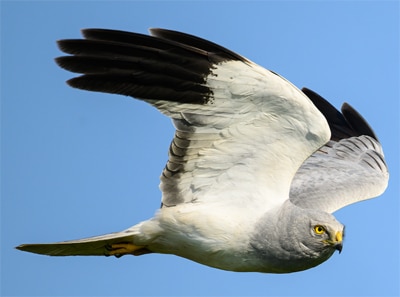
Hen Harrier Circus cyaneus ©Ron Macdonald
Hoy – Hoy is the most rugged of Orkney islands boasts many tern colonies, the Moss of the Whitestanes in Rackwick Bay and Melberry dunes to the far south. Drive leisurely along the magic road to Rackwick, surely the loveliest bay in Britain, looking out for Hen Harriers and Short-eared Owls. Park in the village and take the 3-hour trek to the Old Man of Hoy, which will have been seen from the ferry. En route you will see, and feel if unprepared, both Arctic and Great Skuas, Alpine Hares may be seen in the rock debris of the hillsides and seabird colonies will greet you around the spectacular stack of the Old Man.
If feeling energetic and have the time, walk from the car park at Heldale Water to the coast and continue north. Here in the vast unpopulated wilderness that is SW Hoy you will come across the World’s most numerous Great Black Back colony. The size of these birds is very impressive in close up – complete adult rabbit skulls have been found in their pellets!
Westray – If only 2 or 3 days are available then Marwick Head and Hoy must take precedence. If, however, a lengthier stay – and the hospitality of the islanders is second to none – is a possibility, then a pilgrimage to the greatest bird city in Britain is a must. At the height of the season upwards of a quarter of a million seabirds populate a little more than a kilometre of bedded sandstone cliffs. Noup Head on the isle of Westray is the scene; take the road to the lighthouse (sadly, all automatic now) but park off-road by the loch on your left just about half a mile from the Light. Walk directly, Skuas permitting, to the cliff to your right: soon the noise of the wind (Orkney is oceanic – it is rarely still) becomes punctuated by birdcalls, at the same time your nose will lead you in the right direction. No words will prepare you for the spectacle awaiting you as you near the cliff top…Should you be really lucky, as the evening sun goes down, around Mid-Summer that is 2300 hrs, you might glimpse a pod of Orca travelling south.
Papa Westray – From Pierowall a ferry will whisk you gently to Papa (Westray); in a day you can walk from the terminal in the south to the North Hill where a vast ternery can be viewed on the high ground; a sad monument to the last Great Auk killed in Britain along the cliff, and a great variety of shorebirds can be seen. The treasure of Papay is, however, the unexpected ubiquity of the Black Guillemot that surely has its British headquarters here.
North Ronaldsay – North Ronaldsay is the most remote of the Orcades, has a bird observatory with trapping facilities and attracts as many rarities as the legendary Fair Isle. The island boasts spectacular beaches and dinky seaweed-eating sheep of a most primitive breed.
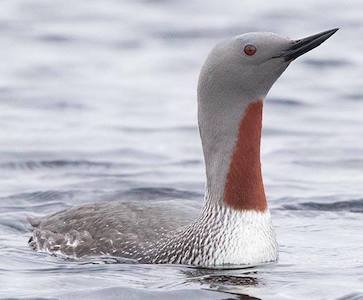
Rousay – Known more for its wonderful Neolithic archaeology than its natural history, Rousay offers both in abundance. Walking the well marked track to the hilly interior from Gue the largest lochs on the isle can be reached; here, on the Rousay plateau, Muckle and Peerie Water can be viewed in their delightful isolation. On Peerie Water the confiding nature of Red-throated Divers is surprising, on the larger loch waders are present in numbers as well as the recently colonised Greylags. On your circuit of the island take time to drive/walk around the Loch of Wasbister taking special notice of any swans seen.
-
Mainland - Burgar Hill & Birsay Moors
Satellite ViewTake the rough road up to the wind farm – beware of running over Oystercatchers who insist on nesting on the track – keep your eyes open for the lovely buoyant flight of the Hen Harrier which frequent these hills. From the hide you will see the Red throated Divers breeding on Lowrie's Water and a visiting flock of Golden Plover if you are lucky. -
Mainland - Deerness & the Gloup
Satellite ViewAt Deerness & the Gloup on the extreme eastern coast of Mainland there is a splendid circular walk, which allows close views and photo chances of nesting auks. Many eider ducks will be visible as well. -
Mainland - Marwick Head
Satellite ViewMarwick Head is on the North West Coast of the largest island, Mainland. Guillemots, fulmars and kittiwakes. Peregrine and Great Black Backs find easy pickings here; excellent photo opportunities for those with a head for heights. -
Mainland - The islets of the Churchill Barriers
Satellite ViewFrom Deerness drive south along the Churchill Barriers enclosing Scapa Flow. Several Little Tern colonies can be found among the historic debris of WWI. -
North Ronaldsay Bird Observatory
WebsiteSatellite ViewNRBO was established in 1987 to study and record the migrant birds that pass through Orkney's most northerly island each year. The number and variety of birds that arrive here on migration in Spring and Autumn can be spectacular, and North Ronaldsay is well-known as one of the best birdwatching sites in the country. The observatory also provides a variety of comfortable accommodation, including guest house, hostel and camping area, and a shop with groceries and other goods for visitors to the island. The occasional trip visits this remote outcrop including an annual island cruise. Despite the short time ashore scarce migrants are often recorded and there was even a Trumpeter Finch one late spring day. -
Rousay - Peerie Water & Muckle Water
Satellite View
-
Steve Dudley
Monivey, Westray, Orkney, KW17 2DW

-
The Orkney Book of Birds
| By Tim Dean & Tracy Hall | Orcadian Ltd | 2011 | Paperback | 246 pages, colour illustrations, 2 b/w maps | ISBN: 9781902957463 Buy this book from NHBS.com -
Where to Watch Birds in Scotland
| By Mike Madders & Julia Welstead | Christopher Helm | 2002 | Paperback | 297 pages, b/w illustrations, maps | ISBN: 9780713656930 Buy this book from NHBS.com

Where to Watch Birds in Scotland
Apple iOS | AndroidThis app will help beginners and experts alike to discover hundreds of the best places to see and enjoy birds around the country. Where to Watch Birds in Scotland, the Scottish Ornithologists' Club's free mobile app for Apple and Android devices, now has over 580 sites. New sites will continue to be added and existing ones updated as far as possible. The app launched in April 2019 and since then has been downloaded by more than 15,000 users and amassed over 750,000 site views. It won 'Product of the Year' in Birdwatch and BirdGuides' 2019 Birders' Choice Awards, and the BTO/Marsh Award for Local Ornithology 2020.Festivals & Bird Fairs-
The Orkney Nature Festival
WebpageThe Orkney Nature Festival has been running annually since 2013, and has given thousands of people the opportunity to enjoy - and be inspired by - the magnificent Orcadian wildlife. Events have included cruises around some of the largest cliffs in Britain, nature photography classes with local experts, guided walks amongst choruses of birdsong, and much more.
Observatories-
North Ronaldsay Bird Observatory
Observatory WebsiteSatellite ViewEstablished in 1987, the observatory's main purpose is to monitor the migrations through, and populations on, the island. This is accomplished by census and is complemented by a bird ringing program. It also provides comfortable, inexpensive accommodation for visitors to the island, and special opportunities for visitors with an interest in birds and natural history.Warden: Alison Duncan, Twingness, North Ronaldsay, Orkney KW17 2BE. 01857 633200 alison@nrbo.prestel.co.uk Also see the BLOG
Organisations-
RSPB Orkney
Facebook Page12-14 North End Road, Stromness @RspbOrkney 01856 850176 -
Scottish Ornithologists Club - Orkney Branch
WebpageVenue: St Magnus Centre, Kirkwall, KW15 1PA Contact: Helen Aiton 01856 751482
Reserves-
LNR Mull Head
WebpageSatellite ViewIt is comprised of about 160 hectares of heathland and grassland at the north-east tip of Deerness. It’s a place of high cliffs and wild heathland, battered by storms in winter and teeming with nesting birds in the summer. The sandstone cliffs have been eroded by the sea to form ledges perfect for nesting birds such as kittiwakes, guillemots, razorbills and fulmars. Other birds, including gulls and skuas, prefer to nest on the open heathland, where the bushy heather provides good cover for their chicks. -
RSPB Birsay Moors
WebpageSatellite ViewThe wild and windswept beauty of Birsay Moors offers visitors a chance to see iconic Orkney birds such as hen harriers, short-eared owls, arctic skuas and red-throated divers. -
RSPB Brodgar
WebpageSatellite ViewHear the bubbling curlews and drumming snipe in the summer, along with lapwings, dunlins, redshanks and oystercatchers. Wildfowl also abound on this small, but beautiful, reserve. Shovelers, teals, wigeons, mallards and gadwalls breed nearby and many more species can be seen from the shores of the surrounding lochs… -
RSPB Copinsay
WebpageSatellite ViewThe cliffs of the reserve are home to a huge colony of breeding seabirds, including fulmars, puffins, guillemots, razorbills and kittiwakes… -
RSPB Cottascarth and Rendall Moss
WebpageSatellite ViewWhen you visit this tranquil wildlife haven, you'll discover a magical mosaic of mires and heath that is a special place for some of the UK's most magnificent birds of prey - merlins, kestrels and hen harriers. It also has one of the highest densities of breeding curlews in Europe. -
RSPB Dunnet Head
WebpageSatellite ViewThis rugged peninsula in Caithness, located on the north coast of Scotland, has the honour of being the most northerly point of mainland Britain. It's a wild and untamed landscape, with stunning sea cliffs and coastal grasslands which are home to puffins, razorbills, guillemots, fulmars and kittiwakes. -
RSPB Hobbister
WebpageSatellite ViewHobbister is where sweeping sea views meet spring birdsong, a magical mixture of land and sea, from sea cliffs to saltmarsh, moorland to sandflats. On the moor, keep an eye out for hen harriers, short-eared owls and red-throated divers, while the coastal walks will reveal red-breasted mergansers and black guillemots. -
RSPB Hoy
WebpageSatellite ViewDiscover the beauty of a wild landscape that ranges from sweeping moorland to dramatic clifftops. A range of fascinating birds, from fulmars, puffins and red-throated divers, to great skuas, hen harriers and stonechats make this their home. Wrap up warm and don't leave without a nod to the Old Man. -
RSPB Marwick Head
WebpageSatellite ViewDiscover a spectacular seabird city at Marwick Head, with breathtaking views along the Orkney coastline. With a blue sky above, an azure sea, a carpet of colourful flowers and the commotion of the seabird colony below, is there is a better place to spend a sunny June afternoon? -
RSPB Mill Dam (Shapinsay)
WebpageSatellite ViewMill Dam is one of Orkney’s important remaining wetlands. This natural marsh was dammed in the 1880s, providing an ideal habitat for birds throughout the year. In summer, you'll see large numbers of breeding wildfowl, including pintails, redshanks and wigeons, while in winter migrating whooper swans and other birds visit. -
RSPB North Hill (Papa Westray)
WebpageSatellite ViewThere's nowhere quite like Papa Westray. Studded with delicate wildflowers, North Hill is perhaps Orkney's finest area of maritime heath. The reserve is home to an extremely rare plant, the Scottish primrose, while stunning low-level cliffs play host to nationally important numbers of breeding Arctic terns and skuas. -
RSPB Noup Cliffs
WebpageSatellite ViewDiscover a seabird city on a spectacular walk along the top of Noup Cliffs, 76 metres above the churning ocean. Marvel at the sights and sounds of thousands of seabirds and don't miss the delicate wildflowers which grow along this wildest of wild coastal paths. -
RSPB Onziebust (Egilsay)
WebpageSatellite ViewDiscover Onziebust, a mosaic of glorious wildflower meadows, grassland fields and wetland areas which are a paradise for wildlife. Situated centrally within the Orkney islands archipelago, this hidden gem (which also features two tranquil lochs) is home to a population of curlews, lapwings and redshanks. -
RSPB The Loons & Loch of Banks
WebpageSatellite ViewThe Loons and Loch of Banks reserve is the largest remaining wetland in Orkney and the perfect place to see wildlife up close, including wigeons, pintails, white-fronted geese and perhaps even a rare great yellow bumblebee. -
RSPB Trumland (Rousay)
WebpageSatellite ViewTrumland in Orkney consists of 131 hectares of blanket bog and 52 hectares of wet heath. It's a remote location and arguably the best time to visit is during the summer months, when you should be able to see breeding red-throated divers, hen harriers, merlins and short-eared owls. -
SWT Hill of White Hamars
WebpageSatellite ViewThis Orkney reserve has impressive coastal features, including cliffs, numerous caves, natural arches, stacks and large blowholes. Narrow inlets provide excellent short-range viewing opportunities of cliff-nesting seabirds. The reserve lies on the south coast of South Walls, Orkney, extending over 1.1 miles of shoreline from the east of Helliack to the west of Rise Geo, and about 0.6 miles inland over the Hill of White Hamars. Most people arrive via the Houton-Lyness ferry.
Sightings, News & Forums-
Orkney Birding
Facebook PageOrkney Birding is a Facebook page designed to be a fully interactive platform for everyone who has an interest in the birds of Orkney. The aim of the page is to provide everyone with information on the birds they see in their everyday life along with in depth discussions and debate.This page has a core of some of the best birding knowledge available in Orkney to assist in identifying that annoying little brown bird and to give pointers on how to identify them yourself. -
Orkney Wildlife
Facebook PageOpen to anyone interested in Orkney's nature
Guides & Tour Operators-
Orkney Island Wildlife Holidays
Tour OperatorWe’re delighted to be working in partnership with the Birdwatching & Wildlife Club of the Grant Arms Hotel in Grantown-on-Spey and offer two new Scottish Highlands & Orkney Islands Tours in 2015 starting on 9 & 30 May 2015.…
Trip Reports-
2010 [06 June] - Mark E P Hows
Report…Photo targets were hen harrier and short eared owl and the king eider on the way up, but we wanted to see all the specialities… -
2013 [05 May] - Steve Sankey
PDF ReportOur first day in Orkney was spent on Westray, a dry but blustery day, too windy to trust to a walk along the Noup cliffs, so we contented ourselves with views of the Gannetry from afar. Occasional Bonxies patrolled the airspace, always on the lookout for Gannets, or indeed any other birds with fish to pirate. A few early Puffins were gathered offshore at their colony on the sea stack of the Castle o’ Burrian, with a few birds investigating their burrows. Waders were also a highlight with Knot, Sanderling, Dunlin, Purple Sandpiper, Turnstone and Whimbrel being seen. Kathy at the Haaf Yok café took pity on us and provided much needed tea!
Other Links-
Birdwatching in Orkney – an interview with Alan Leitch
ArticleWhen imagining birdwatching, one pictures folk hiding in long grass, peering through powerful binoculars. However, the truth is very different in Orkney. Short eared owls can fly along roadside verges as commuters travel to work, and long tailed ducks can be found in the Peedie Sea in the centre of Kirkwall! Alan Leitch, the RSPB Site Manager of Orkney Reserves offers a fascinating insight (and an indispensable holiday guide) to the amazing birds you can easily see in Orkney! -
Orkney Birds & Birdwatching
WebpageFrom puffins to white-tailed eagles, Orkney’s birdlife is remarkably varied, with the islands home to no less than 13 RSPB nature reserves.
Blogs-
Dafi
BlogI hope you enjoy reading my blog. These are just every day tales of birding and related Orkney stuff. With a bit of luck I hope to give a bit of a glimpse into life in the northern isles, I am not what you might call an expert birder. Truth be told I am not even a very good birder. I am lucky enough to live in a great place with great people and great birds tho
Photographers & Artists-
Artist - Tim Wootton
GalleryBorn and raised in a small rural village in South Yorkshire. Graduated with a Ba(hons) in 1986. Shortlisted for the Young European Bird Artist of the Year, 1991
-
Fatbirder - linking birders worldwide...
Skip to content