

Autonomous Region of the Azores
The Azores are a group of nine islands that form a semi-autonomous region of Portugal. They are situated in the northern Atlantic west of Portugal, roughly one third of the distance to North America, 1,400 kilometres from mainland Portugal. They cover an area of 2,351 km2 (908 square miles) with a population of around 240,000 people. The archipelago has three groups – Flores and Corvo in the west, a central group consisting of Faial, Sao Jorge, Graciosa, Terceira and Pico, and Sao Miguel and Santa Maria in the east. The most developed islands are Sao Miguel and Terceira, and to a lesser extent Faial. Mount Pico on the island of Pico is the highest point in the Azores and in the whole of Portugal, rising to 7,713 feet.
The climate is generally mild for such a northerly location, being influenced by the passing Gulf Stream. Temperatures remain mild year-round, with daytime normally fluctuating between 16 and 25 degrees centigrade, depending on the season. Temperatures above 30 degrees or below 3 degrees are unknown in the population centres. The islands are also generally wet and cloudy.
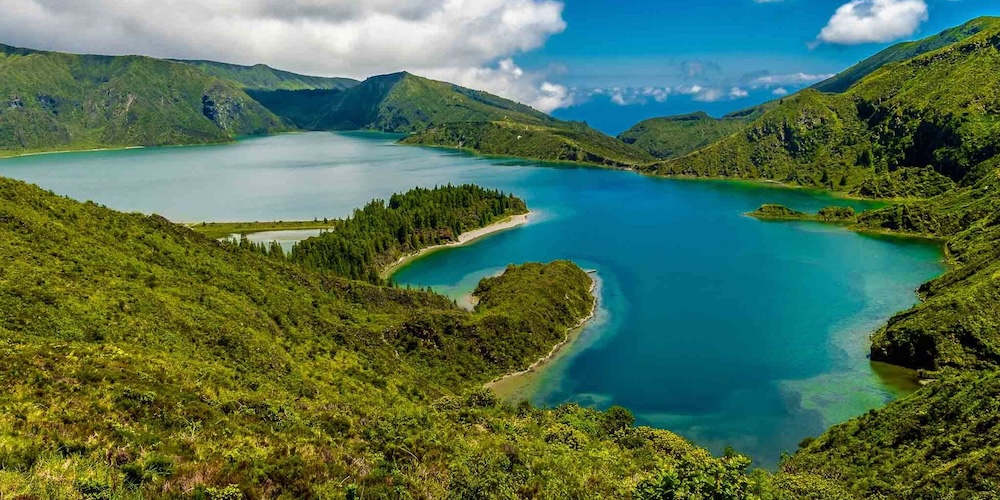
Fogo Lake, St Miguel Island – ©Luis Ascenso CC BY 2.0 via Wikimedia Commons
The main industries are agriculture, with the predominance of dairy farming and livestock, fishing and tourism. The largest city, and administrative capital is Ponte Delgada.
Even though the Azores look very green and sometimes wild, the vegetation has been extremely altered. A great part of it has been wiped out in the past 600 years for its valuable wood and to clear land for agriculture.
Birding the Azores
Transport between the islands is straightforward except in the winter months when schedules are frequently disrupted by the weather. All the islands have airfields, with flights to Lisbon and a few other international sites departing from Terceira and Sao Miguel. Inter-island flights are operated by TAP and SATA. Ferries operate within the central group year-round and more extensively in the summer season. Most flights to and from the islands are via Lisbon, although there are direct flights between the Azores and Madeira.
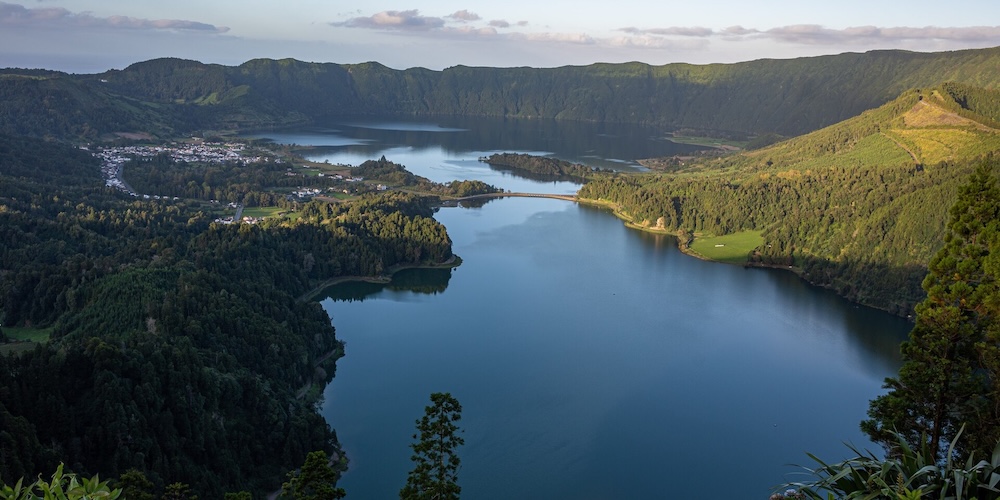
Sao Miguel – ©Tiomax80 CC BY 2.0 via Wikimedia Commons
The islands attract birders for four main reasons. Firstly, being so much nearer America than continental Europe, and Britain of course, the islands have an excellent record for attracting trans-Atlantic vagrants, especially water birds. One site, a disused coastal quarry at Cabo da Praia on Terceira, has an unrivalled reputation as the best western Palaearctic site for American waders, and birds have been found at many other sites. American birds tend to be found throughout the autumn and often stay for the winter.
Secondly, the islands host healthy numbers of breeding seabirds such as Cory’s Shearwater and Roseate Tern, and the colonies have recently been found to harbour individuals of highly sought after species such as Sooty Tern, Red-billed Tropicbird and even Bermuda Petrel. At least one species breeds nowhere else; the
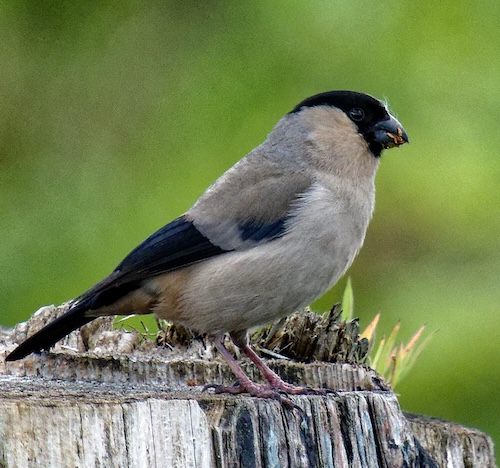
Thirdly, large numbers of migrating sea-birds can be seen, especially in late August and September. And fourthly, there are two Azorean endemics; the Azores Bullfinch and the Azores Chaffinch, with the former found in one area of forest at the eastern end of Sao Miguel and the latter more widespread; there are also endemic subspecies such as of Goldcrest and Grey Wagtail amongst others.

Mount Pico – ©The Cosmonaut CC BY-SA 4.0 via Wikimedia Commons
Being at the junction of three continental plates the islands are subjected to volcanic activity and earthquakes. The resulting landscape is often spectacular, and the site of the fairly recent eruption at Capelhinos, the western tip of Faial, is particularly memorable, as is the area of calderas and crater lakes in central Flores.
Prices on the islands are comparable with mainland Portugal. Roads are generally good, and there is a wide variety of accommodation available. The main tourist season finishes in September, when the weather becomes less settled.
-
Number of bird species: 435
(As at May 2026) - But most are rarities and vagrants - there are just 64 common or regularly occurring species.
Number of endemics: 2
Azores Bullfinch Pyrrhula murina
Azores Chaffinch Fringilla morelettiNumber of endemics: 1 Breeding Endemic
Monteiro's Storm-petrel Hydrobates monteiroi
-
Avibase
PDF ChecklistThis checklist includes all bird species found in Açores , based on the best information available at this time. It is based on a wide variety of sources that I collated over many years. I am pleased to offer these checklists as a service to birdwatchers. If you find any error, please do not hesitate to report them.

-
Birds of the Atlantic Islands
| By Tony Clarke, Chris Orgill & Tony Disley | Christopher Helm | 2006 | Paperback | 368 pages, 56 colour plates, b/w photos, b/w maps | ISBN: 9780713660234 Buy this book from NHBS.com -
Field Guide to the Birds of Macaronesia
| (Azores, Madeira, Canary Islands, Cape Verde) | By Eduardo Garcia-del-Rey | Lynx Edicions | 2011 | Hardback | 342 pages, 150 colour plates, 230 distribution maps | ISBN: 9788496553705 Buy this book from NHBS.com -
Where to Watch Birds in Portugal, the Azores & Madeira Archipelagos
| By Colm Moore, Gonçalo Elias & Helder Costa | Pelagic | 2020 | Edition 2 | Paperback | 212 pages, b/w illustrations, b/w maps | ISBN: 9781784272234 Buy this book from NHBS.com
-
African Bird Club
WebpageThe archipelago of nine islands in the north Atlantic is well-known for its seabird colonies and holds large populations of Cory’s Shearwater Calonectris diomedea, Little Shearwater Puffinis assimilis, Madeiran Storm-petrel Oceanodroma castro and Roseate Tern Sterna dougallii. -
Portuguese Society for the Study of Birds (SPEA) - BirdLife Partner
WebpageThe Portuguese Society for the Study of Birds (SPEA) is a nonprofit scientific association that promotes the study and conservation of birds in Portugal. It was founded on November 25 of 1993 and corresponds to a desire expressed by a large number of professionals and amateurs that developed activities in the field of ornithology and conservation of Nature. Currently SPEA has about 3500 members and develops projects of nature conservation in national territory and also some in partnership abroad (Cape Verde, Sao Tome, Greece, Spain and Malta).
-
Almodôvar Birding Center and Observatory
Tour OperatorExperience a once-in-a-lifetime birding adventure with our Azores Island Tours! -
Azores Wildlife
Local Tour OperatorThis trip is specifically aimed at birders, particularly world and western Palearctic listers to see the endemic Monteiro’s Petrel and also to explore for other rare seabirds and local specialities including Swinhoe’s Storm Petrel, ‘Grant’s’ Band-rumped Storm Petrel, Barolo’s Shearwater, Wilson’s Storm Petrel and other North Atlantic specialities. -
Gerbybirding
Tour OperatorGerbybirding is the first company is the Azores specialized in birdwatching. We are a small company, offering a personalized service to small groups, and we are as comfortable working with a curious observer as well as accompanying experienced ornithologists. Your personal “birdguide” will be Gerbrand Michielsen, better known as Gerby, which will take you to the best spots in São Miguel island, by car, on foot or by kayak – an unforgettable experience! -
HeatherLea
Tour OperatorA lovely blend of birds, whales, plants and geology amidst incredible coastal scenery. -
Terra Azul Azores
Tour OperatorTerra Azul Azores is an Ecotourism Tour Operator, fully licensed to operate year-round Whale Watching & Swimming with Dolphins tours, Family & Private tours, Marine Birdwatching tours, and Scientific Expeditions for fellow researchers, photography, and video professionals.
-
2018 [10 October] - Dominic Mitchell
PDF ReportThis beautiful Atlantic archipelago was little visited by birders until the last decade or so, but it has firmly put itself on the map in recent years with a growing reputation as the Western Palearctic’s number one hot-spot in autumn for regionally rare vagrants - especially for wayward migrants from North America. -
2019 [05 May] - Tom Brereton
PDF Report...This gave the group an opportunity to explore Ponta Delgada in the morning. Tom, Jean and Colin took a walk east along the sea front, where Red Rock Crabs were numerous along with the odd Common Tern and a Little Egret. On the way back to the hotel, Tom found an area of waste ground off Estr. Regional da Ribeira Grande, which was full of colourful arable weeds and other wildflowers, plus Island Canary, Wood Pigeon, Greenfinch, Madeiran Wall Lizards and Clouded Yellow butterflies. As on several of the days, a number of the keener birders in the group scanned the gulls in the harbour as Iceland Gull and Ring-billed Gull had been seen recently, though sadly none were seen over the week... -
2019 [10 October] - Phil Callagher
PDF ReportThis was our first visit to the Azores, a one-week trip in the hope of picking up a few decent Western Palearctic ticks. Owing in part to Hurricane Lorenzo, autumn 2019 was another bumper season on the islands, featuring two firsts for the Western Palearctic: Prothonotary and Connecticut Warblers. Both appeared during the middle two weeks of October (generally recognised as the best fortnight for Nearctic passerines)... -
2021 [09 September] - Adriatic Nature
ReportSão Miguel (Azores): birding, whalewatching and endemic biodiversity in the “Ilha Verde” -
2022 [07 July] n- Zoothera Birding
Report...Our primary target will be Monteiro's Storm-Petrel, a species that until recently was thought to be 'an odd' Band-rumped (Madeiran) Storm-Petrel and only breeds in summer on the islets of Praia and Baixo located just off Graciosa... -
2024 [06 June] - Diedert Koppenol
PDF Report...Out and about early next morning, we went on the hunt for our main quarry: the endemic Azores Bullfinch. The Azores Bullfinch can only be found at the eastern parts of the island of São Miguel, currently. The population is slowly increasing, but it is still vulnerable to natural disaster and habitat destruction... -
2025 [07 July] - Tim Healy
ReportTrip List
-
Azores Bulfinch
WebsiteSpecies account of this endemic -
Azores Choice
WebpageThe archipelago is a stunning backdrop for anyone hoping to spot rare endemics, American vagrants and Nearctic waders. For many, the draw of an Azores bird watching holiday is a potential sighting of the priolo – the endemic Azores bullfinch. The population was estimated at just 400 in 2003, and its natural habitat in and around Sao Miguel’s Serra da Tronqueira mountain range was in danger of being lost due to the intensive farming of non-native Japanese cedar. -
Resident Birds of the Azores
WebpageThe Azores islands are an archipelago located in the middle of the Atlantic, ruled by Portugal. Though its fauna and flora are mostly of European origin, many endemic species and subspecies. This short guide aims to help the amateur naturalist get familiar with the Azorean endemic...