
County Donegal
County Donegal, named after the town, is a county located in the west of the Province of Ulster, in the northwest of Ireland; the most northern county in all of Ireland. County Donegal is the second largest county in Ireland, covering 4,860 km2 (1,880 square miles) with a population of around 170,000 people. The name ‘Donegal’ comes from the Irish, meaning ‘The Fort of the Foreigners’. Uniquely, Donegal shares a border with only one county in the Republic of Ireland, County Leitrim. The rest of its land border is shared with Northern Ireland (the Northern Irish counties of Londonderry, Tyrone and Fermanagh). The county town is Lifford, although Letterkenny is much larger.
Physically, the county is by far the most rugged and mountainous in Ulster. The county consists chiefly of low mountains, with a deeply indented coastline forming natural loughs, of which both Lough Swilly and Lough Foyle are the most notable. The famous mountains or Hills of Donegal consist of two major ranges, the Derryveagh Mountains in the north and the Bluestack Mountains in the south, with Mount Errigal at 749 metres the highest peak. The Slieve League cliffs are the second highest sea cliffs in Europe, while Donegal’s Malin Head is the most northerly point on the island of Ireland.
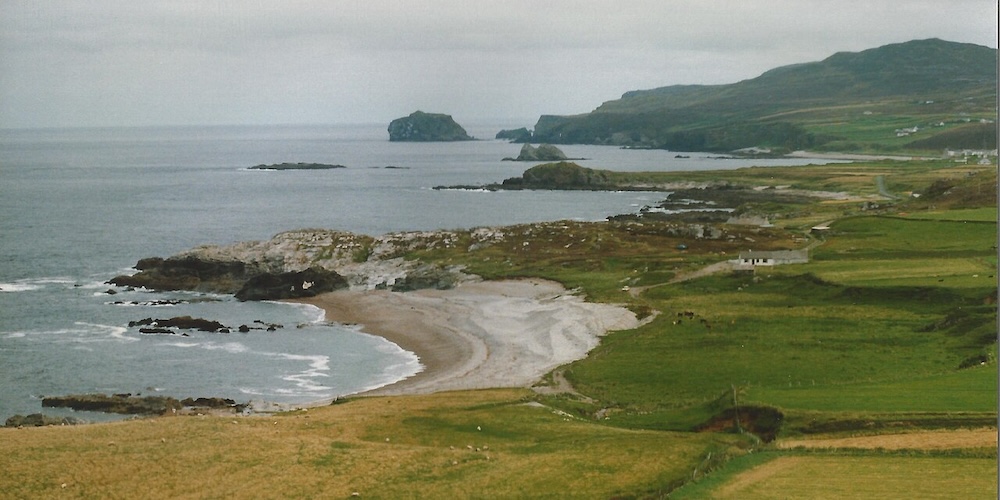
Malin Head, Inishowen – ©Ardfern CC BY-SA 3.0 via Wikimedia Commons
The climate is temperate and dominated by the Gulf Stream, with cool damp summers and mild wet winters. Two permanently inhabited islands, Arranmore and Tory Island lie off the coast, along with a large number of small islands with only transient inhabitants. Ireland’s second longest river, the Erne, enters Donegal Bay near the town of Ballyshannon. The River Erne, along with other Donegal waterways, has been dammed to produce hydroelectric power. The River Foyle separates part of County Donegal from parts of both County Londonderry and County Tyrone.
Birding County Donegal
At around 11% of the area, Donegal is fairly well wooded, although much of the 55,534 hectares are commercial timber plantations. However, there are still lots of native tree species including Scots pine, aspen, birch, oak and hazel. Much of the western and upland areas are still covered with blanket bog, amounting to around 30% of the county. However, there is still a wide variety of habitats and over half of Ireland’s plants and animal species are found within the county. It is a good area for mammals with hares, deer, both red and grey squirrels, pine martins and much of the rest of the normal fauna of Ireland; it is particularly good for bats with at least six species.
The sea cliffs are home to Atlantic puffins, razorbills and other sea birds as well as ravens. In the uplands there is a decent population of golden eagles, which were introduced two decades ago, and there are both barn and long-eared owls.
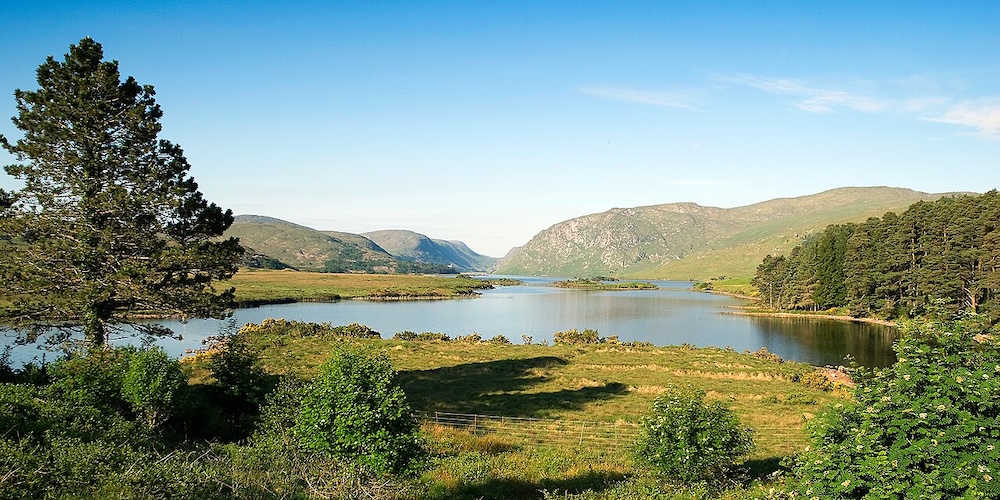
Glenveagh National Park – ©Michal Osmenda CC BY-SA 2.0 via Wikimedia Commons
The county is home to Glenveagh National Park and a number of nature reserves, including Sheskinmore Lough. Donegal Bay is recognised as an IBA. Inch Wildfowl Reserve is located in northern Donegal and each year is host to thousands of wintering wildfowl. This includes over three thousand greylag geese and hundreds of whooper swans. The site is also alive during the summer months as a wide variety of birds, including a particularly noisy colony of Sandwich Tern and Black-headed Gulls, which raise their young around the lake. The site includes an 8km looped path and a number of purpose-built bird hides.
Ardnamona Wood Nature Reserve is a fine oak woodland, some 46.6 hectares in size which lies approximately 5km north-east of Donegal Town, just west of Lough Eske. Ballyarr Wood is a national Nature Reserve owned and managed by the National Parks & Wildlife Service. It has been designated as a Special Area of Conservation under the EU Habitats Directive because it is one of the best and largest examples of semi-natural deciduous woodland in the north-west of the country, and it forms an important link in Ireland’s network of woodland reserves.
-
Sheskinmore Lough
WebpageSatellite ViewA Birdwatch Ireland reserve, the Sheskinmore Lough reserve is part of a large, shallow freshwater coastal lagoon set in wonderful machair (flat sandy) grasslands. It is rich in wild flowers, insects and birds.
-
Wikipedia
GNU Free Documentation License
https://en.wikipedia.org/wiki/County_Donegal
-
Ralph Sheppard
-
Number of bird species: 330
(As at March 2026)
-
Avibase
ChecklistThis checklist includes all bird species found in Donegal , based on the best information available at this time. It is based on a wide variety of sources that I collated over many years. I am pleased to offer these checklists as a service to birdwatchers. If you find any error, please do not hesitate to report them. -
eBird
PDF ChecklistThis checklist is generated with data from eBird (ebird.org), a global database of bird sightings from birders like you. If you enjoy this checklist, please consider contributing your sightings to eBird. It is 100% free to take part, and your observations will help support birders, researchers, and conservationists worldwide.

-
Birds of Ireland - A Field Guide
| By Jim Wilson | Gill Books | 2024 | Edition 2 | Paperback | 288 pages, 1600+ colour photos, colour distribution maps | ISBN: 9781804580721 Buy this book from NHBS.com -
Donegal - From Waves to Wilderness
| By Kate Slevin | O'Brien Press | 2024 | Hardback | 160 pages, colour photos, 1 map | ISBN: 9781788494762 Buy this book from NHBS.com -
Finding Birds in Ireland - The Complete Guide
| By Eric Dempsey & Michael O'Clery | Gill Books | 2014 | Edition 2 | Paperback | 389 pages, 300 colour photos, colour maps | ISBN: 9780717159253 Buy this book from NHBS.com -
Wild Guide - West of Ireland
| (Travel Adventure Guide - Wild Atlantic Way, Donegal, Galway, Mayo, Clare, Cork & Kerry) | By Candida Frith-Macdonald & Daniel Start | Wild Things Publishing | 2025 | Paperback | 300 pages, 300 colour photos, 25 colour maps | ISBN: 9781910636602 Buy this book from NHBS.com
-
BirdWatch Ireland - Donegal
WebpageContacts, events etc... -
Inishowen Wildlife Club
Facebook PageWe are a group who are interested in the flora and fauna of the Inishowen Peninsula, with its diverse habitat, and outstanding beauty, together with its unique position on the most northerly point of the island of Ireland.
-
IBA Donegal Bay
WebsiteSatellite ViewThis is one of the most important wintering sites in Ireland for Melanitta nigra (1,150 birds, 1996), which occur in nationally important numbers, together with Cygnus olor (109 birds, 1995), Clangula hyemalis (32 birds, 1996) and Mergus serrator (50 birds, 1996). The shores of Donegal Bay support nationally important numbers of Calidris alba (100 birds, 1996). -
NP Glenveagh
WebsiteSatellite ViewNatural woodlands of Oak and Birch clothe the slopes of the deep valley that bisects the Park. These woods are inhabited by Badgers, Foxes and Stoats, whilst woodland bird life includes Siskins, Treecreepers, Redstarts and Wood Warblers. On the uplands of the Park, birds more likely to be encountered include Ravens, Peregrines, Stonechat and Grouse… -
NP&WS Nature Reserves
WebpageSatellite View -
NR Sheskinmore Lough
WebpageSatellite ViewThe Sheskinmore Lough reserve is part of a large, shallow freshwater coastal lagoon set in wonderful machair (flat sandy) grasslands. It is rich in wild flowers, insects and birds. Our reserve is within a larger area owned and managed by the National Parks and Wildlife Service, and the whole area forms an extensive Special Protection Area and Special Area of Conservation. It is an important ecosystem which is renowned for its wintering Greenland White-fronted Geese, along with Choughs during the autumn and breeding Lapwings during the summer months. The site is also important for an array of declining species of plants and insects. -
WR Inch Wildfowl Reserve
WebpageSatellite ViewEach year Inch Wildfowl Reserve is host to thousands of wintering wildfowl. This includes over three thousand greylag geese and hundreds of whooper swans. The site is also alive during the summer months as a wide variety of birds, including a particularly noisy colony of sandwich tern and black headed gulls, raise their young around the lake.
-
2019 [11 November] - Andy Hannaford
PDF ReportThe Rosses area of Donegal is somewhere that I have known for a long time having visited since I was a child and in more recent time was home for my parents. I have enjoyed exploring the area spending a great deal of time birdwatching, fishing, climbing and walking across this spectacular region. This year, after fifty-five years of visiting I meet another birder! This shows how quiet the area is.
-
Peter Phillips - Tory Island Bird Blog
BLOGLastb updated 2018 - An account of birding trips to Tory Island County Donegal.