

Crete
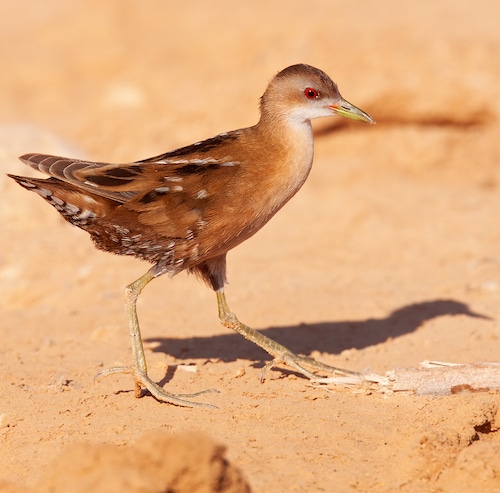
Crete is the largest and most populous of the Greek islands, the fifth largest island in the Mediterranean Sea, after Sicily, Sardinia, Cyprus, and Corsica. Crete is located about 160 km (99 miles) south of the Greek mainland, and about 100 km (62 miles) southwest of Anatolia. Crete has an area of around 8,500 km2 (c.3,250 square miles) and a coastline 1,046 km (650 miles) long with a large number of islands, islets, and rocks that hug the coast. It bounds the southern border of the Aegean Sea, with the Sea of Crete to the north and the Libyan Sea (or South Cretan Sea) to the south. Crete covers 260 km from west to east but is narrow from north to south, spanning three longitudes but only half a latitude.
The island is mostly mountainous, and its character is defined by a high mountain range crossing from west to east. It includes Crete’s highest point, Mount Ida, and the range of the White Mountains (Lefka Ori) with 30 summits above 2,000 metres (6,600 ft) in altitude and the Samaria Gorge, a World Biosphere Reserve. These mountains endow Crete with valleys, such as Amari valley and fertile plateaus, such as Lasithi plateau, Omalos and Nidha.
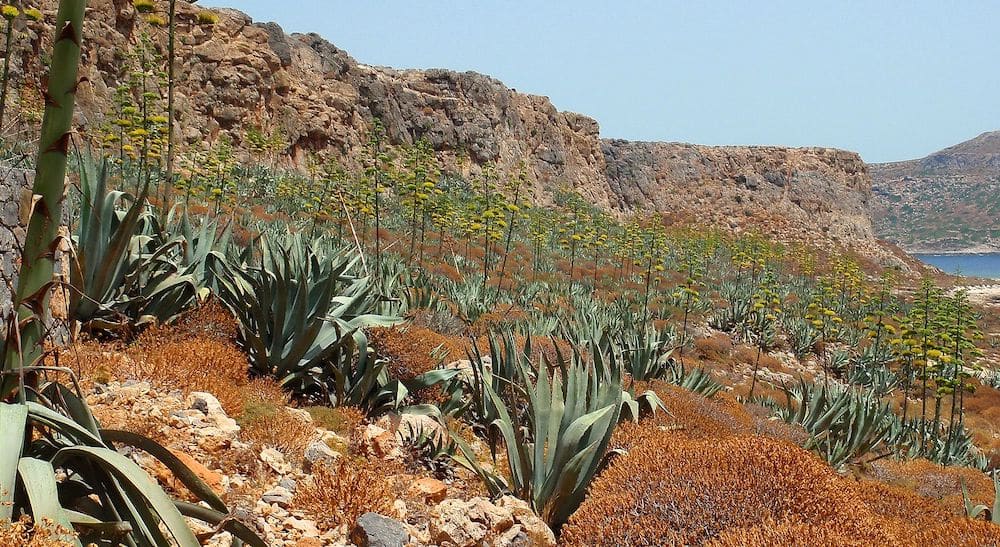
Gramvousa – ©Jimzoun, CC BY-SA 4.0 via Wikimedia Commons
There are a number of peninsulas and gulfs on the north side of Crete, from west to east these include: Gramvousa peninsula, gulf of Kissamos, Rodopos peninsula, gulf of Chania, Akrotiri peninsula, Souda Bay, Apokoronas cape, gulf of Almiros, gulf of Heraklion, Aforesmenos cape, gulf of Mirabello, gulf of Sitia and the Sideros peninsula. On the south side of Crete is the gulf of Messaras and Cape Lithinon. The island also has a number of gorges, such as the Samariá Gorge, Imbros Gorge, Kourtaliotiko Gorge, Ha Gorge, Platania Gorge, the Gorge of the Dead (at Kato Zakros, Sitia) and Richtis Gorge and (Richtis) waterfall at Exo Mouliana in Sitia.
Crete’s rivers include the Geropotamos River, the Koiliaris, the Anapodiaris, the Almiros, the Giofyros, the Keritis, and Megas Potamos. There are only two freshwater lakes: Lake Kournas and Lake Agia. Lake Voulismeni at the coast, at Aghios Nikolaos, was formerly a freshwater lake but is now connected to the sea. There are also three artificial lakes created by dams: the lake of Aposelemis Dam, the lake of Potamos Dam, and the lake of Mpramiana Dam.
Crete straddles two climatic zones, the Mediterranean and the semi-arid climate, mainly falling within the former. It is primarily a hot-summer Mediterranean climate while some areas in the south and east have a hot semi-arid climate. The higher elevations fall into the warm-summer Mediterranean climate category while the mountain peaks might feature a cold-summer Mediterranean climate or a continental climate. The atmosphere can be quite humid, depending on the proximity to the sea, while winter is fairly mild. Snowfall is common on the mountains between November and May, but rare in the low-lying areas.

Asterousia Mountains – ©Unukorno, CC BY 4.0 via Wikimedia Commons
The south coast, including the Mesara Plain and Asterousia Mountains, falls in the North African climatic zone, enjoying significantly more sunny days and high temperatures throughout the year. There, date palms bear fruit, and swallows remain year-round rather than migrate to Africa. The fertile region around Ierapetra, on the southeastern corner of the island, has year-round agricultural production, with summer vegetables and fruit produced in greenhouses throughout the winter. Western Crete (Chania province) receives more rain and the soils there suffer more erosion compared to the Eastern part of Crete. Average annual temperatures reach up to 21.0°C in South Crete. Crete holds the record for the highest temperatures ever recorded in Europe during October, November, January and February.
Birding Crete
Crete, being the largest Greek island and lying a long way south in the eastern Mediterranean, Spring and Autumn migrants and winter visitors use the island and it has a good range of resident birds, such as Griffon Vulture, Bearded Vulture, Bonelli’s Eagle, Ruppell’s Warbler and Red-billed and Alpine Chough.
This mainly limestone island is almost like a miniature continent with many mountain ranges, gorges, coastal fields, beaches, seasonal rivers and pools and even high mountain deserts. All these habitats mean that birding is very varied with residents like Griffon Vultures, Bearded Vulture, Golden Eagle, Peregrine, Buzzard, Kestrel, Cetti’s Warbler, Sardinian Warbler, Chaffinch, Great Tit, Blue Rock Thrush, Zitting Cisticola, Stonechat and Crested Lark and Italian Sparrow are fairly common.
In the uplands on the plateaux and gorges there are Cirl Bunting, Alpine & Red-billed Chough, Woodlark and Black–eared Wheatear. Winter visitors arrive from November to end of March and Kingfisher, Bluethroat, Starling, Robin and Black Redstart over winter. Spring passage begins in late March to May and Pied, Collared and Semi-collared Flycatchers, Wood Warbler, Northern Wheatear, Golden Oriole, Grey and Purple Heron, Night Heron, Little Egret, and Little Bittern, Little Crake and Bee-eaters pass through. Autumn passage begins in late August through September and October when Whitethroat, Red-backed Shrike, Garganey, Mallard pass through. Eleanora’s Falcon are nesting and Harriers and smaller Eagles follow the east coast south to Africa.
As the island is largely dry due to the geology, then river mouth pools, small wetlands and spring pools from underground water are very important for birds. The largest reservoir is at Bramiana to the NE of Ierapetra, the largest town on the south coast. Here there are good roosts of gulls and ducks in winter, and passage waders, birds of prey like Eleanora’s and Red-footed Falcon and interesting birds like Black-winged Stilt, Glossy Ibis, Garganey and Green and Wood Sandpipers.
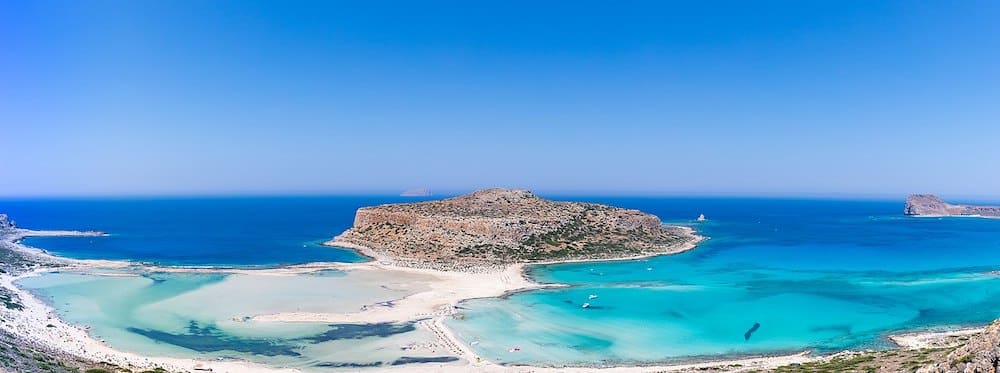
Balos Lagoon – ©dronepicr, CC BY 2.0 via Wikimedia Commons
The rivers tend to run dry by the end of May but in April and early May they are fed by melt water from the snow in the high mountains. The Aposelemis river and Gouves lagoons on the north coast off the old coast road east of Iraklion to Hersonissos are a real hot spot for migrants and breeding birds and regularly attract Little Crake, Garganey, Black-winged Stilt, Purple Heron, Greater Flamingo, Short-toed Lark, Stonechat, Woodchat Shrike, Little Stint, Wood Sandpiper, Buzzard, Kestrel, Griffon Vulture, Little Egret, Northern Wheatear, Black-eared Wheatear in the Gorge behind the site. The bird list is 150+. This cannot be truthfully described as one of Crete’s beautiful spots due to rubbish dumping, the Gouves football pitch and the general air of neglect, but the birds are blind to this and are feeding up frantically before moving on to breed further north. Rarities from Richard’s Pipit to Sociable Plover have turned up here.
The Tavronitis river mouth also attracts similar birds as well as Osprey and lies to the west of Chania and the western side of Maleme. There are other river mouths to check out along the north coast.
Agia Reservoir to the SW of Chania is another small gem. The reservoir is fed by the Great Springs of Ayia, which bring huge amounts of cold underground water to serve the town of Chania. The dam and pumping station are situated on two banks of this reservoir and the other banks are backed by reeds, it holds Marsh Harrier, Reed Warbler, Moustached Warbler, Wood Warbler, Barn Swallow, Red-rumped Swallow, House and Sand Martin, Swift, Alpine Swift, Little and Baillon’s Crake and Yellow Wagtails. If you explore into the mountain ranges and plateaux you will find a wealth of beautiful spots.
The south coast has a steep descent to the sea as Crete really is the top of a mountain range, but there are good beaches at Plakias and Frangocastello that are also good birding areas.
Target Birds (For visitors from UK, Northern Europe and beyond) Bearded Vulture: 10-15 pairs sadly with poor breeding rates. Rûppells Warbler, breed in the locally common areas on the south side of the island. They favour slopes with Yellow Spiny Broom Calicotome villosa. Griffon Vultures are common in small colonies in the gorges. Lanner Falcon may breed in the sea-level gorges and Bonelli’s Eagles also breed in the mountain gorges. Crete has a hundred gorges. Ortolan Bunting breed in the southern mountains on dry slopes and Cirl Buntings prefer the mountain plateaux.
Other Taxa For botanists the island is a delight and there are wonderful displays of Mediterranean flowers and orchids. There are endemic butterflies such as Cretan Argus and Cretan Festoon, as well as a wide variety of others.
Getting There The main airport is at Heraklion on the north coast. Flights direct to Crete by charter aircraft from April to October and daily on scheduled flights via Athens. Crete offers a huge range of accommodation from self-catering apartments through small hotels to large hotel complexes, which are open all year. Transport systems are a good local and town-to-town bus service at a reasonable price and car and motorbike and bicycle hire are available. Most of the northern coast has tourist development and could be used as a base, but the central mountains, the south and the east coasts are more attractive.
-
Ayia reservoir - near Chania
InformationSatellite ViewThis is a small, artificial lake but mostly very natural looking with reeds and trees along three of its banks. There is a less natural looking dam on the fourth side to watch from; the open edge here is well-known for close views of Baillon's and Little Crakes. Other birds could include Marsh Harrier, Moustached Warbler, Squacco Heron and Little Bittern. -
Frangocastello
InformationSatellite ViewThe coastal strip by this former garrison is a good place for migrants such as Wryneck and Black-eared Wheatear, though its appearance is marred by dumping. -
Georgioupolis lake
InformationSatellite ViewThere is a handy viewpoint over this freshwater lake by the bridge over the road. Like all of Crete's wetlands, it can attract herons, terns, waders and passerine migrants. It's a good site for Black-winged Stilt, Common Kingfisher and Great Reed Warbler. -
Kedros foothills - near Spili
Satellite ViewBest known for its orchids –some 25 species – this area can turn up Lammergeier, European Griffon Vulture, Woodlark and Common Quail. -
Kourtaliótiko and Kotsiphos Gorges
Satellite ViewApproaching Plakias by road from the north brings you through Kourtaliotiko gorge. It has a handy layby and stone steps down to a chapel in the gorge. Griffon Vulture and Crag Martin are fairly reliable. Kotsiphos gorge to the west is less dramatic; Blue Rockthrush, Raven and Chukar are possibles. With only six or seven pairs of lammergeiers on Crete you need luck or patience to see one anywhere, but over these gorges it is a possibility. -
Lake Kournas
InformationSatellite ViewCrete's only natural freshwater lake is, frankly, disappointing for birds, but an excellent stop for coffee and yoghurt in the adjacent tavernas. Black-necked Grebe, ducks, warblers in the scrub and passing birds of prey are the best bet. -
Moní Préveli
InformationSatellite ViewThe trees by the monastery attract migrants, which can include flycatchers, Wood Warbler, Golden Oriole and Turtle Dove. Ruppell's Warbler is occasionally seen here, as elsewhere along the south coast of Crete generally in taller scrub than the ubiquitous Sardinian Warbler. Chukar or Ortolan Bunting may be seen by scanning more open hillsides from the car park. -
Plakias
InformationSatellite ViewThis quiet south coast resort is often used a base for wildlife holidays, including for Honeyguide Wildlife Holidays. Immediately east of the town is an open area of fields that often holds migrants, such as Whinchats and Woodchat Shrikes. Like anywhere on the south coast in spring, flocks of migrating herons, egrets and ibises can be seen over the sea or flying inland. Flocks of Garganeys settle in Plakias Bay and waders settle briefly on the shore or in the small river as it joins the sea in the centre of the town.
-
Chris Durdin
| honeyguide@tesco.net
https://www.honeyguide.co.uk -
Stephanie Coghlan
| coghlansm@aol.com
https://www.honeyguide.co.uk/cretebirdreports.htm
-
Number of bird species: 373
(As at June 2024)
-
Avibase
PDF ChecklistThis checklist includes all bird species found in Crete , based on the best information available at this time. It is based on a wide variety of sources that I collated over many years. I am pleased to offer these checklists as a service to birdwatchers. If you find any error, please do not hesitate to report them. -
Crete Birding
ListHere you will find the list of the 250 species we have seen on the island -
eBird
PDF ChecklistThis checklist is generated with data from eBird (ebird.org), a global database of bird sightings from birders like you. If you enjoy this checklist, please consider contributing your sightings to eBird. It is 100% free to take part, and your observations will help support birders, researchers, and conservationists worldwide.

-
A Birdwatching Guide to Crete
| By Stephanie Coghlan | Arlequin Press | 2001 | paperback | 92 pages, 17 col photos, line illus (by John Busby), 43 maps | Out of Print | ISBN: 9781900159104 Buy this book from NHBS.com -
Birds and Mammals of Crete
| By George Sfikas | Efstathiadis Group | 1989 | Paperback | 96 pages, Colour photos | Out of Print | ISBN: 9789602261057 Buy this book from NHBS.com
-
Greek Birds Committee
WebsiteThe Hellenic Rarities Committee was established in December of 2004 by the Hellenic Ornithological Society and the Hellenic Bird Ringing Center, but since then it operates independently
-
Important Bird Areas
InformationSatellite ViewThe information comes from the book Important Bird Areas of Greece, published in 1994. Since then, the Hellenic Ornithological Society -
NP Lefka Ori (Samaria)
InformationSatellite ViewThe National Reserve of Lefka Ori (Samaria) constitutes one of the oldest National Reserves in Greece and was declared a Park in 1962. Its core is the gorge of Samaria, although it also includes the Mount Desert of Lefka Ori and Sfakia shoreline. The main purpose of its protection was to keep the local environment intact, as it hosts many endemic species of fauna and flora. Since 1981m it has been listed in the Global Reserve Network of Biosphere. -
Natural Parks of Crete
InformationSatellite View -
NuP Psiloritis Natural Park
InformationSatellite ViewPsiloritis Natural Park consists of the Ida Range, the highest mount of Crete, and the northern coastal zone of central Crete. Within the territory of the Geopark added in 2001 in the list of UNESCO geoparks, the whole nappe pile of Crete, and the majority of the rock types of the island are presented in excellent outcrops and sections. Big faults with excellent and imposing fault surfaces, fossil sites, caves, impressive gorges and plateaus hosting many endemic species of the island,
-
Honeyguide
Tour OperatorHoneyguide Wildlife Holidays. If you are looking for a quality natural history holiday, this is a great place to start. The Honeyguide programme offers a mix of the very best of birds and other wildlife in fascinating parts of Europe, suitable both for beginners and more experienced naturalists. All holidays contribute to a local conservation project -
Naturetrek
Tour OperatorTour Code: GRC02An 8-day holiday in search of the spring flowers and migrating birds on the island of Crete. -
Travelling Naturalist
Tour OperatorWe spend a week on Crete, the largest and, to many, the most spectacular of the Greek Isles. The geology and isolation from the mainland have given this rugged land a diverse fusion of flowers, birds and wildlife, and this tour
-
2015 [04 April] - Chris Durdin
Report PDF...On the lagoon, we had to ignore the pair of garganeys for a moment as six squacco herons flew past and dispersed into the wetland. -
2015 [06 June] - Tony Benton
ReportBrief annotated list -
2016 [04 April] - Chris Durdin
PDF ReportThere was a tight group of four feeding curlew sandpipers and it was almost certainly one of these that was snatched by a peregrine that appeared out of nowhere. -
2017 [04 April] – David Collins
PDF ReportThere seemed to be spotted and pied flycatchers everywhere. Chris had a fleeting view of a flycatcher with a partial white collar and much white on the wing. Happily this confiding male ‘pied’ type came back into view and we also noted a pale rump and bolder than usual white spot over the beak. Could it be the rare semi-collared flycatcher? -
2022 [09 September] - Martin Ropwer
Report...The distinctive call of a Hoopoe was followed by a brief sighting of a pair foraging in the nearby olive groves, heading for cover beneath the dappled shade of an old tree we were duly rewarded when one of the Hoopoe hopped onto a gnarled trunk a few yards away oblivious to our presence while the other sat in a stand of trees along the shoreline... -
2023 [04 April] - Barry Embling
PDF ReportCrete’s Spring Flowers and Birds
-
Into Crete
WebsiteCrete has a fantastic variety of birds, not only its resident bird species which are numerous and include rare and endangered birds but also the migrants who stop over on Crete during their migrations to and from Africa and Europe. The diversity of habitats and the richness of the environment on Crete for bird-life, results in an impressive species list and many unexpected surprises, especially during Spring and Autumn migrations