

Hesse
Landlocked Hesse is one of the 16 federal states of Germany. Centrally located; it is bordered by Lower Saxony to the north, North Rhine-Westphalia to the northwest, Rhineland-Palatinate to the southwest, Baden-Württemberg to the south, Bavaria to the southeast and Thuringia to the east. It covers an area of 21,115.62 km2 (8,152.79 square miles) with a population of almost 6.5 million people. Wiesbaden isb the state capital, although then largest city by far is Frankfurt, with most of Hesse’s population within its metropolitan area.
Frankfurt is the financial capital of mainland Europe. It is home to the Central European Bank, as well as the German Bundesbank, HQs of many smaller banks and the Frankfurt Stock Exchange. It being a significant financial centre is one of the factors that make Hesse one of the biggest economies in Germany. The state is also the second largest industrial area in Germany. The main industries being chemical and pharmaceutical, with many international headquarters of those industries there. But it’s also a producer of consumer goods, engineering, tyre production and metal working as well as optical, electronic IT and aerospace industries and medical manufacturing.
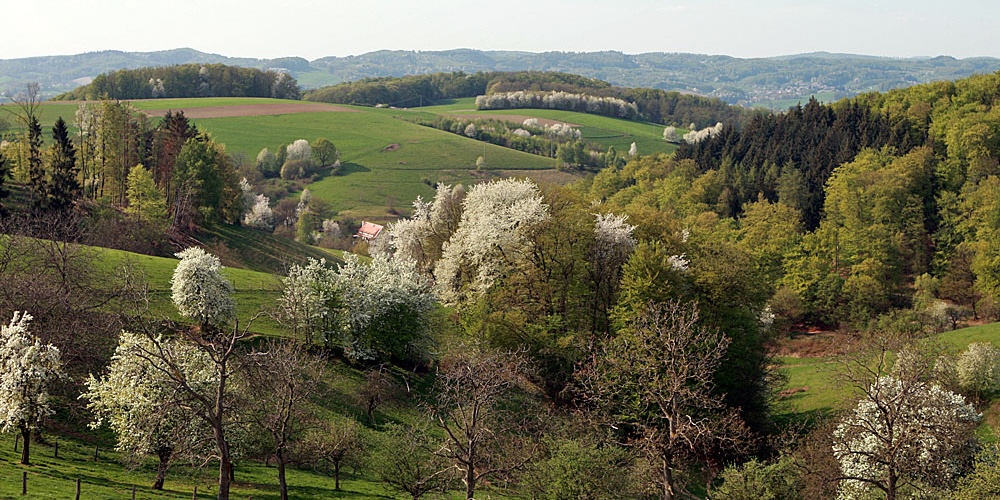
Typical Odenwald Landscape – ©Hans Niepoetter CC BY-SA 3.0 via Wikimedia Commons
The plain between the rivers Main, Rhine, and lower Neckar, and the Odenwald ridge of very high hills continues to the north, across the Main. Both plains which are quite densely populated also have a substantial built environment such as the country’s largest airport, contrasting with the more forested, hillier middle and northern thirds of Hesse.
The longest rivers in Hesse are the Eder and its tributary the Fulda that drains most of the north, the Lahn in the centre-west and, the Main and the Rhine in the south. The countryside is generally hilly. The notable range forming the southern part of Hesse, briefly spanning the middle Neckar valley is the Odenwald. The Rhine forms the long southwest border of Hesse. There are two notable oxbow lakes, the Stockstadt-Erfelder Altrhein and Lampertheimer Altrhein, which are in the south-west fringe of the state.
Birding Hesse
Although Hesse is not known as a birding destination, with 42% of its land forested, is the greenest state in Germany. It lies on the periphery of the Atlantic influenced zone. The state as a whole lies south of the German central low mountain range chain and extensive lowland areas are to be found in the central and southern regions only. This is the Upper Rhine Lowlands region and its northerly trough merges into the largely cultivated Wetterau district. Interesting areas for ornithologists lie on the Rhine (Inselrhein near Ruedesheim, Kuehkopf-Knoblochsaue and the Lampertheimer Altrhein). Some man-made bodies of water have been created over the past 100 years. In North Hesse these are the Edersee, Diemelsee and Affoldener reservoirs.
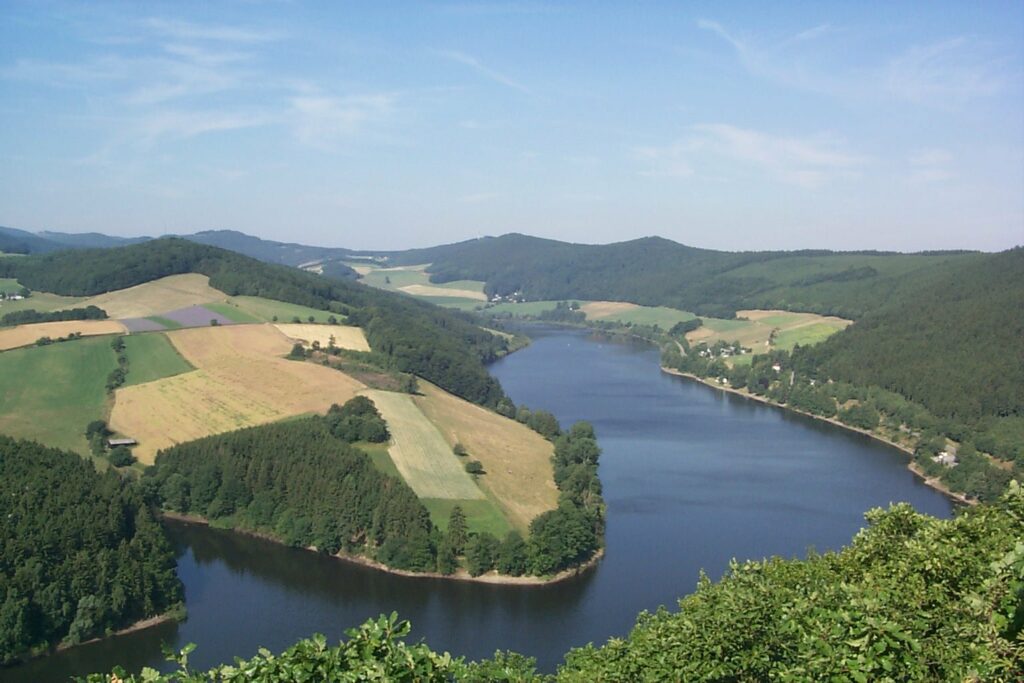
Diemelsee – ©JSteinhardt CC BY-SA 3.0 via Wikimedia Commons
In central Hesse, in addition to the Aartal reservoir with its small front weir created for conservation purposes, there are a number of reclaimed gravel pits between Marburg and Wetzlar. In the Wetterau there are some flooded former open-cast brown coal mines and several other bodies of water such as the Mooser pond complex in Vogelberg. More reclaimed gravel pits lie south of the River Main. All of these are of interest as they attract water loving bird species.
The larger deciduous forests consist mainly of the European Beech Fagus sylvatica. Of these beech forests, the Kellerwald has been designated a national park. Beech woodland also characterises the Rhoen biosphere reserve which has the Wasserkuppe, where gliding was invented, as its highest point. The characteristic bird of the Rhoen is the Red Kite Milvus milvus and Black Grouse Tetrao tetrix can also be seen here. These woods are also ideal habitat for woodpeckers such as the Middle-spotted Dendrocopos medius, Black Dryocopus martius, and four other woodpecker species. Honey Buzzard Pernis apivorus also breeds here. Marsh Tit Parus palustris (called locally the Nun Tit – Nonnenmeise) is a regular resident in the beech forests through the year. Some 25 % of the world population breed in Germany.
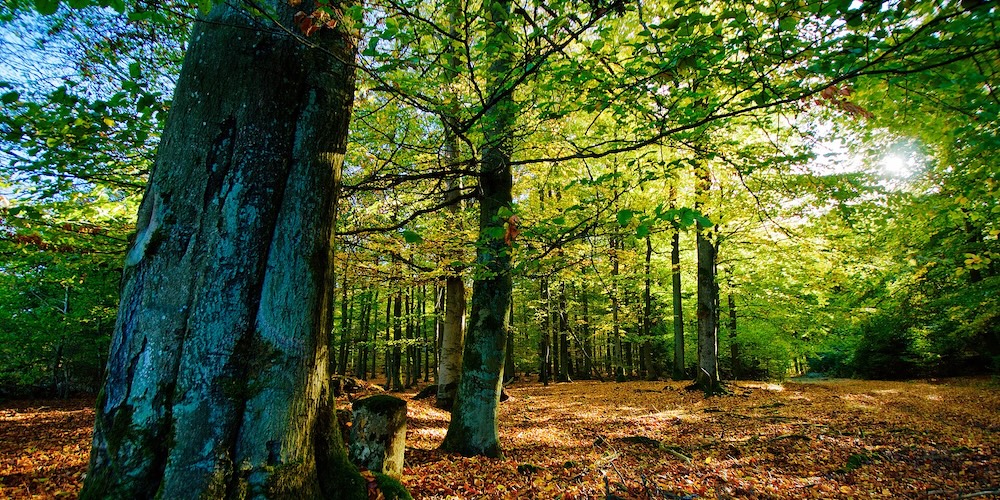
Nationalpark Kellerwald-Edersee – ©Estherluise CC BY-SA 4.0 via Wikimedia Commons
In northern and central Hesse on the other hand, Black Stork Ciconia nigra can be found. A good area for owl lovers lies north of Marburg. It is known as the Burgwald and is home to Pygmy Glaucidium passerinum and Tengmalm’s Owl Aegolius funereus.
An unusual feature is to be found in the Westerwald, which is part of the Rhine slate hill country on the western boundary of the state. So-called ‘low woods’ still exist here. These consist of trees which regenerate from stumps or roots. They are coppiced every 20 to 30 years and re-grow. Hazel Hen Bonasa bonasia still lives in these woods. These ‘Haubergen’, managed by the Hauberg cooperative under ancient rights, are also home to Nightjar Caprimulgus europaeus, which otherwise has its largest population in the pine woods of the River Main plain. The region where the Rhine Lowland Plain meets the slate hill country is the Rheingau, a well-known wine-growing area. Here, upriver from Ruedesheim, Rock Bunting Emberiza cia can be seen.

Westerwald – ©Yvonne Bentele CC BY-SA 4.0 via Wikimedia Commons
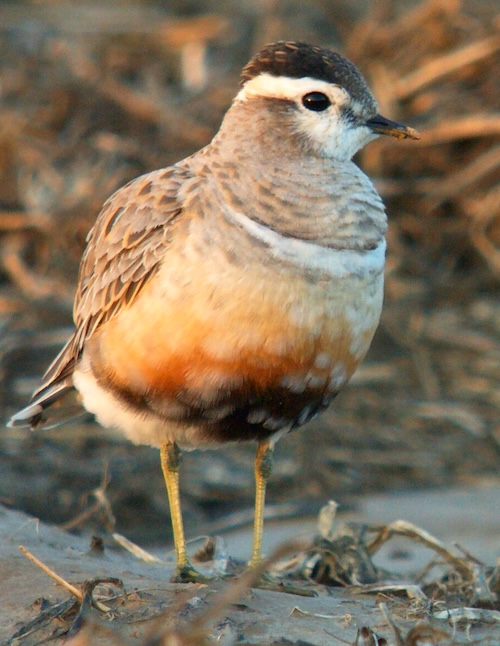
Large areas of cultivated land, where Dotterel Chardrius morinellus regularly stops on migration, lie in the Wetterau. The waterway system in the region was the first water meadow complex in Germany to be given protected status. The regular flooding attracts water birds and waders on migration. Species such as Marsh Harrier Circus aeruginosus and Spotted Crake Porzana porzana breed in parts of the region. Under ideal conditions, when there is a shallow water level in the meadows, one of the largest Common Crane Grus grus migration stopovers in Western Germany can be found in the Wetterau where several thousand birds remain for a long period in autumn.
Hesse also has a comparatively large number of mixed orchard meadows where, in central and southern Hesse, and Little Owl Athene noctua is a relatively common bird there – after North-Rhine Westphalia, Hesse has the largest Little Owl population in Germany.
-
Arzbachniederung near Schroeck in May
Satellite ViewIn the middle of the last century Snipe, Curlew and other meadow breeders were widespread as breeding birds in the Amoeneburger Basin. The land was drained on an extensive to provide better farmland and here, as in many other parts of Germany, these birds lost their breeding habitat. Nowadays they are all much endangered species or threatened with local extinction. As a result of the backfilling of the Arzbach stream in 2002 a new wetland has been created which will provide meadow breeders with a new habitat. Highland Cattle and horses will be introduced to graze and keep the grass short. Interesting birds (seasonal): Whinchat, Snipe, Lapwing and raptors such as Marsh Harrier and Black and Red Kite. -
Castle Hill (Schlossberg) in Marburg
Satellite ViewThe varied trees and bushes growing on Castle Hill and around the castle itself are home to a not uninteresting bird life. Of course only those species which can cope with the streams of visitors and the various events held in the castle, such as Blackbird, Chaffinch and Great Tit are to be found here. Nevertheless, one can also observe here the Greater Spotted Woodpecker, Nuthatch, Marsh Tit, Long-tailed Tit, Greenfinch and also in winter the Brambling and in summer the Spotted Flycatcher. The castle towers are home to several families of Kestrels which are interesting to observe during the mating season (end of March – beginning of April) when their hair-raising chases and their display can be seen at close quarters. In autumn another spectacle is on offer when the Jackdaws and Ravens take over the Marburg airspace and put on their stunt flights around the castle tower. Last but not least, the castle is a marvellous observation post during Common Crane migration, when they sometimes pass close by in autumn. -
Erlensee - KG Niederwald – Wohrasandfang
Satellite ViewThese three neighbouring sites are a good example of how birds at times don’t give a monkey’s for human habitat planning. The Erlensee is a nature reserve with a well-kept trail and lots of information. More interesting from a birdwatching point of view is however the unprotected flooded quarry in Niederwald! Not only have goose colonies become established here, it is also a good site for regular sightings of gull and tern species. Above all, the mudflats here offer optimal conditions for a variety of waders. Although the artificial lake is also used by anglers, wind-surfers swimmers and gravel is still extracted, these usually shy birds seemed to have grown accustomed to the hustle and bustle. The Wohrasandfang, which is situated immediately adjacent to the Kirchhain sports facility, is also worth a detour. Some species such as Tufted Duck, Pochard, Coot and Egyptian Goose are particularly tame as they are fed regularly. Rare species such as Ferruginous Duck have also been recorded here. -
New Botanical Garden
Satellite ViewOnce a hot tip for birders, the botanical gardens have long become an attraction for the curious and those seeking relaxation from far around. Such a large and varied area with stretches of water and heath and woodland zones in the centre of the state forest is of course highly interesting for birders as well. The first Common Rosefinch in Hesse was observed here. Ornithological tours are regularly organised here. -
Niederwalgern / Roth sewage fields and quarry ponds
Satellite ViewNot only is Marburg home to a number of breeding birds, it is also, which is often forgotten, situated on a well frequented migrant passage flyway with an unbelievable high number of birds which transit or stop to feed. The remarkable topography of the Lahn Valley, bordered on both sides by low mountain ranges, acts as a funnel for many migrants. This can be most obvious during Common Crane migration, when even the casual observer might notice passing formations; yet the professionally organised counts at the Niederwalgern quarry ponds record hundreds of formations with several thousand individuals. This makes the Lahn Valley one of the main routes for this species alone. This applies to the Osprey as well which, taken on its population as a whole, is very commonly seen in the Lahn Valley. In addition to these rather spectacular species there is a strong passage of song birds and waders, including several rare species which are regularly observed here. As the ponds are mainly a site for birds on passage, activity here is markedly dynamic. One moment all is quite – the next can be thrilling. Any species (well almost) can turn up here! -
Niederweimar leisure centre and quarry
Satellite ViewThis area is a complex one and the variety of bird species only becomes apparent during intensive observation in the course of the whole year. The area comprises three completely different parts: 1. The gravel pit, in use, with steep sandy walls, a number of pools and extensive patches of wasteland (in grey on the sketch). 2. The southern leisure lake (freshwater) bordered by reed beds and used by a fishing club. 3. The northern leisure lake, the shoreline of which has changing vegetation and with a lot of human activity in summer. A complete circuit of the lake can only be made between October and the end of April as the gates is closed at the start of the bathing season On the one hand, typical quarry and pool dwellers can be found; on the other the area is a stopover for an amazing number of species. The original photos of 83 different were taken in the area and represent only a selection of species recorded here. Best birds: Bearded Reedling, Purple Heron, Water Rail, Spotted Crake, and Long-tailed Duck etc., -
Rauischholzhausen Castle Park
Satellite ViewRauischholzhausen Castle with its extensive estate is not only a hot tip for a Sunday outing, it also offers ideal preconditions for birding. The estate itself is like a fairytale wood with ponds, streams, winding paths and ancient trees with open glades – in other words ideal for many birds. The short standard tour goes from the lower pond (ducks and swans) past the castle to the upper pond (Kingfisher). A complete day out can be filled by going into the woodland adjacent to the estate in the south. The marked trail can be followed to the village of Dreihausen (5 km). The woods have many woodpecker species and Tawny Owls can sometimes be heard. In Dreihausen itself the basalt outbreaks are often visited by birders -
The Radenhaeuser Pool
Satellite ViewThe Radenhaeuser Pool lies within a nature reserve in the storage pond of the River Ohm. Here, as in the adjacent renaturised areas, there are many breeding birds. The main attraction is however the migrants which use it as a rest area in the main passage periods of August/September an. March/April. Some quite large mudflats come to light when the water level drops and serves up waders on a plate for birdwatchers. There is scarcely a better site in the whole region for learning wader identification as, on a good day, up to a dozen different species can be observed at the same time. There is also a good chance of seeing Black and White Stork, Common Crane or Curlew on passage in Radenhausen. The observation platform offers a good overview across the whole area. A scope is recommended. Species identification posters are at the foot of the ladder. There is also a box for people to post their sightings. A herd of Highland Cattle, which live in peaceful coexistence with the birds, keep the shoreline vegetation and the mudflats in order. -
The River Lahn, its banks and riverine woodland
Satellite ViewModesty aside, the Lahn Valley has so much to offer in terms of abundance and variety of species that it can put some highly publicised National Parks or Biosphere reserves to shame. Not only that, it’s right on our doorstep. So many species have grown used to human presence that many can be observed at close quarters. The Lahn itself has a lot to offer. It is wide, narrow, flows fast and slowly, is deep and shallow, has sand, stones, trees and bushes …… in other words it provides a habitat for very different bird species within a short stretch of water. I addition to water birds, one finds the typical species which live near weirs, rapids and overhanging bushes such as Dipper, Blue Wagtail or Kingfisher. The dense and varied undergrowth on the banks acts as a magnet for reed or other warblers. Finally, some of the shallower stretches provide watering places for birds which attract half of the bird life in summer from Redstart to Wren. The rare countless good birding sites along the Lahn. Good examples are the weirs near Roth and the Steinmuehle near Gisselberg as well as the newly renaturised area “Auf der Weide” (on the meadow) in the centre of Marburg. The leisure lakes and quarries Niederweimar and Niederwalgern as well as the Roth sewage fields are also in the Lahn valley. The photos show only a selection of the bird species which can be seasonally observed on the Lahn and its banks.
-
Number of bird species: 401
(As at June 2026)State Bird - Grey Heron Ardea cinerea
-
Avibase
PDF ChecklistThis checklist includes all bird species found in Hesse , based on the best information available at this time. It is based on a wide variety of sources that I collated over many years. I am pleased to offer these checklists as a service to birdwatchers. If you find any error, please do not hesitate to report them. -
eBird
PDF ChecklistThis checklist is generated with data from eBird (ebird.org), a global database of bird sightings from birders like you. If you enjoy this checklist, please consider contributing your sightings to eBird. It is 100% free to take part, and your observations will help support birders, researchers, and conservationists worldwide.
-
Frankfurt Zoological Society
WebsiteFrankfurt Zoological Society conserves wildlife and ecosystems, focusing on protected areas and outstanding wild places. -
Hessian Agency for Nature Conservation, Environment and Geology
WebsiteThe Hessian Agency for Nature Conservation, Environment and Geology (HLNUG) was founded in the year 2000 through the fusion of the Hessian Agency for Soil Research (state geological service) and the Hessian Agency for Environment. The agency is located in Wiesbaden and has branches in Kassel and Darmstadt. Furthermore, it maintains two drill core storages in Limbach and Villmar-Aumenau as well as the collection point for low level radioactive waste in Ebsdorfergrund.
-
BR The Rhön Biosphere Reserve
InformationSatellite ViewThe Rhön Biosphere Reserve includes the entire central area of the Rhön Mountains, a low mountain range in the German states of Hesse, Bavaria and Thuringia. -
NP Kellerwald-Eder Reservoir
InformationSatellite ViewIn the Kellerwald, parts of which are also a Special Protection Area (for birds), a number of bird species still or once again breed, among them the black stork, the common raven, six kinds of woodpecker (among them the rare middle spotted woodpecker and the grey-headed woodpecker), the black and the red kite (which here reach their highest population density anywhere in Hesse), the peregrine falcon, the Tengmalm's owl, the honey buzzard, the Eurasian eagle owl and the great grey shrike. -
NR Klosterwiesen von Rockenberg
WebsiteSatellite ViewA little known but interesting nature reserve between Butzbach und Bad Nauheim in der Wetterau (Hesse). The site (in German) has an interactive map with views into the reserve and a list of species recorded… -
NR Kuehkopf-Knoblochsaue
InformationSatellite View(In German) The Kuehkopf-Knoblochsaue includes the Kuehkopf island in the Rhine, the old course of the Rhine near Stockstadt-Erfeldat, the shore area between the old southern course of Rhine and the King’s Dyke (Koenigsdeich), the Knoblochsaue riverine woodland, of ther das Auwaldgebiet der, das Peterswert and the old Rhine riverbed near Schusterwoerth. It is the largest nature protection area in Hesse with an area of 2,370 hectares and is also a designated UNESCO Europa Reserve. It is close to Frankfurt am Main and is ideal for a half day trip for visitors to the city. In summer it is a good site for Golden Oriole Oriolus oriolus and Spotted Flycatcher Muscicapa striata. In winter it is a rest area for the White-fronted Goose Anser albifrons and Bean Geese Anser fabalis… -
NR Red Moor (Rhön)
InformationSatellite ViewThe Red Moor is a raised bog in the Hessian part of the Rhön Mountains in Germany. It lies within the eponymous nature reserve in the Rhön Biosphere Reserve and is part of the Europe-wide conservation system, Natura 2000.
-
Hessen Rare Bird Alert
SightingsThe report below shows observations of rare birds in Hessen. Includes both unreviewed and reviewed/approved observations.
-
Good Birdwatching Areas in Hesse
WebsiteThis interactive map in German links to most of the nature protection areas/nature reserves in Hesse with descriptions of the locations and records of bird sightings. The reserves immediately North of Frankfurt form part of the Wetterau water meadows complex (without their own website) which offers probably the most interesting birding opportunities in Hesse. In winter it is a rest area for the White-fronted Goose Anser albifrons and Bean Geese Anser fabalis and the Whooper Swan Cygnus cygnus is a regular visitor, mainly to the Bingenheimer Ried and Mittlere Horloffaue nature reserves. Here, in spring, displaying Black-tailed Godwits Limosa limosa can be observed and also the Eurasian Curlew Numenius arquata although the both are expected to have died out here within the next few years as breeding conditions become more unsuitable… -
The Bird Life of Marburg and Environs
WebsiteIn German but nevertheless a very graphic and informative site for the university town of Marburg and its surroundings. Local bird photos (with English names), species list, interactive map of birding sites and other information. A nice and useful site.
-
Johannes Ferdinand
PhotographerJohannes Ferdinand was born 1961 in Cologne, Germany. Very young, he was interested in nature and especially birds.