

Republic of Azerbaijan
Azerbaijan is a transcontinental country located at the boundary of Eastern Europe and West Asia considered European, Asian and part of the Middle East depending on one’s perspective. It is a part of the South Caucasus region and is bounded by the Caspian Sea to the east, Russia’s republic of Dagestan to the north, Georgia to the northwest, Armenia and Turkey to the west, and Iran to the south with around 10.5 million inhabitants. Baku is the capital and largest city with around 2.5 million people in the metropolitan area.
Three physical features dominate Azerbaijan: the Caspian Sea, whose shoreline forms a natural boundary to the east; the Greater Caucasus mountain range to the north; and the extensive flatlands at the country’s center. There are also three mountain ranges, the Greater and Lesser Caucasus, and the Talysh Mountains, together covering approximately 40% of the country. The highest peak of Azerbaijan is Mount Bazardüzü 14,652 feet, while the lowest point lies in the Caspian Sea −28 m. Nearly half of all the mud volcanoes on Earth are concentrated in Azerbaijan.
The main water sources are surface waters. Only 24 of the 8,350 rivers are greater than 100 km (62 miles) in length. All the rivers drain into the Caspian Sea in the east of the country. The largest lake is Sarysu 67 km2 (26 square miles), and the longest river is Kur 1,515 km (941 miles), which is transboundary with Armenia. Azerbaijan has several islands along the Caspian Sea, mostly located in the Baku Archipelago. Around 8% of the country is protected.
The Greater Caucasus protects the country from direct influences of cold air masses coming from the north. That leads to the formation of subtropical climate on most foothills and plains of the country. Meanwhile, plains and foothills are characterized by high solar radiation rates. Nine out of eleven existing climate zones are present in Azerbaijan.
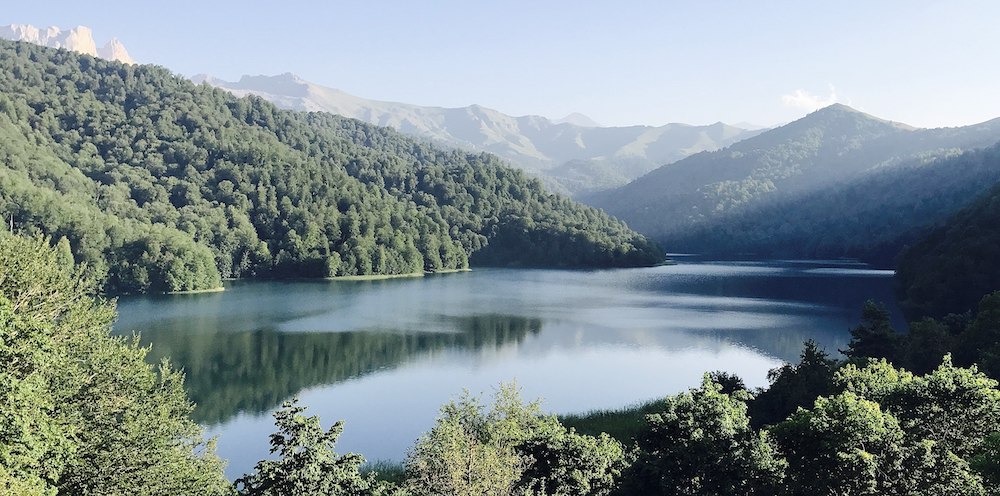
Göygöl National Park – ©Anarzey, CC BY-SA 4.0 via Wikimedia Commons
The country lies within four ecoregions: Caspian Hyrcanian mixed forests, Caucasus mixed forests, Eastern Anatolian montane steppe, and Azerbaijan shrub desert and steppe. Azerbaijan’s flora consists of more than 4,500 species of higher plants. Due to the unique climate in Azerbaijan, the flora is much richer in the number of species than the flora of the other republics of the South Caucasus. 106 species of mammals, 97 species of fish, 423 species of birds, 10 species of amphibians, and 52 species of reptiles have been recorded in Azerbaijan.
Birding Azerbaijan
Azerbaijan is a wonderful place for birdwatching. Tucked in its relatively small space are environments ranging from alpine to subtropical, and this makes a home for a wide range of life, including birds. Some 423 species of birds have been recorded in Azerbaijan. These range from the large and spectacular – such as flamingos and eagles – to many kinds of waterfowl, colourful bee-eaters, rollers and hoopoes, and numerous small brown warblers that strain even the expert’s identification skills.
The avian show keeps changing through the year. Because of Azerbaijan’s relatively mild winters, many birds from farther north winter here. Water birds by the thousands concentrate in the many wetlands, large and small, coastal and inland. Among these birds are swans, geese, ducks, flamingos, and waders like Black-tailed Godwit, curlew, and snipe. Along the coast, Common and Great Black-headed Gulls appear. Over the land, Hen Harriers and a few Peregrines and Saker Falcons hunt; the latter two, unfortunately and illegally, are captured for lucrative sale to Arab falconers.
Some species of small birds that nest farther north also come here for the winter. Big flocks of Meadow Pipits and Bramblings, for instance, roam the open areas, feeding on seeds. In the mountains, most birds of the alpine zone, like Guldenstadt’s Redstart and the Great Rosefinch, are forced lower in winter by snow, some down to the river valleys. The kinds of birds you can see in winter – the Peregrine for instance – may be composed of some individuals from farther north and some that are here all year. Global warming may be increasing the number of species that habitually winter in Azerbaijan.
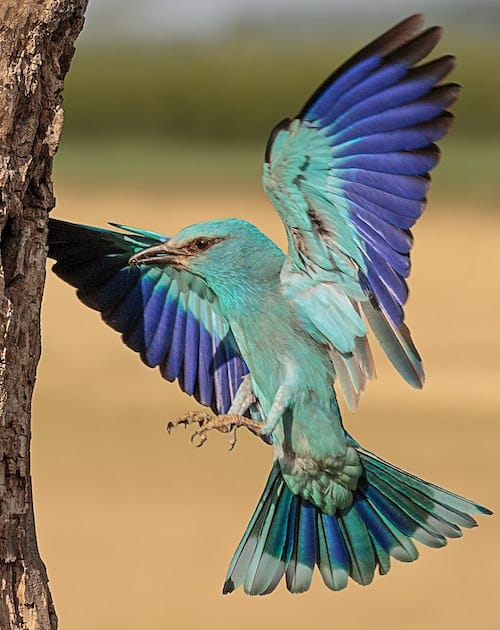
Spring reduces the great wetland show but brings in a different storm of migrants and nesters. Most of the waterfowl and shorebirds depart for northerly climes, beginning in late February. Early arrivals from the south include Hoopoes, Barn Swallows and wheatears, all easily seen along roadsides. Overhead, you might hear the hoarse croaking of Common Cranes or glimpse a Steppe Eagle, both on their way to Russia or Kazakhstan. Spring migration peaks in April and May. All sorts of small birds, such as shrikes, warblers, and flycatchers, pass through or stay to nest. Look for European Bee-eaters and electric blue European Rollers on telephone wires. Along the coast, cormorants, terns, and waders stream by. All this passing and arrival of new life is what makes spring the most exciting time of the year for most birdwatchers.
Summer, of course, is the time of reproduction for most birds. In the marshes, herons, Pigmy Cormorants, and the remaining ducks are conspicuous, while Purple Gallinule, Common Moorhens, and Water Rails skulk in the reeds. The forest birds, such as tits and woodpeckers, in the mountain forests and remnant lowland patches, break away from the winter flocks to set up paired housekeeping. Alpine birds move upslope to the meadows below the snowline. Larks and wheatears sing above their open country territories. Some of the days may be too hot for us sensitive humans, but there is much to see out there in the mountains and plains. Try early morning for coolness and the most bird activity.
Bird migrations in autumn are not as urgent and concentrated as they are in spring. There is no reproductive command pushing them, just the need to get where they`ll find their kind of food in winter. It all begins with certain shorebirds in late summer, picks up with small land birds in September, continues strongly with a variety of land and water birds in October, and ends with the great influx of waterfowl (ducks, geese and swans) from October to December. Throughout the autumn, raptors such as eagles and hawks pass through, especially along the coast. Water birds, too, have preferred flyways. The majority follow the coast, some cutting across the Apsheron Peninsula and some going around it. While many of those not stopping in Azerbaijan continue toward Iran along the coast, others turn westward up the Kura River lowlands toward interior wetlands. A few go on to the Black Sea.

Babadagh – ©Kupr31, CC BY-SA 4.0 via Wikimedia Commons
Where to Go Below are in Top Sites are five favourite birdwatching places. Four of these areas are nature reserves. To enter these you need written permission from the State Ecological Committee, which manages them. However, if you don’t have permission, nearby areas often have many of the same birds. Many of the wetlands are hunted, but this poses no danger to birdwatchers. Extract from Azerbaijan International (2001) By Nepýer Shelton
-
Babadagh
InformationSatellite ViewThis mountain, which rises to 3,629 meters, is sacred to many Azeris, who make pilgrimages to it. I include it here as an excellent place to see alpine birds and enjoy the craggy scenery. Late May through July is the season. The birds, most of which are infrequently seen at lower elevations, include the Caucasian Snowcock, Caucasian Grouse, Great Rosefinch, Guldenstadt's Redstart, Red-fronted Serin, Snowfinch, and many others. It is 1½ days from Baku. The usual route is from the Guba side of the mountains, starting the trek from the village of Garkhun or higher, depending on what your four-wheel-drive can negotiate. -
Cape Gilazi Dili
Satellite ViewI like this place for its sense of remoteness as well as its birds. It offers wet fields, rocky and sandy shore, and a marsh-fringed lagoon that is often full of birds. In the wet fields north of the road that leads to Yeni Yashma, ducks and geese congregate in the cooler months, along with lapwings and other shorebirds. There is usually a Marsh Harrier or two cruising about, and once I saw a magnificent Imperial Eagle. Shorebirds like Grey Plovers and Dunlins can be seen along the sea fringe. At the end of this track you'll find a shack on stilts and the lagoon mentioned above. Dalmatian Pelican, Short-eared Owl, Common Cranes, and White Stork, along with five kinds of herons can be seen in early October at Cape Gilazi. -
Haciqabul Golu - Hajigabul
InformationSatellite ViewOne of the virtues of this lake, just south of Gazimammad, is that much of it has no fringing reeds you have an unobstructed view of the thousands of ducks that winter here. They usually congregate off the north shore or out in the middle. With a telescope you can get a wonderful view of ten or more kinds of ducks - Shoveler, Mallard, Teal, White-headed Ducks, Common and Red-crested Pochard, Tufted Duck, and others. Late summer through spring, you should also see herons and a variety of waders. On one January visit, I saw seven flamingos and a flock of 300 avocets. The ponds along the highway on the west side of the lake can be very good for shorebirds too. To reach the lake, about 1½ hours from Baku, take the southerly bypass around Gazimammad. -
Lankaran to Lerik
Satellite ViewThis road, running from the coastal lowland to a view of Talish Mountain peaks, follows a stream valley with the lushest, most beautiful forest I've seen in Azerbaijan. I include this area here because of the scenery and the potential for birds – I have not yet studied it carefully. The forest should have the usual complement of permanent residents such as tits, woodpeckers, and treecreepers, and summer birds such as Semi-collared and Red-breasted Flycatchers. Along the stream hunt for Dippers. Past Lerik look for Lammergeier (Bearded Vulture), Radde's Accentor, Alpine Swift, Snowfinch, Alpine Chough, and other birds of the high mountains. Check the routes beyond Lerik and see if permission and/or a military guide is needed to enter this area near the Iranian border. The border guards may be suspicious of someone using binoculars. -
Red (Bloody) Lake [Qanlı göl]
Satellite ViewThis freshwater lake is the best birdwatching area near Baku. Red Lake is full of birds, especially in winter. Up the valley from it, extensive marshes hide lots of other birds. What you can see, of course, changes with the seasons. Early summer is the low season, with a few ducks and herons hanging around and warblers and other small birds creeping about in the reeds. If you can get there just after sunrise, you may see Purple Swamphens catching the sun's warmth at the edge of the marsh below Wolfgate. In late summer, migrating waders begin arriving, to feed on invertebrates in the mudflats. During the main Autumn migration you can see a great variety of water birds: ducks, waders, herons, gulls, terns, & maybe a flamingo or two. As winter comes on, many of these disappear, but the duck and coot populations build up to hundreds. Often these Shovelers, Mallards, the rare White-headed Duck, and others are easily watched from the highway on the south side. Other days you need to don rubber boots and trek the muddy west shore. Almost always, you'll see Marsh Harriers coursing over the reeds, looking for prey.
-
Number of bird species: 423
(As at July 2024)
-
Avibase
PDF ChecklistThis checklist includes all bird species found in Azerbaijan , based on the best information available at this time. It is based on a wide variety of sources that I collated over many years. I am pleased to offer these checklists as a service to birdwatchers. If you find any error, please do not hesitate to report them. -
Wikipedia
Annotated ListThis is a list of the bird species recorded in Azerbaijan. The avifauna of Azerbaijan include a total of 423 species. -
eBird
PDFChecklistThis checklist is generated with data from eBird (ebird.org), a global database of bird sightings from birders like you. If you enjoy this checklist, please consider contributing your sightings to eBird. It is 100% free to take part, and your observations will help support birders, researchers, and conservationists worldwide.

-
Birds of Europe, North Africa, and the Middle East
| Photographic Guide | By Frédéric Jiguet & Aurélien Audevard | PUP | 2017 | Paperback | 447 pages, 2200 colour photos, colour distribution maps | ISBN: 9780691172439 Buy this book from NHBS.com -
Birdwatching in Azerbaijan
(A Guide to Nature and Landscape) | By Sebastian Schmidt, Kai Gauger & Nigar Agayeva | Michael Succowe Foundation | 2008 | Paperback | 224 pages, colour photos, maps, includes audio CD | ISBN: 9783000241581 Buy this book from NHBS.com -
Collins Bird Guide
| By Lars Svensson | Harper Collins | Edition 3 | 2023 | Paperback | 478 pages, 4000+ colour illustrations, 700 colour distribution maps | ISBN: 9780008547462 Buy this book from NHBS.com -
The Birds of Azerbaijan
By M Patrikeev | Pensoft Publishers | 2004 | Hardback | 380 pages, 70 colour & b/w photos, 250 distribution maps, tables | ISBN: 9789546422071 Buy this book from NHBS.com -
Where to Watch Birds in Azerbaijan
| By Napier Shelton | Napier Shelton | 2001 | Paperback | 112 pages, Col photos, illustrations | ISBN: 9780976012009 Buy this book from NHBS.com

Collins Bird Guide
AndroidThe Collins Bird Guide App provides everything you need to identify a species quickly and learn about it thoroughly.
Collins Bird Guide
Apple iOS |Collins Bird Guide 4+ A field guide to Europe NatureGuides Ltd. Designed for iPadUseful Information-
OSME
WebpageAzerbaijan is a small country, at the eastern border of the Western Palearctic, which is mainly influenced by the Caucasian mountain ranges and the Caspian Sea...
Organisations-
Azerbaijan Ornithological Society (AOS)
LinkedInAddress: M. Mushbig Street 4B, Ap. 60, Baku, AZ, AZ1021 Tel/Fax: Tel. 00994 12 480 0495; Fax 00994 12 579 1651 -
Birding Azerbaijan
WebsiteWe are a small group of birders regularly visiting Azerbaijan since 2004. Initially, few of us came as students from Greifswald University (Germany) to conduct the fieldwork for our theses in the wake of the former activities of the Michael Succow Foundation. During this time we learned much about the rich Azerbaijani bird life, local distribution and occurrence. Our findings are presented in a few publications and the field guide “Birdwatching in Azerbaijan – a guide to nature and landscape”. -
Ecological club of Azerbaijan
LinkedInEcological club of Azerbaijan (Eco Club of Azerbaijan) offers all kinds of active recreation in Azerbaijan and other countries. Our club was established by a group of young sportsmen-tourists and joins people who love nature, popularise and develop tourism close to nature
Reserves-
*Protected areas of Azerbaijan
InformationSatellite View11 state reserves, 8 national parks and 24 state game reserves -
NP Absheron
InformationSatellite ViewThe Absheron State Nature Preserve was created in July 1969 in order to protect gazelles, Caspian seals and water birds that inhabit the territory. The climate of the area is semi-arid, specific to semi-desert and dry steppe. -
NP Absheron
InformationSatellite ViewThe Absheron State Nature Preserve was created in July 1969 in order to protect gazelles, Caspian seals and water birds that inhabit the territory. The climate of the area is semi-arid, specific to semi-desert and dry steppe. -
NP Absheron
InformationSatellite ViewThe Absheron State Nature Preserve was created in July 1969 in order to protect gazelles, Caspian seals and water birds that inhabit the territory. The climate of the area is semi-arid, specific to semi-desert and dry steppe. -
NP Absheron
InformationSatellite ViewThe Absheron State Nature Preserve was created in July 1969 in order to protect gazelles, Caspian seals and water birds that inhabit the territory. The climate of the area is semi-arid, specific to semi-desert and dry steppe. -
NP Ag-Gel
InformationSatellite ViewAg-Gol, situated in the Mil plain of the Kur-Araz lowlands has a semi-desert landscape and is an important overwintering and nesting place for birds. Over 140 species of birds are found in the park, including 89 species of nesting birds (partridge, spoonbill, swan, teal, bustard, etc.). Approximately 30 specimens of charadriiformes and 24 specimens of anseriformers have chosen this reserve home for themselves. A number of threatened bird species are here such as white-tailed eagle, white pelicans and Dalmatian pelicans -
NP Göygöl
InformationSatellite ViewThe national park includes one of the most beautiful and cleanest lakes in Azerbaijan, Lake Göygöl. The reserve is intended to protect the natural ecosystem of the subalpine zones of the northern slopes of the Lesser Caucasus. Birds include bearded vulture (Gypaetus barbatus), Egyptian vulture (Neophron percnopterus), Eurasian eagle-owl (Bubo bubo), black woodpecker (Dryocopus martius), golden oriole (Oriolus oriolus), mistle thrush (Turdus viscivorus), stock dove (Columba oenas), Eurasian woodcock (Scolopax rusticola), woodlark (Lullula arborea), mute swan (Cygnus olor), common quail (Coturnix coturnix), Caspian titmouse (Poecile hyrcanus) subspecies of the titmouse; the Caucasus pheasant (Phasianus colchicus colchicus) subspecies of the common pheasant are common. -
NP Hirkan
InformationSatellite ViewThe Hirkan National Park protects the humid subtropical and humid temperate forests in the area of the Lenkoran Lowland and the Talysh Mountains, sheltering many endemic plant and animal species. Birds include Caspian Tit and Caucasus Pheasant. Large mammals includee Persian leopard (Panthera pardus saxicolor), lynx (Lynx lynx), brown bear (Ursus arctos), wild boar (Sus scrofa), wolf (Canis lupus), golden jackal (Canis aureus), jungle cat (Felis chaus), red fox (Vulpes vulpes), roe deer (Capreolus capreolus), badger (Meles meles), otter (Lutra lutra). -
NP Shirvan
InformationSatellite Viewhe reserve‘s activity is focused on the protection and reproduction of the Goitered Gazelle (Gazella sulgutturosa), waterfowl birds and typical plant biotypes of the Shirvan Lowland. The area is 25800 hectares, of which 3500 hectares are water reservoirs. There are bustards, Francolins, little bustard (Otis tetrax), white-tailed eagle (Haliaeetus albicilla), steppe eagle (Aquila nipalensis), saker falcon (Falco cherrug) etc.. In winter, there are many migratory birds on the water bodies such as grey geese. -
NP Zangezur
InformationSatellite ViewZangezur National Park is situated in the exclave of Nakhchivan. In addition to mammals, 217 bird species and subspecies such as Levant sparrowhawk, great white pelican, Dalmatian pelican, white-tailed eagle, lammergeyer, short-toed eagle, great bustard and little bustard can be found in the region. -
SR Ghizil-Agaj
InformationSatellite ViewQizil-Aghaj State Reserve or Qızılağac State Reserve was created for the purpose of protecting, creating conditions for wintering and nesting of migrant, swamp and wild birds. 248 species of birds, wild boar, wolf, wild cat, badger, sable, fox, etc. populate this reserve. -
SR Ghzil-Aghaj State Reserve
InformationSatellite ViewGhizil-Aghaj State Reserve was created for protecting, creating conditions for wintering and nesting of migrant, swamp and wild birds. -
SR Ismailli
InformationSatellite ViewIsmailli State Reserve or Ismayilly State Reserve was established for preservation and protection of natural complexes, occupying the north part of southern slope of Major Caucasus. Forests are mainly formed by such tree types as beeches, hornbeams and oaks, with small numbers of birch-trees, cud, lime-trees, etc. Among them are chestnut-leaved oak and horehound oak that are included in the Red Book of Azerbaijan. The reserve accounts for nearly 170 animal species. 104 bird species of 13 orders are found in this reserve. Such mammals as brown bear, wild cat, lynx, Caucasian dear, roe dear, chamois, Caucasian goat, etc. populate the reserve. -
SR Turian-Chay
InformationSatellite ViewThe reserve is situated on the spurs of the Buz-Dag Ridge, in the southern foothills of the Major Caucasus, on the right bank of the River Turian-Chay in the Agdash area. -
SR Zagatala
InformationSatellite ViewThe reserve's fauna includes the Syrian brown bear, Indian wolf, forest cat and Caucasian lynx.. It also has a diverse range of birds, including the golden eagle (Aquilla chrysaetos), Egyptian vulture (Neophron percnopterus), griffon vulture (Gyps fulvus), but especially bearded vulture (Gypaetus barbatus) and monk vulture (Aegypius monachus).
Sightings, News & Forums-
Birding Azerbaijan
FacebookPageBird news from Azerbaijan, birding trips, nature conservation, scientific ornithology -
eBird
SightingseBirding This Month...
Guides & Tour Operators-
BirdFinders
Tour OperatorThis ground-breaking new tour to the farthest reaches of the Western Palearctic where, amidst spectacular mountain scenery, we will search for such sought-after species as Caucasian Snowcock, White-winged Redstart, Great Rosefinch, Caspian Tit, Mongolian Finch, White-throated Robin, the ever-delightful Wallcreeper and Shikra in its only breeding area within the boundaries of the Western Palearctic region. -
Birding Azerbaijan
Tour OperatorAs specialists in guided birding tours across Azerbaijan, we take you to the most exceptional spots to witness the finest avian species. Our currently available tours are outlined below, ranging from 10 to 12 days, while bespoke short trips, lasting 1 to 5 days, can also be individually tailored to your preferences. -
Birding Caucasus
Tour OperatorThe notorious Caucasus, including Georgia, Armenia, Azerbaijan, and parts of Iran, Turkey and Russia, is a home for anticipating wildlife with enormous number of endemism, which makes it one of the world’s richest and important biodiversity hotspots. -
Birding Direct
Tour Operator9/10 Days Azerbaijan Birding Tour -
Birding Ecotours
Tour OperatorOur Azerbaijan birding tours are particularly exciting as this Western Palearctic country often produces rare and exotic vagrants and also hosts a number of range-restricted resident specials. In particular, Azerbaijan birding tours are noteworthy for their huge flocks of wintering Little Bustards... -
GoCaucasus
Tour OperatorStraddling the border between East and West, the country contains geographical features of both, resulting in a remarkable range of landscapes, habitats, and climate zones. There are high mountains, extensive coastline and lowlands, reed-fringed lakes, wetlands and rivers, subtropical forests, and dry steppes and semi-deserts – all of which are buzzing with birdlife and their own set of attractive species. -
NatureTrek
Tour OperatorSpring Birding in Azerbaijan - An 11-day birding tour of Azerbaijan in search of the passage visitor, summer migrant and resident birds of this exciting destination. -
Neophron Tours
Tour OperatorSpring Birding Tour in Azerbaijan -
Rockjumper
Tour OperatorAzerbaijan is a hidden gem for birdwatchers in the Western Palearctic. Located in the Caucasus region, it is a crossroads for a variety of birds from Europe, Asia, and the Middle East. This small country has recorded over 400 species...
Trip Reports-
2018 [05 May] - Kai Gauger
ReportFrom May 20th to 28th Kai Gauger led a trip along the birding hotspots in eastern Azerbaijan and Nakhchivan. The guests were from Germany, Austria, Denmark and Great Britain and the ground logistics were (as always) perfectly arranged by Hajibaba Imanli from olivetravel.co -
2018 [10 October] - Oscar Campbell & Mark Smiles
PDF ReportGiven Azerbaijan’s relatively recent appearance as a birding hotspot, and the general dearth of trip reports available online (and those existing written mainly by the same gang of European trailblazers) we felt it was worth putting a few logistical details - correct as of October 2018 -
2019 [05 May] - Aleix Comas
PDF Report...Early morning birds produced plenty of Isabelline Wheatears singing and displaying all over the area, plus several Lesser Short-toad Larks, Black-bellied Sandgrouses flying by, Tawny Pipits, Linnets, and other typical dry and open area birds... -
2019 [11 November] - Michael HeiB
ReportOur trip started on 6 November and finished on 23 November 2019 and followed the route Baku – Absheron National Park – Besh Barmag – Greater Caucasus (Xinaliq, Laza) – Shirvan National Park – Qizilagach National Park – Talysh Mountains including Zuvand upland – Gobustan – Besh Barmag – Baku. -
2020 [03 March] - Ernst Albegger
PDF Report...Ernst and Rami checked the areas visited on the previous day and the huge part of the NP accessed via the main gate (see map below). A promising reedy lagoon is at 38.907867, 48.900433, which can be entered by car from the main road at 38.908835, 48.908233. The adjacent coastline of the Caspian Sea was checked with small numbers of Dalmatian Pelican, a Sandwich Tern, a 2cy Pallas’s Gull, 6 Common Gull (race heinei), 2 nice breeding plumage Slender-billed Gull and bigger numbers of Black-headed and Caspian Gull... -
2022 [02 February] - Dr M Zieger
PDF Report...Yield of the day: Kentish Plover, Little Stint, Common Snipe, Wood Sandpiper, Slender-billed Gull, Little Gull, Pallas's Gull, Caspian Gull, Pygmy Cormorant, Eurasian Marsh-Harrier, Hen Harrier, White-tailed Eagle, Eurasian Kestrel, Isabelline Shrike (rare for Azabaijan), European Stonechat Ssp. variegatus, Black Francolin, Dalmatian Pelican, Eurasian Penduline-Tit, Eurasian Siskin... -
2022 [10 October] - Oscar Campbell
PDF Report...Caspian Gulls were everywhere, with a few Pallas’s soon appearing, as did Sandwich Tern, whilst the Dunlin flocks produced quite a few Sanderling and Grey Plover (neither too scarce on the Caspian apparently) but also two Red Knot (which definitely are). Active migration included a flyby male Pallid Harrier and a scattering of passerines in the dunes; mainly Chiffchaffs but also Northern Wheatear... -
2022 [11 November] - Johannes Ferdinand
Report -
2023 [03 March] - Peter Alfrey - Shirvan NP
ReportMost of our time looking for Omid was at Shirvan National Park, an area of semi-desert, steppe, lakes and coastal habitats. Famous not only for being a staging post for Western Siberian Crane but also hosting large numbers of wintering Little Bustards and a good population of rare mammals including Goitered Gazelles and Caspian Sea Wolves (last year we saw Marbled Polecat here too). -
2024 [04 April] - Erik Hirschfeld
PDF Report...we had Caspian Tit, Semicollared Flycatcher and Green Warblers. Necessary to hire a local guide, check with Birding Azerbaijan. The road from Lerik is undrivable with ordinary vehicles if rainy, so when hiring a guide pickup with Ladas in Lerik is necessary. A group after us did not succeed in reaching the Caspian Tits due to rain...
Other Links-
Bird Watching in Azerbaijan
WebpageWhere to Go What You'll See - Azerbaijan is a marvelous place for bird watching. Tucked into this relatively small country the size of Austria (or the state of Maine) are environments ranging from alpine to subtropical, all of which are home for a wide range of life, including birds. -
Birding Azerbaijan
Facebook PageBird news from Azerbaijan, birding trips, nature conservation, scientific ornithology
Blogs-
Birding Azerbaijan
BLOGBirdwatching news and bird photography from Transcaucasia - by Kai Gauger and Michael Heiß…
Fatbirder - linking birders worldwide...
Skip to content