

Pitcairn, Henderson, Ducie and Oeno Islands
The Pitcairn Islands are a group of four volcanic islands in the southern Pacific Ocean that form the sole British Overseas Territory in the Pacific Ocean. The four islands are Pitcairn, Henderson, Ducie and Oeno. They are scattered across several hundred kilometres of ocean and have a combined land area of about 47 km2 (18 square miles). Henderson Island accounts for 86% of the land area, but only Pitcairn Island is inhabited. The inhabited islands nearest to the Pitcairn Islands are Mangareva (of French Polynesia), 688 km to the west and Easter Island, 1,929 km to the east. The Pitcairn Islanders are a biracial ethnic group descended mostly from nine HMS Bounty mutineers and a handful of Tahitian consorts. As of 2023, the territory had only 35 permanent inhabitants.
The Pitcairn Islands form the southeasternmost extension of the geological archipelago of the Tuamotus of French Polynesia, and consist of four islands: Pitcairn Island, Oeno Island (atoll with five islets, one of which is Sandy Island), Henderson Island and Ducie Island (atoll with four islets). They were formed by a centre of upwelling magma called the Pitcairn hotspot. Pitcairn Island is a volcanic remnant where the north side of the cone has been eroded. Pitcairn is the only permanently inhabited island. Adamstown, the main settlement on the island, lies within the volcanic basin.
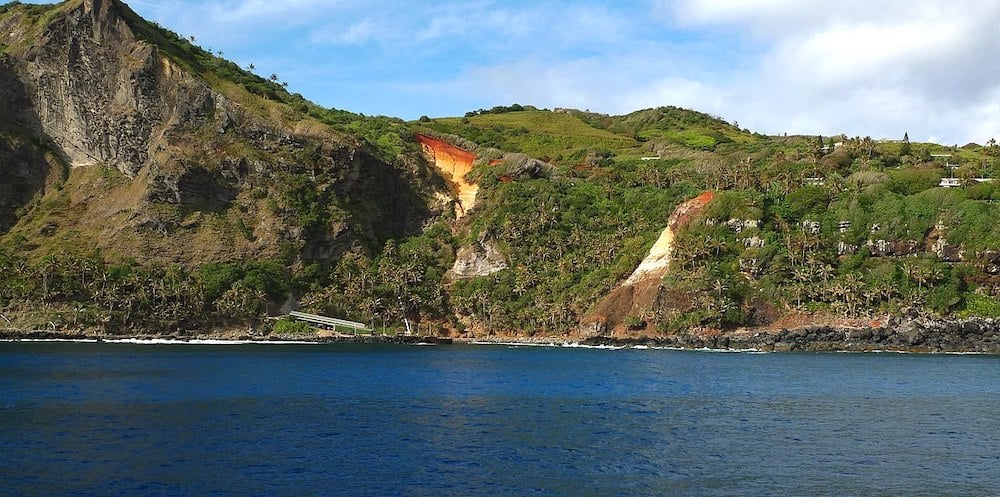
Bounty Bay – ©Henning Axt CC BY-SA 3.0 via Wikimedia Commons
It is accessible only by boat through Bounty Bay, due to the island’s steep cliffs. Henderson Island supports a rich variety of animals in its nearly inaccessible interior, is also capable of supporting a small human population despite its scarce fresh water, but access is difficult, owing to its outer shores being steep limestone cliffs covered by sharp coral. It is designated as a UNESCO World Heritage site. The other islands are at a distance of more than 100 km (62 miles) and are not habitable. Pitcairn Island has no permanent water source; however, the island has three seasonal semi-permanent springs. Pitcairn is located just south of the Tropic of Capricorn and experiences year-round warm weather.
The islands are best known for being the home of the descendants of the HMS Bounty mutineers and the Tahitians who accompanied them, an event retold in numerous books and films. This story is still apparent in the surnames of many of the islanders. It is also notable for being the least populated jurisdiction in the world (although it is not a sovereign nation). The United Nations Committee on Decolonisation includes the Pitcairn Islands on the United Nations list of Non-Self-Governing Territories.
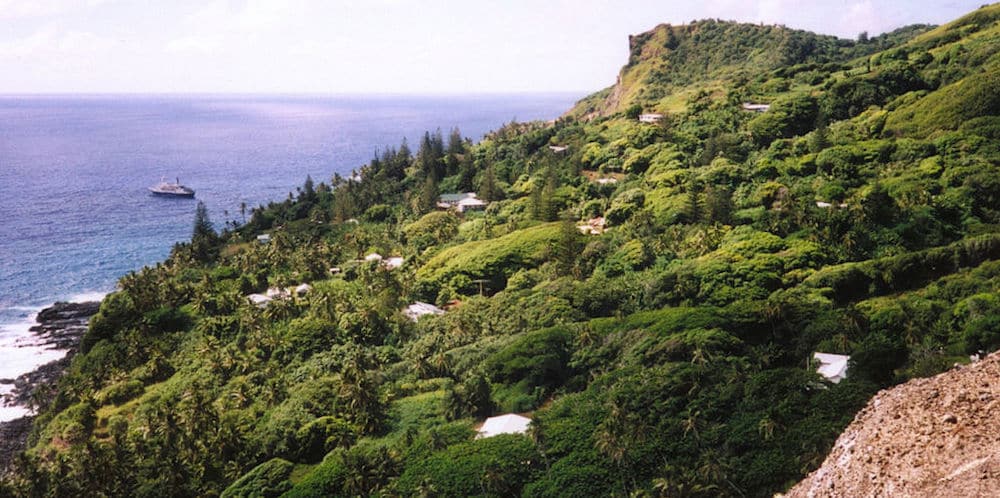
Adamstown – ©Makemake CC BY-SA 3.0 via Wikimedia Commons
Pitcairn Island is remarkably productive and its benign climate supports a wide range of tropical and temperate crops. Isaac’s Valley on the gentle slopes southeast of Adamstown, produces a wide variety of fruits, including bananas, papaya (paw paws), pineapples, mangoes, watermelons, cantaloupes, passionfruit, breadfruit, coconuts, avocados, and citrus (including mandarin oranges, grapefruit, lemons and limes). Vegetables include sweet potatoes (kumura), carrots, sweet corn, tomatoes, taro, yams, peas, and beans. Arrowroot and sugarcane are grown and harvested to produce arrowroot flour and molasses, respectively. An apiculture programme was undertaken for Pitcairn including training for Pitcairn’s beekeepers and a detailed analysis of Pitcairn’s bees and honey with particular regard to the presence or absence of disease. Pitcairn has one of the best examples of disease-free bee populations anywhere in the world and the honey produced was and remains exceptionally high in quality. Fish are plentiful in the seas around Pitcairn. Spiny lobster and a large variety of fish are caught for meals and for trading aboard passing ships.
About nine plant species are thought to be endemic to Pitcairn. These include tapau, formerly an important timber resource, and the giant nehe fern. Some, such as red berry Coprosma rapensis var. Benefica, are perilously close to extinction. The plant species Glochidion pitcairnense is endemic to Pitcairn and Henderson Islands.
Pitcairn is part of the Tuamotu tropical moist forests terrestrial ecoregion.
Birding The Pitcairns
The British government established one of the largest marine protected areas in the world around the Pitcairn Islands. The reserve covers the islands’ entire exclusive economic zone of 834,334 km2 (322,138 square miles). The intention is to protect some of the world’s most pristine ocean habitat from illegal fishing activities. A satellite ‘watchroom’ dubbed ‘Project Eyes on the Seas’ has been established by the Satellite Applications Catapult and the Pew Charitable Trusts at the Harwell Science and Innovation Campus in Harwell, Oxfordshire to monitor vessel activity and to gather the information needed to prosecute unauthorised trawling. Recently, the International Dark-Sky Association approved the Pitcairn Islands as a Dark Sky Sanctuary. The sanctuary encompasses all 4 islands in the Pitcairn Islands Group.
A small population of humpback whales migrate to the islands annually, to over-winter and breed.
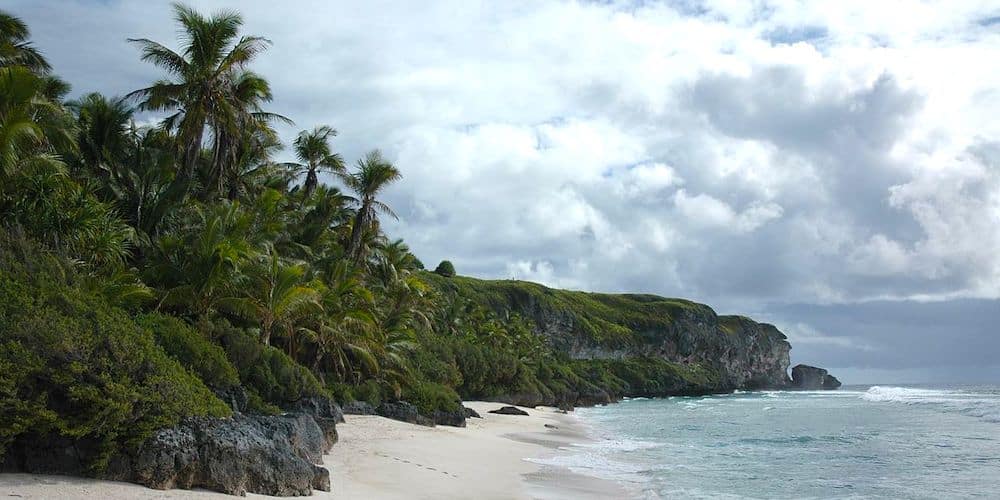
Henderson Island – ©Ron Van Oers CC BY-SA 3.0 IGO via Wikimedia Commons
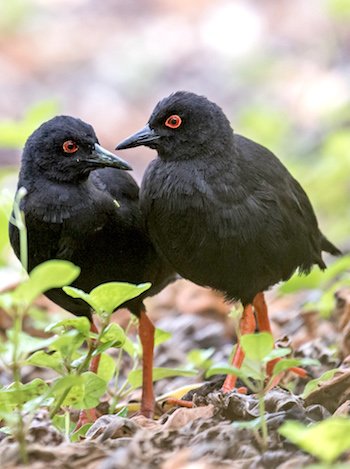
Just sixty-five species of bird have ever been recorded in the island group, but no less than five are endemic and one wide-wandering seabird breeds nowhere else. The birds of Pitcairn fall into several groups. These include mostly seabirds, and wading birds but there are a handful of resident land-bird species. Of 20 breeding species, Henderson Island has 16, including the unique flightless Henderson crake; Oeno hosts 12; Ducie 13 and Pitcairn six species. Birds breeding on Pitcairn include Fairy Tern, Common Noddy and Red-tailed Tropicbird. The Pitcairn Reed Warbler, known by Pitcairn Islanders as a ‘sparrow’, is endemic to Pitcairn Island; formerly common, it is now considered an endangered species.
The four islands have been identified by BirdLife International as separate Important Bird Areas (IBAs). Pitcairn Island is recognised because it is the only nesting site of the Pitcairn Reed Warbler. Henderson Island is important for its endemic land-birds as well as its breeding seabirds. Oeno’s ornithological significance derives principally from its Murphy’s Petrel colony. Ducie is important for its colonies of Murphy’s, Herald and Kermadec Petrels, and Christmas Shearwaters.
-
Wikipedia
GNU Free Documentation License
http://en.wikipedia.org/wiki/Pitcairn_Islands
-
Number of bird species: 65
(As at January 2025)
Number of endemics: 5
Henderson Crake Porzana atra
Henderson Fruit-dove Ptilinopus insularis
Henderson Lorikeet Vini stepheni
Henderson Reed-warbler Acrocephalus taiti
Pitcairn Reed-warbler Acrocephalus vaughaniBreeding Endemic:
Henderson Petrel Pterodroma atrata
-
Avibase
PDF ChecklistThis checklist includes all bird species found in Pitcairn , based on the best information available at this time. It is based on a wide variety of sources that I collated over many years. I am pleased to offer these checklists as a service to birdwatchers. If you find any error, please do not hesitate to report them. -
Wikipedia
Annotated ListThis is a list of the bird species recorded in the Pitcairn Islands. The avifauna of the Pitcairn Islands include a total of 65 species, of which five are endemic. -
e-Bird
PDF ChecklistThis checklist is generated with data from eBird (ebird.org), a global database of bird sightings from birders like you. If you enjoy this checklist, please consider contributing your sightings to eBird. It is 100% free to take part, and your observations will help support birders, researchers, and conservationists worldwide.

-
Birds of Eastern Polynesia: A Biogeographic Atlas
| By Jean-Claude Thibault & Alice Cibois | Lynx Edicions | 2017 | Hardback | 438 pages, 200 colour photos and illustrations, 70 b/w illustrations, 142 colour distribution maps | ISBN: 9788416728053 Buy this book from NHBS.com -
Birds of the Pitcairn Islands
| By Lars-Åke Götesson | Lars-Åke Götesson | 2013 | Paperback | 274 pages, 4 plates with 4 colour photos; 6 b/w maps | Out of ~Print | ISBN: 9789174655353 Buy this book from NHBS.com
-
Pitcairn’s Environment
WebpageThe Pitcairn Islands Marine Reserve, one of the largest on Earth, was established in March 2015 after years of collaborative efforts. Beginning in 2011, the Pew Environment Group's Global Ocean Legacy project worked with the Pitcairn islanders to create this marine sanctuary. In 2012, a National Geographic expedition assessed the health of the marine environment around the islands, discovering thriving ecosystems and new species.
-
Henderson Island
Observatory WebsiteSatellite ViewHenderson Island is an unihabitated raised reef island, 9.6 km long by 5.1 km wide with an area of 36 square km, in the Pitcairn Island group of the SE Pacific. The island's perimeter is 26.4 km; of this, 16.5 km is encircled by a fringing reef. It is 168 km ENE of Pitcairn. Henderson Island is the largest island in the Pitcairn Island group, one of the remotest groups of islands in the South Pacific, with no major land mass within a 5,000km radius. The group comprises four islands, with Henderson lying 200km east-north-east of Pitcairn, 200km east of Oeno and 360km west of Ducie. Only Ducie, and the Chilean islands of Rapa Nui (Easter Island) and Sala y Gomez lie further to the east within Polynesia. The Pitcairn group is a Dependent Territory of the United Kingdom governed by the British High Commissioner in New Zealand, and a 10 member island council of H.M.S. Bounty descendants on Pitcairn Island. Henderson Island is (British) Crown Land. -
Henderson Island IBA
InformationHenderson Island is, without question, one of the world's best remaining examples of an uplifted coral atoll. Compared to other such raised atolls, it has suffered limited disturbance. Thus, the original ecosystem is largely intact, and the number of introduced species is low. Uplift occurred via lithospheric flexure when the oceanic floor became loaded under Pitcairn Island.Satellite View
-
BirdQuest
Tour OperatorPITCAIRN & FRENCH POLYNESIA – Islands at The End of the World -
WildWings
Tour OperatorAfter hugely successful expeditions in 2014 and 2018, WildWings plans to return to some of the most rarely visited parts of the Central Pacific with an exciting voyage to some truly iconic islands as well as looking for a fantastic range of speciality seabirds.
-
2014 [10 October] - Derek Scott
PDF Report...Aswas to be expected, the friendly and inquisitive Tuamotu Sandpipers on Tenararo Atoll were voted the mostpopular bird of the trip, but the cute little Henderson Crakes on Henderson, the amazingly confidingPolynesian Ground Doves on Tenararo and the colourful Ultramarine Lorikeets on Ua Huka in theMarquesas were also much admired. Other great birds included Murphy’s, Juan Fernandez, Kermadec,Herald, Henderson, Phoenix and Tahiti Petrels, White-bellied and Polynesian Storm Petrels, Bristle-thighedCurlew, Blue and Grey Noddies, Grey-green, Atoll, White-capped and Henderson Fruit Doves, MarquesanImperial Pigeon, Pacific Long-tailed Cuckoo, Tahiti and Marquesan Swiftlets, Society and MarquesanKingfishers, Kuhl’s and Stephen’s Lorikeets, and Tahiti, Iphis and Fatu Hiva Monarchs... -
2017 [10 October] - Pete Morris & Mark Beaman
PDF Report...After a warm welcome from the islanders, we headed up hill towards Adamstown, soon finding the local ‘sparrow’ – Pitcairn Reed Warbler, the only landbird on the island. They proved to be common, most being leucistic to some extent, but endearing nevertheless... -
2018 [11 November] - Graham Talbot
PDF Report...Then one very hot day in August I was randomly surfing the web and I saw that there was still a place available on the Wildwings Wake of the Bounty Tour departing in November and thought why not its not every year they run, and time is not on my side... -
2018 [12 December] - Bill Simpson
PDF Report...I booked the In the Wake of the Bounty two week tour via Wildwings http://www.wildwings.co.uk/ as there was some uncertainty as to the trips future...