

Commonwealth of the Northern Mariana Islands
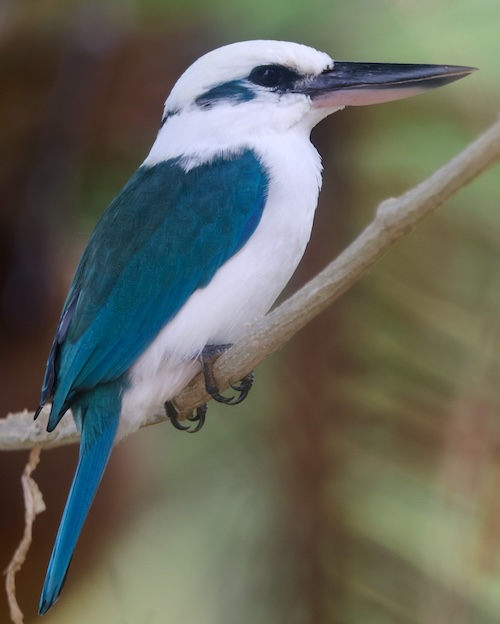
The Northern Mariana Islands is an unincorporated territory and commonwealth of the United States consisting of 14 volcanic islands in the northwestern Pacific Ocean. The CNMI includes the 14 northernmost islands in the Mariana Archipelago; the southernmost island, Guam is a US territory. The Northern Mariana Islands were listed by the United Nations as a non-self-governing territory until 1990.
The United States Department of the Interior cites a landmass of 475 km2 (183.5 Square Miles). It has a population of somewhat less than 50,000 people. The vast majority of the population resides on Saipan, Tinian, and Rota. The other islands of the Northern Marianas are sparsely inhabited; the most notable among these is Pagan, which was left largely uninhabited since a volcanic eruption. The administrative centre is Capitol Hill, a village in northwestern Saipan.
The southern islands are limestone, with level terraces and fringing coral reefs. The northern islands are volcanic, with active volcanoes on several islands, including Anatahan, Pagan, and Agrihan. The volcano on Agrihan, Mount Agrihan, has the highest elevation at 3,166 feet. The islands going from north to south comprise 14 main islands, but some smaller islands are often grouped together. Also, Zealandia Bank can sometimes be an island, depending on the tide. In terms of area, it is smaller than Guam; however, as an island chain, it spans hundreds of kilometres from the northernmost to the southernmost.
The Marianas Trench includes the deepest ocean water on the planet, along with other underwater wonders, including a pool of liquid sulphur located at Daikoku, an underwater volcano.
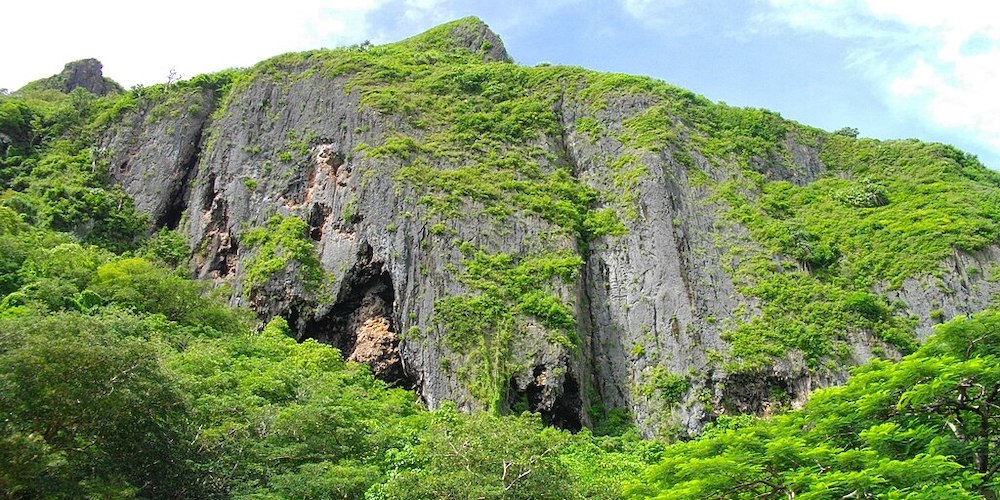
Suicide Cliff Saipan – ©Abasaa日本語: あばさ Public domain, via Wikimedia Commons
The Northern Mariana Islands have a tropical rainforest climate moderated by seasonal northeast trade winds, with little seasonal temperature variation. The dry season runs from December to June; the rainy season runs from July to November and can include typhoons. The Guinness Book of World Records has said Saipan has the most equable climate in the world.
Birding the Northern Mariana Islands
The islands of Saipan and Tinian were turned over to sugar production during Japanese colonial times (1899-1944) and most of the lowlands were converted to intensive agriculture. During the Second World War the islands were razed during the American invasion when extensive use was made of fire to clear possible cover used by the Japanese occupying forces. After the war aerial re-seeding was undertaken, but with non-native trees! That any birds survived at all is a tribute to their adaptability.
The brown tree snake, probably introduced via furniture imports from Indonesia, which has devastated native birds on Guam has been reported on Saipan, but eradication efforts are under way and numbers, if any, are still small. Non-native bird species are doing some crowding out of the pretty little fantail Rufous Fantail rhipidura rufifrons on the island of Rota.
The islands these days are a major tourist destination for Japan and hotels and other tourist attractions abound. The ecology of Guam and Saipan have suffered accordingly. Two small islets attached to Saipan are noted for birds; the appropriately named Bird Island and Forbidden Island (so named because it was, for a long period, part of a CIA training area). The Island of Farallon de Mendinilla just north of Saipan is also noted for its bird population but is not a good place to watch them because it is presently a US Naval bombing range.
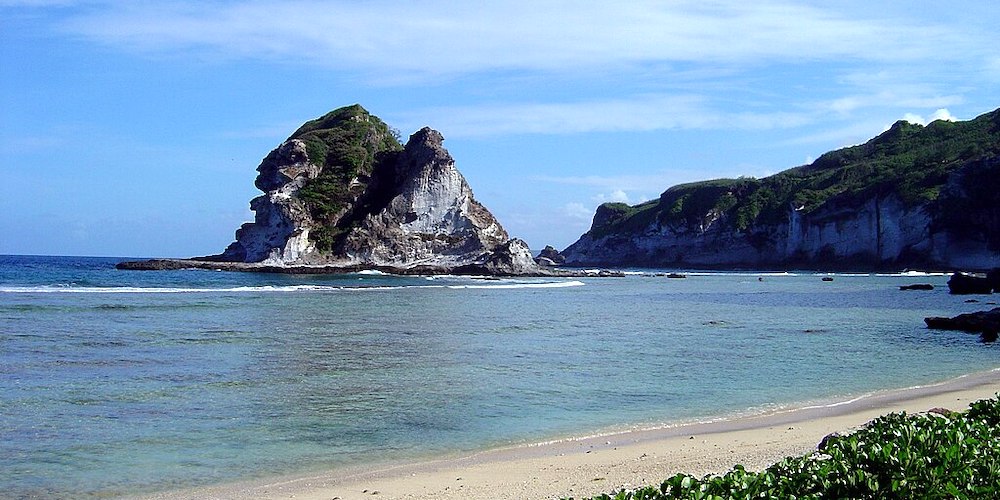
Bird Island – ©David Burdick., Public domain, via Wikimedia Commons
The official bird of the Northern Marianas Islands is the Mariana Fruit Dove and the official flower is the Plumeria. The islands are home to many tropical plants and animals, as well as around the islands marine life such as whales and dugongs. The islands are heavily forested, with about 80% ground cover consisting of tropical forests. Trees include palm, banana, pine, fern, and plumeria. There are many species of coral around the islands, many of which are ringed by coral reefs, and some islands have upwards of 60 species of coral.
There are nine known species of birds endemic to the Northern Marianas, such as the Saipan Reed Warbler and Golden White-eye, as well as a variety of invertebrates, insects, and plants. Some of examples include Langford’s Tree Snail Partula langfordi or the Tree Fern Cyathea aramaganensis.
-
Number of bird species: 79
(As at June 2026)
Number of endemics: 7(Regional)
Mariana Fruit-dove Ptilinopus roseicapilla
Tinian Monarch Metabolus takatsukasae (
Mariana Crow Corvus kubaryi
Saipan Reed-warbler Acrocephalus hiwae
Golden White-eye Cleptornis marchei
Rota White-eye Zosterops rotensis
Saipan White-eye Zosterops saypani
-
Avibase
PDF ChecklistThis checklist includes all bird species found in Northern Marianas , based on the best information available at this time. It is based on a wide variety of sources that I collated over many years. I am pleased to offer these checklists as a service to birdwatchers. If you find any error, please do not hesitate to report them. -
Wikipedia
Annotated ListThis is a list of the bird species recorded in the Northern Mariana Islands. The avifauna of the Northern Mariana Islands include a total of 180 species. -
eBird
PDF ChecklistThis checklist is generated with data from eBird (ebird.org), a global database of bird sightings from birders like you. If you enjoy this checklist, please consider contributing your sightings to eBird. It is 100% free to take part, and your observations will help support birders, researchers, and conservationists worldwide.

-
Birds of Eastern Polynesia: A Biogeographic Atlas
| By Jean-Claude Thibault & Alice Cibois | Lynx Edicions | 2017 | Hardback | 438 pages, 200 colour photos and illustrations, 70 b/w illustrations, 142 colour distribution maps | ISBN: 9788416728053 Buy this book from NHBS.com -
The Scientific Bases for Preservation of the Mariana Crow
| By National Research Council | National Academies Press (NAP) | 1997 | Paperback | 138 pages, Illustrations & tables | ISBN: 9780309055819 Buy this book from NHBS.com
-
Bird Island Observatory
Observatory WebsiteSatellite ViewBird Island Observatory is a hidden gem located in the idyllic Northern Mariana Islands, specifically on the beautiful island of Saipan. This tranquil spot is renowned for its panoramic views of the surrounding ocean and the enchanting Bird Island, which is a sanctuary for a diverse range of seabirds. As you stand at the observatory, you’ll be captivated by the vibrant hues of the crystal-clear waters and the lush greenery that frames this picturesque setting. The area is perfect for nature enthusiasts and photographers who wish to capture the stunning landscapes and unique wildlife.
-
Mariana Islands Nature Alliance (MINA)
WebsiteMINA has been consistently advancing environmental stewardship in the CNMI since 2005 with its Tasi Watch Ranger Program, marine debris removal, and a continuation of our Bring Back our Trees campaign, outreach, and education programs, and marine debris prevention with our Adopt-a-Bin program. We have another exciting project launched last spring through our Schools for Environmental Conservation program called "Community Recycles Plastic" with plastics upcycled to create products, which was highlighted at this year's Gala. -
Pacific Bird Conservation
WebpageThe MAC program started in 2004. This project is intended to provide the avifauna of the Mariana archipelago with the best possible chances for long-term survival, with the objectives of preserving, maintaining, and establishing self-sustaining populations of native birds secure from the threat of the brown tree snake. -
The Institute for Bird Populations
WebpageThe Institute for Bird Populations is a 501(c)(3) nonprofit conservation science organization founded in 1989 to study the causes of bird declines. -
The National Aviary
WebpageThe National Aviary is working in collaboration with the Commonwealth of the Northern Mariana Islands’ Division of Fish and Wildlife, the United States Fish and Wildlife Service, the nonprofit group Pacific Bird Conservation, and Association of Zoos and Aquariums (AZA) accredited zoos to address this major threat to birds through the Marianas Avifauna Conservation (MAC) project.
-
Mariana Trench National Wildlife Refuge
InformationSatellite ViewThe Mariana Trench was created geologically as the Pacific Plate plunged beneath the Philippine Sea Plate and into the Earth’s mantle and contains some of the deepest known points in the global ocean. -
Wildlife Conservation Areas
InformationSatellite ViewA number of wildlife conservation areas have been established in the CNMI through legislative act, local laws, and regulations by the Division of Fish and Wildlife, which is responsible for the management of these conservation areas and the enforcement of conservation area and wildlife related laws. Each wildlife conservation area is different in terms of conservation purpose, goals and rules, and they offer a range of opportunities for public enjoyment, including hiking and nature trails, wildlife viewing, hunting and recreation. -
l'Chenchon Park Bird Sanctuary
InformationSatellite ViewThe bird sanctuary is located on the cliffs on the east side of Rota. It is a large-scale wild bird habitat in Rota. Dozens of seabirds live here, and three of them are unique to the Northern Mariana Islands. species. The observation deck and the observation trail are built along the cliff. Standing on the observation deck at the top of the cliff, you can have a panoramic view of the blue Pacific Ocean view and lush jungle. Seabirds of all shapes and sizes nest or rest on the cliffs and tree canopies. Seabirds here are not afraid of human beings at all and fly freely by the sea breeze, which is a suitable place to watch wild birds.
-
Bird-Photo-Tours ASIA
Tour OperatorBird-Photo-Tours ASIA is the specialists in bird photography tours on the Asian and Oceanian continents with a portfolio of destinations across 40 countries including the Northern Mariana Islands. -
BirdQuest
Tour OperatorThe Forgotten Islands of the Pacific
-
2023 [04 April] - Doug Whitman
PDF ReportRare birds, coral reefs, ancient ruins, and boats: independent birding in Micronesia -
2026 [02 February] – Nick Ludovic Green | Bird-Photo-Tours ASIA
ReportThis Trip Report showcases many of the photographic portraits from our 8-day 2026 Northern Mariana Islands Bird-Photo-Tour expedition covering the municipalities of Saipan, Tinian and Rota.
-
Mariana Swiftlet Aerodramus bartschi
InformationThe Mariana swiftlet is endemic to the Northern Mariana Islands of Guam, Rota, Aguiguan, Tinian, and Saipan, but are currently found only on Guam, Aguiguan, and Saipan