

Tasmania
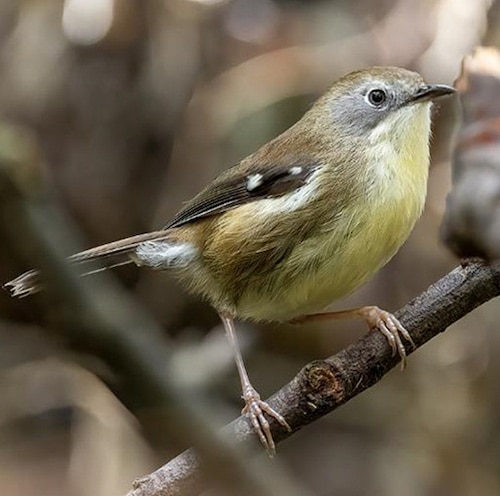
Tasmania, the smallest state of Australia, is a heart-shaped island about 290 k (180 miles) long by 305 k (190 miles) wide covering about 68,500 K² (26,500 square miles). It is located 240 kilometres (150 miles) to the south of the Australian mainland, separated from it by the Bass Strait, with the archipelago containing the southernmost point of the country. It is easily accessible by daily vehicular ferries from Melbourne, and several direct flights daily from both Sydney and Melbourne into Hobart, Launceston and the North West.
Depending on which borders of the oceans are used, the island can be said to be either surrounded by the Southern Ocean, or to have the Pacific on its east and the Indian to its west. Still other definitions of the ocean boundaries would have Tasmania with the Great Australian Bight to the west, and the Tasman Sea to the east. The state encompasses the main island of Tasmania, the 26th-largest island in the world, and the surrounding 1000 islands and islets. The largest of these are Flinders Island in the Furneaux Group of Bass Strait, King Island in the west of Bass Strait, Cape Barren Island south of Flinders Island, Bruny Island separated from Tasmania by the D’Entrecasteaux Channel, Macquarie Island 1,500 km from Tasmania, and Maria Island off the east coast.

The Neck Bruny Island – ©JJ Harrison CC BY-SA 2.5 via Wikimedia Commons
It is Australia’s least populous state, with about 575,00 residents (2023). The state capital and largest city is Hobart, with around 40 percent of the population living in the Greater Hobart area. Tasmania is the most decentralised state in Australia, with the lowest proportion of its residents living within its capital city. Tasmania has the smallest economy of the Australian states and territories, principally comprising tourism, agriculture and aquaculture and is a significant agricultural exporter, as well as a significant destination for eco-tourism. Over 40% of its land area, including national parks and World Heritage Sites (20%) is protected in some form of reserve. The first environmental political party in the world was founded in Tasmania.
The most mountainous region is the Central Highlands area, which covers most of the central western parts of the state. The Midlands located in the central east, is fairly flat, and is predominantly used for agriculture, although farming activity is scattered throughout the state. Tasmania’s tallest mountain, Mount Ossa is over 5,000 feet. Much of Tasmania is still densely forested, with the Southwest National Park and neighbouring areas holding some of the last temperate rain forests in the Southern Hemisphere. The Tarkine, containing Savage River National Park located in the island’s far north west, is the largest temperate rainforest area in Australia covering about 3,800 square kilometres (1,500 square miles). With its rugged topography, Tasmania has a great many rivers and waterfalls. Several of the largest rivers have been dammed at some point to provide hydroelectricity. Many rivers begin in the Central Highlands and flow out to the coast. Tasmania’s major population centres are mainly situated around estuaries.
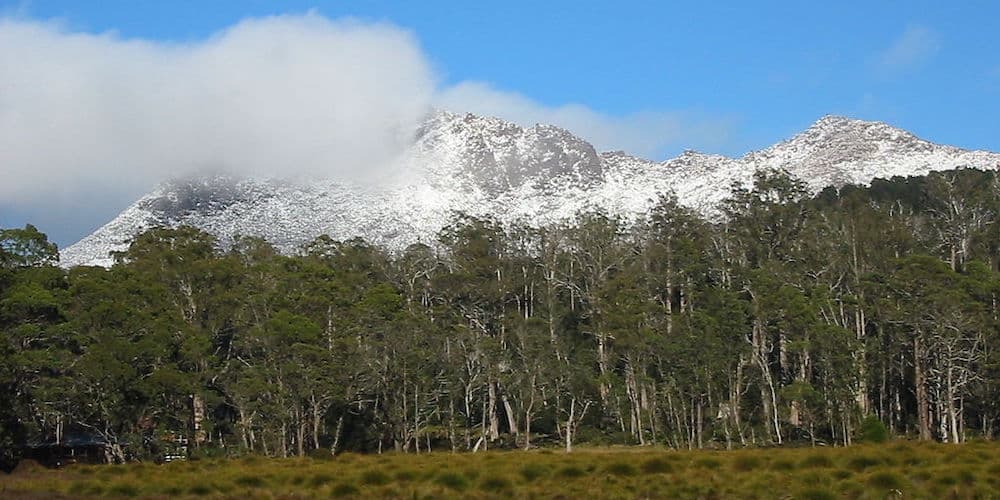
Mount Ossa – ©Humphrey Murray CC BY-SA 2.5 via Wikimedia Commons
Tasmania has a relatively cool temperate climate compared to the rest of Australia, experiencing four distinct seasons. Summer is from December to February when the average maximum sea temperature is 21 °C and inland areas reach 24 °C. or much cooler, ranging between 4 °C and 17 °C in February. Autumn is from March to May, with mostly settled weather, as summer patterns gradually take on the shape of winter patterns. The winter months are from June to August and are generally the wettest and coldest months in the state, with most high lying areas receiving considerable snowfall. Winter maximums are 12 °C on average along coastal areas and 3 °C on the central plateau, as a result of a series of cold fronts from the Southern Ocean. Inland areas receive regular freezes throughout the winter months. Spring is from September to November, and is an unsettled season of transition, although snowfall is still common up until October. Spring is generally the windiest time of the year with afternoon sea breezes starting to take effect on the coast.
Many plant species are unique to Tasmania, and some are related to species in South America and New Zealand through ancestors which grew on the supercontinent of Gondwana, 50 million years ago. Tasmania has a large percentage of endemism whilst featuring many types of animals found on mainland Australia. Many of these species, such as the platypus, are larger than their mainland relatives.
Birding Tasmania
There are birds to greet you when you step from the aircraft – parrots flash among flowering eucalypts in the airport precincts, and ten minutes after leaving Hobart Airport you could have seen about half of the endemic birds. Tasmania is a hotspot for giant habitat trees and the large animal species that occupy them, notably the endangered Tasmanian Wedge-tailed Eagle Aquila audax fleayi and the Tasmanian Masked Owl Tyto novaehollandiae castanops. is also home to the world’s only three migratory parrots, the critically endangered Orange-bellied Parrot Neophema chrysogaster, the Blue-winged Parrot Neophema chrysostoma, and the fastest parrot in the world, the Swift Parrot Lathamus discolor.
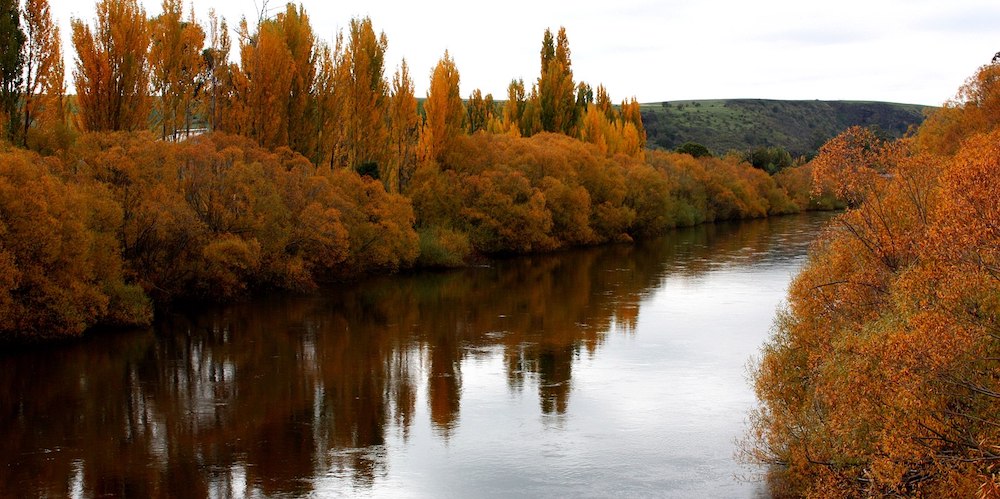
Tasmania in Autumn – ©Just Emi CC BY-SA 2.0 via Wikimedia Commons
There are 12 endemic species of bird in total, fourteen if you include the migratory parrots which breed only in Tasmania, and several subspecies are among over 230 species which have been recorded in the state. is also home to the world’s only three migratory parrots, the critically endangered Orange-bellied Parrot Neophema chrysogaster, the Blue-winged Parrot Neophema chrysostoma, and the fastest parrot in the world, the Swift Parrot Lathamus discolor. Tasmania has 12 endemic species of bird in total. There are about 90 endangered, vulnerable, or threatened vertebrate species Tasmania has the worst (per kilometre) roadkill rate in the world, with 32 animals killed per hour and at least 300,000 per year.
If you stay overnight in country accommodation you will be woken by bird song, and birds may be the first thing you see when you look through your window – honeyeaters in the garden shrubs, Grey Fantails and Scarlet Robins watching for insects at the forest edge, a family of Superb Fairy-wrens hopping across the lawn. Tasmania is a small island but because of its hilly terrain and indented coastline, it has a range of habitats not found in many larger regions. Some of the best birding spots are set out below.
-
Bridport/Waterhouse
Satellite ViewBridport/Waterhouse is on the Northeast coast. The mild climate here encourages over-wintering by some of the migratory species, so even in winter you might see Welcome Swallows, Fan-tailed Cuckoos, Black-faced Cuckoo Shrikes and on the beaches and sandspit, Red-necked Stints along with the resident shorebirds. Between Bridport and Waterhouse Point the improved pastures provide for many species such as Egrets, Australasian Shelduck, Masked and Banded Lapwings, Pipits and raptors. The dune-locked lakes hold Black Swans, Grebes, most species of duck, Black-fronted Dotterels, Tasmanian Native Hens etc. and a good chance of spotting an Australasian Bittern. The coastal heathland of Waterhouse Protected Area is a stronghold of the Tawny-crowned Honeyeater and many other species. -
Bruny Island
Satellite ViewBruny Island is off the South East coast and accessible by vehicular ferry several times a day; it has all 12 endemic species, plus a penguin viewing area. There is plenty of variety in accommodation, and you'll probably want more than a day to spend on this lovely island, which has the biggest population of our rarest endemic, Forty- spotted Pardalote, in the drier Northern half. -
Melaleuca/Port Davey
Satellite ViewMelaleuca/Port Davey is difficult to get to but worth every dollar and day waiting for the right weather for the flight in by light aircraft. The heart of the true wilderness of Tasmania's South West and home to the tin-mining King family for many years (read King of the Wilderness by Christobel Mattingley for the fascinating story); it is now a vital part of the Orange-bellied Parrot Recovery Plan. The only place you are likely to see these beautiful little parrots (but only in summer and early autumn) is at the feeding station and observation area set up at Melaleuca. The Beautiful Firetail, our only native finch, will probably show up for a snack too. Even if you don't see the parrots, the flight over the mountains or along the coastline is magnificent. -
Narawntapu National Park
WebsiteSatellite ViewNarawntapu National Park is a coastal park between Launceston and Devonport in the North. Much of it was previously farmed and it now has the most extensive bird checklist of any Tasmanian National Park. There is a good bird hide on the lagoon - I used it three times in one morning and saw several new birds on each visit. Narawntapu also has a huge population of marsupials including Tasmanian Devils. -
Tasman Peninsula
Satellite ViewTasman Peninsula is part of the Southeast best known for the Port Arthur Historic Site. Lots of accommodation, and things to see and do. All 12 endemics are recorded here, and it is a favourite place for pelagic bird trips, being near to the continental shelf. The eastern half, most of which is in the Tasman National Park, has wet forest with rainforest gullies (Pink Robins, and Tasmanian Scrubwrens) and spectacular sea cliffs (Wedge-tailed and White-bellied Sea Eagles, Peregrine Falcon, etc.). In the Northwest of the Peninsula a special place is the Coal Mines/Lime Bay State Reserve. Birds abound among little-known convict era ruins, and nearby an ephemeral lagoon can provide thrills for birders. The Peninsula is the best area in the state for year-round hiking, and has superb, often deserted beaches on all coasts.
-
Number of bird species: 282
182 of which are regularly recorded, while another 79 are vagrants and one is extinct. Unofficial State Bird: Yellow Wattlebird Anthochaera paradox
Number of endemics: 15
Tasmanian Native-hen Tribinix mortierii
Tasmanian Wedge-tailed Eagle Aquila fleayi
Tasmanian Boobook Ninox leucopsis
Tasmanian Masked-Owl Tyto castanops
Green Rosella Platycercus caledonicus
Dusky Robin Melanodryas vittata
Tasmanian Thornbill Acanthiza ewingii
Scrubtit Acanthornis magnus
Tasmanian Scrubwren Sericornis humilis
Yellow Wattlebird Anthochaera paradoxa
Yellow-throated Honeyeater Lichenostomus flavicollis
Black-headed Honeyeater Melithreptus affinis
Strong-billed Honeyeater Melithreptus validirostris
Black Currawong Strepera fuliginosa
Forty-spotted Pardalote Pardalotus quadragintus

-
Australian Good Birding Guide: Tasmania
| By Ted & Alex Wnorowski | Port Campbell Press | 2017 | Paperback | 220 pages, colour photos, colour maps | ISBN: 9780648010463 Buy this book from NHBS.com -
Field Guide to Tasmanian Birds
| By Dave Watts| New Holland Publishers | 2003 | Paperback | 192 pages, 170 colour photos, colour distribution maps | ISBN: 9781876334604 Buy this book from NHBS.com -
The Feathered Tribes of Van Diemen's Land
| By Sarah Lloyd | Tympanocryptis Press | 2015 | Paperback | 104 pages, colour photos, b/w illustrations | Out of Print | ISBN: 9780646944142 Buy this book from NHBS.com
-
Nature-based Tourism
http://www.parks.tas.gov.au/ This information is of potential value to Tasmanian tourism operators in tailoring their activities and services towards satisfying visitors' requirements for participating in nature-based tourism and in more effectively marketing this type of travel product
-
Bruny Island Bird Festival
WebsiteThe Bruny Island Bird Festival: Bringing together Science, Conservation, Community and Creativity to create three days of enjoyment and education about the birdlife of this wonderful island.
-
Tasmainia University
WebpageEnvironmental science -
Tasmania Museum
WebpageThe Zoology Unit is responsible for the development, maintenance and management of the Tasmanian Museum and Art Gallery’s (TMAG’s) zoological collections. The collections represent over 150 years of museum acquisitions, and include many specimens of great scientific and historical importance. They are housed in a dedicated facility at Rosny, and comprise at least 150,000 specimens.
-
BirdLife Australia
WebpageTasmania and its numerous offshore islands cover an area of about 6,723,000 hectares. Because of the island’s topography, vegetation communities (including buttongrass moorlands, wet and dry eucalypt forests, myrtle beech rainforests and coastal heathlands) can change over small distances. Forests still cover approximately 47% of the island; 25% is included in the Tasmanian Wilderness World Heritage area and there are approximately 3000 kilometres of coastline. -
Burnie Field Naturalists
Facebook PageP. O. Box 455, Burnie, Tasmania - @BurnieFieldNats - Call 64421253 -
North West Bird Club
WebsiteThe North West Bird Club was established in 1972 in our home Town of Wynyard in Tasmania Australia. Club meetings are held on the second Friday during the month of September through to May and we do not meet during the months of June, July and August each year… -
Tasmanian Conservation Trust
WebsiteThe Tasmanian Conservation Trust is a voluntary organisation working on conservation issues, especially those that directly affect Tasmania. The TCT was formed in 1968 and aims to foster and assist in the conservation of flora, fauna and important natural, archaeological and cultural features…
-
CA Tamar River
InformationSatellite ViewThe Tamar River Conservation Area stretches through the upper part of the Tamar Estuary from St Leonards to the Batman Bridge. The Interpretation Centre and the boardwalk leading to Tamar Island are just a ten minute drive north from the centre of Launceston on the West Tamar Highway, just north of Riverside… -
GR Moulting Lagoon IBA
WebpageSatellite ViewMoulting Lagoon and the Apsley Marshes – at the head of Great Oyster Bay, near the base of the Freycinet Peninsula, between the towns of Swansea and Bicheno. Both components of the site are listed separately under the Ramsar Convention as wetlands of international significance. Moulting Lagoon is so named because it is a traditional moulting place for black swans. It is an important site for waterbirds. -
Inverawe Native Gardens & Nature Trails
WebsiteSatellite ViewIf bird watching is your brief, Inverawe is the place to be. Grab the binoculars, slip the field guide into your pocket and hurry on down for some real bird watching. 84 species of birds have been spotted at Inverawe… -
NP Douglas-Apsley
WebpageSatellite ViewFrom its deep river gorges and waterfalls to its dolerite capped plateau; from dry eucalypt forest and colourful heathlands to pockets of rainforest, Douglas-Apsley National Park is a place of surprising contrasts. This park is one of the few that conserve the diverse wealth of dry sclerophyll forest plants found on the east coast of Tasmania. -
NP Mt William
WebpageSatellite ViewFrom its long, lonely beaches to its teeming wildlife; from its unique history to its abundant plant life, Mt William National Park is a place of constant fascination. Nestled in the far north-east corner of the State, the park is an important area for the conservation of Tasmania's coastal heathlands and dry sclerophyll plants. -
NP Narawntapu
InformationSatellite ViewNarawntapu National Park (formerly known as Asbestos Range National Park) is a place of peace for people and wildlife alike. It stretches from the low coastal ranges to the long Bass Strait beaches, and includes an historic farm, a complex of inlets, small islands, headlands, wetlands, dunes and lagoons, all with an amazing variety of plants and animals. -
NP South Bruny
InformationSatellite ViewSouth Bruny National Park lies at the southern tip of Bruny Island off the southeast coast of Tasmania. The park encompasses all of the coastline and some of the hinterland between Fluted Cape and the southern part of Great Taylors Bay. -
NP Strzelecki
WebpageSatellite ViewStrzelecki National Park covers 4216 hectares in the south-western corner of Flinders Island. Flinders is the main island in the Furneaux Group, a group of 54 islands in Bass Strait off the north-east coast of mainland Tasmania. -
NR Tom Gibson
Facebook PageSatellite ViewThe reserve is important because the type of dry forest and woodland found in the Midlands has mostly been cleared and of the remainder, hardly any is reserved. The block has been identified by botanists as having high conservation significance because there are many rare, threatened and previously unreserved (not known in any State Reserve) plant species on the block. Some of these plants are listed below. The area is also known to be important for the Tasmanian bettong, a species which is confined to the drier forests of the east of Tasmania. -
SR Notley Fern Gorge
InformationSatellite ViewThe pristine forest of the reserve is similar to that which faced the early settlers of the West Tamar. About a century ago the Notley forest provided timber for boatbuilding at Rosevears (on the Tamar River) and hiding places for bushrangers… -
Tasmania National Parks
InformationSatellite ViewTasmania's outstanding national park system offers visitors a wide choice of opportunities to discover spectacular landscapes, from highlands carved by glaciers to quiet, solitary beaches; from cool, silent rainforests to colourful, alpine wilderness wildflowers. Tasmania's 19 national parks encompass a diversity of unspoiled habitats and ecosystems which offer refuge to unique, and often ancient, plants and animals found nowhere else on Earth.
-
Australian Ornithological Services
GuidePhilip Maher was born in Deniliquin, in south-western New South Wales in 1954. His interest in natural history was fostered by his parents from a young age. While Philip is an authority on Australian birds generally, his name is synonymous with the Plains-wanderer, a bird of the open plains in inland Australia. In 1980 Philip was with a party of local birders when they came across the Plains-wanderer. He went on to study the species extensively, banding about 600 birds and has shown the species to great numbers of Australian, American and European birders -
Inala Nature Tours
Tour Operator & Guide…a family owned and operated company that specializes in designing and organizing personalized wildlife tours for groups such as birdwatchers and nature enthusiasts…
-
2014 [11 November] - John Coons
ReportDuring our three weeks in Australia we found loads of birds in the Top End, forests of northern Queensland, Atherton Tableland, inland deserts, mountain rainforests, and Tasmania. Birds and mammals performed well, and we saw many of the legendary creatures for which Australia is well known.... -
2015 [10 October] - Andy Walker
PDF ReportThis tour commenced on 24th October 2015 in Hobart, Tasmania, and then continued through Victoria, southern New South Wales, and Queensland, where the tour concluded in Cairns on 14th November 2015. -
2015 [10 October] - Dr Andrew Hingston
PDF ReportWe were collected fromLaunceston airport at 14:20, and transported to ouraccommodation at Mountain Valley WildernessLodge. This included a stop to watch a ShortbeakedEchidna digging for food. After arriving atMountain Valley Wilderness Lodge, we saw ourfirst Common Wombats and TasmanianPademelons. After dark, we enjoyed seeingTasmanian Devils, Spotted-tail Quolls andCommon Brushtail Possums outside our rooms. -
2016 [02 February] - Philip Maher
ReportAs it turned out, we had a fantastic trip and saw most of the birds and mammals with some memorable highlights. This year we saw our first Tasmanian devil in three years, hopefully a positive sign. We also saw our first swift parrots in three years. -
2017 [02 February] - Philip Maher - Tasmanian bird and mammal tour
Report...After breakfast at the Old Wool Store in Hobart, we headed for Mount Wellington but en route pulled up in an area of bush that adjoins some houses in the outer suburbs. This spot often has a nice lot of birds and that again proved to be the case. Some species here included our first yellow wattlebirds, black-headed and yellow-throated honeyeaters, eastern spinebill, dusky robin, spotted and striated pardalotes, brown thornbill, green rosella and a pair of satin flycatchers on a nest. The dusky robins surprised me as I had not seen them here before. We were off to a great start!... -
2018 [02 February] - Ian Merrill
PDF ReportOur trip was hugely successful in achieving the above goals, recording all endemic birds, of which personal highlights included Tasmanian Nativehen, Green Rosella, Tasmanian Boobook, four endemic honeyeaters and Forty-spotted Pardalote. -
2018 [10 October] - Chris Lotz
PDF ReportThis short Tasmania group tour commenced in the state capital Hobart and concluded back there. The tour focused on finding the state’s endemic birds as well as two breeding endemic species (both Critically Endangered [IUCN] parrots), and the tour is a great way to get accustomed to Australian birds and birding ahead of the longer East Coast tour. -
2018 [10 October] - Steve Davidson - East Coast & Tasmania
PDF ReportMaking the ferry crossing to Bruny Island in good time, the first bird we saw upon disembarking was Swift Parrot; in fact, they were seemingly everywhere in the huge flowering Blue Gums there, and in teeming rain we enjoyed our first views of this critically endangered species, a spring-summer migrant to Tas. -
2023 [10 October] - Andrew Walker
PDF ReportWe recorded 96 bird species on this short Tasmanian birdwatching tour, (two of these were heard only). Some of the tour highlights seen included some of the best birds in Tasmania, including Musk Duck, Tasmanian Nativehen, Hooded Dotterel, Pacific Gull, Short-tailed Shearwater (thousands!), Black-faced Cormorant, Yellow-tailed Black Cockatoo, Green Rosella, Swift Parrot, Orange-bellied Parrot, Superb Fairywren, Southern Emu-wren, Yellow-throated Honeyeater, Strong-billed Honeyeater, Black-headed Honeyeater, Yellow Wattlebird, Fortyspotted Pardalote, Scrubtit, Striated Fieldwren, Black Currawong, Olive Whistler, Australian Golden Whistler, Satin Flycatcher, Forest Raven, Dusky Robin, Pink Robin, Flame Robin, Scarlet Robin, and Beautiful Firetail. -
2024 [10 October] - Chris Lotz
PDF ReportWe enjoyed great views of both Critically Endangered Tasmanian breeding endemic parrots (Orange-bellied and Swift Parrots), all the Tasmanian endemic birds except for Tasmanian Boobook, but including the Endangered Forty-spotted Pardalote, a number of species which are relatively easy to find in Tasmania, such as Pink Robin, Crescent Honeyeater, Southern Emu-wren, Beautiful Firetail, Hooded Plover (Dotterel), and great mammals, such as the weird Tasmanian form of Short-beaked Echidna (an egg-laying mammal!), beautifully spotted Eastern Quoll, a lot of Red-necked Wallabies (the Tasmanian endemic subspecies, known as Bennett’s Wallaby) and various others.
-
Currawong Lakes Retreat
WebsiteFor the passionate and motivated Birding enthusiast, Currawong Lakes contains a rich and diverse number of biotic environments both aquatic and arboreal and boasts being home to over 90 species of birds… -
Inala - Bruny Accommodation
AccommodationNestled in tall eucalypt forest on our 500 acre private reserve at the foot of the South Bruny Ranges on Bruny Island our guests have a choice of a three bedroom cottage (Inala cottage) or a one bedroom spa unit (Nairana cottage).… -
Tasmania Mountain Valley Wilderness
WebsiteHidden in the lost valley of Loongana amongst the mountains of North West Tasmania. Mountain Valley an eco retreat on a 'Private Nature Reserve', with six cosy log cabins nestled under the majestic presence of Black Bluff Mt ideal for those interested in hiking, flora and unique wildlife experiences. Guided platypus, glow worm grotto, cave or forest habitat tours. There are deep river gorges, cool fern glades, ancient rainforests, glacial lakes, mountain peaks and cascading waterfalls - all easy to explore. We suggest you take a few days to explore this lost valley
-
Tasmania's Endemics
WebsiteA list with photos and info about the endemics of the Island -
Tasmanian Native Hen
WebsiteA large, heavy bodied, flightless bird found only in Tasmania. It is similar in shape to the Black-tailed Native-hen Tribonyx ventralia but is larger. The Tasmanian Native-hen has a large yellow bill, a red eye, brown head, back and wings and is slate grey on its underparts -
Tasmanian Penguins
WebpageLittle Penguins, also known as Fairy or Blue Penguins, are a feature of Australia’s southern coastline and marine parks. At about 35 cm tall and weighing less than a kilo and a half, these Little Penguins are the smallest penguin species in the world. These little guys are also the only penguin species to breed in Australia.