

Northern Territory
The Northern Territory (abbreviated as NT) is a federal Australian territory in the central and central northern regions of Australia. It shares borders with Western Australia to the west, South Australia to the south and Queensland to the east. To the north, the territory is bordered by the Timor Sea, the Arafura Sea and the Gulf of Carpentaria. Despite its large area, more than half a million square miles making it the third largest Australian federal division, it is sparsely populated. The Northern Territory’s population of around a quarter of a million people makes it the least populous of Australia’s eight states and territories, having fewer than half as many people as Tasmania. The capital and largest city is Darwin.
Generally, the population is concentrated in coastal regions and along the Stuart Highway. There are many very small settlements scattered across the territory, but the larger population centres are located on the single paved road that links Darwin to southern Australia, via Alice Springs, the Stuart Highway, known to locals simply as ‘the track’. In the northern part of the Territory lies Kakadu National Park, which features breathtaking wetlands and native wildlife.
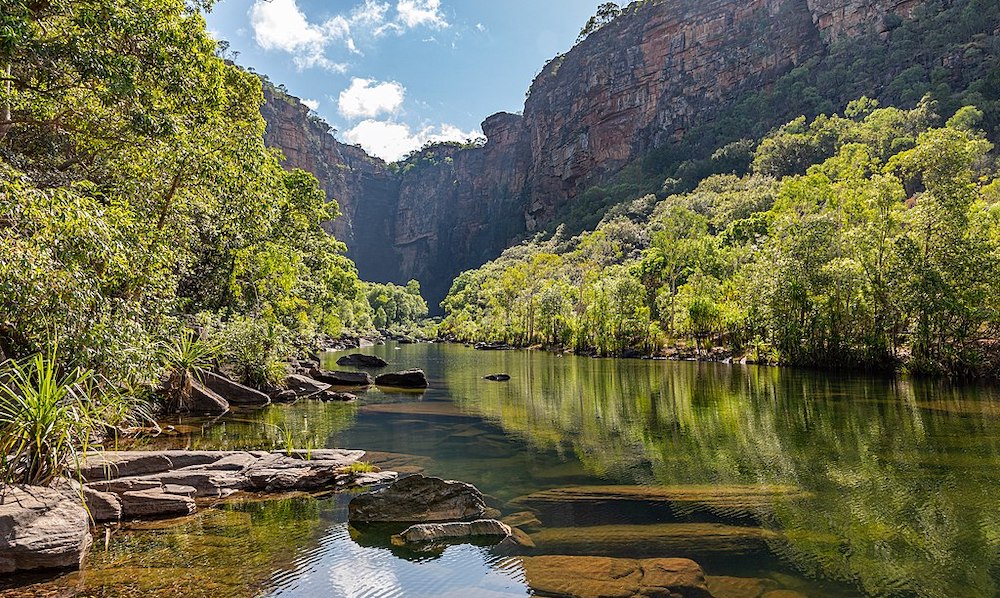
Jim Jim Creek, Kakadu National Park – ©Dietmar Rabich CC BY-SA 4.0 via Wikimedia Commons
To the north of that lies the Arafura Sea, and to the east lies Arnhem Land, whose regional centre is Maningrida on the Liverpool River delta. There is an extensive series of river systems in the Northern Territory. These rivers include: the Alligator Rivers, Daly River, Finke River, McArthur River, Roper River, Todd River and Victoria River. The Northern Territory is also home to two spectacular natural rock formations, Uluru (Ayers Rock) and Kata Tjuta (The Olgas), which are sacred to the local Aboriginal peoples and which have become major tourist attractions.
Birding The Northern Territory
Darwin, the capital of the Northern Territory situated on the coast of mid-northern Australia, has much to offer the visiting birdwatcher. To give an example my yard list is 140 species, and the sewage pond twice that. The best time to come is May to October/November. May to September is the dry season; sunny and cool with low humidity in the Top End (excellent birding conditions) and can drop below freezing at night in the Red Centre. October & November are the hottest, most humid times of the year so be prepared! Northwest Australia is renowned for mangrove birds (and reputed to have the highest diversity of specialised mangrove birds in the world). Among them are Chestnut Rail, a chicken-sized, very shy bird, the engaging but often hard-to-spot Mangrove Grey Fantail, and the tiny Mangrove Gerygone, a member of an ancient Australian family. Chestnut Rail can be a very difficult bird to see. However, it can be found within three kilometres of the CBD, at the Stuart Park mangroves. Remember that mangroves, and all water bodies around Darwin and northern Australia pose real risks of Saltwatwer crocodile (100,000 in NT) as well as biting insects. So cover up and stay away from the water’s edge and seek local knowledge first.
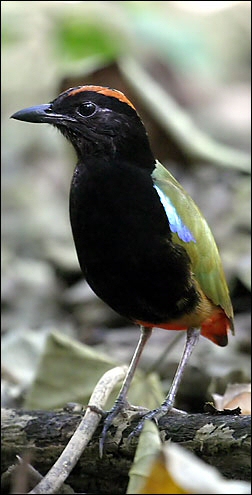
Then there are monsoon forest birds e.g. Orange-footed Scrubfowl, Rose-crowned Fruit-dove, Emerald Dove, Rainbow Pitta, Little Shrike-thrush, Green-backed and Large-billed Gerygone. Many of these species are also found in mangroves. However, in the wet season, October-April (with rains setting in around December to March) some disperse into open forest. Most songbirds breed at the beginning and end of the wet season. Others like Rainbow Pitta (the only suboscine in the Top End) mostly breed in the first half. This species begins calling about September (again depending on weather) and have mostly ceased by February. Wetlands are also found around Darwin. This habitat changes amazingly with the seasons. Grasslands during the dry they become densely-vegetated floodplains during the wet season with grasses up to three metres high. In the dry season these areas are inhabitated by few birds, namely Magpie-lark, Brown Quail, and Singing Bushlark (and perhaps one of our two cisticola species depending on the dryness of the area).
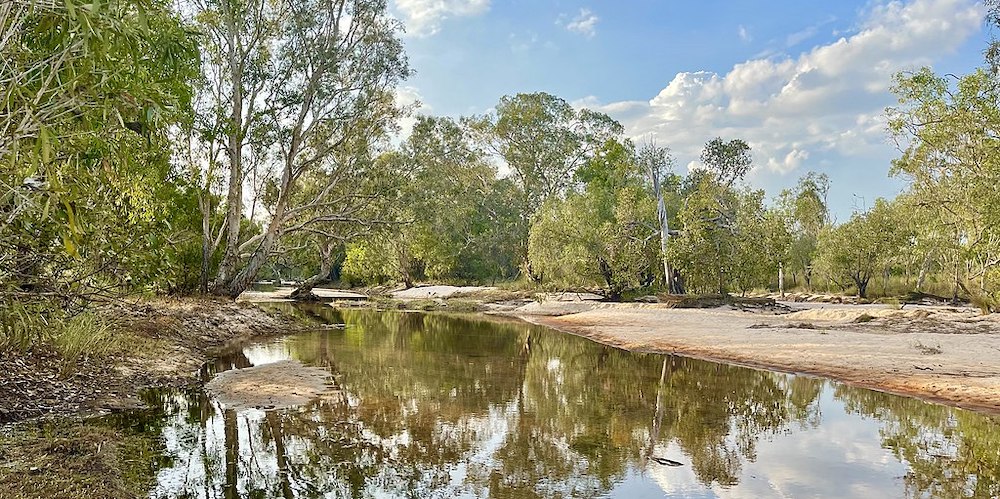
Magela Creek – ©Kgbo CC BY-SA 4.0 via Wikimedia Commons
At the beginning of the wet season at Holmes Jungle, just twelve or so kilometres from the CBD, Brolga gather in their hundreds, along with Magpie Geese, strange pied birds that are probably most closely related to the Southern Screamer of South America, and around mid-September, Little Curlew gather to feed in the mud and still-short grass. As the wet season progresses and the vegetation continues to grow the careful viewer may see White-browed Crakes feeding among the sedges, and Tawny Grassbird or Red-backed Button-quail among the rank grass on the water’s edge. Another reason for spending time in Darwin is that many birds hard to see out of town are easily spotted in parks and gardens here, among them Yellow Oriole and Figbird and Brown, Dusky, White-gaped, Red-headed and Rufous-banded honeyeaters.
This page is sponsored by NT Birding Specialists

-
Botanic Gardens
InformationSatellite ViewThe Botanic gardens in the Darwin municipality are a great place for roosting owls and common passerines. -
Fogg Dam
WebsiteSatellite ViewFogg Dam seventy kilometres from Darwin is great spot for birds. Here the juxtaposition of monsoon, paperbark and open forest and floodplains makes for a great mix of species. Waterbirds abound but so do raptors and many passerines… Black-necked Stork, Pied Heron, Royal Spoonbill, egrets, Comb-crested Jacana et al… -
Howard Springs Nature Park
InformationSatellite ViewHoward Springs Nature Park is 35 kilometres south of Darwin and brilliant for butterflies and birds. It is the haunt of Rainbow Pitta at the right time of year and is great for Shining Flycatchers, White-winged Triller, Black Butcherbird and Northern Fantails etc. but is also greatly favoured by some of the most predatory mossies I've ever encountered! [Fatbirder] -
Judbarra/Gregory National Park
InformationSatellite ViewGregory National Park and the surrounding area, 500 kms southwest of Darwin, is possible site for nomadic Grey Falcons, and the Victoria River (in the same area) the most accessible site for Purple-crowned Fairy-wren… -
Marrakai Track
InformationSatellite ViewMarraki Track which is a dirt road going many kilometres into the bush and eventually fording [in the dry season] the Adelaide River. It is great for finches, gerygones, Rufous-banded Honeyeater, Grey-crowned Babbler, White-bellied Cuckooshrike, Partidge Pigeon, Varied Lorikeet and Northern Rosellas. Of particular interest is Red-backed Kingfisher. -
Palmerston Sewage Works
InformationSatellite ViewThis can be a great place for water birds but it is spasmodic even in very dry times. The surrounding scrub can be alive with finches, wrens, cuckoos etc. and the sky is often filled with hirundines. However, it is no longer accessible. It is possible to walk around the outside of the ponds, but take care as you will be walking along uneven ground and through high grass. -
Pine Creek
InformationSatellite ViewThe Pine Creek area (200 kms south of Darwin) is a great area in which to see a mix of birds, including Partridge Pigeon, Hooded Parrot and Gouldian Finch. The Fountainhead-Pine Creek area is also good for diurnal birds of prey in the dry season - including Black-breasted Buzzard & Square-tailed Kite…
-
Number of bird species: 448
State Bird - Wedge-tailed Eagle Aquila audax
Number of endemics: 5
Hooded Parrot Psephotus dissimilis
Chestnut-quilled Rock-Pigeon Petrophassa rufipennis
Banded Fruit-Dove Ptilinopus cinctus
White-throated Grasswren Amytornis woodwardi
White-lined Honeteater Meliphaga abilineata
Helmeted Friarbird Philemon buseroides ammitophila
Helmeted Friarbird Philemon buseroides gordoni (Some authorities regard these endemic races as a a different species)

-
Birds & Animals of Australia's Top End:
| (Darwin, Kakadu, Katherine, and Kununurra) | by Nick Leseberg & Iain Campbell | Wildguides | 2015 | Paperback | 272 Pages | 400 Colour Photographs | 2 Colour Maps | ISBN: 9780691161464 Buy this book from NHBS.com -
Birds of Australia's Top End
| By Denise Goodfellow | New Holland Publishers | 2005 | Paperback | 159 pages, Colour illustrations, b/w illustrations, maps | Out of Print | ISBN: 9781877069192 Buy this book from NHBS.com -
Birds of Australia's Top End
| By Denise Lawungkur Goodfellow | Scrubfowl Press | 2001 | Paperback | 159 pages, colour plates, b/w photos, illustrations, distribution maps | Out of Print | ISBN: 9780957884908 Buy this book from NHBS.com -
Birds of Palmerston in Australia's Top End
| By Denise Lawungkurr Goodfellow | Scrubfowl Press | 2012 | Paperback | 52 pages, 80 colour & 27 b/w illustrations | ISBN: 9780957884922 Buy this book from NHBS.com -
Birds of the Darwin Area
| By Niven McCrie And Richard Noske | CSIRO Publishing | 464 pages | 2015 | Paperback | 454 pages, colour photos, colour illustrations, colour distribution maps | Out of Print | ISBN: 9781486300341 Buy this book from NHBS.com -
Finding Birds in Australia's Northern Territory
| By D Donato, P Wilkins, G Smith & L Alford | CSIRO | 1997 | Paperback | 192 pages, Colour Phots, Tables, maps | Out of Print | ISBN: 9780643062580 Buy this book from NHBS.com -
Finding Birds in Darwin, Kakadu and the Top End:
| (Northern Territory Australia) | By Niven McCrie & James Watson | NT Birding (Niven McCrie) | 2006 | Spiralbound | 160 pages, tabs, maps | Out of Print | ISBN: 9780646460413 Buy this book from NHBS.com -
The Birds of Groote Eylandt
| By Richard A Noske & Graham P. Brennan | Northern Territory University Press | 2002 | Paperback | 187 pages, Colour & b/w photos, maps | Out of Print | ISBN: 9781876248680 Buy this book from NHBS.com
Field Guide to Northern Territory Fauna
Apple iOS |Explore the Northern Territory's unique and diverse wildlife at home or in the great outdoors with the Museum & Art Gallery of the Northern Territory's Field Guide app. The app combines detailed animal descriptions with stunning imagery and sounds to provide a valuable reference that can be used in urban, bush and coastal environments. It holds descriptions of nearly 600 species, from animals found in tropical rivers and reefs, the outback desert, and your backyard; covering colourful birds, iconic fish and mammals, crocodiles and dangerous snakes, through to tiny termites. We’ve put in a lot of species, but it’s still a fraction of the complete fauna of the Northern Territory. Our scientists will continue to add additional species and refine descriptions over time.Museums & Universities-
Charles Darwin University
CoursesCharles Darwin University, based in Darwin Northern Territory of Australia.
Organisations-
Alice Springs Field Naturalists Club
WebsiteThe object of the club is to promote interest in all aspects of natural history -
BirdLife Central Australia
WebpageCentral Australian regional branch based in Alice Springs but includes members from a very broad geographic catchment in the inland regions of South Australia and Northern Territory - from our most southerly members in Roxby Downs all the way to our most northerly in Tennant Creek. We are just commencing as a Branch and will have our inaugural AGM on April 30th, 2014. -
The Environment Centre Northern Territory
WebsiteThe Environment Centre Northern Territory was established in 1983 and has played a crucial role in achieving environmental protection and management throughout the Territory
Reserves-
CR Connells Lagoon
Information PDFSatellite ViewConnells Lagoon Conservation Reserve is situated in the heart of the Barkly Tableland. It is the only Reserve in Australia established primarily for the conservation of Mitchell grassland communities. The Reserve is dominated by perennial Mitchell Grass. Trees are found only in the watercourse and floodout areas with Bluebush dominating the wettest areas. The Parks and Wildlife Commission of the Northern Territory carried out the onlymajor biological survey in the region in 1982. Even though the Reserve looks flat and uninteresting, the PWCNT found 189 species of plants which is surprisingly rich. At the time 9 mammal, 53 bird and 19 reptile species were also recorded in and near the Reserve. Several birds considered endangered, including the Flock Bronzewing Pigeon, Pictorella Mannikin Finch, Red-chested Button-quail and the Australian Bustard were recorded in higher then expected numbers… -
CR Fogg Dam
InformationSatellite ViewFogg Dam is a remnant of early attempts to produce rice on the Adelaide River flood plains. Today it provides an important refuge for wildlife… -
NGPA Newhaven Sanctuary
WebsiteSatellite ViewCovering 262,000 hectares, and located near the intersection of three central Australian bioregions, Newhaven Wildlife Sanctuary is one of Australia’s largest non-government protected areas managed by the Australian Wildlife Conservancy. -
NP Barranyi (North Island)
InformationSatellite ViewBarranyi (North Island) National Park is in the Gulf of Carpentaria in the Northern Territory of Australia, 737 km southeast of Darwin. -
NP Djukbinj
InformationSatellite ViewDjukbinj is a national park in the Northern Territory (Australia), 59 km east-north-east of Darwin. The park protects a major breeding ground for magpie geese, herons and egrets. The wetland has cultural and ecological values so is classified as having national importance. The park is part of the Adelaide River catchment, which is one of several connected catchments that make up the Top End coastal wetland regions. This area is a traditional hunting ground for Limilngan people, who also manage the park in partnership with Parks and Wildlife. -
NP Elsey
InformationSatellite ViewThis 13,800 hectare park was made famous in Jeannie Gunn's popular novel 'We of the Never Never'. You could easily stay a few days and find it hard to leave the natural beauty of Bitter Springs, which is in the northern end of the park. -
NP Finke Gorge
InformationSatellite ViewSpectacular Finke Gorge National Park covers an area of 46,000 hectares and includes the impressive Palm Valley. Palm Valley is home to a diverse range of plant species, many that are rare and unique to the area, including the red cabbage palm (Livistona mariae), which gives the area its name. There are around 3,000 adult palms and thousands of juveniles, which are extremely sensitive to visitor impact. -
NP Garig Gunak Barlu
InformationSatellite ViewGarig Gunak Barlu is a national park around the Cobourg Peninsula in the Northern Territory, Australia, 216 km northeast of Darwin. It was established by joining the former Gurig National Park and the Cobourg Marine Park. The park consists of all land of the Cobourg Peninsula, of Burford Island, the Sir George Hope Islands (from west to east Greenhill, Wangoindjung, Warldagawaji, Morse, Wunmiyi), Mogogout Island and Endyalgout Island (117.4 km²) to the south of the peninsula, and of adjacent waters. Croker Island, although close east of the peninsula, is not part of the park. The jointly-managed national park is perfect for bushwalking, birdwatching, fishing, boating and photography. You may see saltwater crocodiles and the endangered dugong swimming in the clear blue ocean. You must apply to the Northern Land Council for a permit to visits or join a scheduled fishing of safari tour. -
NP Iytwelepenty / Davenport Range
InformationSatellite ViewSeparated from other river systems, the park also provides an important refuge for waterbirds found in desert country and seven species of fish. -
NP Judbarra (was Gregory National Park)
InformationSatellite ViewJudbarra National Park, formerly Gregory National Park, is a national park in the Northern Territory (Australia), 359 km south of Darwin. The park is the second largest national park in the Northern Territory, after Kakadu National Park, with an area of 13,000 km2 (1.3 million ha). The park has been identified by BirdLife International as an Important Bird Area (IBA) because it supports much of the eastern subspecies of the white-quilled rock-pigeon and small numbers of the vulnerable Gouldian finch, as well as populations of the chestnut-backed buttonquail, yellow-rumped mannikin and several other near-threatened or savanna-biome-restricted species. You’ll need to plan ahead and either be self-sufficient or take a tour to visit these remote areas with limited services. -
NP Kakadu
InformationSatellite ViewInternationally recognised, the World Heritage listed Kakadu National Park is one of the nation's most prized cultural and ecological treasures and home to over one third of Australia’s bird species, including all Northern Territory endemics. Kakadu Bird Week is held annually in September/October and is a great way to see birds in various habitats. -
NP Keep River
InformationSatellite ViewKeep River National Park is in the Northern Territory of Australia, 418 km southwest of Darwin and 468 km west of Katherine. The nearest town is Kununurra in Western Australia. Most of the land in the park also lies within the Keep River Important Bird Area, identified as such because of its importance for the conservation of the vulnerable Gouldian finch. -
NP Litchfield
InformationSatellite ViewLitchfield National Park, covering approximately 1500 km2, is near the township of Batchelor, 100 km south-west of Darwin, in the Northern Territory of Australia. Each year the park attracts over 260,000 visitors. Proclaimed a national park in 1986, it is named after Frederick Henry Litchfield, a Territory pioneer, who explored areas of the Northern Territory from Escape Cliffs on the Timor Sea to the Daly River in 1864. -
NP Mary River
InformationSatellite ViewMary River Wilderness Retreat and Caravan Park is located halfway between Darwin and Kakadu National Park. This eco-tourism property offers budget to deluxe accommodation, caravan & camping sites, restaurant, campers kitchen & amenities, bush walks, river cruises and many other great facilities and experiences. -
NP Nitmiluk
InformationSatellite ViewNitmiluk National Park is in the Northern Territory of Australia, 244 km southeast of Darwin, around a series of gorges on the Katherine River and Edith Falls. Previously named Katherine Gorge National Park, its northern edge borders Kakadu National Park. Birds that can be seen include ospreys, red-tailed black cockatoos, great bowerbirds, white-gaped honeyeaters and red-winged parrots. Part of the Yinberrie Hills Important Bird Area, identified as such by BirdLife International because of its importance for vulnerable Gouldian finches, is near the park (not accessible to the public unless roadside) -
NP Uluṟu-Kata Tjuṯa
InformationSatellite ViewUluṟu-Kata Tjuṯa National Park is a protected area located in Northern Territory of Australia. The park is home to both Uluru and Kata Tjuta. It is located 1,943 kilometres (1,207 mi) south of Darwin by road and 440 kilometres (270 mi) south-west of Alice Springs along the Stuart and Lasseter Highways. The park covers 1,326 square kilometres (512 sq mi) and includes the features it is named after: Uluru and, 40 kilometres (25 mi) to its west, Kata Tjuta. The location is listed with UNESCO World Heritage sites. Iconic birds of Uluru-Kata Tjuta National Park include the pied butcherbird, black breasted buzzard, black-faced woodswallow and crimson chat. -
NP Watarrka
InformationSatellite ViewWatarrka is a national park in the Northern Territory (Australia), 1316 km south of Darwin and 323 km southwest of Alice Springs. It contains the much visited Kings Canyon at the western end of the George Gill Range and Kathleen Springs (22 km to the southeast of Kings Canyon). -
NP West MacDonnell
InformationSatellite ViewWest MacDonnell is a national park in the Northern Territory (Australia) due west of Alice Springs and 1234 km south of Darwin.[2] It extends along the MacDonnell Ranges west of Alice Springs. -
NrP Berry Springs
InformationSatellite ViewBerry Springs is one of the most beautiful parks to cool off and relax in close to Darwin. Native flowers in the park bloom from March to April. Walkers and bird watchers should take the monsoon forest and woodlands walk, through the Top End habitats. Good site for Rainbow Pitta and next to the Territory Wildlife Park which has many wild birds come into the grounds. -
NrP Daly River
InformationSatellite View -
NrP Giwining / Flora River
InformationSatellite ViewThe Flora River is stunning with crystal-clear emerald springs and tufa dams. There are saltwater crocodiles in the river so do not swim. -
NrP Holmes Jungle
InformationSatellite ViewHolmes Jungle Nature Park is a protected area in the Northern Territory of Australia consisting of a small, relatively isolated area of monsoon forest at the edge of northern suburbs of the territorial capital of Darwin. It provided a habitat for a large variety of native birds, mammals and reptiles which are able to breed and find refuge in the thick vegetation. The area of the park is approximately 250 hectares and Pine Creek winds its way through the park to its centre. -
NrP Howard Springs
InformationSatellite ViewHoward Springs Nature Park protects 283 ha of diverse habitats including monsoon forest, extensive swamps and riverine areas. These areas provide valuable wildlife habitats, especially for Magpie Geese, Whistling Ducks, Radjah Shelducks and Pygmy Geese… -
NrP Katherine Low Level
InformationSatellite ViewBeing only 6 feet above the ‘Dry Season’ water Level, it is impassable during the majority of the wet season (Dec- April) when the water level is 40 feet above it. As all the trees you can see in this photo go under water... -
The Territory Wildlife Park
WebsiteSatellite ViewMany captive native species etc… a chance to get up close to species albeit in captivity… -
WPA Ilparpa Swamp
eBird PageSatellite View
Sightings, News & Forums-
Birdline Northern Territory
SightingsPublic group with 2,000 members -
Northern Territory Birders
Facebook GroupPhotos, chat etc
Guides & Tour Operators-
Arnhemland Barramundi Nature Lodge Tours
Tour OperatorSrarting in 2006, the Arnhemland Barramundi Nature Lodge has four exclusive bird tours. In September 2005, renowned Australian bird-watching authority, Dick Eussen, was engaged to conduct a survey of the bird species within a 50 km radius of the Arnhemland Barramundi Nature Lodge -
Experience the Wild
Tour OperatorBirdwatching and Nature Tours in Darwin and the Top End -
Northern Territory Bird Specialists
Tour OperatorNT Bird Specialists is an award-winning birding and photography tour operation, owned and operated by Luke Paterson and Sarah Burgess in Darwin. Their tours explore Darwin, Kakadu, Katherine, Timber Creek (Northern Territory), Mount Isa (Queensland), Kununurra, Kimberley (Western Australia) and international ecotours in Sri Lanka and Borneo. Highlight tours include Finch Frenzies (7-10 days), Kimberley expeditions and outback birding for Grey Falcons and Grasswrens. -
Tim Dolby's Trip Reports & Birding Tours
Tour OperatorThis report covers a recent trip to the southern part of the Top End. A superb birding area - it is a Mecca for finches for instance - these are the places ~300 to ~500 km south of Darwin
Trip Reports-
2020 [08 August] - Ian Reed
Report PDFNorthern Territory, Top End -
2020 [08 August] - Laurie Ross
Report PDFThis customized tour was put together for people who were interested finding, and photographing some of the specialty birds of Australia’s Top End, the northern section of the Northern Territory. This weeklong tour started and ended in the northern city of Darwin, a great birding and photo locale in its own right. After photographing one of the Top End’s star birds – Rainbow Pitta – we headed south... -
2023 [10 October] - Andrew Walker
Report PDFThis Alice Springs birding tour started in Alice Springs on the 6th of October 2023 and ended back there on the 11th of October 2023. This short bird tour focused on birding around Alice Springs but ventured further afield to Uluru-Kata Tjuta National Park; this area is included on the UNESCO World Heritage List for its natural and cultural values. We visited the spectacular Uluru...
Places to Stay-
Arnhemland Barramundi Nature Lodge
AccommodationThe comfortable lodge is situated on an escarpment fringe overlooking the Liverpool and Tomkinson River Valleys. You can choose between safari tent accommodation and purpose-designed, large, comfortable and breezy deluxe cabins. The deluxe cabins have spacious en suite bathrooms and a small bar fridge offer a taste of luxury in an otherwise remote and unspoiled environment. The main lodge includes a large, kitchen/dining area, a bar and tasteful dining decor overlooking the river valley -
Gagudju Lodge Cooinda
AccommodationKakadu is home to about one third of Australia's bird species and this spectacular natural aviary is well represented at Yellow Water, from the comb-crested Jacana to hawks, eagles and the magnificent Brolga and Black-necked Stork… -
Mary River Retreat
AccommodationWe offer accommodation, camping, river cruises, 4WD tours, and woodland, grassland or wetland bushwalks that are perfect for birdwatching or simply being close to nature. Meals are country hospitality at its best - homestyle meals are served in our tropical design dining room overlooking the woodlands. Meal times are flexible, and are adjusted to suit guests leaving or returning on tours away from Mary River Park… -
Seven Spirit Bay Wilderness Lodge
AccommodationSeven Spirit Bay Wilderness Lodge has recently been purchased by Outback Spirit.... Located in Garig Gunak Barlu National Park on the Cobourg Peninsula at the Top End of the Northern Territory in Aboriginal Arnhem Land Australia, where entry is by permit only and extremely limited. The Cobourg Peninsula became the first reserve for the protection of flora and fauna in northern Australia when it was proclaimed in 1924. Seven Spirit Bay Wilderness Resort is perfect for the adventurous or those who just want to relax. Adventure into the great diversity of the landscape and learn about the fascinating environments from our experienced guides. Every morning, every afternoon, a different experience is yours to enjoy if you want it…
Other Links-
Birds of the Northern Territory
WebsiteFinding Birds in Kakadu, Darwin & the Top End A NEW 19 page book with maps, notes and directions to good birdwatching sites along 1000km of the Kakadu, Stuart and Victoria Highways for the most sought after Top End Birds -
NT Birds
WebsiteWhether you're coming from overseas to do some birdwatching in Australia's 'Top End' or from Australia, I hope this website will be of assistance while planning your trip.... -
Northern Territory Bird Watching Tours
WebsiteOver the years I've seen numerous people come to the Top End with great expectations of African style national parks jam-packed with roaming animals around every bend. The reality is… it's true. There are animals around every bend, however in contrast to many expectations you really have to look for them and know how to look for them. It’s a matter of getting out of the car, standing still, listening, watching and feeling the country around you. -
Tracks Birding & Photography Tours
Tour Operator
Photographers & Artists-
NT Bird Specialists Videos
YouTube ChannelJoin renowned Australian bird guide Luke Paterson (owner of NT Bird Specialists) on a guided birdwatching tour of Kakadu National Park, Northern Territory Australia. Luke Paterson explores the Northern Territory's Top End regions to find endemic birds of Kakadu and other iconic and rare Australian birds. Key birds of Kakadu and the northern Territory include Gouldian Finch, Hooded Parrot, White-throated Grasswren, White-lined Honeyeater, Chestnut-quilled Rock Pigeon, Red Goshawk, Rainbow Pitta … -
Photographer - Laurie Ross Bird Photography
Gallery -
Through the Lens: Birds of Australia's Northern Territory
VideoJoin wildlife photographer Marie Read as she documents the bird life in Kakadu National Park in Australia's Northern Territory…
-
Fatbirder - linking birders worldwide...
Skip to content