

Federal Democratic Republic of Nepal
Nepal is a landlocked country in South Asia. It is mainly situated in the Himalayas, but also includes parts of the Indo-Gangetic Plain. It borders the Tibet Autonomous Region of China to the north, and India to the south, east, and west, while it is narrowly separated from Bangladesh by the Siliguri Corridor, and from Bhutan by the Indian state of Sikkim. Nepal has a diverse geography, including fertile plains, subalpine forested hills, and eight of the world’s ten tallest mountains, including Mount Everest, the highest point on Earth. Kathmandu is the nation’s capital and the largest city. Nepal is a multi-ethnic, multi-lingual, multi-religious, and multi-cultural state, with Nepali as the official language.
Nepal is of roughly trapezoidal shape, about 800 kilometres (500 miles) long and 200 kilometres (120 miles) wide, with an area of just over 147,500 km2 (almost 57,000 square miles). It lies between latitudes 26° and 31°N, and longitudes 80° and 89°E. As the Indian plate began a north-eastward drift it created the Himalayas. The rising barriers blocked the paths of rivers creating large lakes, which broke through creating fertile valleys in the middle hills like the Kathmandu Valley. In the western region, rivers which were too strong to be hampered, cut some of the world’s deepest gorges. Immediately south of the emerging Himalayas, plate movement created a vast trough that rapidly filled with river-borne sediment and now constitutes the Indo-Gangetic Plain. Nepal lies almost completely within this collision zone, occupying the central sector of the Himalayan arc with a small strip of southernmost Nepal stretching into the Indo-Gangetic plain and two districts in the northwest stretching up to the Tibetan plateau.
Nepal is divided into three principal physiographic belts known as Himal-Pahad-Terai. Himal is the snow-clad mountain region situated in the Great Himalayan Range; it makes up the northern part of Nepal. It contains the highest elevations in the world including 29,032 feet high Mount Everest (Sagarmāthā in Nepali) on the border with China. Seven of the world’s other “eight-thousanders” are in Nepal or on its border with Tibet: Lhotse, Makalu, Cho Oyu, Kangchenjunga, Dhaulagiri, Annapurna and Manaslu.
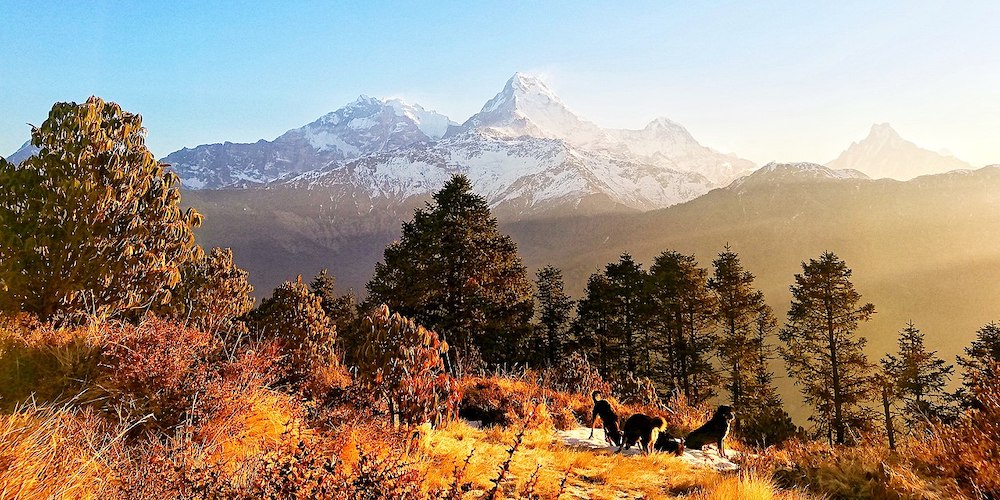
Himalayan Range – ©Gbinod, CC BY-SA 4.0 via Wikimedia Commons
Pahad is the mountain region that does not generally contain snow. The mountains vary from 2,600 to 13,100 feet, with progression from subtropical climates below 3,900 feet to alpine climates above 11,800 feet. The Lower Himalayan Range, reaching 4,900 to 9,800 feet, is the southern limit of this region, with subtropical river valleys and hills alternating to the north of this range. Population density is high in valleys, but notably less above 6,600 feet and very low above 28,200 feet, where snow occasionally falls in winter. The southern lowland plains or Terai bordering India are part of the northern rim of the Indo-Gangetic Plain. Terai is the lowland region containing some hill ranges. The plains were formed and are fed by three major Himalayan rivers: the Koshi, the Narayani, and the Karnali as well as smaller rivers rising below the permanent snowline. This region has a subtropical to tropical climate. The outermost range of the foothills called Sivalik Hills or Churia Range, cresting at 2,300 to 3,280 feet, marks the limits of the Gangetic Plain. Broad, low valleys called Inner Terai Valleys (Bhitri Tarai Upatyaka) lie north of these foothills in several places.
Nepal has five climatic zones, broadly corresponding to the altitudes. The tropical and subtropical zones lie below 1,200 metres (3,900 ft), the temperate zone 1,200 to 2,400 metres (3,900 to 7,900 ft), the cold zone 2,400 to 3,600 metres (7,900 to 11,800 ft), the subarctic zone 3,600 to 4,400 metres (11,800 to 14,400 ft), and the Arctic zone above 4,400 metres (14,400 ft). Nepal experiences five seasons: summer, monsoon, autumn, winter and spring. The Himalayas block cold winds from Central Asia in the winter and form the northern limits of the monsoon wind patterns.
The country contains a disproportionately large diversity of plants and animals, relative to its size and forms the western portion of the eastern Himalayan biodiversity hotspot, with notable biocultural diversity. The dramatic differences in elevation result in a variety of biomes. The Eastern half of Nepal is richer in biodiversity as it receives more rain, compared to western parts, where arctic desert-type conditions are more common at higher elevations. Nepal is a habitat for 4.0% of all mammal species, 8.9% of bird species, 1.0% of reptile species, 2.5% of amphibian species, 1.9% of fish species, 3.7% of butterfly species, 0.5% of moth species and 0.4% of spider species. In its 35 forest-types and 118 ecosystems, Nepal harbours 2% of the flowering plant species, 3% of pteridophytes and 6% of bryophytes.
It’s forests cover almost 60,000 km2 c.40% of the country’s total land area, with an additional 5% of scrubland, a total wooded area of 45%, an increase of 5% since the turn of the millennium. In the southern plains, Terai–Duar savanna and grasslands ecoregion contains some of the world’s tallest grasses as well as Sal forests, tropical evergreen forests and tropical riverine deciduous forests. In the lower hills, subtropical and temperate deciduous mixed forests containing mostly Sal (in the lower altitudes), Chilaune and Katus, as well as subtropical pine forest dominated by chir pine are common. The middle hills are dominated by oak and rhododendron. Subalpine coniferous forests cover the 3,000 m to 3,500 m range, dominated by oak (particularly in the west), Eastern Himalayan fir, Himalayan pine and Himalayan hemlock; rhododendron is common as well. Above 3,500 m in the west and 4,000 m in the east, coniferous trees give way to rhododendron-dominated alpine shrubs and meadows.
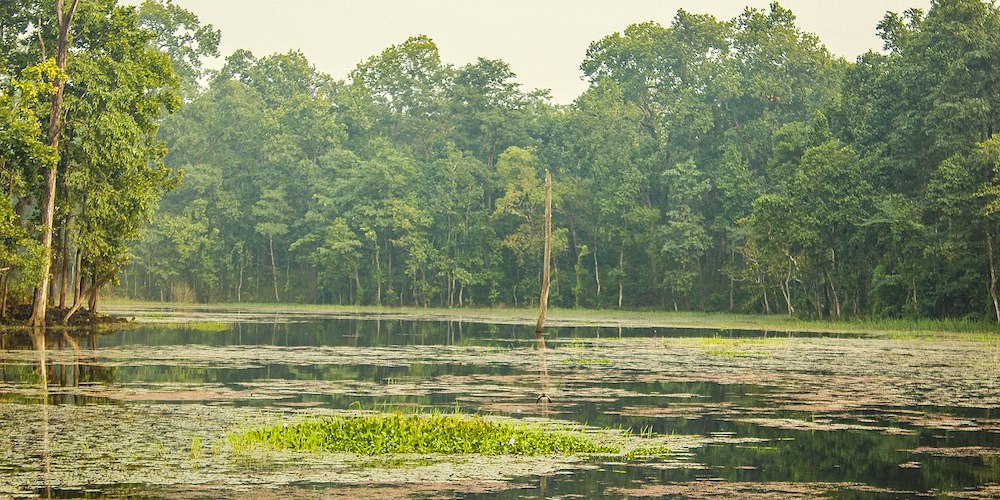
Chitwan National Park – ©Rajivkilanashrestha CC BY-SA 4.0 via Wikimedia Commons
Nepal has 107 threatened species, 88 of them animals. These include the endangered Bengal Tiger, Red Panda, Asiatic Elephant, Himalayan Musk Deer, Wild Water Buffalo and South Asian River Dolphin, as well as the critically endangered Gharial (Crocodile), Bengal Florican and the White-rumped Vulture, which was nearly wiped out by ingesting the carrion of diclofenac-treated cattle. The pervasive and ecologically devastating human encroachment of recent decades has critically endangered Nepali wildlife. In response, the system of national parks and protected areas was substantially expanded. Vulture restaurants coupled with a ban on the veterinary use of diclofenac has seen a rise in White-rumped Vulture numbers. The community forestry programme has seen a third of the country’s population directly participate in managing a quarter of the total forested area, helping local economies while reducing human-wildlife conflict. The breeding programmes coupled with community-assisted military patrols, and a crackdown on poaching and smuggling, has seen poaching of critically endangered tigers and elephants as well as vulnerable rhinos, among others, go down to effectively zero, and their numbers have steadily increased. Nepal has ten national parks, three wildlife reserves, one hunting reserve, three Conservation Areas and eleven buffer zones, covering a total area of almost 29,000 km2, around 20% of the total land area. Ten wetlands are registered under the Ramsar Convention. On the downside, Nepal has consistently been ranked as one of the most polluted countries in the world.
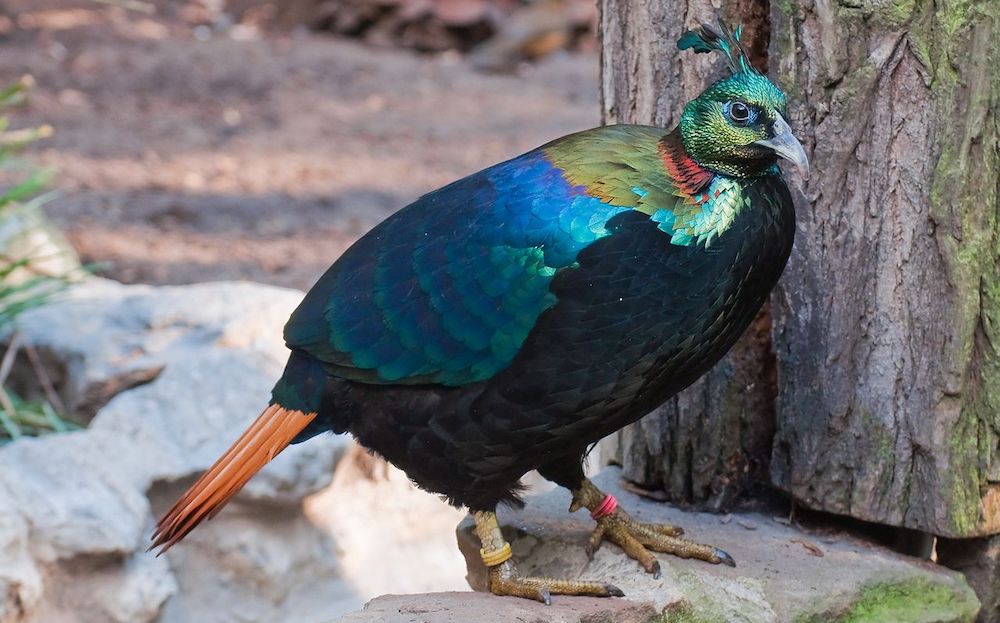
Himalayan Monal Lophophorus impejanus National Bird of Nepal – ©H005, Public domain, via Wikimedia Commons
Birding Nepal
Nepal with its exceptional topography and climate provides ideal habitats for an extremely wide variety of rich bird life; 902 species have been recorded to date. A country that occupies just 0.1% of the world’s landmass and yet has almost 9% of the worlds recorded bird species.
This is perhaps not surprising when you consider Nepal begins at around sea level on its southern border with India and ends on the top of Mt Everest 8,848 meters, touching Tibet, all within a distance of less than 200 Kilometers.
From the lowland tropical and subtropical jungle of the Terrai, Nepal marches upwards to the dense lower-temperate and temperate forests of rhododendron and oak predominantly found in the middle hills. It continues to the beautiful fresh alpine meadows to finally reach the rugged windswept plateaus of the high Himalayas. This extremely unusual terrain with its many ecosystems and numerous bird habitats create exceptionally rich and varied experiences for Birding.
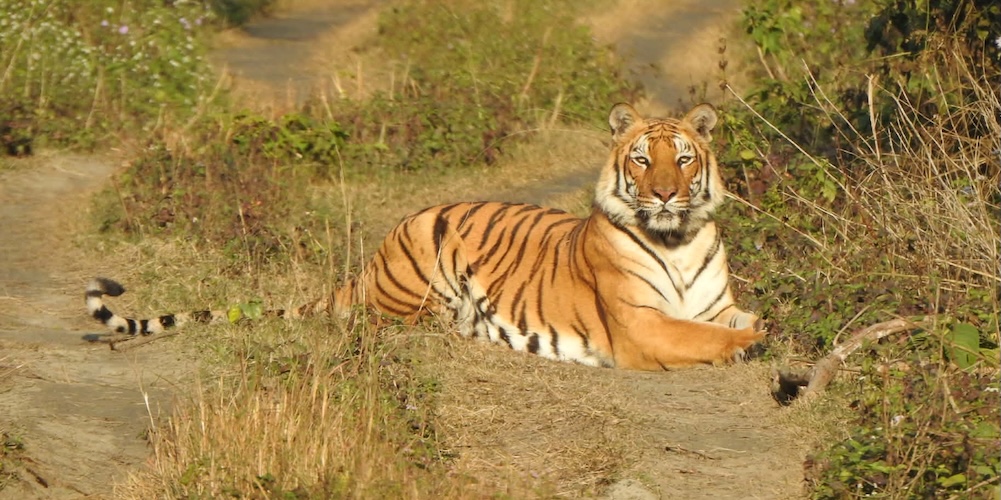
Tiger in Chitwan National Park – ©Seejan Gyawali
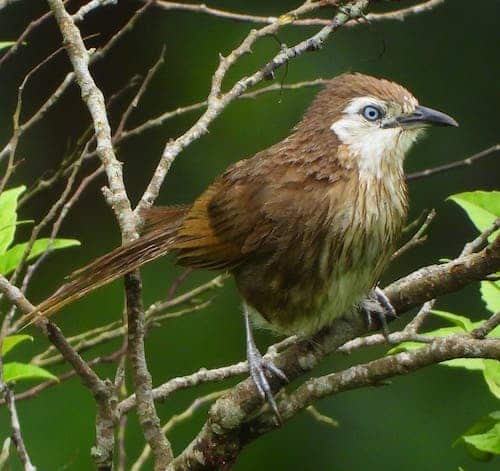
The country also serves as a major migration highway, allowing for some intensive migratory study and research between late October to March. Rare species include Himalayan Griffon, Himalayan Monal, Satyr Tragopan who inhabit the inner valleys below the mountain peaks. The rarest bird in the world, Bengal Florican along with Sarus Crane are both found on the southern plains of the Terai. The two Indigenous bird species, Slaty Woodpecker (common in Bardia National Park) and Spiny Babbler (in mid hills only) are birds often sighted in Nepal. Within the total of birds recorded in Nepal, 40 species are deemed to be globally threatened with 35 globally near threatened. A further 172 species are thought to be nationally threatened.
The Kathmandu Valley:
With only one international airport in Nepal, the vast majority of Birders will arrive in Kathmandu. If you are limited to three or four days, the advice is to base yourself in the valley.
Over 400 species of birds have been recorded. The lush hills that surround the valley offer a varied ecology ranging from primary and secondary forests of Rhododendron, Oak, Pine and Bamboo. The wetlands and open fields inside the valley make up a diverse habitat providing a stopover for migratory birds during the winter.
If your time is limited to a few days, The Kathmandu Valley is probably your best focus. It provides a very good opportunity to see a wide range of species, some of which are rare or endangered.
Pulchowki Hill:
The most popular bird watching spot for the majority of Birders is Phulchowki Hill. At an altitude of 2700m it is the highest peak on the valley rim. Over 300 species of birds have been recorded. Pulchowki is situated 20km southeast of Kathmandu. It’s a fascinating venue, covered with rhododendron-oak-pine and fir trees making it an excellent habitat for both native and migratory species. Most people choose to hire a 4×4 for the journey to the top of the hill which has approximately 27 birding corners. Birds spotted here include babblers, warblers, tits, thrushes, minivets, woodpeckers, eagles. Godavari at the base the hill is laid out as a Botanical Garden where over 100 species of birds have been checked, including Lesser Racket-tailed Drongo, Tibetan Siskin and Spotted Forktail.
Shivapuri and Nagarjun National Park:
Another important area is Shivapuri Nagarjun National Park watershed, declared as a national park in 2003. It is situated to the north of The Kathmandu Valley 7 km from Kathmandu ring road and 12 km from central Kathmandu. Mainly comprised of Rhododendron Oak and Pine, Shivapuri is pristine nature at its best with 170 species recorded.
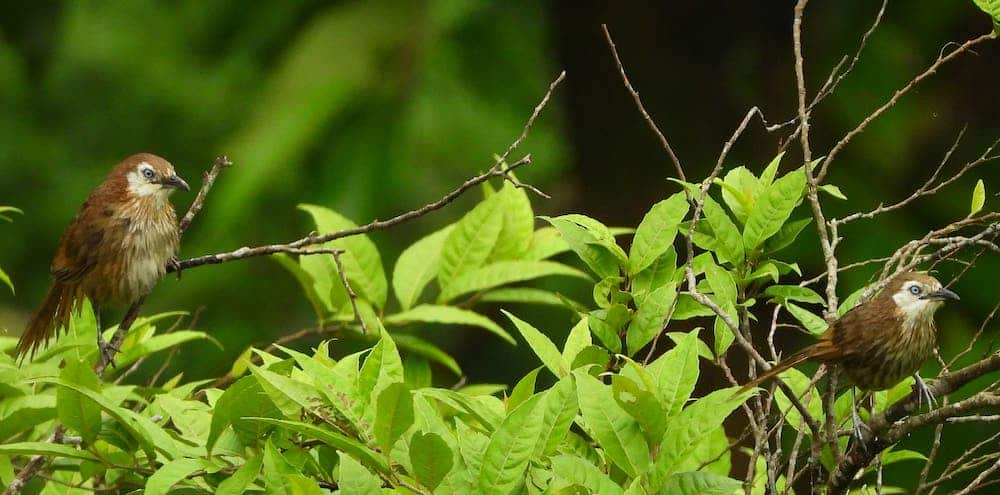
The Spiny Babbler (the only Nepalese endemic) and Wren Babbler are found here. Other notables include Hoary-throated Barwing and the White-throated Tit.
Nagarjun Forest on Jamacho Hill lies around 5kms from central Kathmandu on the way to Kakani from Balaju. It is popular for a wide variety of birds: Blue Magpies, Kalij Pheasants, Bonelli’s Eagles, Great Himalayan Barbets and other exotic birds.
Wetlands in the Valley:
The banks of the Manohara River on the way to Bhaktapur along with the Bagmati River that flows into the valley from Shivapuri Hill to the North of the valley and out through Chobhar Gorge are great places for watching waders and waterfowl.
Bagmati River & Taduha Lake:
Taduha Lake is a worthwhile long half day or full day excursion, especially in winter for migratory birds. Around 263 species of birds have been recorded. Black Kite, Black Drongo, Cattle Egret, Oriental Magpie Robin, Common Myna, Jungle Crow, Rose-ringed Parakeet, White-throated Kingfisher and Red-vented Bulbul are some of the resident birds. Barn Swallow and Indian Cuckoo are summer visitors. Winter migrants include the Great Cormorant, Ruddy Shelduck, Northern Shoveler, Mallard, Gadwall, Eurasian Coot, Northern Pintail and Common Teal.
Getting around the valley:
Motorable roads lead to all the places listed. Accommodation is easy to find in the valley with a wide range of hotels. Good Bird guides are limited so wherever possible do some checks beforehand.
Popular Birding outside the Kathmandu Valley are set out alphabetically below.
This page is sponsored by Early Birders

This page is sponsored by Bird-Photo-Tours ASIA

-
Annapurna Region
InformationSatellite ViewTo set the scene a little, the Annapurna region is a conservation area (A.C.A.P); covering around 2600sq km in the north-central region of Nepal. The Kali Gandaki River (the world’s deepest gorge) runs north to south through the region some 6,000m below the peaks of the Annapurna and Dhaulagiri massifs. Seven of these peaks are over 7,000m, the highest (Annapurna I) at 8,091m. A few facts and figures above, but as you can imagine the Annapurna region supports a remarkable but delicate biodiversity with over 480 species of birds recorded; including one of only two endemic species of Nepal, Spiny Babbler.Bird habitats range from the sub-tropical forest lowlands towards Pokhara in the south to dry sub-alpine conditions above the tree-line in the north. The Kali Gandaki Valley acts as a major migration pathway in the autumn, the most notable being the impressive migration of Demoiselle Cranes from late September to around the middle of October where Often over 15.000 birds are recorded.
Migrating west about this time further south around Khare and Dhampus, 20 identified species of eagle and other birds of prey have been recorded. The most commonly observed are: Lammergeier (Bearded Vulture); known as the Giddha in Nepal, it frequently occurs at around 4,000m. Golden Eagle, known as Baaj in Nepal. Six Himalayan pheasants are habitants: Himalayan Satyr Tragopan, Crimson Horned Pheasant, Blood Pheasant, Koklass Pheasant, Cheer Pheasant , Kalij Pheasant.
Getting there:
Road: 1 hour from Pokhara.
Accommodation: Mountain lodges Tea Houses. -
Bardia National Park
InformationSatellite ViewBardia National Park is a little piece of Birding heaven tucked away in Nepal’s far west, it the largest park in the lowland Terai. The park was established to protect representative eco-systems and conserve tiger and its prey species. Bardia is beautifully situated and spreads over 968 sq. km. It remains undisturbed wilderness and it is predominantly made up of Sal forest sprinkled with tall grasslands, bounded to the north by The Churia Hills and skirted on the West by the Geruwa River.More than 400 species of birds have been recorded, including the endangered Bengal Florican, Sarus Crane and many species of geese, duck and parakeets. Apart from the birding experience your chances of spotting a tiger in Nepal are very good in this area. Other mammals include rhinoceros, swamp deer, leopard, jungle cats, blue bulls, sloth bear, barking deer, and languor. .
What makes a visit to Bardia National Park particularly special is not only its isolated location, but also the presence of one of the last known herds of wild elephants in South Asia. The Geruwa River that rushes into the park through a break in the hill range is used as a spawning route by the mighty Masher game fish, Marsh Mugger crocodiles along with freshwater Gangetic Dolphins also inhabit the river.
Getting there: 385 kms from Kathmandu:
Road: 13 hours.
Flight: to Nepalgunj 1 hour > road 2 hours. Total 3 hours.
From Chitwan 305 kms: Road 13 hours.
Flight to Bharatpur >Kathmandu > Nepalgunj >road. Total 5 hours. -
Chitwan National Park
WebsiteSatellite ViewThe park is widely acknowledged as one of the best national parks in Asia, it is a significant for Birding and nature conservation. Covering an area of 935 square kilometers the park is located 90 kilometers by air southwest of Kathmandu (25 min flight) and five hours by road.Chitwan was the first forest area of Nepal to be designated a National Park in 1973, subsequently declared a World Heritage Nature Site by UNESCO in 1984. The park contains thriving and diverse wildlife, it’s relatively easy access from Kathmandu makes it popular add on to Birding in the Kathmandu Valley. If you are considering a stay of around ten days it is possible to fit Kathmandu and Chitwan into a relatively comfortable itinerary.
Around five hundred and eighty bird species have been recorded, including many lodging birds, parakeets of many types are dominant; other birds include Blue-throated (thrush), Large-tailed Nightjar, Indian Peafowl, Great Barbet, Red-billed Blue Magpie, Grey-crowned Pinea, Blue Flycatcher Hornbill and Trogon.
Of the 43 species of mammals recorded in the park there are an estimated 600 Great One- Horned Rhinoceros, a recent tally on tigers shows them to number 106. Other mammals include; Leopard, Gaur (Indian Bison), Wild Elephant, Sloth Bear, Freshwater Dolphin, Rhesus Monkey, Langur, Wild Boar, Striped Hyena, Jackal, Dhole (wild dog), Ratel, Palm Civet, Mongoose, various antelopes, Sambar, Spotted, Hog & Barking Deer. Reptiles include : Ghariyal, a crocodile native to Chitwan, Python, Monitor Lizard, Pangolin, Tortoise, King Cobra and 19 other snake species.
Getting there: 98 kms from kathmndu.
Flight: From Kathmandu to Bharatpur 30 mins then 10 kms by road.
Road: Five hours from Kathmandu.
Accommodation: A large variety of Lodges and Hotels -
Koshi Tappu Wildlife Reserve
InformationSatellite ViewNepal’s smallest (175 sq kms) wildlife reserve is renowned for being one of the best locations for birding in Nepal, especially for water birds.Designated as a Ramsar site in 1987 it is situated within Nepal’s sub-tropical Terai belt. The reserve is comprised mainly of mudflats, freshwater marshes and deciduous riverine forest. Koshi’s extensive reed bed covering provides an ideal habitat to a huge variety of birds with over 485 recorded to date. The reserve is situated just to the northeast of the convergence of the Sapt Koshi and Trijuga Khola rivers. Due to its location on the Sapt Koshi floodplain, the environment varies dramatically according to the seasons.
During the Monsoon (June to September) the flow becomes torrential and covers most of the floodplain, whilst during the dry seasons many flat sandy islands are exposed. Over 20 species of duck have been recorded along with ibises, storks, swamp partridges, herons, egrets, the endangered Bengal Florican and many other exotic and migratory waterfowl.
Getting there: 330 kms from Kathmandu.
Flight: Kathmandu to Biratnagar 35 mins / approx two and a half hours by road to Koshi Thappu.
Road: Chitwan to Koshi: 365 kms / 7 hours. -
Langtang Valley
InformationSatellite ViewLangtang National Park forms part of Nepal’s Central Highland, it was the first designated Himalayan National Park in Nepal. If you enjoy trekking/hiking along with your Birding a journey to Langtang is well worth considering. Once one of Nepal’s hidden valleys, Langtang borders Tibet with a dramatic landscape comprising of mountain peaks, glaciers and glacial lakes, rivers, cliffs and pastures.The park represents eighteen ecosystems ranging from the hill Sal and Pine forests on its Southern belt to an alpine belt of glaciers snow and rocks. Over 345 species of birds have been recorded.
Notable Birds:
Bearded Vulture, Ibisbill , Himalayan Vulture, Golden Eagle, Crested Kingfisher, Snow Partridge,, Yellow-rumped Honey guide, Tibetan Snowcock, Himalayan Snowcock, Satyr Tragopan, Himalayan Monal, Tibetan Siskin, Eurasion Woodcock, Fire- tailed Myzornis, Scarlet Finch, Red Crossbill & Grandala.
Langtang’s expansive high meadows provides summer habitat to a variety of mammals to include Snow Leapord, Red Panda, Clouded Leapord, Musk Deer and Himalayan Tahr.
Getting there: Road 8 hours from Kathmandu.
Accommodation: Mountain lodges Tea Houses. -
Pokhara
InformationSatellite ViewPokhara is a very popular destination for many people with a variety of interests due to its setting. Situated around a large lake it has a wonderful mountain backdrop, it also acts as a base for trekking into the Annapurna Region. The area is good for bird watching; Black Kite, Himalayan Vulture, Rose-ringed Parakeet and White-throated Kingfisher being just some of the birds that can be seen around the lake, amongst the trees and along the riverbanks.Getting there: 200 kms from Kathmandu.
Road: 6 hours.
Flight: Kathmandu Pokhara 25 mins.
Accommodation: Wide range of Hotels. -
Shuklaphanta National Park
InformationSatellite ViewShuklaphanta is located in the South West corner of Nepal, it represents the largest grassland in lowland Terai. The park also contains forests of Chir Pine, Fir and Hill Sal along with riverbeds and wetlands.Shuklaphanta has recorded over 350 bird species to date among the more noteworthy are Great Slaty Woodpecker, Bengal Florican, Bristled Grassbird, Hodgson Bushchat, Black-capped Kingfisher and Finns weaver.
The reserve is also home to forty-six species of mammal of which the most famous is Royal Bengal Tiger. In fact the chances of spotting a tiger in the reserve are greater here than anywhere else in Nepal. There are between eighteen and twenty two breeding adults in what is a relatively small area. Regular monitoring of tiger is maintained using camera traps.
The park is very well maintained with the local community an integral part of conservation issues nowadays which includes regenerative forestry, biogas production and school eco clubs.
Getting there: 700 kms from Kathmandu.
Road: 14 hours.
Flight: Kathmandu Surkhet > Road: total 6 hours.
Accommodation: Lodges Homestay.
-
Seejan Gyawali
Kathmandu | earlybirdbirders@hotmail.com
https://earlybirdbirders.com -
Nick Fry
Kathmandu | nickearlybirdbirder@gmail.com
Nick is a keen environmentalist based in Kathmandu; please contact him if you need help with your Birding arrangements.
-
Number of bird species: 902
(As at May 2026)National Bird: Himalayan Monal Ophophorus impejanus
Number of endemics: 1
Spiny Babbler Turdoides nipalensis
-
Avibase
PDF ChecklistThis checklist includes all bird species found in Nepal , based on the best information available at this time. It is based on a wide variety of sources that I collated over many years. I am pleased to offer these checklists as a service to birdwatchers. If you find any error, please do not hesitate to report them. -
Department of National Parks and Wildlife Conservation
PDF BookOfficial Checklist -
Wikipedia
Annotated ListThis is a list of the bird species recorded in Nepal. The avifauna of Nepal include a total of 915 species recorded, of which one is endemic, and one has been introduced by humans. 42 species are globally threatened. -
eBird
PDF ChecklistThis checklist is generated with data from eBird (ebird.org), a global database of bird sightings from birders like you. If you enjoy this checklist, please consider contributing your sightings to eBird. It is 100% free to take part, and your observations will help support birders, researchers, and conservationists worldwide.

-
A Birdwatcher's Guide to the Kathmandu Valley
| By Dev Ghimire | Bird Conservation Nepal | 2008 | Paperback | 53 Pages, Maps, Photos | ISBN: 9789993379225 Buy this book from NHBS.com -
A Naturalist's Guide to the Birds of Nepal
| By Bikram Grewal | John Beaufoy Publishing | 2023 | Paperback | 176 pages, ~300 colour photos, 1 colour map | ISBN: 9781912081394 Buy this book from NHBS.com -
A Photographic Field Guide to Birds of India, Pakistan, Nepal, Bhutan, Sri Lanka, and Bangladesh
| By Bikram Grewal & Sumit Sen | Princeton University Press | 2017 | Paperback | 792 pages, 4000+ colour photos, 1300+ colour distribution maps | ISBN: 9780691176499 Buy this book from NHBS.com -
A Pocket Photo Guide to the Birds of Nepal
| By Prajwal Pradhan | Falcon Publication | 2017 | Paperback | 268 pages, colour photos, 1 colour map | ISBN: 9789937018722 Buy this book from NHBS.com -
Birds of Nepal
| (With Reference to Kashmir and Sikkim) | By Robert L Fleming, Sr., Robert L Fleming, Jr. & Lain Singh Bangdel | Adarsh Enterprises | 2024 | Paperback | 370 pages, 152 plates with colour illustrations, 2 b/w fold-out maps | ISBN: 9788187138129 Buy this book from NHBS.com -
Birds of Nepal
| By Richard Grimmett, Carol Inskipp, Tim Inskipp & Hem Sagar Baral | Christopher Helm | 2016 | Edition 2 | Paperback | 142 plates with colour illustrations; colour photos, colour distribution maps, 1 colour map | ISBN: 9781472905710 Buy this book from NHBS.com -
Birds of the Indian Subcontinent
| By Richard Grimmett, Carol Inskipp & Tim Inskipp | Christopher Helm | 2012 | Edition 2 | Paperback | 528 pages, 226 colour plates, colour distribution maps, b/w illustrations | Out of Print | ISBN: 9781408127636 Buy this book from NHBS.com -
Important Bird Areas in Nepal
(Key Sites for Conservation) | By Hem Sagar Baral & Carol Inskipp | Bird Conservation Nepal | 2005 | Paperback | 242 pages, colour photos, distribution maps | ISBN: 9789993379225 Buy this book from NHBS.com
-
Nepal Bird Fair
Website
-
Bird Conservation Nepal
WebsiteEstablished in 1982, Bird Conservation Nepal (BCN) is the leading organisation in Nepal, focusing on the conservation of birds, their habitats and sites. It seeks to promote interest in birds amongst the general public, encourage research on birds and identify major threats to birds' continued survival. As a result, we are the foremost scientific authority providing accurate information on birds and their habitats throughout Nepal. We provide scientific data and expertise on birds for the Government of Nepal through the Department of National Parks and Wildlife Conservation (DNPWC) and work closely in birds and biodiversity conservation throughout the country. Kathmandu,Nepal - Phone : 977-1-4417805 / 4420213 - Fax : 977-1-4413884 - Email : bcn@birdlifenepal.org -
Bird Watch Nepal
Facebook PageWelcome All To Bird Watch Nepal, The Group Is Dedicated To All Inspiring Bird Watchers, Photographers & Bird Lovers Of Nepal & The World -
Nepalese Ornithological Union
WebsiteThe Nepalese Ornithological Union (NOU), founded in 2009 by a group of dedicated ornithologists in Nepal. It is a non-profit, membership organization, works to protect wild birds with a focus on threatened and endangered species and their habitats across Nepal through scientific research and conservation -
Pokhara Bird Society (PBS)
WebsitePokhara Bird Society (PBS) is one of the leading organizations in Nepal working for the conservation of birds and their natural habitat.
-
*List of protected areas of Nepal
InformationSatellite ViewInteractive list of National Parks, conservation areas, wetlands, reserves etc. -
NP Banke
InformationSatellite ViewThe protected area covers an area of 550 km2 (210 sq mi) with most parts falling on the Churia range. The park is surrounded by a buffer zone of 344 km2 (133 sq mi) in the districts of Banke, Salyan and Dang. The protected area holds tiger and four-horned antelope. In 2014, a ruddy mongoose was recorded for the first time in the protected area. -
NP Bardiya
InformationSatellite ViewCovering an area of 968 km2 (374 sq mi) it is the largest and most undisturbed national park in Nepal's Terai, adjoining the eastern bank of the Karnali River and bisected by the Babai River in the Bardiya District. Current checklists include 407 bird species, among them the Bengal florican, white-rumped vulture, peafowl, and bar-headed geese, which are symbolic of the park.[5] Lesser florican and sarus crane are present; grey-crowned prinia, jungle prinia, pale-footed bush warbler, aberrant bush warbler, striated grassbird, golden-headed cisticola and chestnut-capped babbler occur in the park's grasslands -
NP Chitwan
WebsiteSatellite ViewA total of 68 species of mammals, 544 species of birds, 56 species of herpetofauna and 126 species of fish have been recorded in the park. The park is especially renowned for its protection of One Horned Rhinoceros, Royal Bengal Tiger and Gharial Crocodile. -
NP Khaptad
InformationSatellite ViewKhaptad National Park is a protected area in the Far-Western Region, Nepal that was established in 1984. Stretching over the four districts of Bajhang, Bajura, Achham and Doti it covers an area of 225 km2 (87 sq mi) and ranges in elevation from 1,400 m (4,600 ft) to 3,300 m (10,800 ft). Current checklists include 23 mammals, 287 birds, and 23 amphibians and reptiles. Bird species symbolic of the park include Impeyan pheasant, peregrine falcon, and white-rumped vulture. -
NP Langtang
InformationSatellite ViewIt exceeds an altitudinal range of 6,450 m (21,160 ft) and covers an area of 1,710 km2 (660 sq mi) in the Nuwakot, Rasuwa and Sindhulpalchok Districts of the central Himalayan region. In the north and east it is linked with Qomolangma National Nature Preserve in Tibet. -
NP Makalu Barun
InformationSatellite ViewIt is the world's only protected area with an elevation gain of more than 8,000 m (26,000 ft) enclosing tropical forest as well as snow-capped peaks. It covers an area of 1,500 km2 (580 sq mi) in the Solukhumbu and Sankhuwasabha Districts, and is surrounded by a bufferzone to the south and southeast with an area of 830 km2 (320 sq mi). Ornithologists have recorded 440 bird species, ranging from eagles and other raptors to white-necked storks and brilliantly colored sunbirds. The 16 rare or protected bird species include the rose-ringed parakeet, Blyth's kingfisher, deep-blue kingfisher, blue-naped pitta, pale blue flycatcher, sultan tit, silver-eared mesia, spiny babbler and the white-naped yuhina. -
NP Parsa
InformationSatellite ViewIt covers an area of 627.39 km2 (242.24 sq mi) in the Parsa, Makwanpur and Bara districts and ranges in altitude from 435 m (1,427 ft) to 950 m (3,120 ft) in the Siwalik Hills. It was established as a wildlife reserve. A camera-trapping survey conducted in February 2017 for three months revealed the presence of 19 Bengal tigers. This indicates the rise in tiger population by three times in three years. -
NP Rara
InformationSatellite ViewCovering an area of 106 km2 (41 sq mi) in the Mugu and Jumla districts, it is the country's smallest national park. Its main feature is Rara Lake at an altitude of 2,990 m (9,810 ft). There are 241 recorded species of birds, including 49 wetland species. Birds seen often include Himalayan Snowcock, chukar partridge, Himalayan monal, kalij pheasant and blood pheasant. -
NP Sagarmatha
InformationSatellite ViewSagarmāthā National Park is a national park in the Himalayas of eastern Nepal that is dominated by Mount Everest. It encompasses an area of 1,148 km2 (443 sq mi) in the Solukhumbu District and ranges in elevation from 2,845 to 8,848 m (9,334 to 29,029 ft) at the summit of Mount Everest. In the north, it shares the international border with the Qomolangma National Nature Preserve of Tibet. In the east it is adjacent to Makalu Barun National Park, and in the south it extends to Dudh Kosi river. The forests provide habitat to at least 118 species of birds, including Himalayan monal, blood pheasant, red-billed chough, and yellow-billed chough. Sagarmāthā National Park is also home to a number of rare mammal species, including musk deer, snow leopard & Himalayan black bear. -
NP Shey Phoksundo
InformationSatellite ViewShey Phoksundo National Park is the largest and only trans-Himalayan national park in Nepal. It covers an area of 3,555 km2 (1,373 sq mi) in the districts of Dolpa and Mugu in the Mid-Western Region, Nepal. The park provides habitat for over 200 species of birds, such as Tibetan partridge, wood snipe, white-throated tit, wood accentor and crimson-eared rosefinch. -
NP Shivapuri Nagarjun
InformationSatellite ViewIt is located in the country's mid-hills on the northern fringe of the Kathmandu Valley and named after Shivapuri Peak of 2,732 m (8,963 ft) altitude. It covers an area of 159 km2 (61 sq mi) in the districts of Kathmandu, Nuwakot and Sindhupalchowk. Ornithologists recorded 318 species of birds including Eurasian eagle-owl, slender-billed scimitar-babbler, white-gorgeted flycatcher, barred cuckoo-dove and golden-throated barbet. -
NP Shuklaphanta
InformationSatellite ViewShuklaphanta National Park is a protected area in the Terai of the Far-Western Region, Nepal, covering 305 km2 (118 sq mi) of open grassland, forests, riverbeds and tropical wetlands at an altitude of 174 to 1,386 m (571 to 4,547 ft). A total of 423 bird species has been recorded. The park supports the highest population of Bengal floricans in Nepal. It is the western limit of swamp francolin, Jerdon's bushchat, rufous-rumped grassbird, chestnut-capped babbler and Jerdon's babbler; the north-western limit of yellow-eyed babbler; the eastern limit of Finn's weaver and the most important regular wintering site of Hodgson's bushchat. Forest birds include spot-bellied eagle owl, dusky eagle owl, rufous-bellied eagle and Oriental pied hornbill. The forests are also important for great slaty woodpecker and white-naped woodpecker. The white-rumped vulture, slender-billed vulture, lesser adjutant, grey-headed fish eagle, darter and rufous-rumped grassbird are breeding residents. Sarus crane, painted stork and bristled grassbird are summer visitors. Greater racquet-tailed drongo, white-capped water redstart, rusty-tailed flycatcher and rufous-gorgeted flycatcher are uncommon winter visitors. -
National Parks
InformationSatellite ViewNepal is endowed with rich and varied biodiversity.Altitudinal variances in short distance give Nepal's biogeography variety that range from lush moist forests and sparse alpine deserts to luxurious grasslands in lowland Terai. The mountainous country also shelters some of the world's most rare animals… -
WR WII Koshi Tappu
InformationSatellite ViewKoshi Tappu Wildlife Reserve is an example of one of the finest birding sites in Asia. The reserve has a total area of 175sq. km. and is roughly rectangular in shape. The principal habitats in the reserve include: wetlands, grasslands and small patches of riverine forest.Notable among the 485 bird species are watercock, Indian nightjar, dusky eagleowl, black-headed cuckooshrike, white-tailed stonechat, striated grassbird, large adjutant stork, Pallas’s fish eagle, common golden-eye, and gull-billed tern.Swamp francolin and rufous-vented grass babbler occur as well In spring 2011, 17 Bengal floricans were recorded from nine different sites along a 39 km (24 mi) north-south stretch of the Koshi River. -
Wetlands
WebpageSatellite ViewNepal currently has 10 sites designated as Wetlands of International Importance (Ramsar Sites), with a surface area of 60,561 hectares.
-
eBird
SightingseBirding This Month
-
FEATURED
Early Birders
Local Tour OperatorsWe are a team of experienced ornithologist and nature guide who are constantly engaged in maintaining excellent service. Earlybirdbirders wants to make memorial trip of Nepal visit to their clients. We have one charity organization called Birds Nepal (www.birdsnepal.org) where we donate 20% of the gross profit. -
Asian Adventures
Tour OperatorSpecial Birds and Mammals of Nepal – 250 Species of 4 National Parks in 14 Days -
Bird Photo Tours ASIA
Tour OperatorsOur Nepal Bird-Photo-Tour produces an extraordinary number of Himalayan specialities with key photographic targets including Satyr Tragopan, Himalayan Monal, Snow Partridge, Blood Pheasant, Tibetan Snowcock, Himalayan Snowcock, Ibisbill and Sarus Crane. -
BirdFinders
Tour OperatorNepal holds a total of over 850 species and the scenery is some of the most stunning on Earth. On this tour we will visit Koshi Tappu Wildlife Reserve, the world famous Chitwan National Park and Mount Pulchowki, from where we hope to see sunrise over the Himalayas. -
BirdQuest
Tour OperatorRED PANDA EXPEDITION – A Quest for a Wonderful Creature of the Himalayas, with Spiny Babbler extension -
Birding Ecotours
Tour OperatorThe former kingdom of Nepal, now officially the Federal Democratic Republic of Nepal, is a land-locked country in Asia and one of the most mountainous on the planet. It is located in the central Himalayas, and of the world’s ten highest mountains eight are in Nepal. This land was cut off from the outside world for many decades after the second world war. But now it has opened up its boundaries to travelers, and it offers birders the opportunity to experience the immensity of birding the world’s highest mountain range without the high costs associated with visiting Bhutan. -
Bluetail Birding
Tour OperatorsBluetail Birding is a dedicated bird tour operator offering both scheduled departure (small group) and custom travel worldwide. We specialise in bird tours across South Asia, to destinations throughout India, Bhutan, Nepal and Sri Lanka where we have been operating since 2009 as India Nature Tourism, which now acts as our ground agent in this region. -
HeatherLea
Tour OperatorNepal is a fantastic country for the wildlife enthusiast, boasting 885 bird species and 210 mammals. -
Limosa
Tour OperatorFlanked by the world’s tallest mountains, the spectacular Himalayan kingdom of Nepal should be on every birder’s list of places to go! Focusing on three of the country's finest wildlife areas, our birdwatching tour to Nepal begins amidst the bird-rich hill forests of the beautiful Kathmandu Valley where we look for birds such as Fire-tailed Sunbird and Himalayan Bluetail. -
NatureTrek
Tour OperatorAn 11-day birdwatching tour of Koshi Tappu Wildlife Reserve, Chitwan National Park, and the forested hills of the Kathmandu Valley – Nepal's top three sites! -
Nepal Bird Guide
Local Tour OperatorsWe are well equipped professional birders. And we have been twitching around in Nepal for the last one decade and a half as bird guides. -
Ornis Birding Expeditions
Tour OperatorsA unique opportunity to visit a blossoming ecotourism destination in pristine forest! All our needs will be fully catered-to by the team of locals who run the cosy and comfortable homestay while also expertly tracking their fluffy targets: the enigmatic Red Panda. -
Rockjumper
Tour OperatorNepal is a beautiful and diverse land with an amazing variety of wildlife and landscapes. Its cultural and religious mix and intriguing history have conquered the hearts and minds of visitors throughout time. -
Travel & Tour Operators in Nepal
Tour OperatorsTravel & Tour Operators in Nepal -
Wings of Nepal
ExpeditionWings of Nepal is a 16-day all-inclusive scientific birdwatching expedition departing February 12, 2027. Led by Naturalist David Wimpfheimer and Nepal-based birding guide Tek Bahadur Gharti Magar, the expedition targets over 300 species across Nepal's extraordinary ecological sweep — from the Ramsar-listed wetlands of Koshi Tappu Wildlife Reserve and the Sal forests of Chitwan National Park to the rhododendron forests of the Khumbu region.
-
2022 [04 April] - Erik Vikkelsø Rasmussen
PDF Report...We have seen the most of the bird species which occurs in Nepal in different other countries before – f.ex Northern India more times including Himalayan foothills at Nainital, Sattal, and most of the countries in Asia and South East Asia too. In 2017 we visited Tibet including crossing the Tibetan plateau and later Sichuan in China... -
2022 [05 May] - Komal Agrawal[2022] - Komal Agrawal
PDF ReportTrekking with birding is fun. It really tests your patience and that of the ones with you. I had the best guide and porter who were such patient people. They stopped at every single bird I wanted to see: trust me it can get really frustrating at times. At one point, it took 45 minutes for the Pygmy Wren-babbler to come out, and Chhak sat by me all the time and had fantastic views of her first ever wren-babbler! -
2023 [04 April] - Joshua Bergmar
PDF Report...We had one primary target, Spiny Babbler (Nepal’s only endemic bird). Despite hearing one at our first stop, it wouldn’t come out of the bushes, and our day turned into a long session trying as many territories as possible. Although we were on a mission, the incidental birding was excellent and we saw a lovely set of species. These included Nepal Fulvetta, Rusty-cheeked Scimitar-Babbler, Black-chinned Babbler, Himalayan Buzzard, Grey-backed Shrike, Tickell’s Leaf Warbler, Hume’s Warbler, Grey-hooded Warbler, Scaly Thrush, Blue-capped Rock Thrush, and Little Bunting... -
2024 [04 April] - Daniel López-Velasco
PDF Report...We had one primary target, Spiny Babbler (Nepal’s only endemic bird). We tried at a couple of known territories, to no avail, although other new birds kept us entertained, such as Grey-backed Shrike, Common Green Magpie, Rusty-cheeked Scimitar Babbler, Tickell’s Leaf Warbler and Blue Whistling Thrush... -
2025 [04 April] - Donna Belder
PDF ReportOur main target was Nepal’s only endemic bird, the Spiny Babbler. An initial attempt at a known territory was unsuccessful, but our trip list was off to a nice start with Himalayan Bulbul, Grey-backed Shrike, Scarlet Minivet, Oriental Cuckooshrike, Crimson Sunbird, four different species of drongo...
-
Koshi Tappu Wildlife Camp
WebsiteKoshi Tappu Wildlife Camp, set up in 1993, was the first luxury camp in this wildlife Reserve. It was set up primarily for bird watchers. The Camp is ideal for all nature lovers seeking peace within a paradise of nature.
-
Birding Nepal
ArticleI've been to Nepal lots of times but only in recent years as a birder, so I re-visited places to see whay kind of birdlife I had missed. It's hard to choose between Annapurna and Langtang for birding. -
Birding Nepal
ArticleThis area was good for Olive-backed Pipit, Blue-throated Barbet and Fire-breasted Flowerpecker. After the flight to Biritnagar we travelled by road along flat agricultural land to the Kosi Tappu Game Reserve near the Kosi Barrage, a major irrigation project…