

Burma – Republic of the Union of Myanmar
Myanmar aka Burma is mainland Southeast Asia’s largest country, with a land area equivalent to that of the US state of Texas. North-south, it stretches 2,100km, a distance equal to that between Stockholm and Naples and covers an area of 676,579 km2 (261,229 square miles) with a population of around 55 million people. It is bordered by India and Bangladesh to its northwest, China to its northeast, Laos and Thailand to its east and southeast, and the Andaman Sea and the Bay of Bengal to its south and southwest. The country’s capital city is Naypyidaw, and its largest city is Yangon (formerly Rangoon) with a population approaching six million people.
Physically, the country can be divided into four elongated north-south regions: the narrow Rakhine Coastal Strip, the Fold Mountain Belt, the Central Belt and the Shan Plateau in the east. Each has its own geological history with the Fold Mountain Belt (Chin Hills and Rakhine Yoma) considered to be a southward extension of the Himalayas and part of a 7000 km mountain chain that includes the Andaman and Nicobar Islands, Java and Bali.
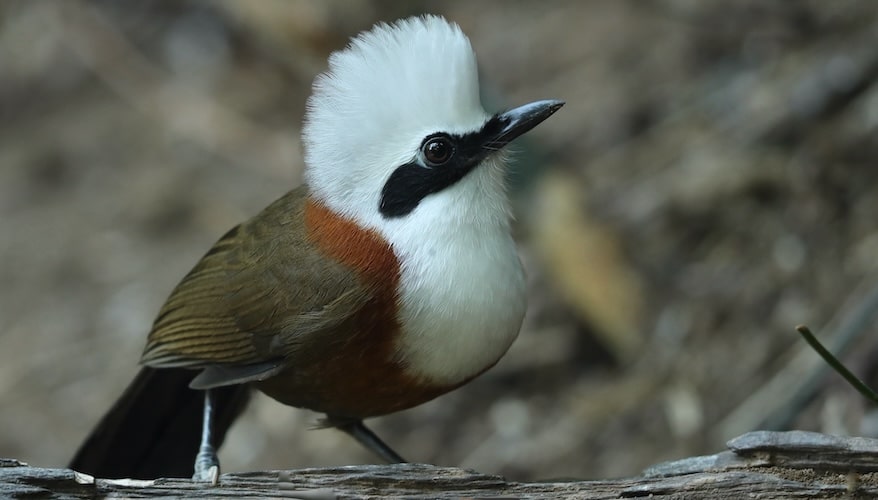
White-crested Laughingthrush Garrulax leucolophus – ©Bird-Photo-Tours ASIA
In the north, the Hengduan Mountains form the border with China. Hkakabo Razi, located in Kachin State, at an elevation of 19,295 feet, is the highest point in Myanmar. There are many mountain ranges, such as the Rakhine Yoma, the Bago Yoma, the Shan Hills and the Tenasserim Hills, all of which run north-to-south from the Himalayas. The mountain chains divide Myanmar’s three river systems, which are the Irrawaddy, Salween (Thanlwin), and the Sittaung rivers. The Irrawaddy River, Myanmar’s longest river at nearly 2,170 kilometres (1,348 miles), flows into the Gulf of Martaban. Fertile plains exist in the valleys between the mountain chains. The majority of Myanmar’s population lives in the Irrawaddy valley, which is situated between the Rakhine Yoma and the Shan Plateau.
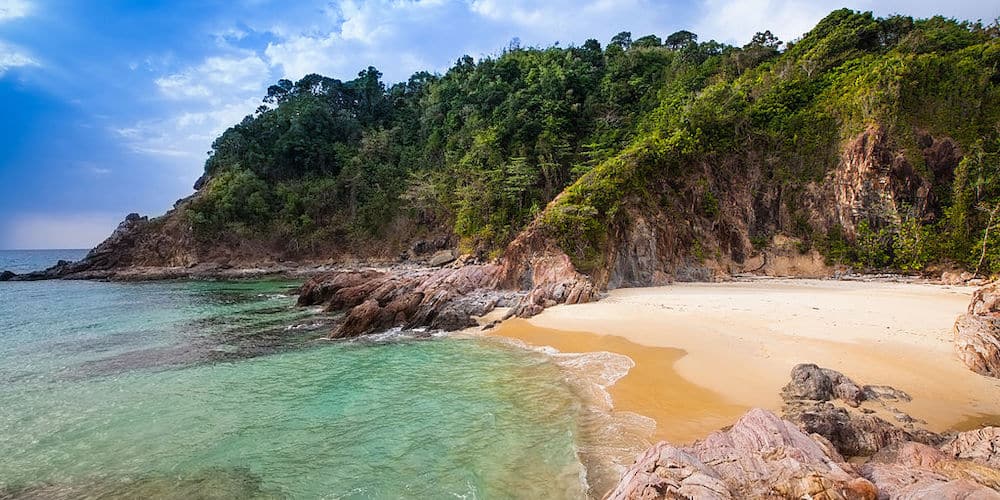
Lampi Island Marine National Park – ©Rueangrit srisuk CC BY-SA 3.0 via Wikimedia Commons
The Central Belt is home to the major centres of human population such as Yangon (Rangoon); Mandalay, Bago and Pathein. It was once submerged under an ancient sea known as the Burmese Gulf. Subsequently, the Ayeyarwady (Irrawady); Chindwin and Sittang Rivers have deposited millions of tons of silt on this region. This makes for extremely rich and fertile agricultural land. The Shan Plateau has an average elevation of 950 metres and is dissected by a series of deep and often spectacular gorges. A clearly defined fault line marks its western margin.
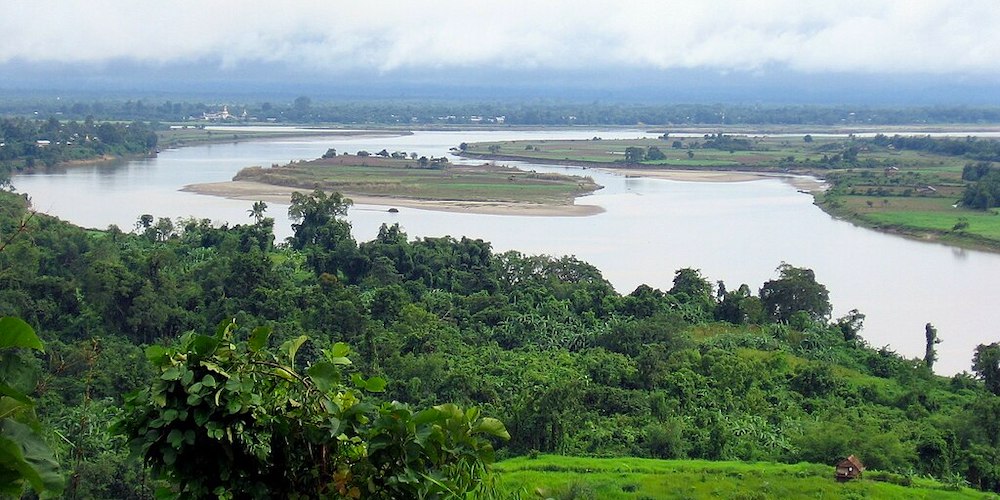
Ayeyarwady River – ©Colegota CC BY-SA 2.5 ES via Wikimedia Commons
The climate is dominated by two sub-continental monsoons. The most important of these is the southwest monsoon which brings the majority of the country’s rainfall. It generally lasts from June to October and defines the summer wet season, with the coastal and mountain areas receiving the majority of the rain (98 inches). The northeast monsoon usually arrives in November and lingers until March. It is not characterised by significant precipitation. November to mid-February is Myanmar’s cool season, while March and particularly April and May can be extremely hot. The northern regions of Myanmar are the coolest, with average temperatures of 21 °C. Coastal and delta regions have an average maximum temperature of 32 °C.
Birding Burma
Zoographically, it is a meeting point of four sub-regions. Most of the country lies within the Indochinese sub-region (of the Oriental region). However, the Rakhine (Arakan) and Chin Hills in the west form part of the Indian sub-region. The high mountains in the extreme north, with their typically Himalayan species, form part of the Palaearctic region and the forests of the Tanintharyi Division (Tennasserim) in the southeast contain many species with Malesian affinities. This zoogeographical diversity is reflected in the diversity of all organisms, including birds.
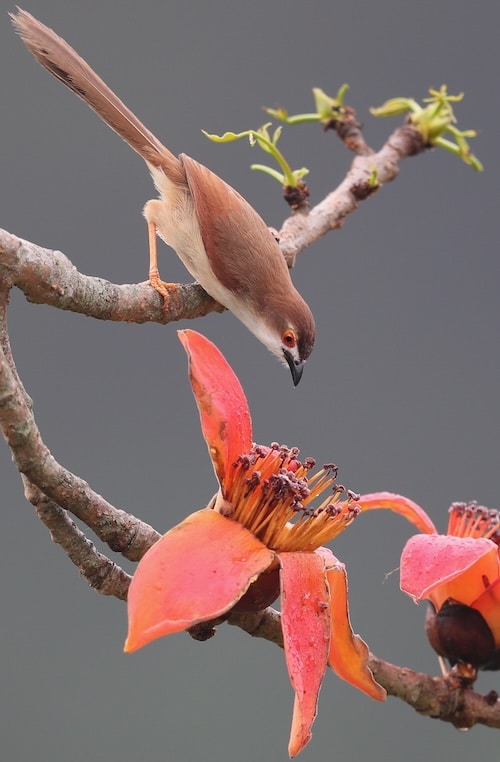
Yellow-eyed Babbler Chrysomma sinense – ©Bird-Photo-Tours ASIA
Myanmar is often considered to be the last frontier of global biodiversity in mainland Asia. This diversity includes 64 terrestrial ecosystems including tropical and subtropical vegetation, seasonally inundated wetlands, shoreline and tidal systems, and alpine ecosystems. Such diversity means there are over 11000 flowering plants, with 841 species of orchid; 1014 species of butterfly (some 6% of the world’s total); 314 mammals including 92 species of bat (about 9% of the world’s total) 293 reptiles and 139 amphibians. Typical jungle animals, particularly tigers, occur sparsely in Myanmar. In upper Myanmar, there are rhinoceros, wild water buffalo, clouded leopard, wild boars, deer, antelope, and elephants, which are also tamed or bred in captivity for use as work animals, particularly in the lumber industry. Smaller mammals are also numerous, ranging from gibbons and monkeys to flying foxes. Sadly nearly half of its ecosystems are threatened.
However, Myanmar’s slow economic growth has contributed to the preservation of much of its environment and ecosystems. Forests, including dense tropical growth and valuable teak in lower Myanmar, cover over 49% of the country, including areas of acacia, bamboo, ironwood and Magnolia champaca. Coconut and betel palm and rubber have been introduced. In the highlands of the north, oak, pine and various rhododendrons cover much of the land. However, more recent heavy logging has seriously reduced forest area and wildlife habitat. The lands along the coast support all varieties of tropical fruits and once had large areas of mangroves although much of the protective mangroves have disappeared. In much of central Myanmar (the dry zone), vegetation is sparse and stunted.
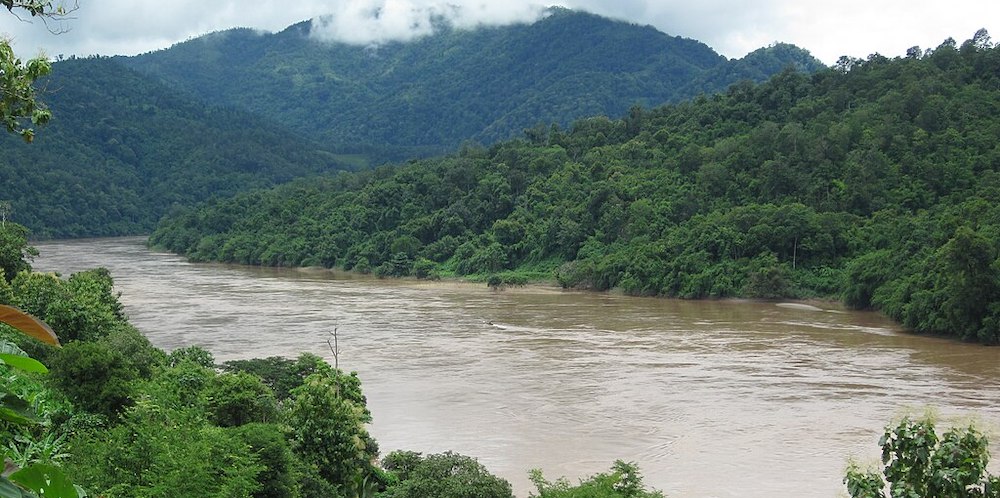
Salween (Thanlwin) River on the Thai Border – ©Ken Marshall CC BY 2.0 via Wikimedia Commons
1155 species of bird have been recorded, including 137 species shared with the UK. This makes Myanmar one of the most diverse bird faunas per unit area of any country in the world. Although there is an extensive bird literature for Myanmar, with some 680 references, the vast majority of papers and books were written in the late 19th and first part of the 20th century. Relatively few bird watchers or professional ornithologists have visited the country in the past 50 years and the local bird watching scene is currently underdeveloped. This paucity of recent information offers great opportunities for in-country and international bird watchers alike, as there is an urgent need to revisit many former bird hotspots to reassess the diversity and estimate the population status.
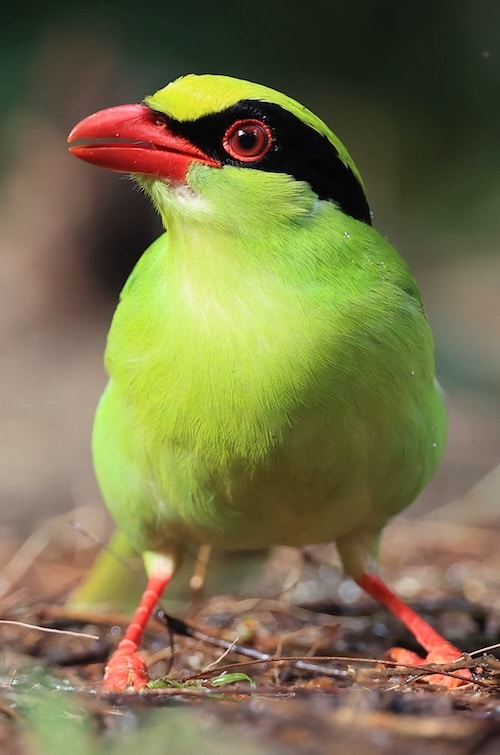
Common Green Magpie Cissa chinensis – ©Bird-Photo-Tours ASIA
To help the potential birder to chose their site, we have subdivided the country into 8 areas, loosely defined by geography and/or habitat type and climate. These appear in the Top Sites section below…
Parts of this report are extracted from Myanmar (Burma): an illustrated guide to the country and its wildlife by Si Si Hla Bu and Paul Bates; it can be ordered from info@harrison-institute.org
-
Ayeyarwady (Irrawady) Delta
InformationSatellite ViewAyeyarwady (Irrawady) Delta is a vast complex of islands and waterways that covers an area equivalent to that of the Netherlands. Its size is constantly increasing, although its natural habitat, including swamp and mangrove forest is under threat from charcoal burners and rice cultivation. The delta includes two wildlife sanctuaries – one primarily for marine turtles, the other for crocodiles. The delta is rich in birds, especially from the end of the rainy season in September-October, when a huge wave of migrants fly south from their breeding sites in Central Asia and Siberia to winter in Myanmar. Many of the waders make their way to the paddy plains, coastal mud flats and tidal creeks of the delta. The delta is also one of the last refuges of the Eastern Sarus Crane. -
Chin Hills
InformationSatellite ViewThe Chin Hills, with their cool climate and rich bird fauna of some 200 species the Chin Hills are an excellent place to go bird watching. The open pinewoods are home to a variety of colourful flycatchers as well as the Orange flanked bush robin, Chestnut-vented nuthatch and Fire-tailed sunbird. Black eagles patrol the skies. Rare and endemic birds on Mount Victoria (Natma Taung) include the Spotted wren-babbler, Brown capped Laughingthrush, Black-breasted Parrotbill, Yellow-breasted greenfinch & Myanmar's most famous endemic, the White-browed nuthatch. -
Coastal Areas
Myanmar has two principal coastal areas -
Dry Zone
The Dry Zone is usually associated with an area of central Myanmar, which receives less than 1,275 mm of rain each year. It comprises the plains of the Chindwin, Ayeyarwady and Mu rivers and is bounded by hills in all directions except the south, where it extends as far as Pyay (Prome). Although originally covered with acacia and dry monsoon forest, the area has been cultivated for many hundreds of years. The bird fauna is diverse and the long hot evenings of March and April are punctuated by the stone-on-ice call of the Indian nightjar, whilst the rippling sound of the Burmese barred owlet can be heard at dawn. The skies are patrolled by some of the 63 bird of prey species known from Myanmar, including the White-eyed buzzard eagle and White-backed vulture. -
Shan Plateau
InformationSatellite ViewThe Shan Plateau is comprised of a vast and complex series of rounded hills and plateaux, interspersed with many dried up depressions of former lakes. It has an average elevation of 950 metres and many spectacular gorges, such as that at Gokteik, and extensive cave systems. The western margin is famous for its hill stations, which offer in summer an opportunity to escape the stifling heat of the plains. These include Pyin Oo Lwin (Maymyo) and Kalaw. Pyin Oo Lwin was known to have a particularly diverse bird fauna in its oak and chestnut copses, although the current situation is unclear. One of the best areas to see birds is Inle Lake, especially in the winter season when it is home to a large number of migrants. -
Teak Forests
Teak Forests are Myanmar`s deciduous forests are home to the majority of the world`s teak reserves. These occur predominantly in a wide arc, sandwiched between the central Dry Zone and the mountains of the Rakhine Yoma, Chin Hills and the hills of Sagaing Division and Kachin in the north. One of the best places to see natural teak forest is Alaungdaw Kathapa National Park, which is situated some 180 km west-north-west of Mandalay. It is an area rich in wildlife and was recently described as a magically still, yet intensively alive Eden. To date, eighty bird species have been recorded from Alaungdaw including crested Serpent eagle, Shikra, Great hornbill, Kalij pheasant, Green imperial pigeon and Black-headed woodpecker -
The North
Although relatively little visited, the North, which comprises northern Kachin and Sagaing Division, is an area of outstanding natural beauty and wildlife interest. Physically it borders two vast plateaux, the Yunnan to the east and the Tibetan to the north. In the past, extensive snowfields covered much of the area. Even today, there are many glaciers and permanent snow beds in the region, especially adjacent to Myanmar`s highest mountain, Mount Hkakaborazi (5881 metres). The North`s vegetation is dominated by vast areas of broad-leafed evergreen and semi-deciduous rain forest and include many familiar plants, laurels, rhododendrons, magnolias, oaks, willows, cherries and viburnum. A relict alpine flora is present on the highest pinnacles. The forests have an outstanding bird, butterfly and orchid diversity. Over 470 bird species were recorded in the 1930s from Myitkyina district alone and charismatic taxa include Eastern White and Spot-billed pelican, White-winged duck, Asian paradise flycatcher, Mountain Imperial Pigeon and a number of rare and beautiful pheasants. -
Yangon (Rangoon)
InformationIn and around Yangon (Rangoon)
-
Dr Paul Bates
Kent, UK | hzm@btinternet.com
https://www.harrison-institute.org
-
Number of bird species: 1155
(As at January 2025)National Bird: Grey Peacock-pheasant (aka Chinquis) Polyplectron bicalcaratum
Number of endemics: 10-13
Burmese Collared Dove Streptopelia xanthocycla
Irrawaddy Broadbill Cymbirhynchus affinis
Burmese Bushlark Mirafra microptera
Jerdon's Minivet Pericrocotus albifrons
Hooded Treepie Crypsirina cucullata
Pale-eyed (Davison's) Bulbul Pycnonotus davisoni
Grey-crowned Bulbul Alophoixus griseiceps
Naung Mung Wren-babbler Rimator naungmungensis
White-throated Babbler Turdoides gularisrdi
White-browed Nuthatch Sitta victoriae
Some authorities also consider the following to be endemic:
Irrawaddy Bulbul Pycnonotus blanfordi
Burmese Bushtit Aegithalos sharpei
Burmese Prinia Prinia cooki
-
Avibase
PDF ChecklistThis checklist includes all bird species found in Myanmar , based on the best information available at this time. It is based on a wide variety of sources that I collated over many years. I am pleased to offer these checklists as a service to birdwatchers. If you find any error, please do not hesitate to report them. -
Wikipedia
Annotated Listhis is a list of the bird species recorded in Myanmar. The avifauna of Myanmar include a total of 1150 species, of which 7 are endemic, and two have been introduced by humans. 68 species are globally threatened. -
eBird
PDF ChecklistThis checklist is generated with data from eBird (ebird.org), a global database of bird sightings from birders like you. If you enjoy this checklist, please consider contributing your sightings to eBird. It is 100% free to take part, and your observations will help support birders, researchers, and conservationists worldwide.

-
A Naturalist's Guide to the Birds of Myanmar
| By Thet Zaw Naing, Robert Tizar & Geoffrey Davidson | John Beaufoy Publishing | 2023 | Paperback | 176 pages, 300 colour photos | ISBN: 9781909612723 Buy this book from NHBS.com -
Birds of Myanmar
| By Kyaw Nyunt Lwin, Khin Ma Ma Thwin & Aung Thant | Silkworm Books | Paperback | 2005 | 166 pages, 64 plates with 350 colour illustrations | ISBN: 9789749575680 Buy this book from NHBS.com -
The Birds of Burma
| By Bertram E Smythies & AM Hughes | Natural History Publications Borneo | 2001 | $th Edition | Hardback | 601 pages, 32 plates with colour illustrations; 1 b/w map | ISBN: 9789838120494 Buy this book from NHBS.com
-
Biodiversity and Nature Conservation Association (BANCA)
WebsiteConservation of nature, primarily biological diversity, through action based on research, advocacy, network building, education and public awareness - BirdLife International in representative for Myanmar… -
Myanmar Birding Club
Facebook PageWe create opportunities to meet people with similar interest, especially in birds, bird-watching -
Myanmar Birds & Nature Society (MBNS)
WebsiteMyanmar Birds & Nature Society…
-
*Biodiversity Zone, protected areas
InformationSatellite ViewInteractive list -
*Protected areas in Myanmar
WebsiteSatellite ViewThe following are a list of National parks, wildlife sanctuaries and botanical gardens in Burma… -
BS Taunggyi
InformationSatellite ViewIt is located near Taunggyi and is governed by the Burma Forest Department. The level of protection is unknown. The altitudes within the reserve range from 1,045m to 1,750m. The main purpose of the reserve is habitat conservation of the resident bird species and the dry hill forest ecosystem. -
NP Alaungdaw Kathapa
InformationSatellite ViewThe park consists of the Patolon Reserved Forest and the adjoining Taungdwin Reserved Forest. The park is home to numerous wildlife species, including a small population of wild Asian elephants. -
NP Hlawga
InformationSatellite ViewLocated in Mingaladon, Yangon Division, Myanmar, 22 miles (35 km) north of Yangon. The 1540-acre (623-hectare) park includes an 818-acre (313 hectare) wildlife park, a 62-acre (25-hectare) mini-zoo and a 660-acre (267-hectare) buffer zone. According to a 1992 survey, the park was home to at least 21 species of mammals, 145 species of birds and 8 species of reptiles. -
NP Khakaborazi
InformationSatellite ViewIt is located in Naungmung Township in Kachin State. It occupies an area of 3,810 square kilometres (1,472 sq mi) and was established in 1996. It surrounds Hkakabo Razi, the highest peak in Burma. -
NP Lampi Island Marine Park
InformationSatellite ViewLampi Island is a demarcated marine national park located in Lanbi Island, Mergui Archipelago, Burma. The main purposes of the reserve are habitat conservation of both marine and island resources. 228 species of birds including 19 threatened species such as plain-pouched hornbill and Wallace's hawk-eagle, 10 species of amphibians and 19 species reptile with 3 species of endangered sea turtles (green, loggerhead and olive ridley), 19 species of mammals including sunda pangolin are present. -
NP Lenya
InformationSatellite ViewLenya is a national park located in the Tenasserim Hills, Burma in the border area with Thailand,[1] limiting with the Namtok Huai Yang National Park. The park consists of 176,638 hectares of lowland tropical forest. -
NP Loimwe
InformationSatellite ViewLoimwe National Park is a national park in the Shan Hills, Burma. It is located near Loi Mwe or Lwemwe, -
NP Mount Victoria
InformationSatellite ViewIt is located close to the border with India and features Mt. Victoria, which at 3,035 meters above sea level is the highest mountain in Chin Hill, Chin State, in the western part of Central Myanmar. -
NP Popa Mountain
InformationSatellite ViewIt is located in Kyaukpadaung Township in Mandalay Division. It occupies an area of 129 square kilometres (49.63 sq mi) and was established in 1989. It surrounds Mount Popa. -
NP Tanintharyi
InformationSatellite ViewThe Tanintharyi National Park is a demarcated national park located in the Tenasserim Hills, Burma, further south from the Tanintharyi Nature Reserve in the border area with Thailand. -
NR Hukawng Valley Tiger Reserve
InformationSatellite ViewIt is a wildlife reserve located in Hukawng Valley, near Tanai in Myitkyina District of Kachin State, Burma (Myanmar). Hukawng Valley Tiger Reserve covers 21890 km². The Burmese government has also designated 6500 km² of the valley as the protected forest reserve. It is the world's largest tiger reserve. he reserve also consists of 35 kinds of mammals such as Indochinese tiger, Indochinese leopard, Indian elephant, bear and species of monkeys, over 370 species of birds, 46 species of frogs, 37 species of fresh water fish, four species of turtle, species of butterflies and 13,500 plant species. -
NR Tanintharyi
InformationSatellite ViewThe Tanintharyi Nature Reserve is a nature reserve in the Tenasserim Hills, Burma, north of Tanintharyi National Park on the border with Thailand, adjacent to Kaeng Krachan National Park. The endangered Gurney's pitta, native to (possible Thailand and) Myanmar, is found in the reserve. -
WR Shwesettaw
InformationSatellite ViewIt occupies an area of 553 square kilometres (213.4 sq mi). -
WR Tamanthi
InformationSatellite ViewIt lies within the Hkamti District of Sagaing Region, and covers 830.40 sq mi (2,150.7 km2), bounded between the Uyu and Chindwin rivers with 230.40 sq mi (596.7 km2) of the area in Homalin Township, and 600 sq mi (1,600 km2) in Hkamti Township. The sanctuary is home to Indochinese tigers, Indian elephants, gaur (Asiatic bison), Indochinese leopards, serow, and bear. In all over 30 mammals are found there. Formerly it was the home of the Northern Sumatran rhinoceros (Didermocherus Sumatrensis lasiotis) and the Indian Javan rhinoceros (Rhinoceros sondaicus inermis), which seem to have become extinct in the area in the 1980s. Among the many birds found in the reserve are the white-winged wood duck (Cairina scutulata) and the masked finfoot (Heliopais personata). -
WS BR WII Inlay Lake Wetland Sanctuary
InformationSatellite ViewIt occupies an area of 642.32 square miles (1,660 km2) and was established in 1985 and designated as one of ASEAN Heritage Parks in 2003. It is part of 1891 square miles wide Inle World Network of Biosphere Reserves site. It located between 20° 10' N and 97° 02' E in Nyaungshwe, Pinlaung and Pekon Township of Taunggyi District. Its elevation is over 2,900 feet. 255 woodland birds, 90 wetland birds, 59 fish species, 3 turtle species, 94 butterfly species, 25 amphibian and reptile species,[6] and several plant species including 184 orchid and 12 algae species are recorded in this wetland sanctuary. It was reported that this Sanctuary could be a nesting place for the globally endangered sarus crane. -
WS Indawgyi Lake
InformationSatellite ViewIt is located in Mohnyin Township in Kachin State. It occupies an area of 299.32 square miles (775 km2) and was established in 1999. The Ministry of Forestry of Myanmar Government announced Indawgyi Lake with surface area 64,003 acres (25,901 ha) and five surrounding forest reserves with the area of 137,386 acres (55,598 ha), totaling 201,389 acres (81,499 ha) as “Inndawgyi Lake Sanctuary” with the Notification No (39/2004) dated 9-8-2004; On 18 December 2003, it was recognized as ASEAN Heritage Park. The region is home to rare bird species and other wild animals including wild elephants, bantengs and gaurs, rare gibbon species and forest birds. -
WS Mein-ma-hla Kyun
InformationSatellite ViewThe protected area has a total of 29 mangrove tree species, saltwater crocodiles and a wide range of birds. -
WS Minsontaung
InformationSatellite ViewIt occupies an area of 22.6 square kilometres (8.7 sq mi). The sanctuary protects the endangered Eld's Deer and the Burmese star tortoise, a Critically Endangered species. It is named after Minson Taung, a small isolated massif with a maximum height of 398m. -
WS Moneyingyi Wetland Sanctuary
InformationSatellite ViewIt is located in Bago Division. It occupies an area of 100 square kilometres (40 sq mi) and was established in 1986. -
WS Mulayit
InformationSatellite ViewThe reserve occupies an area of 139 square kilometres (53.7 sq mi. The white-fronted scops owl, the silver-eared laughingthrush (Trochalopteron melanostigma), the grey-sided thrush (Turdus feae), a vulnerable species and the Tenasserim white-bellied rat (Niviventer tenaster) are found in the Mulayit Taung area. The wildlife sanctuary is an insurgency area and wildlife biodiversity is declining. Protection of species is compromised for all the forests of the region have seen unprecedented destruction in recent years.
-
Birds & Nature
News & Sightings, ViewsLast posting 2013
-
BirdQuest
Tour OperatorMYANMAR (BURMA) – Endemics and Specialities of the land of pagodas. -
BirdTour Asia
Tour OperatorTBA -
Calidris
Tour OperatorMyanmar birding tour highlights include Mount Victoria Babax, White-browed Nuthatch, Burmese Bushtit, White-throated Babbler, Hooded Treepie, Jerdon’s Minivet, Collared Myna, Chin Hills Wren Babbler, Burmese Bushlark, Rusty-fronted Barwing, Assam Laughingthrush, Black-bibbed Tit, Jerdon’s Bushchat, Black-tailed Crake, Brown-capped Laughingthrush -
GoMyanmarTours
Local Tour OperatorMyanmar Bird Watching Tour – 14 Days -
Myanmar Birding & Adventure Tours
Local Tour OperatorMyanmar Birding & Adventures is a local birding tour operator specializing in small groups of guided bird watching tours in Myanmar. -
Myanmar Birding Tours
Local Tour OperatorBeing nestled between the south easternmost part of the Himalayas and the northern end of Malay Peninsula, Myanmar is considered one of the most ornithologically fascinating countries in Southeast Asia, offering the rare opportunities to see not only Malay Peninsula species but also Himalayan species in the same country. With over 1100 bird species including some of the world most sought-after and endangered bird species, Myanmar is now on its way to becoming one of the ideal birding destinations in Southeast Asia for international birders. -
Myanmar City Star Travel & Tours Co
Local Tour OperatorMyanmar Himalaya Bird Watching Tour -
NatureTrek
Tour OperatorMyanmar Highlights - A Wildlife & Cultural Tour -
Rockjumper Birding Tours
Tour OperatorMyanmar (Burma), saddled between Thailand and India, remains a poorly known birding destination...
-
2016 [02 February] - Glen Valentine
PDF Report...Our trip was no doubt a resounding success once again, as we managed to obtain excellent views of all thecountry’s endemics (Hooded Treepie, Jerdon’s Minivet, Burmese Bush Lark, White-throated Babbler,White-browed Nuthatch and Burmese Bushtit) as well as every near-endemic species... -
2016 [04 April] - James Eaton
PDF ReportThis tour recorded an impressive 478 species during our 18-day visit to the country, though as always with ourtours it’s not about the numbers but the quality, which more than surpassed expectations. We began the tour inYangon, with two brief excursions outside of the city’s limits for ‘Davison’s Bulbul’ and Jerdon’s Babbler beforeflying north to Bagan where our birding around the historic temples revealed the four central Burmese dry-zoneendemics; Burmese Bushlark, White-throated Babbler, Jerdon’s Minivet and Hooded Treepie. -
2017 [02 February] - Ken Behrens
PDF ReportThe trip started as Myanmar-only, but we expanded it to include Thailand when I realized that quite a few of the most-wanted targets were better sought there. -
2017 [04 April\ - Dave Farrow
PDF ReportThis years' Birdquest tour to Burma was once again a splendid affair. We saw all eight – oh wait, there's one more now – nine Burmese endemics – Hooded Treepie, Jerdon’s Minivet, White-throated Babbler, Burmese Bushlark, White-browed Nuthatch (the ‘jewel in the crown’ of the endemic birds), Burmese Bushtit, Davison’s Bulbul, Burmese Collared Dove, and Irrawaddy Bulbul - the ‘newest’ of the set... -
2018 [02 February] - Rob Hutchinson - Malaysia & Myanmar
PDF ReportThis tour was loosely centred around a desire to see two monotypic families – Rail-babbler and Elachura, but in visiting some of the main birding sites in both Malaysia and Myanmar also allowed for a wide variety of iconic Southeast Asian birds. In Malaysia we first visited the highlands of Fraser’s Hill, with a special mention to Malaysian Partridge, Malayan Laughingthrush and Blue Nuthatch before the usual feeding frenzy of Mountain Peacock Pheasant and Ferruginous Partridge. -
2018 [02 February] - Zoothera Birding
ReportThis list of highlight species below only tells a small part of how enjoyable the birding on our tour to Myanmar was. Not only was there quality of birds but also a good abundance, although birds were quite shy, allowing us to see most species more than once... -
2019 [01 January] - Robbert Schepers
PDF Report -
2019 [02 February] - Sujan Chatterjee
PDF ReportToday we started early, and after breakfast drove for an hour to Hlawage Wildlife Sanctuary. The Hlawga Park is situated north of Yangon. We quickly started adding specialities like Western Osprey, Black-naped Oriole, Ayeyarwady (formerly known as Streak-eared) Bulbul, Brown Shrike, Chestnut-headed Bee-eater, Ashy Drongo, etc. Next, we drove through the reserve, spotting White-rumped Munia and Oriental (also known as Crested) Honey Buzzard. On the way back, we stopped at the War Cemetery for a few minutes. We then stopped for lunch at the ‘Golden Duck’ before heading back to the hotel. -
2019 [03 March] - Dave Farrow
PDF ReportThis years' Birdquest tour to Burma was once again a successful and enjoyable affair. We saw all nine of the Burmese endemics – Hooded Treepie, Jerdon’s Minivet, White-throated Babbler, Burmese Bushlark, Whitebrowed Nuthatch (surely the ‘jewel in the crown’ of the endemic birds), Burmese Bushtit, and Irrawaddy Bulbul - the ‘newest’ of the set, plus Davison’s Bulbul and Burmese Collared Dove that are not yet universally split. We also found six taxa that could be described as near-endemics - Collared Myna, Striped and Browncapped Laughingthrushes, Mount Victoria Babax, Burmese Yuhina and Chin Hills Wren-Babbler. -
2019 [12 December] - Bill Simpson
PDF Report...Hitched a lift with Helen to the 10 mile camp after breakfast, walking a couple of miles further north and downhill to where another birder had seen a flock of Buff-breasted Parrotbills the day before but no luck. Walked back by dusk... -
2020 [02 February] - Zoothera Birding
ReportMyanmar (formerly known as Burma) has been one of the least visited countries in Southeast Asia for many years but changes within the country have meant that now is an excellent time to visit this friendly nation and enjoy its fantastic birds...
-
Ornithology of Northern Myanmar
Article PDFMyanmar is a large, biodiverse country located between India and China in the west and east, and south of Tibet. Kachin State, situated in far northern Myanmar, is expected to be especially biodiverse because of its habitat and climatic diversity, ranging from lowland riparian areas to the high-elevation Himalayan Mountains...