

Republic of Indonesia
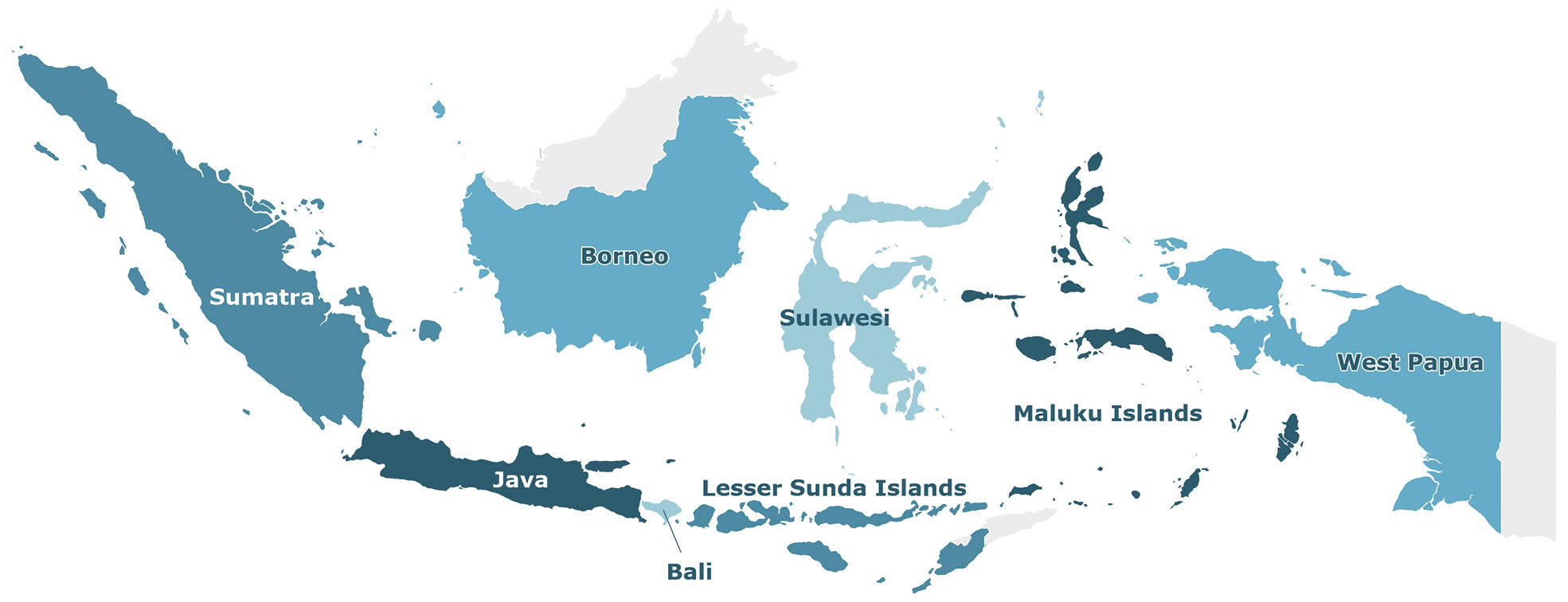
Indonesia is a country in Southeast Asia, between the Indian and Pacific oceans. It is the world’s largest archipelagic country, with more than 17,500 islands straddling the equator. At over 1,900,000 square kilometres (c.735,000 square miles), it is the 14th largest by land area and the 7th largest in combined sea and land area. It extends over five thousand kilometres (3,000 miles) east to west and 1,750 kilometres (1,000 miles) north to south. Its highest peak (over 16,000 feet) is Puncak Jaya in West Papua, its largest lake, covering c.1,150 km2 (c.440 square miles) is Lake Toba in Sumatra. The largest rivers are in Kalimantan and West Papua and include the Kapuas, Barito, Mamberamo, Sepik and Mahakam and are often the main transport routes.
With over 280 million people, it is the world’s 4th most populous country as well as the most populous Muslim-majority country. Java’s 34 provinces comprise the world’s most populous island and contains more than half of the country’s population. Jakarta, the country’s capital, is the second most populous urban area in the world has a population of c. 11.5 million people. The country shares land borders with Papua New Guinea, East Timor, and the eastern part of Malaysia. Other neighbouring countries include Singapore, Vietnam, the Philippines, Australia, Palau, and India’s Andaman and Nicobar Islands.
Lying along the equator, Indonesia’s climate tends to be relatively even year-round. There are two seasons – a wet season and a dry season – with no extremes of summer or winter. For most of Indonesia, the dry season falls between April and October with the wet season between November and March. Indonesia’s climate is almost entirely tropical, dominated by the tropical rainforest climate found in every major island of Indonesia, followed by the tropical monsoon climate that predominantly lies along Java’s coastal north, Sulawesi’s coastal south and east, and Bali, and finally the tropical Savanna climate, found in isolated locations of Central Java, lowland East Java, coastal southern Papua and smaller islands to the east of Lombok.
Birding Indonesia
Despite its large population and densely populated regions, Indonesia has vast areas of wilderness that support a high level of biodiversity. Its flora and fauna is a mixture of Asian and Australasian species. The islands of the Sunda Shelf (Sumatra, Java, Borneo, and Bali) were once linked to mainland Asia, and have a wealth of Asian fauna. Large species such as the Sumatran tiger, rhinoceros, orangutan, Asian elephant, and leopard, were once abundant as far east as Bali, but numbers and distribution have dwindled drastically. Sadly, Indonesia has a terrible record of deforestation, losing almost half of the forest in the last fifty years, often to the ubiquitous monoculture of palm oil plantations sometimes described as ecocide! Many species are critically endangered.
Sulawesi, Nusa Tenggara, and Maluku – having been long separated from the continental landmasses – have developed their own unique flora and fauna. Papua was part of the Australian landmass, and is home to a unique fauna and flora closely related to that of Australia, including over 600 bird species. Forests cover approximately 70% of the country. Indonesia is second only to Australia in terms of total endemic species, with 36% of its over 1,700 species of bird and 39% of its 515 species of mammal being endemic.
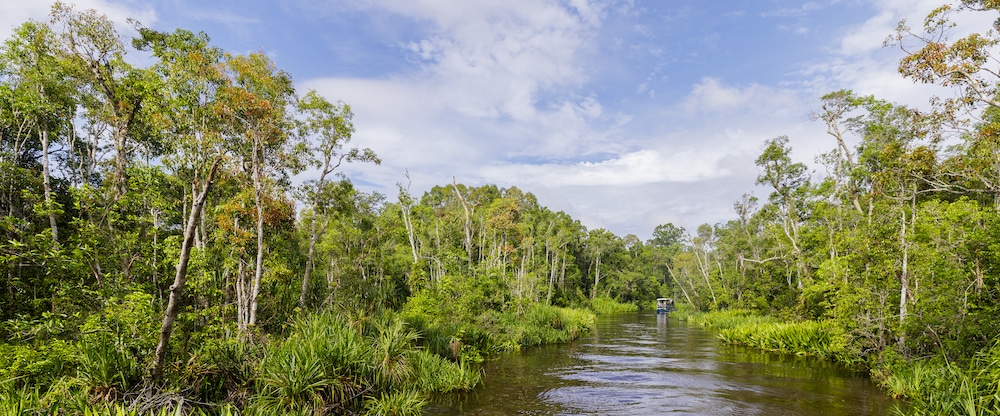
Tanjung Puting National Park, Kalimantan ©Thomas Fuhrmann
It’s hardly surprising, therefore, that Indonesia has some of the best bird watching in the world! At over 1,700 species, or around 17% of the worlds birds, are found in Indonesia. Of these almost 600 are endemics: the most of any country in the world. Birding highlights are too many to mention. From crowned pigeons and birds-of-paradise, to endemic pheasants and pittas. There are plenty of reasons to visit once, re-visit and then keep going back.
Indonesia spans two continental regions – Asia and Australasia – with an island-region of its very own in the middle – Wallacea. Add to this 17,000 islands (making it the world’s largest archipelago) and you can start to understand the spectacular diversity and endemism among birds here.
Indonesia is huge, but its domestic travel network is good and getting better. Many excellent birding sites are well known and the access is straightforward. There are also many local guides and tour companies that can make birding easy. Alternatively, for those looking for adventure and discovery there is probably few better places to try than Indonesia. Many regions, including many smaller islands and mountains, are rarely ever visited by birders, and as a result there are probably more ‘lost species’, that have not been recorded for decades, than anywhere else. Also, almost certainly, there are still new species waiting to be discovered.
This page is sponsored by Birding Ecotours

This page is sponsored by Bird-Photo-Tours ASIA

-
See Regional Pages
There are so many birding places, with such diversity, that it is impossible to pick individual sites as the top for the nation. Therefore, top sites are listed in each of the individual regional pages
-
Nick Brickle
| info@burung-nusantara.org
http://burung-nusantara.org/author/nick-brickle/
-
Number of bird species: 1847
(As at April 2024)National Bird: Javan Hawk-eagle Nisaetus bartelsi
Number of endemics: 398 (168 Non-Passerines)
Bruijn's Brush-Turkey Aepypodius bruijnii
Red-Billed Brush-Turkey Talegalla cuvieri
Maleo Macrocephalon maleo
Moluccan Scrubfowl Eulipoa wallacei
Sula Scrubfowl Megapodius bernsteinii
Tanimbar Scrubfowl Megapodius tenimberensis
Biak Scrubfowl Megapodius geelvinkianus
Snow Mountain Quail Anurophasis monorthonyx
White-Faced Hill-Partridge Arborophila orientalis
Chestnut-Bellied Partridge Arborophila javanica
Red-Billed Partridge Arborophila rubrirostris
Green Junglefowl Gallus varius
Hoogerwerf's Pheasant Lophura hoogerwerfi
Salvadori's Pheasant Lophura inornata
Bronze-Tailed Peacock-Pheasant Polyplectron chalcurum
Spotted Kestrel Falco moluccensis
Sulawesi Serpent Eagle Spilornis rufipectus
Sulawesi Goshawk Accipiter griseiceps
Spot-Tailed Goshawk Accipiter trinotatus
Moluccan Goshawk Accipiter henicogrammus
Small Sparrowhawk Accipiter nanus
Rufous-Necked Sparrowhawk Accipiter erythrauchen
Vinous-Breasted Sparrowhawk Accipiter rhodogaster
Flores Hawk-Eagle Nisaetus floris
Javan Hawk-Eagle Nisaetus bartelsi
Sulawesi Hawk-Eagle Nisaetus lanceolatus
White-Striped Forest-Rail Rallina leucospila
Sharpe's Rail Gallirallus sharpei
Invisible Rail Gallirallus wallacii
Snoring Rail Aramidopsis plateni
Blue-Faced Rail Gymnocrex rosenbergii
Talaud Rail Gymnocrex talaudensis
Isabelline Waterhen Amaurornis isabellinus
Talaud Bush-Hen Amaurornis magnirostris
Sumba Buttonquail Turnix everetti
Javanese Lapwing Vanellus macropterus
Javan Plover Charadrius javanicus
Javan Woodcock Scolopax saturata
Sulawesi Woodcock Scolopax celebensis
Moluccan Woodcock Scolopax rochussenii
White-Faced Cuckoo-Dove Turacoena manadensis
Barred Dove Geopelia maugeus
Sulawesi Ground Dove Gallicolumba tristigmata
Western Crowned-Pigeon Goura cristata
Grey-Cheeked Green Pigeon Treron griseicauda
Flores Green Pigeon Treron floris
Sumba Green Pigeon Treron teysmannii
Sumatran Green Pigeon Treron oxyurus
Pink-Headed Fruit-Dove Ptilinopus porphyreus
Red-Naped Fruit-Dove Ptilinopus dohertyi
Red-Eared Fruit-Dove Ptilinopus fischeri
Maroon-Chinned Fruit-Dove Ptilinopus subgularis
Scarlet-Breasted Fruit-Dove Ptilinopus bernsteinii
Wallace's Fruit-Dove Ptilinopus wallacii
Blue-Capped Fruit-Dove Ptilinopus monacha
Grey-Headed Fruit-Dove Ptilinopus hyogastrus
Carunculated Fruit-Dove Ptilinopus granulifrons
Elegant Imperial Pigeon Ducula concinna
White-Bellied Imperial Pigeon Ducula forsteni
Grey-Headed Imperial Pigeon Ducula radiata
Spectacled Imperial Pigeon Ducula perspicillata
Spice Imperial Pigeon Ducula myristicivora
Cinnamon-Bellied Imperial Pigeon Ducula basilica
Dark-Backed Imperial Pigeon Ducula lacernulata
Silver-Tipped Imperial Pigeon Ducula luctuosa
Sombre Pigeon Cryptophaps poecilorrhoa
Buru Mountain Pigeon Gymnophaps mada
Sulawesi Hanging-Parrot Loriculus stigmatus
Moluccan Hanging-Parrot Loriculus amabilis
Sula Hanging-Parrot Loriculus sclateri
Sangihe Hanging-Parrot Loriculus catamene
Red-Billed Hanging-Parrot Loriculus exilis
Yellow-Throated Hanging-Parrot Loriculus pusillus
Flores Hanging-Parrot Loriculus flosculus
Geelvink Pygmy-Parrot Micropsitta geelvinkiana
Salmon-Crested Cockatoo Cacatua moluccensis
White Cockatoo Cacatua alba
Tanimbar Cockatoo Cacatua goffiniana
Black Lory Chalcopsitta atra
Red-And-Blue Lory Eos histrio
Violet-Necked Lory Eos squamata
Red Lory Eos bornea
Blue-Streaked Lory Eos reticulata
Black-Winged Lory Eos cyanogenia
Blue-Eared Lory Eos semilarvata
Ornate Lorikeet Trichoglossus ornatus
Yellow-cheeked Lorikeet Saudareos meyeri
Sula Lorikeet Saudareos flavoviridis
Chattering Lory Lorius garrulus
Purple-Naped Lory Lorius domicella
Blue-Fronted Lorikeet Charmosyna toxopei
Yellowish-Breasted Racquet-Tail Prioniturus flavicans
Golden-Mantled Racquet-Tail Prioniturus platurus
Buru Racquet-Tail Prioniturus mada
Black-Lored Parrot Tanygnathus gramineus
Great-Billed Parrot Tanygnathus megalorynchos
Moluccan King-Parrot Alisterus amboinensis
Salvadori's Fig-Parrot Psittaculirostris salvadorii
Sulawesi Hawk-Cuckoo Cuculus crassirostris
Moluccan Cuckoo Cacomantis aeruginosus
Pied Bronze-Cuckoo Chrysococcyx crassirostris
Black-Billed Koel Eudynamys melanorhynchus
Yellow-Billed Malkoha Phaenicophaeus calyorhynchus
Sumatran Ground Cuckoo Carpococcyx viridis
Goliath Coucal Centropus goliath
Kai Coucal Centropus spilopterus
Biak Coucal Centropus chalybeus
Sunda Coucal Centropus nigrorufus
Bay Coucal Centropus celebensis
Sulawesi Golden Owl Tyto inexspectata
Seram Masked Owl Tyto almae
Taliabu Masked Owl Tyto nigrobrunnea
Moluccan Masked Owl Tyto sororcula
Sulawesi Owl Tyto rosenbergii
Simeulue Scops-Owl Otus umbra
Javan Scops-Owl Otus angelinae
Sulawesi Scops-Owl Otus manadensis
Sangihe Scops-Owl Otus collari
Flores Scops-Owl Otus alfredi
Siau Scops-Owl Otus siaoensis
Enggano Scops-Owl Otus enganensis
Biak Scops-Owl Otus beccarii
Mentawai Scops-Owl Otus mentawi
Wallace's Scops-Owl Otus silvicola
Javan Owlet Glaucidium castanopterum
Sumba Boobook Ninox rudolfi
Least Boobook Ninox sumbaensis
Cinnabar Boobook Ninox ios
Ochre-Bellied Boobook Ninox ochracea
Togian Boobook Ninox burhani
Speckled Boobook Ninox punctulata
Satanic Nightjar Eurostopodus diabolicus
Sulawesi Nightjar Caprimulgus celebensis
Mees's Nightjar Caprimulgus meesi
Salvadori's Nightjar Caprimulgus pulchellus
Long-Whiskered Owlet-Nightjar Aegotheles crinifrons
Vogelkop Owlet-Nightjar Aegotheles affinis
Moluccan Swiftlet Collocalia infuscata
Volcano Swiftlet Collocalia vulcanorum
Javan Trogon Apalharpactes reinwardtii
Sumatran Trogon Apalharpactes mackloti
Purple-Winged Roller Coracias temminckii
Purple Dollarbird Eurystomus azureus
Green-Backed Kingfisher Actenoides monachus
Scaly Kingfisher Actenoides princeps
Kofiau Paradise-Kingfisher Tanysiptera ellioti
Biak Paradise-Kingfisher Tanysiptera riedelii
Numfor Paradise-Kingfisher Tanysiptera carolinae
Lilac-Cheeked Kingfisher Cittura cyanotis
White-Rumped Kingfisher Caridonax fulgidus
Black-Billed Kingfisher Pelargopsis melanorhyncha
Javan Kingfisher Halcyon cyanoventris
Blue-And-White Kingfisher Todirhamphus diops
Lazuli Kingfisher Todirhamphus lazuli
Sombre Kingfisher Todirhamphus funebris
Talaud Kingfisher Todirhamphus enigma
Sulawesi Kingfisher Ceyx fallax
Small Blue Kingfisher Alcedo coerulescens
Black-Headed Kingfisher Actenoides capucinus
Purple-Bearded Bee-Eater Meropogon forsteni
Sulawesi Hornbill Penelopides exarhatus
Knobbed Hornbill Aceros cassidix
Sumba Hornbill Aceros everetti
Brown-Throated Barbet Megalaima corvina
Black-Banded Barbet Megalaima javensis
Flame-Fronted Barbet Megalaima armillaris
Sulawesi Woodpecker Dendrocopos temminckii
Ashy Woodpecker Mulleripicus fulvusNumber of endemics: 398 (230 Passerines)
Schneider's Pitta Pitta schneideri
Ivory-Breasted Pitta Pitta maxima
Sula Pitta Pitta dohertyi
Graceful Pitta Pitta venusta
Elegant Pitta Pitta elegans
Vogelkop Bowerbird Amblyornis inornata
Golden-Fronted Bowerbird Amblyornis flavifrons
Orange-Cheeked Honeyeater Oreornis chrysogenys
White-Streaked Friarbird Melitograis gilolensis
Brass's Friarbird Philemon brassi
Dusky Friarbird Philemon fuscicapillus
Black-Faced Friarbird Philemon moluccensis
Grey-Necked Friarbird Philemon subcorniculatus
Arfak Honeyeater Melipotes gymnops
Vogelkop Melidectes Melidectes leucostephes
Rufous-Sided Honeyeater Ptiloprora erythropleura
Dark-Eared Myza Myza celebensis
White-Eared Myza Myza sarasinorum
Scaly-Crowned Honeyeater Lichmera lombokia
Olive Honeyeater Lichmera argentauris
Indonesian Honeyeater Lichmera limbata
White-Tufted Honeyeater Lichmera squamata
Buru Honeyeater Lichmera deningeri
Seram Honeyeater Lichmera monticola
Black-Chested Honeyeater Lichmera notabilis
Drab Myzomela Myzomela blasii
Wetar Myzomela Myzomela kuehni
Sumba Myzomela Myzomela dammermani
Sulawesi Myzomela Myzomela chloroptera
Wakolo Myzomela Myzomela wakoloensis
Banda Myzomela Myzomela boiei
Vogelkop Scrubwren Sericornis rufescens
Biak Gerygone Gerygone hypoxantha
Rufous-Sided Gerygone Gerygone dorsalis
Ivory-Backed Woodswallow Artamus monachus
Slaty Cuckooshrike Coracina schistacea
Wallacean Cuckooshrike Coracina personata
Moluccan Cuckooshrike Coracina atriceps
Buru Cuckooshrike Coracina fortis
Cerulean Cuckooshrike Coracina temminckii
Pied Cuckooshrike Coracina bicolor
White-Rumped Cuckooshrike Coracina leucopygia
Halmahera Cuckooshrike Coracina parvula
Pygmy Cuckooshrike Coracina abbotti
Sumba Cicadabird Coracina dohertyi
Sula Cicadabird Coracina sula
Kai Cicadabird Coracina dispar
Sulawesi Cicadabird Coracina morio
Pale Cicadabird Coracina ceramensis
White-Rumped Triller Lalage leucopygialis
White-Shouldered Triller Lalage sueurii
Rufous-Bellied Triller Lalage aurea
White-Browed Triller Lalage moesta
Flores Minivet Pericrocotus lansbergei
Sunda Minivet Pericrocotus miniatus
Olive-Flanked Whistler Hylocitrea bonensis
Maroon-Backed Whistler Coracornis raveni
Sangihe Shrikethrush Coracornis sanghirensis
Island Whistler Pachycephala phaionota
Sulphur-Bellied Whistler Pachycephala sulfuriventer
Vogelkop Whistler Pachycephala meyeri
Bare-Throated Whistler Pachycephala nudigula
Black-Chinned Whistler Pachycephala mentalis
Rusty-Breasted Whistler Pachycephala fulvotincta
Drab Whistler Pachycephala griseonota
Wallacean Whistler Pachycephala arctitorquis
Wetar Figbird Sphecotheres hypoleucus
Black-Eared Oriole Oriolus bouroensis
Grey-Collared Oriole Oriolus forsteni
Dusky-Brown Oriole Oriolus phaeochromus
Raja Ampatn Pitohui Pitohui cerviniventris
Sumatran Drongo Dicrurus sumatranus
Sulawesi Drongo Dicrurus montanus
Wallacean Drongo Dicrurus densus
Caerulean Flycatcher Eutrichomyias rowleyi
Rufous-Tailed Fantail Rhipidura phoenicura
White-Bellied Fantail Rhipidura euryura
Brown-Capped Fantail Rhipidura diluta
Cinnamon-Tailed Fantail Rhipidura fuscorufa
Sulawesi Fantail Rhipidura teysmanni
Taliabu Fantail) Rhipidura sulaensis
Tawny-Backed Fantail Rhipidura superflua
Streaky-Breasted Fantail Rhipidura dedemi
Long-Tailed Fantail Rhipidura opistherythra
White-Naped Monarch Monarcha pileatus
Loetoe Monarch Monarcha castus
Black-Bibbed Monarch Monarcha mundus
Flores Monarch Monarcha sacerdotum
White-Tipped Monarch Monarcha everetti
Black-Tipped Monarch Monarcha loricatus
Black-Chinned Monarch Monarcha boanensis
White-Tailed Monarch Monarcha leucurus
Black-Backed Monarch Monarcha julianae
Biak Monarch Monarcha brehmii
Biak Flycatcher Myiagra atra
Dark-Grey Flycatcher Myiagra galeata
Piping Crow Corvus typicus
Banggai Crow Corvus unicolor
Flores Crow Corvus florensis
Long-Billed Crow Corvus validus
Brown-Headed Crow Corvus fuscicapillus
Halmahera Paradise-Crow Lycocorax pyrrhopterus
Obi Paradise-Crow Lycocorax obiensisa
Long-Tailed Paradigalla Paradigalla carunculata
Arfak Astrapia Astrapia nigra
Bronze Parotia Parotia berlepschi
Western Parotia Parotia sefilata
Wilson's Bird-Of-Paradise Cicinnurus respublica
Wallace's Standardwing Semioptera wallacii
Red Bird-Of-Paradise Paradisaea rubra
Vogelkop Superb Bird-Of-Paradise Lophorina niedda
Smoky Robin Peneothello cryptoleuca
Golden-Bellied Flyrobin Microeca hemixantha
Snow Mountain Robin Petroica archboldi
Pygmy Tit Psaltria exilis
Bar-Winged Prinia Prinia familiaris
Cream-Striped Bulbul Pycnonotus leucogrammicus
Spot-Necked Bulbul Pycnonotus tympanistrigus
Orange-Spotted Bulbul Pycnonotus bimaculatus
Aceh Bulbul Pycnonotus snouckaerti
Seram Golden Bulbul Alophoixus affinis
Green-Winged Bulbul Hypsipetes virescens
Javan Tesia Tesia superciliaris
Russet-Capped Tesia Tesia everetti
Tanimbar Bush Warbler Cettia carolinae
Sulawesi Bush Warbler Locustella castanea
Javan Bush Warbler Locustella montis
Sulawesi Leaf Warbler Phylloscopus sarasinorum
Sunda Warbler Phylloscopus grammiceps
Rufous-Fronted Laughingthrush Garrulax rufifrons
Spotted Crocias Crocias albonotatus
Sulawesi Babbler Trichastoma celebense
Sumatran Babbler Trichastoma buettikoferi
Black-Browed Babbler Malacocincla perspicillata
Rusty-Breasted Wren-Babbler Napothera rufipectus
Javan Fulvetta Alcippe pyrrhoptera
White-Breasted Babbler Stachyris grammiceps
White-Bibbed Babbler Stachyris thoracica
Crescent-Chested Babbler Stachyris melanothorax
Grey-Cheeked Tit-Babbler Macronous flavicollis
Malia Malia grata
Enggano White-Eye Zosterops salvadorii
Lemon-Bellied White-Eye Zosterops chloris
Pearl-Bellied White-Eye Zosterops grayi
Golden-Bellied White-Eye Zosterops uropygialis
Pale-Bellied White-Eye Zosterops consobrinorum
Lemon-Throated White-Eye Zosterops anomalus
Yellow-Spectacled White-Eye Zosterops wallacei
Black-Crowned White-Eye Zosterops atrifrons
Sangihe White-Eye Zosterops nehrkorni
Seram White-Eye Zosterops stalkeri
Creamy-Throated White-Eye Zosterops atriceps
Biak White-Eye Zosterops mysorensis
Buru Yellow White-Eye Zosterops buruensis
Ambon Yellow White-Eye Zosterops kuehni
Bicoloured White-Eye Tephrozosterops stalkeri
Rufous-Throated White-Eye Madanga ruficollis
Javan Grey-Throated White-Eye Lophozosterops javanicus
Streaky-Headed White-Eye Lophozosterops squamiceps
Yellow-Browed White-Eye Lophozosterops superciliaris
Grey-Hooded White-Eye Lophozosterops pinaiae
Crested White-Eye Lophozosterops dohertyi
Thick-Billed White-Eye Heleia crassirostris
Tanimbar Starling Aplonis crassa
Moluccan Starling Aplonis mysolensis
Long-Tailed Starling Aplonis magna
Sulawesi Myna Basilornis celebensis
Helmeted Myna Basilornis galeatus
Long-Crested Myna Basilornis corythaix
White-Necked Myna Streptocitta albicollis
Bare-Eyed Myna Streptocitta albertinae
Fiery-Browed Myna Enodes erythrophris
Finch-Billed Myna Scissirostrum dubium
Bali Starling Leucopsar rothschildi
Black-Winged Starling Sturnus melanopterus
Shiny Whistling-Thrush Myophonus melanurus
Javan Whistling-Thrush Myophonus glaucinus
Chestnut-Winged Whistling-Thrush Myophonus castaneus
Geomalia Zoothera heinrichi
Slaty-Backed Thrush Zoothera schistacea
Buru Thrush Zoothera dumasi
Seram Thrush Zoothera joiceyi
Enggano Thrush Zoothera leucolaema
Red-Backed Thrush Zoothera erythronota
Red-And-Black Thrush Zoothera mendeni
Fawn-Breasted Thrush Zoothera machiki
Sulawesi Thrush Cataponera turdoides
Sumatran Cochoa Cochoa beccarii
Javan Cochoa Cochoa azurea
Great Shortwing Heinrichia calligyna
Sunda Robin Cinclidium diana
Sunda Forktail Enicurus velatus
Buru Jungle Flycatcher Eumyias additus
Sumba Brown Flycatcher Muscicapa segregata
Rufous-Throated Flycatcher Ficedula rufigula
Cinnamon-Chested Flycatcher Ficedula buruensis
Damar Flycatcher Ficedula henrici
Sumba Flycatcher Ficedula harterti
Lompobattang Flycatcher Ficedula bonthaina
Matinan Flycatcher Cyornis sanfordi
Blue-Fronted Flycatcher Cyornis hoevelli
Rueck's Blue-Flycatcher Cyornis ruckii
Sulawesi Blue-Flycatcher Cyornis omissus
Flores Jungle Flycatcher Cyornis oscillans
Sumba Jungle Flycatcher Cyornis stresemanni
Sula Jungle Flycatcher Cyornis colonus
Banggai Jungle Flycatcher) Cyornis pelingensis
Sumatran Leafbird Chloropsis media
Blue-Masked Leafbird Chloropsis venusta
Golden-Rumped Flowerpecker Dicaeum annae
Yellow-Sided Flowerpecker Dicaeum aureolimbatum
Crimson-Crowned Flowerpecker Dicaeum nehrkorni
Flame-Breasted Flowerpecker Dicaeum erythrothorax
Ashy Flowerpecker Dicaeum vulneratum
Black-Fronted Flowerpecker Dicaeum igniferum
Grey-Sided Flowerpecker Dicaeum celebicum
Blood-Breasted Flowerpecker Dicaeum sanguinolentum
Scarlet-Headed Flowerpecker Dicaeum trochileum
Apricot-Breasted Sunbird Nectarinia buettikoferi
Elegant Sunbird Aethopyga duyvenbodei
White-Flanked Sunbird Aethopyga eximia
Javan Sunbird Aethopyga mystacalis
Black-Faced Munia Lonchura molucca
White-Capped Munia Lonchura ferruginosa
Five-Colored Munia Lonchura quinticolor
Pale-Headed Munia Lonchura pallida
Grey-Banded Munia Lonchura vana
Snow Mountain Munia Lonchura montana
Black-Breasted Munia Lonchura teerinki
Java Sparrow Padda oryzivora
-
Avibase
PDF ChecklistThis checklist includes all bird species found in Indonesia , based on the best information available at this time. -
BirdList
ChecklistNot downloadable -
Burung-Nusantara
PDF ChecklistComplete list including all subspecies -
Wikipedia
Annotated ListThe avifauna of Indonesia include a total of 1809 species, of which 786 are endemic, and 3 have been introduced by humans. 150 species are globally threatened.

-
A Photographic Guide to the Birds of Indonesia
| By Morton Strange | Periplus Editions | 2012 | Paperback | 544 pages, 920 colour photos, colour distribution maps | Out of Print | ISBN: 9780804842006 Buy this book from NHBS.com -
Birding Indonesia
| (A Bird-watcher's Guide to the World's Largest Archipelago) | Edited by Paul Jepson | Periplus Editions | 1997 | 284 pages, 120 colour plates, 40 maps | Out of Print | ISBN: 9789625930718 Buy this book from NHBS.com -
Birds of Java, Sumatra and Bali
| By Tony Tilford & Alain Compost | Bloomsbury Publishing | 2017 | Paperback | 136 pages, 250 colour photos, 1 colour map | Out of Print | ISBN: 9781472938183 Buy this book from NHBS.com -
Birds of South-East Asia
| (A Photographic Guide to the Birds of Thailand, Malaysia, Singapore, the Philippines and Indonesia) | By Morten Strange | New Holland Publishers | 1998 | Paperback | 12 pages, Colour photos throughout | Out of Print | ISBN: 9781853688799 Buy this book from NHBS.com -
Birds of the Indonesian Archipelago: Greater Sundas and Wallacea
| By James A Eaton, Bas van Balen, Nick W Brickle & Frank E Rheindt | Lynx Edicions | 2021 | Edition 2 | Flexibound | 536 pages, 2800+ colour illustrations, 1350+ colour distribution maps | ISBN: 9788416728442 Buy this book from NHBS.com -
Birds of the Philippines, Sumatra, Java, Bali, Borneo, Sulawesi, the Lesser Sundas and the Moluccas
| By Norman Arlott | William Collins (Harper Collins imprint) | 2018 | Hardback | 416 pages, 179 plates with colour illustrations; colour distribution maps | ISBN: 9780008102395 Buy this book from NHBS.com
-
BirdLife - Burung Indonesia
WebpageTo be the guardian of Indonesia’s wild birds and their habitats through working with people for sustainable development. To achieve this, Burung Indonesia has been working on: Promoting conservation of sites, species and habitats. Working with communities to promote collaborative conservation and natural resource management for sustainable development. Developing the organizational capacity for improved management of habitats, sites, and species. Founded in 2002 - Staff: 74 - Jl. Dadali 32, Bogor, ID, 16161 . Tel. +62 251 835 7222 Ext 101; Fax. +62 251 835 7961 birdlife@burung.org -
Burung Indonesia
Website -
IdOU - Indonesian Ornithologists' Union
WebsiteIdOU is a non profit membership-based organisation with the following objective: “To advance the ornithology of Indonesia by promoting the study of all aspects of Indonesian birds”. IdOU was established with the help of PILI- NGO Movement, and inaugurated at the Centre for Biology Research, Indonesian Institute of Sciences, (Cibinong, 23 August 2004). IdOU publishes Kukila, as well as facilitating relevant scientific fora as seminar, symposia, workshop, and invited talks. -
Ornithological Society of Indonesia
WebpageThe Indonesian Ornithologists’ Union (IdOU) is a non profit membership-based organisation with the following objective: “To advance the ornithology of Indonesia by promoting the study of all aspects of Indonesian birds -
Wildlife Conservaton Society – Indonesia Program (WCS-IP)
WebsiteThe Wildlife Conservaton Society – Indonesia Program (WCS-IP) began working in Indonesia in 1965 and established a formal country program in 1991. Using a “muddy boots” method to conservation, we identify critical conservation issues, find sciencebased solutions to these problems, and achieve tangible, on-the-ground success that benefits wildlife and wild places…
-
*See regional pages for national parks and reserves
Observatory WebsiteSatellite View -
Indonesia National Parks
InformationSatellite ViewAn extensive list of the national parks with information about each and some nice photographs. -
Nature Reserves
WebpageSatellite ViewIndonesia comprises a vast area in which various geological and climatological circumstances occur. Geological, the country can be divided in three parts. Sumatra, Java, Kalimantan and Bali, together with parts of the Philipines, Thailand and Malaysia, lie on the Sunda continental shelf whereas Irian Jaya, together with Australia lies on the Sahul continental shelf. The sea bottom around Sulawesi, Nusa Tenggara and Maluku forms no continuous shelf. These islands are seperated by very deep seas.
-
Bird-Photo-Tours ASIA
Tour OperatorIndonesia is home to more than 1,700 bird species, making it one of the most biodiverse countries in the world to photograph birds. -
Birding Ecotours
Tour OperatorThe fauna of the vast island country of Indonesia is characterised by high levels of biodiversity and endemism due to its distribution over a vast tropical archipelago. -
Naturalist Journeys
Tour OperatorNaturalist Journeys is excited to offer Indonesian birding and nature tours. Choose from one of the Indonesian birding tours below to get started. -
Rockjumper
Tour OperatorVarious locations -
Sultan Birding Tours
Tour OperatorSultan birding tours based in Manado North Sulawesi of Indonesia, specialized in operating bird photography and bird watching within the island of Sulawesi (Tangkoko Nature Reserve, Tomohon Highland, Dumoga Bone national Park, Lore Lindu National Park), Halmahera and other birding destination in Indonesia… -
Vacation Indonesia Tours
Tour OperatorVacation Indonesia Tours, owned by Nurlin Djuni & Darwin Sumang, is your gateway to Indonesia. We can immerse you in our culture, heritage and our extraordinarily diverse natural history. The Islands of Indonesia are justly famous for birdwatching. Over 372 species have been recorded and many are found nowhere else. Nurlin Djuni specialises in Birdwatching/Holidays Tours in Sulawesi, Halmahera, Papua, Java, Bali, Kalimantan, Lesser Sundas and Sumatera
-
2017 [09 September] - Ross Gallardy - Lesser Sundas, Sulawesi, Sangihe, Talaud, Halmahera, & Moluccas
PDF ReportFrom June-August 2017, Melissa and I traveled independently throughout the Lesser Sundas, Sulawesi, Sangihe, Talaud and theMoluccas in Indonesia. In total we visited twenty-three separate islands. Since there are already many good reports that coverthe majority of this region, I have decided to just give brief overviews of each spot we visited mostly focusing on updatedlocations for target birds and some updated cost information. For additional information on the region check out the reportsfrom others (listed below) especially the reports from Gareth Knass which are still mostly current and very detailed. Forinformation on exact species lists for each location visited, search in eBird. Overall the trip went very well and we thoroughlyenjoyed our extended visit to Indonesia. -
2018 [08 August] - Mark Van Beirs - Sulawesi & Halmahera
PDF ReportThe highlight of our recent ‘Best of Sulawesi and Halmahera’ tour was the amazing spectacle of displaying Wallace’s Standardwings deep in the jungle of Halmahera, where the intrepid Alfred Russell Wallace himself had witnessed it c160 years ago. Seeing these incredible birds-of-paradise perform so well at close range sure made a lasting impression. -
2018 [09 September] - Mike Nelson
PDF ReportWith a tasty list of endemics, it’s no wonder our West Java and Sumatra tour is very popular and our third tour this year didn’t disappoint, notching up a total of 341 species, including a fantastic crop of endemics and local specialties. -
2018 [10 October] - Craig Robson - Sulawesi, Morotai & Halmahera
PDF ReportWith an ever-evolving and improving itinerary this fantastic tour continues to produce the goods. With our first ever visit to the North Moluccan islands of Morotai and Bacan, the addition of Obi as a post-tour extension, and further explorations in the Lompobattang mountains of SW Sulawesi, we were able to amass an impressive total of 320 species... -
2018 [10 October] - james Eaton - Banda Sea Cruise
PDF ReportThe 4,000km long Indonesian archipelago, stretching east to west across three time zones, is host to more than 300 endemic birds. With more than 18,000 islands, it is almost impossible to see all of those endemics, and a considerable number are amongst the most difficult species on earth to see because they inhabit remote islands where there are no airports and boat travel is both slow and unpredictable. -
2019 [05 May] - Carlos Bocos - Sumatra & Java
PDF ReportSumatra and West Java, one of the classic birding tours in Asia, was again an amazing journey through some of the best spots in the whole continent. -
2019 [07 July] - Sumaraja - Simeulue, Mentawai and Belitung
PDF ReportSituated in the Karimata Strait between Sumatra and Borneo, Bangka and Belitung are surprisingly large islands that share a number of Greater Sundas endemics, though the number of Bornean taxa here found on the islands reveal their closer association to the world’s third largest island. Between the two islands there are several distinctions too, one of which is the natunensis race of Crested Serpent Eagle, found only on Belitung and Natuna. -
2019 [08 August] - Mike Nelson - Sumatra & Java
PDF ReportThe two huge islands of Sumatra and Java comprise half of the Greater Sundas. From steamy lowlands to high volcanic peaks these two islands boast over 80 endemic bird species, a number that makes them a priority for many avid birders. Our -
2019 [09 September - Mike Nelson - Sumba, Rote, Timor, Flores and Komodo
PDF ReportThe Indonesian archipelago is home to just over 600 endemics and within Wallacea itself there are roughly around 265, over 40% of the close to 700 species recorded, and this number continues to grow with the ever-changing taxonomic picture. It is for this reason that the Lesser Sundas are such a magnet for birders and this year’s tour was filled with many of those endemics. Of the 230 species we recorded 77 are endemic with three heard only, these included such sought-after species as Flores Scops Owl showing amazingly well, Bare-throated Whistler and its amazing song, Red-naped Fruit Dove, Rote Boobook in drooping-wing display, colourful Iris and Marigold Lorikeets and concluded with monstrous Komodo Dragons feet away. -
2019 [11 November] - Mike Nelson - Sulawesi & Halmahera
PDF ReportWhen Alfred Russel Wallace arrived on Sulawesi, he noticed that the species were much more Australasian here compared with the Malay Archipelago. -
2020 [08 August] - Andy Walker - Flores
ReportStraight away on my first morning I heard my main target and after the usual pitta-cat-and-mouse I managed to get onto the bird, just as the sun was coming over the ridge and of course out of all the places it could choose... you guessed it! Over the course of the few days we were at the coast I heard several of them and saw at least three individuals. Managed to get an ok photo (below) but it was quite tough given the acacia-like dense vegetation. I was more than satisfied with my views. This was the 18th species of pitta I've seen, 16 of these have been photographed (see the pitta photo bar on the right of the blog) -
2022 [07 July] - Andrew Walker - Sulawesi & Halmahera
PDF ReportWe recorded 232 species on the tour (nine of these heard only). Some of the birding highlights included Moluccan Megapode, Maleo, White (Umbrella) Cockatoo, Moluccan King Parrot, Golden-mantled Racket-tail, Moluccan Hanging Parrot, Knobbed Hornbill, Sulawesi Hornbill, Blyth’s Hornbill, Goliath Coucal, Sulawesi Hawk-Eagle, Gurney’s Eagle, Pygmy Eagle, Barred (Sulawesi) Honey Buzzard, Sulawesi Masked Owl, Eastern Grass Owl, Ochre-bellied Boobook, Speckled Boobook, Halmahera Boobook, Satanic Nightjar, Scaly-breasted Kingfisher, Green-backed Kingfisher, Sulawesi Lilac Kingfisher, Great-billed Kingfisher, Blue-and-white Kingfisher, Sombre Kingfisher, Common (Halmahera) Paradise Kingfisher, Purple-bearded Bee-eater, Halmahera Paradise-crow, (Wallace’s) Standardwing, Hylocitrea, Malia, Lompobattang Flycatcher, and Lompobattang Leaf Warbler. -
2022 [10 October] - Derek
ReportWe visited a number of islands in Indonesia so I am writing this report based on the island rather than giving a daily summary. And as usual I will only list our life birds – the rest will be in the attached lists... -
2023 [08 August] - Birding Ecotours
PDF ReportsSeveral recent reports listed for download -
2023 [11 November] - Rockjumper
PDF ReportsSeveral recent reports listed for download
-
Nihiwatu
AccommodationFor trekkers there are incredible waterfalls and beaches to discover and while hiking through the tropical forests you can also search for the indigenous birds of Sumba Island. If you are looking for adventure, true natural beauty or just relaxing and really getting away to another world, Nihiwatu Resort, in Indonesia is the place to be.
-
Birding in Indonesia
WebsiteIndonesia consists of thousands of islands and more than 1500 species of birds are recorded in the country. Many of these islands are of great biological value. There are hundreds of nature reserves. I will describe a few of these, starting with some on Java, Bali and Lombok. In 1994 my wife and I spent five weeks on these islands. The pressure on bird habitats here is very high and many species are rather scarce as a result of massive capture for the pet trade. But still many places are worth a birding visit. -
Birding on Bali
WebsiteThe Bali Barat National Park is located on the north west tip of Bali. This reserve is the last site for the endangered Bali Myna. At Tegal Bunder it is possible to visit the Bali Myna project release centre. Pulau Menjangan is a small island that belongs to the reserve. Here are very beautiful coral reefs and it is a good spot for Lemon-bellied White-eye. The park is pretty much left alone by the thousands of tourists that visit Bali each year. -
Birding on Java
WebsiteA number of different locations with access details, checklists etc. -
Burung-Nusantara - Birds-Indonesia
WebsiteBirding and bird conservation in Indonesia. Site-by-site birdwatching guides, maps, birding trip reports, Indonesia bird checklists, listings of local guides & services, photo galleries, local bird conservation groups, bird conservation projects, birding ID forums and more -
Javan Hawk-Eagle Spizaetus bartelsi
InformationUntil recently, little was known about this enigmatic bird of prey, but ecological research, including radio tracking, has provided information on prey species, breeding biology and the home range of non-breeding males -
Operation Wallacia
WebsiteOperation Wallacea is a series of scientific wildlife survey and conservation expeditions to a remote corner of the island of Sulawesi. It has been running wildlife research and community development projects in SE Sulawesi for the last 6 years. In 2001 there were nearly 300 mainly University students, together with 35 scientists, a professional photographer, an artist, expert trackers and forest support teams, diving staff and extensive logistics team to support the wide range of projects completed. -
Project Birdwatch
WebsiteTo develop locally owned, low-cost, ecotourism cooperatives which enable wild bird trappers and sellers to work as birdwatching guides and tour organizers. To promote conservation of threatened bird populations and draw wider attention to unsustainable practices in the existing wild-caught bird trade.