

West Bengal
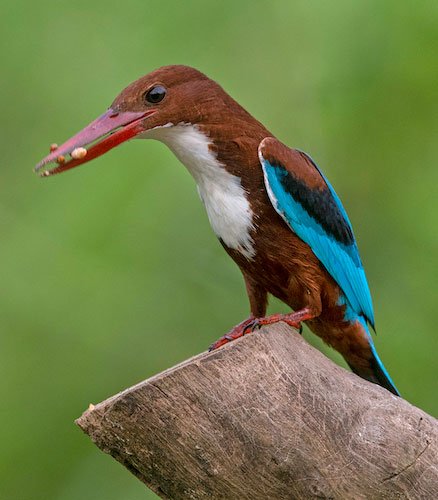
West Bengal is a state in the eastern portion of India. It is situated along the Bay of Bengal. It has a population of over 100 million people within an area of 88,752 km2 (34,267 square miles). West Bengal is the fourth-most populous and thirteenth-largest state by area in India, as well as the eighth-most populous country subdivision of the world. As a part of the Bengal region of the Indian subcontinent, it borders Bangladesh in the east, and Nepal and Bhutan in the north and the Indian states of Jharkhand, Odisha, Bihar, Sikkim and Assam. The state capital is Kolkata, which metropolitan area has a population of 16 million. The city itself is the third-largest metropolis, and seventh largest city by population in India. West Bengal includes the Darjeeling Himalayan hill region, the Ganges delta, the Rarh region, the coastal Sundarbans and the Bay of Bengal. The state’s main ethnic group are the Bengalis, with the Bengali Hindus forming the demographic majority.
West Bengal is on the eastern bottleneck of India, stretching from the Himalayas in the north to the Bay of Bengal in the south. The Darjeeling Himalayan hill region in the northern extreme of the state is a part of the eastern Himalayas Mountain range. In this region is Sandakfu, which, at 11,929 feet, is the highest peak in the state. The narrow Terai region separates the hills from the North Bengal plains, which in turn transitions into the Ganges delta towards the south. The Rarh region intervenes between the Ganges delta in the east and the western plateau and high lands. A small coastal region is in the extreme south, while the Sundarbans mangrove forests form a geographical landmark at the Ganges delta.
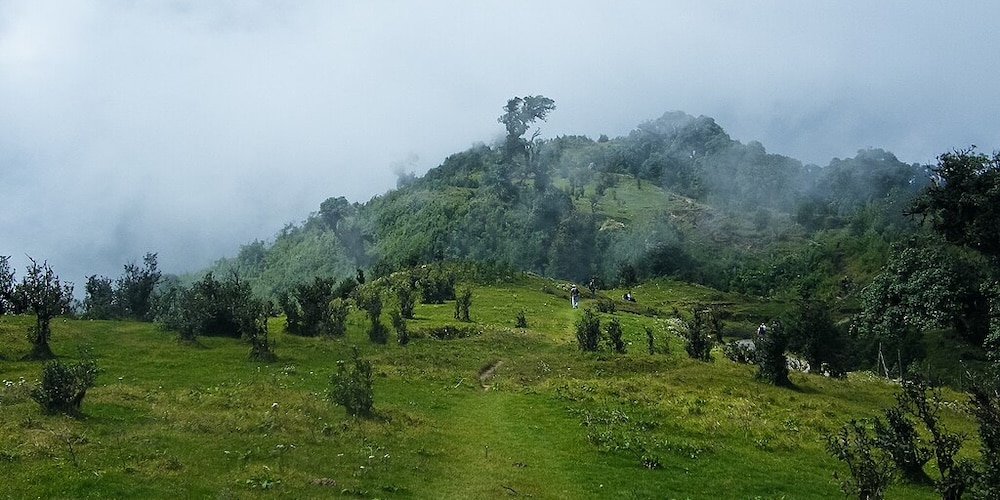
Singalila National Park – ©Spattadar CC BY-SA 4.0 via Wikimedia Commons
The main river in West Bengal is the Ganges, which divides into two branches. One branch enters Bangladesh as the Padma, while the other flows through West Bengal as the Bhagirathi River and Hooghly River. The Farakka barrage over the Ganges feeds the Hooghly branch of the river by a feeder canal. Its water flow management is a source of lingering dispute between India and Bangladesh. The Teesta, Torsa, Jaldhaka and Mahananda rivers are in the northern hilly region. The western plateau region has rivers such as the Damodar, Ajay and Kangsabati. The Ganges delta and the Sundarbans area have numerous rivers and creeks. Pollution of the Ganges from indiscriminate waste dumped into the river is a major problem. Damodar, another tributary of the Ganges and once known as the ‘Sorrow of Bengal’ (due to its frequent floods), has several dams under the Damodar Valley Project. At least nine districts in the state suffer from arsenic contamination of groundwater.
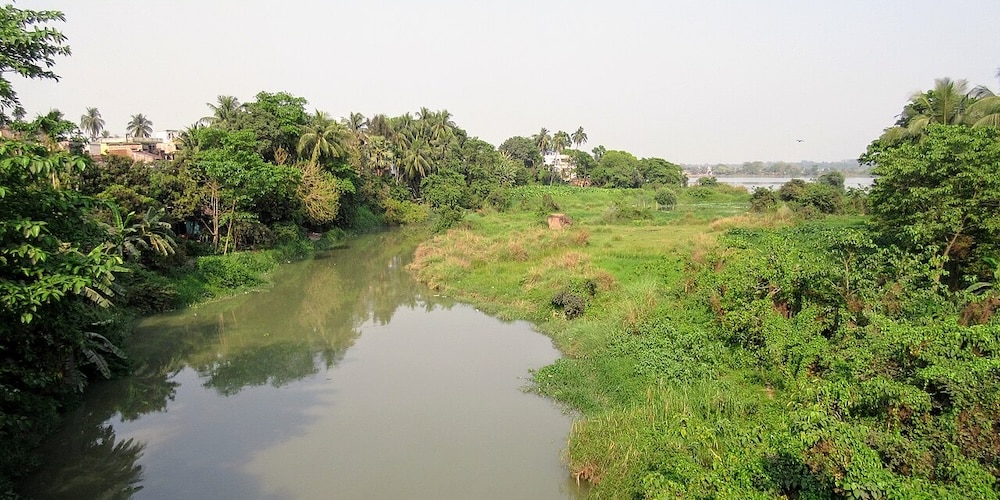
Saraswati River meeting the Hooghly River – ©Dassurojitsd CC BY-SA 4.0 via Wikimedia Commons
West Bengal’s climate varies from tropical savanna in the southern portions to humid subtropical in the north. The main seasons are summer, the rainy season, a short autumn and winter. While the summer in the delta region is noted for excessive humidity, the western highlands experience a dry summer like northern India. The highest daytime temperatures range from 38 to 45 °C. At night, a cool southerly breeze carries moisture from the Bay of Bengal. In early summer, brief squalls and thunderstorms known as Kalbaisakhi often occur. West Bengal receives the Bay of Bengal branch of the Indian Ocean monsoon that moves in a southeast to northwest direction. Monsoons bring rain to the whole state from June to September. Heavy rainfall of above 100 inches can occur in the Darjeeling, Jalpaiguri, and Cooch Behar districts. During the arrival of the monsoons, low pressure in the Bay of Bengal region often leads to the formation of storms in the coastal areas. Winter (December–January) is mild over the plains with average minimum temperatures of 15 °C. A cold and dry northern wind blows in the winter, substantially lowering the humidity level. The Darjeeling Himalayan Hill region experiences a harsh winter, with occasional snowfall.
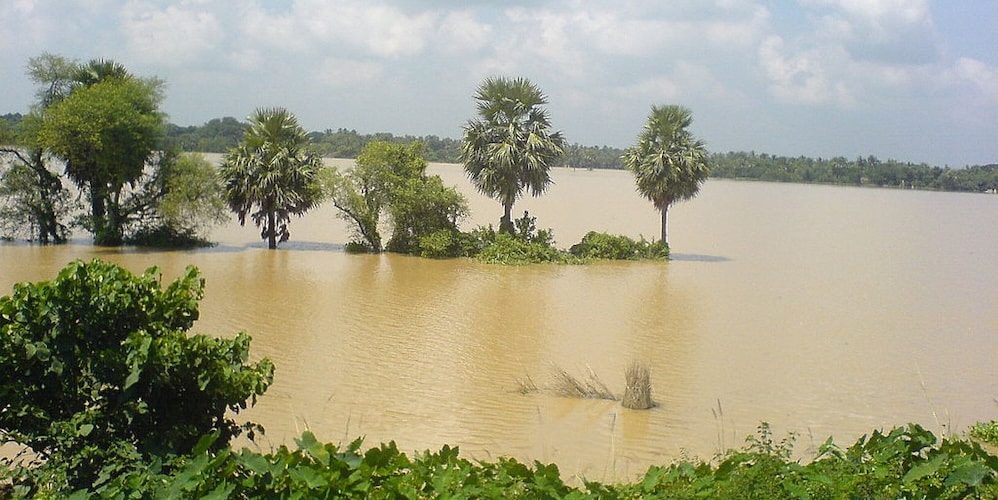
Monsoon Flooding – ©Soumyasch CC BY-SA 3.0 via Wikimedia Commons
The forested area of the state covers 16,847 km2 (6,505 square miles), around 19% of the state’s geographical area. Reserves and protected parts constitute 90% of forested areas. Part of the world’s largest mangrove forest, the Sundarbans is in southern West Bengal. From a phytogeographic viewpoint, the southern part of West Bengal can be divided into two regions: the Gangetic plain and the littoral mangrove forests of the Sundarbans. The alluvial soil of the Gangetic plain, combined with favourable rainfall, makes this region especially fertile. Much of the vegetation of the western part of the state has similar species composition with the plants of the Chota Nagpur plateau in the adjoining state of Jharkhand.
The distribution of vegetation in northern West Bengal is dictated by elevation and precipitation. For example, the foothills of the Himalayas, the Dooars, are densely wooded with sal and other tropical evergreen trees. Above an elevation of 3,300 feet, the forest becomes predominantly subtropical. In Darjeeling, which is above 4,900 feet, temperate forest trees like oaks, conifers and rhododendrons predominate.
Birding West Bengal
The state has fifteen wildlife sanctuaries and five national parks – Sundarbans National Park, Buxa Tiger Reserve, Gorumara National Park, Neora Valley National Park and Singalila National Park. Wildlife includes Indian rhinoceros, Indian elephant, various deer, leopard, gaur, tiger and crocodiles, as well as many bird species. Many migratory birds over-winter. The high-altitude forests of Singalila National Park shelter red panda and pangolin as well as Kalij Pheasant and many other sought-after birds. The Sundarbans are noted for a reserve project devoted to conserving the endangered Bengal tiger, although the forest hosts many other endangered species such as the Gangetic dolphin, river terrapin and estuarine crocodile. The mangrove forest also acts as a natural fish nursery, supporting coastal fishes along the Bay of Bengal. Recognising its special conservation value, the Sundarbans area has been declared a Biosphere Reserve.
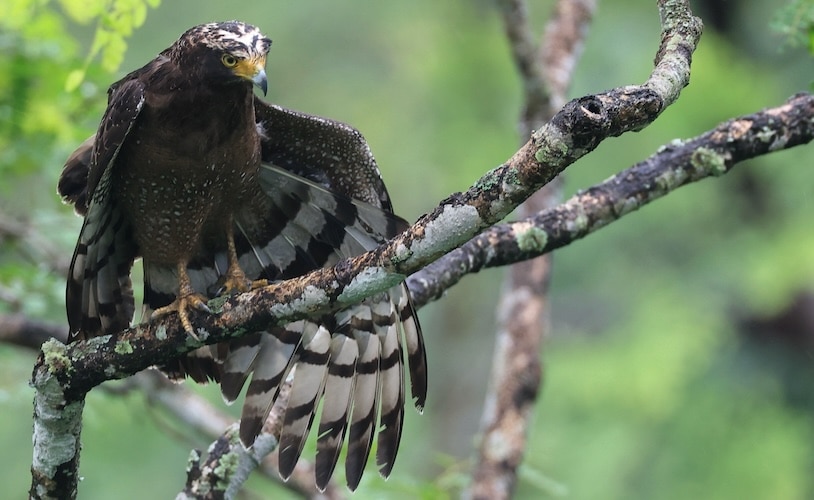
Crested Serpent Eagle Spilornis cheela – ©Bird-Photo-Tours ASIA
The best birding region comprising the state of Sikkim and the adjoining parts of North Bengal – Darjeeling and Kalimpong, lies between Latitude 27 and 28 degrees North, and Longitude 87 to 89 degrees East. It is a rugged strip of vertical mountain country. Wedged between Nepal, Tibet, Bhutan, and the North Bengal Plains of India.
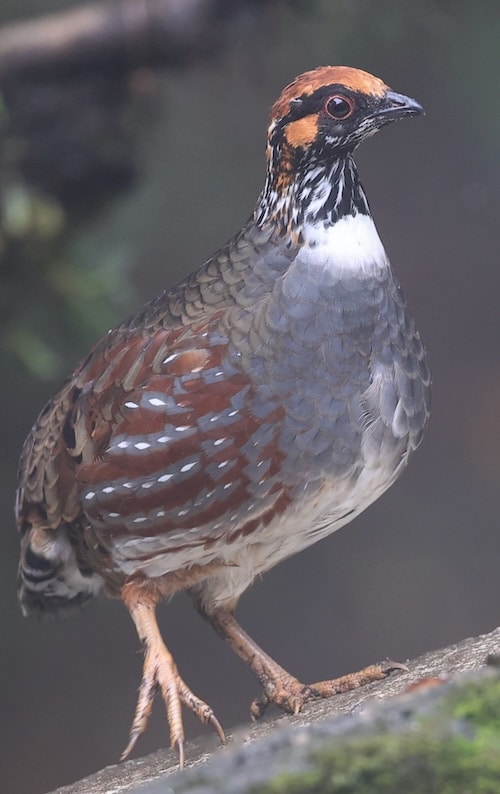
Hill Partridge Arborophila torqueola – ©Bird-Photo-Tours ASIA
This tiny region is just 90km wide and 150km deep. The country rises from near sea level to 8,500 meters, in a very short distance, The great Himalayan Range with its giant spurs – Singelila and Chola, virtually enclose this region in a titanic horseshoe. Starting from the plains of North Bengal tangled interlacing ridges rise range after range to the foot of the great wall of high peaks and passes opening into Tibet, Nepal and Bhutan.
The climate varies between the tropical heat of the valleys and the alpine cold of the snowy regions. With rainfall averaging 137 inches, it is the most humid region of the Himalayas. (The dry season is from November to March). The altitudinal zones of vegetation range from Tropical, through sub-tropical and temperate to Alpine. In some places only 10kms in a direct line separate the palm growing valleys from perpetual snow.

Grey-sided Laughing Thrush Pterorhinus caerulatus – ©Bird-Photo-Tours ASIA
This telescoping of terrain has created marked altitudinal zonation in the humidity, rainfall, climate and vegetation. This factor is responsible for the great variety and abundance of the resident bird life, making this area arguably one of the richest areas of its size anywhere in the world. Dr Salim Ali – one of India’s foremost ornithologists – recorded 527 species of resident birds. In addition, there are vagrants, and transients on migration. It is estimated that more than 30% of the species of the whole Indian Sub-continent can be seen in this small region.
This page is sponsored by Bird-Photo-Tours ASIA

-
Lava
InformationSatellite ViewThis is the prime birding destination in this region, located 35Km from Kalimpong (1¼hrs). It is 85Km from Darjeeling via Kalimpong. (4hrs) Alternativly it is 115Km from Bagdogra Airport via Kalimpong (4hrs). It is a small bazaar, once a halting place for caravans on the trade routes to Bhutan and Sikkim. It is now a tiny forest Village with a Buddhist Monastery amidst a sea of evergreen forests at an elevation of 2100m. Surrounded by very large tracts of protected forests ranging in elevation between 1600m and 2400m, it includes the remote and uninhabited Neora National Park. It is a bird watcher`s delight. The forests have rough roads and walking trails. Birding is feasible from the main roads. However for deeper entry, forest department permission and a guide is required. Some of the sought after birds that have been recorded are: Satyr Tragopan, Ashy Wood-pigeon, Rufous-throated and Spotted Wren Babblers, Yellow-throated Fulvetta, Red-faced Liocichla, Cutia, Rusty-belied Shortwing, Blue-fronted robin & Long-billed Thrush. Even though densities are not high, it is possible to spot in excess of 200 species in 4-5 days of birding. -
Samthar-Ponbu - Dong
Satellite ViewThe Samthar area at an elevation of 1500m, is connected to Lava by a 52Km forest road, which is partly a wilderness trail. This forested drive via Lolegaon, offers good birding. Driving time from Lava is 2½hrs and from Kalimpong 3½hrs. This is still an unexplored area, and birders with a pioneering spirit and strong legs will love the experience. The terrain around Samthar comprises interlocking ridges with forest cover on the top and terraces lower down. Water courses (local name Jhora for smaller ones and Khola for larger ones) form deep valleys, with bio-diverse flora. They feed the Samthar Khola on the North, The Lish River in the East, the Suruk Khola in the West and the Ponbu Khola in the South. All lead to the Teesta River. Large tracts of reserve forest also exist. The area is criss-crossed by many easy walking trails. Several birding hot spots have been identified. Many virgin areas await exploration. Most of the species like Pigmy Blue Flycatcher & Long-tailed Broadbills occurring below 2,500m around Lava are present around Samthar -Ponbu- Dong areas. February-March and November-December are good months as altitudinal migrants are present. Added attractions are sunrise and sunset views and staying at the atmospheric Samthar Farm House. -
Singelila (Sandakphu) Range
InformationSatellite ViewThe Sandakphu Ridge of the Singelila Range is located at an elevation of 3,600m. Maneybhanjan, 30km from Darjeeling (2 hours by jeep) and 70Km (4 hrs) from Kalimpong is the starting point for a 5-8 days trek, which provides good birding in Bamboo, Oak, and Rhododendron forests between 2,000m and 3,000m elevation. Some of the best species recorded are, Blood Pheasant, Satyr Tragopan, Hill Partridge, Collared Pygmy Owlet, Darjeeling Woodpecker, Spotted Nutcracker, Slender-billed Scimitar Babbler, Scaly-breasted Wren Babbler, Brown & Black-throated Parrotbill, Spotted and Chestnut-crowned Laughingthrush, Plain Mountain Finch, White-winged Grosbeak, Dark-breasted & White-browed Rosefinch, Plain Mountain Finch, White-winged Grosbeak, Dark-breasted and White-browed Rosefinch. There is also the attraction of breathtaking views of Khangchen Dzonga, and glimpses on Mount Everest, apart from the delightful forests.
-
Number of bird species: 1007
(As at July 2025)State Bird: White-throated Kingfisher Halcyon smyrnensis
-
Avibase
PDF ChecklistThis checklist includes all bird species found in West Bengal , based on the best information available at this time. It is based on a wide variety of sources that I collated over many years. I am pleased to offer these checklists as a service to birdwatchers. If you find any error, please do not hesitate to report them. -
Bubo Birding
PDF ChecklistThis checklist includes all species that have been reported in West Bengal in eBird, but updated to IOC taxonomy, together with the likelihood of seeing each species for each month of the year. -
E-Bird
PDF ChecklistThis checklist is generated with data from eBird (ebird.org), a global database of bird sightings from birders like you. If you enjoy this checklist, please consider contributing your sightings to eBird. It is 100% free to take part, and your observations will help support birders, researchers, and conservationists worldwide. -
Indian Birds
Annotated PDF ChecklistA checklist of the birds of West Bengal, India

-
Birds of the Indian Subcontinent
| By Richard Grimmett, Carol Inskipp & Tim Inskipp | Helm | 2025 | Edition 2 | Paperback | 544 pages, 240+ plates with colour illustrations; colour distribution maps, b/w illustrations | ISBN: 9781472984777 Buy this book from NHBS.com -
Urban Biodiversity of Calcutta
| (Flowering Plants, Butterflies, Birds and Mammals, West Bengal, India) | By Suchitra Ghosh | Zoological Survey of India | 2010 | Paperback | 250 pages, colour illustrations, colour maps | ISBN: 9788181712813 Buy this book from NHBS.com
Birds of the Indian Subcontinent
Apple iOS | AndroidThe eGuide to Birds of the Indian Subcontinent is an interactive companion to Birds of the Indian Subcontinent – the definitive guide for birdwatchers visiting the region. It covers India, Pakistan, Nepal, Bhutan, Bangladesh, Sri Lanka and the Maldives. This application has specific features that will enhance your birding experience.
Indian Birds
Apple iOS | AndroidPioneers in bringing Indian Birding to the smart phone generation - Introducing Indian Birds, the time-honoured and cherished birding companion for India. Established in 2010, it proudly remains the sole mobile app available on App Store, offering bird enthusiasts the ability to explore bird namesOrganisations-
Birdwatchers’ Society Of Bengal
WebsiteA group of birdwatchers who conduct regular bird walks, bird monitoring programs and workshops for all age groups. They are most active in and around Kolkata but function throughout West Bengal.
Reserves-
*National Parks and Wildlife Sanctuaries
InformationSatellite View24 national parks and reserves with interactive links. -
NP Gorumara
InformationSatellite ViewLocated in the Dooars region of the Himalayan foothills, it is a medium-sized park with grasslands and forests. It is primarily known for its population of Indian rhinoceros. The park has recorded fifty species of mammals, 194 species of birds, 22 species of reptiles, 7 species of turtles, 27 species of fish, and other macro and micro fauna. Birds at the Gorumara National Park include submontane forest birds like the scarlet minivet, sunbird, Asian paradise flycatchers, spangled drongo, and Indian hornbill. Numerous woodpeckers and pheasants inhabit the park. Peafowls are very common. The park is on the flyway of migratory birds including the rare brahminy duck. -
NP Jaldapara
InformationSatellite ViewJaldapara Sanctuary is of 26 sq. km where one-horned rhinoceros, elephant, sambhar, barking deer, spotted deer etc. can be spotted. The drive to Jaldapara takes you over the coronation bridge through the dense forests to the Bengal Plains and through the tea gardens to Madrihat. -
NP Neora Valley
InformationSatellite ViewNeora Valley National Park thus is known as birders' paradise; some of India's most sought-after birds are found here in winter months as well. The semi-evergreen forests between 1600 m and 2700 m is the home of several rarities like rufous-throated partridge, satyr tragopan, crimson-breasted woodpecker, Darjeeling woodpecker, bay woodpecker, golden-throated barbet, Hodgson's hawk cuckoo, lesser cuckoo, brown wood owl, ashy wood pigeon, mountain imperial pigeon, Jerdon's baza, black eagle, mountain hawk eagle, dark-throated thrush, rufous-gorgeted flycatcher, white-gorgeted flycatcher, white-browed bush robin, white-tailed robin, yellow-browed tit, striated bulbul, chestnut-headed tesia, chestnut-crowned warbler, black-faced warbler, black-faced laughingthrush, chestnut-crowned laughingthrush, streak-breasted scimitar babbler, scaly-breasted wren-babbler, pygmy wren-babbler, rufous-fronted babbler, black-headed shrike babbler, white-browed shrike babbler, rusty-fronted barwing, rufous-winged fulvetta, brown parrotbill, fire-breasted flowerpecker, fire-tailed sunbird, maroon-backed accentor, dark-breasted rosefinch, red-headed bullfinch, gold-naped finch and many other rarities. -
NP Singalila
InformationSatellite ViewSingalila National Park is a national park of India located on the Singalila Ridge at an altitude of more than 7000 feet above sea level, in the Darjeeling district of West Bengal. It is well known for the trekking route to Sandakphu that runs through it. The park is a birder's delight with over 120 species recorded including many rare and exotic species like the scarlet minivet, kalij pheasant, blood pheasant, satyr tragopan, brown and fulvous parrotbills, rufous-vented tit, and Old World babblers like the fire-tailed myzornis and the golden-breasted fulvetta. The park is also on the flyway of many migratory birds. -
NP Sunderbans
InformationSatellite ViewThe Sundarbans National Park is a National Park, Tiger Reserve, and a Biosphere Reserve in West Bengal, India. It is part of the Sundarbans on the Ganges Delta, and adjacent to the Sundarban Reserve Forest in Bangladesh. The Sundarbans forest is home to more than 400 tigers and is very rich in birdlife. -
NR Mayurjharna Elephant Reserve
InformationSatellite ViewThe area of this elephant reserve is 414.06 km2. and adjoining 1436 km2. area is also declared as 'Zone of Influence'. The elephant population in MER increased from 47 in 1987 to 118 in 2010. -
TR Buxa
InformationSatellite ViewThe Buxa Tiger Reserve is a 760-square-kilometre (290 square mile) tiger reserve located inside the Buxa National Park in West Bengal, India, in the Buxa Hills of the southern hilly area south of Bhutan. Animals found in the park include, the tiger, civet, elephant, gaur (Indian bison), Indian boar and red jungle fowl. There are more than 284 species of birds, 73 species of mammals, 76 species of snakes and 5 species of amphibians have been identified so far including greater pied hornbill, ibisbill and the rare black necked crane. -
WS Ballabhpur
InformationSatellite ViewIt is home to a number of deer including the Blackbuck and Spotted deer. Other animals include jackals, foxes and a variety of water birds. -
WS Bethuadahari
InformationSatellite ViewBethuadahari Wildlife Sanctuary is situated in the Bethuadahari town (Nakashipara area) of Nadia District, West Bengal, India. The sanctuary is located beside National Highway 34 and covers 67 hectares, and was established in 1980 to preserve a portion of the central Gangetic alluvial ecozone. Bird species include parakeets, Indian cuckoos, barbets and a variety of passerines. -
WS Bibhutibhushan
InformationSatellite ViewBibhutibhusan Wildlife Sanctuary (formerly Parmadan Forest) is an animal sanctuary in North 24 Parganas district in the Indian state of West Bengal.[1] The forest is located about 100 km from Kolkata and 25 km from Bongaon. Situated on the banks of the Ichamati River covering an area of 0.68 km2 it has more than 200 deer, birds, rabbit and a large number of langurs. -
WS Chapramari
InformationSatellite ViewChapramari Wildlife Sanctuary (formerly Chapramari Wildlife Reserve) is close to the Gorumara National Park. It is about 30 kilometres from Chalsa and Lataguri in northern West Bengal, India. The total coverage of the forest is 960 hectares. A large variety of flora and fauna are found in the forests. Chapramari is known for its elephant population. Gaur (commonly known as Indian bison) are not uncommon in the Chapramari region. Rhinoceros, Deer, boars, and leopards are also found there. However like Gorumara Royal Bengal Tiger are not found here. The place is popular with bird watchers, with parakeets, kingfishers, and green pigeons found in abundance. -
WS Mahananda
InformationSatellite ViewBirds at Pangolakha Wildlife Sanctuary includes some very endangered species like Rufous-necked Hornbill, Oriental Pied Hornbill, Great Hornbill etc. Among the others swallow, swift, thrush, babbler, warbler, roller, minivet and sunbird can be found in abundance. -
WS Raiganj (aka Kulik Bird Sanctuary)
InformationSatellite ViewThe bird sanctuary is home to 164 species of birds, and some 90,000 to 1,00,000 migratory birds visit the sanctuary every year. -
WS Senchal
InformationSatellite ViewSenchal Wildlife Sanctuary was set up in 1915 in the Darjeeling District of West Bengal, India. It is one of the oldest wildlife sanctuaries of India. It covers an area of 38.6 km2 (14.9 sq mi). The elevation ranges from 1,500 to 2,600 m (4,900 to 8,500 ft). High-altitude animals such as barking deer, wild pig, himalayan black bear, leopard, jungle cat, common rhesus monkey, Assam macaque, Himalayan flying squirrel, etc. are found in their natural habitats. The sanctuary is also rich in bird life. The two Senchal lakes supply drinking water to the town of Darjeeling.
Sightings, News & Forums-
eBird
SightingseBirding This Month
Guides & Tour Operators-
All India Birding Tours
Local Tour OperatorWe will be visiting chosen “hot spots” These include Mahananda WLS ( 100-300 m), Lava Reserved Forests and fringes of Neora National Park ( 2000- 2700 m), The Rangit River Valley ( 300 –1200 m), Hilley forests and Vershay Rhododendron Sanctuary ( 2300-3050 m), Sandakphu Ridge of 3600 mtrs. -
Asian Adventures
Local Tour Operator300 Himalayan Birds and Mammals of Sikkim and North Bengal in 2 Weeks -
Avion Holidays
Tour Operatoringalila National Park or the Sandakhphu Trek as popularly known, ranges from 2000mts to 3600 mts. The habitat varies from bamboos, oaks, to rhododendron. The trek which starts from Manebhanjan is a spectacular birding trail, which can be covered in 3.5 days. -
Bird Photo Tours ASIA
Tour OperatorThis is a specially-designed wetland Bird-Photo-Tour focused around West Bengal plus Gujarat States and is home to thousands of wintering wildfowl and via individual boats, one client per boat, each driven by a skilled local boatsman, photographers can obtain point-blank views of its waterbirds. -
Farouttrek
Local Tour OperatorThe Singalila National Park and Neora Reserve Park are the best spots for Bird watching tour in Darjeeling, also because of the mountain views that these. -
India Birding Tours
Local Tour OperatorThe quiet village of Latpanchar in the Himalayan foothills of northern Bengal is the focus of our Mahananda Wildlife Sanctuary Short Birding Tours. Spread out over 159 sq. km of forested area between the Teesta and Mahananda rivers -
Jungle Lore
Local Tour OperatorSpecial Birds and Mammals of Assam and North Bengal – 250 Species in 2 weeks -
Ryask Tourism
Local Tour OperatorBest Birdwatching Tours in West Bengal India- Book Now -
Shikhar Travels
Local Tour OperatorBirding in Assam and West Bengal -
Tour My India
Local Tour OperatorAre you an avid bird watcher who just cherishes to see the various species of birds in their natural habitats or enjoy their sweet chirping? If yes, then a bird watching trip to Assam and West Bengal is what you should not miss. -
WildIndiaTravels
Local Tour OperatorLava is a beautiful birdwatching destination. It is not only the birder’s paradise but a very nice place to spend your holidays. In this article, we will focus on certain things like how to reach Lava, what to see as sightseeing places, where to stay in Lava, budget hotels and homestays of Lava, etc. Lava is a very beautiful and ideal place for nature study and birdwatching.
Trip Reports-
2017 [02 February] - Titash Chakrabarti
ReportBirding on fishing boats on the Ox-bow Lake at Chupi/Purbasthali (Burdwan, West Bengal). This 11 kms long lake in the shape of an Ox-bow has been the winter and permanent homes of thousands of ducks, waders and other birds from time immemorial, i suppose. -
2017 [11 November] - Julian Bell - Darjeeling & Sikkim
ReportThis trip report covers the best part of a week spent in Darjeeling and Sikkim, starting off at Kurseong for a few days before moving to Glenburn and then onwards to Biksthang (Sikkim). As usual for my holidays this was not by any means a full-on birding trip - though I did spend a whole day birding in the vicinity of Kurseoung and had a number of early morning walks. -
2018 [05 May] - Phil Gregory
Report...We began by birding at a wetland area called Rajarhat in Kolkata, which gave us Asian Openbill, Watercock, Greater Painted Snipe, Bengal Bushlark and Red Avadavat, all valuable additions to the triplist and a nice easy start... -
2024 [12 December] - Ashit Gandhi
ReportExploring the Avian Wonders - Part 2: A Birding Adventure at Buxa Tiger Reserve (West Bengal) -
2025 [02 February] - Bird-Photo-Tours
ReportThis trip report showcases many of the photographic portraits from this Bird-Photo-Tour to the Indian States of West Bengal and Gujarat, with an itinerary that focussed principally on wetland birds photography.
Places to Stay-
West Bengal Forest Development Lodges
AccommodationThe West Bengal Forest Development corporation has a number of lodges well-located for birding in West Bengal. -
West Bengal Retreats
AccommodationSinclairs Retreat Dooars is a getaway resort spread over 20 acres at Dooars...
Fatbirder - linking birders worldwide...
Skip to content