

Madhya Pradesh
Madhya Pradesh literally means ‘Central Province’ and the state is located in the geographic heart of India. Its capital is Bhopal (population 2.7 million) and the largest city is Indore with 3.5 million. Other major cities include Gwalior, Jabalpur, and Sagar. Madhya Pradesh is the second largest Indian state by area and the fifth largest state by population with over 88 million residents. It borders the states of Rajasthan to the northwest, Uttar Pradesh to the northeast, Chhattisgarh to the east, Maharashtra to the south, Gujarat to the west. The state straddles the Narmada River, which runs east and west between the Vindhya and Satpura ranges; these ranges and the Narmada are the traditional boundaries between the north and south of India. The highest point in Madhya Pradesh is Dhupgarh, with an elevation of 4,429 feet.
The Satpuras, in the Gawilgarh and Mahadeo Hills, also contain a watershed, which is south facing. The Wainganga, the Wardha, the Pench, the Kanhan rivers, discharge an enormous volume of water into the Godavari River system. The Godavari basin consists of sub-tropical, semi-moist forests, mainly in the valley of the Indrawati. Narmada is the longest river and it flows westward through a rift valley, with the Vindhya ranges sprawling along its northern bank and the Satpura range of mountains along the southern. Its tributaries include the Banjar, the Tawa, the Machna, the Shakkar, the Denwa and the Sonbhadra rivers. The Tapti River runs parallel to Narmada, and also flows through a rift valley.
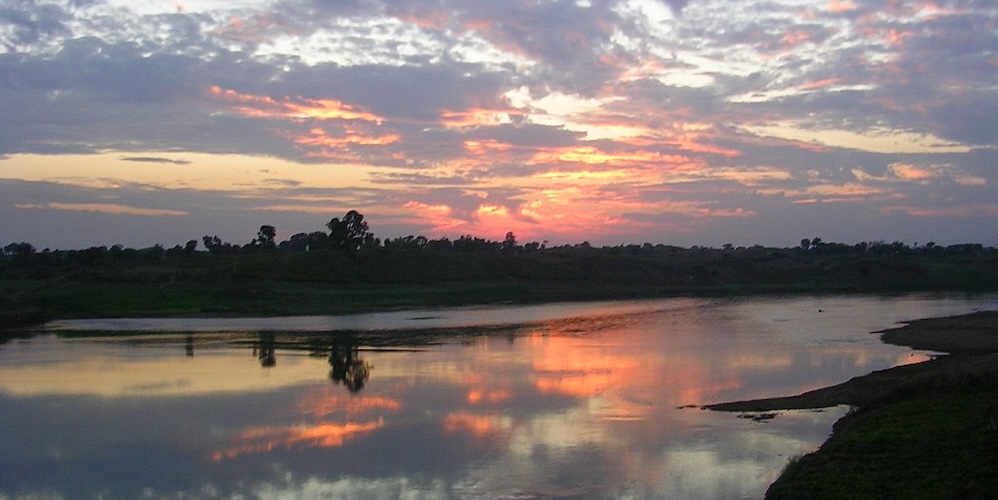
Narmada River – ©Rbsrajput CC BY-SA 3.0 via Wikimedia Commons
The Narmada–Tapti systems carry an enormous volume of water and provide drainage for almost a quarter of the land area of Madhya Pradesh. The Narmada River is considered very sacred and is worshipped throughout the region. It is the main source of water and acts as a lifeline to the state. The Vindhyas form the southern boundary of the Ganges basin, with the western part of the Ganges basin draining into the Yamuna and the eastern part directly into the Ganges itself. All the rivers, which drain into the Ganges, flow from south to north, with the Chambal, Shipra, Kali Sindh, Parbati, Kuno, Sind, Betwa, Dhasan, Ken and Sun arrivers being the main tributaries of the Yamuna. Shipra is stretched across Indore, Ujjain and Dewas. The land drained by these rivers is agriculturally rich, with the natural vegetation largely consisting of grass and largely thorny, dry deciduous forest. The eastern part of the Ganges basin consists of the Son, the Tons and the Rihand Rivers. Son, which arises in the Maikal hills around Amarkantak, is the largest tributary that goes into the Ganges on the south bank and that does not arise from the Himalayas. Son and its tributaries contribute the bulk of the monsoon flow into the Ganges, because the north bank tributaries are all snow fed. The forests in their basins are much richer than the thorn forests of the northwestern part of Madhya Pradesh.
There are three major seasons – Summer, Monsoon, and Winter. During summer (March to June), the temperature in the entire state ranges above 34 °C, it has increased as it is all-time high in Madhya Pradesh. In general, the eastern parts of Madhya Pradesh are hotter than the western parts. The regions like Gwalior, Morena and Datia record temperatures of over 42 °C in May. The humidity is relatively very low and the region usually experiences frequent mild dust storms. The southwest Monsoon usually breaks out in mid-June and the entire state receives a major share of its rainfall between June and September. The south and south-east regions tend to experience a higher rainfall whereas the parts of the north-west receive less. Jabalpur, Mandla, Balaghat, Sidhi, and other extreme eastern parts receive more than 60 inches of rainfall. The districts of western Madhya Pradesh receive less than 32 inches.
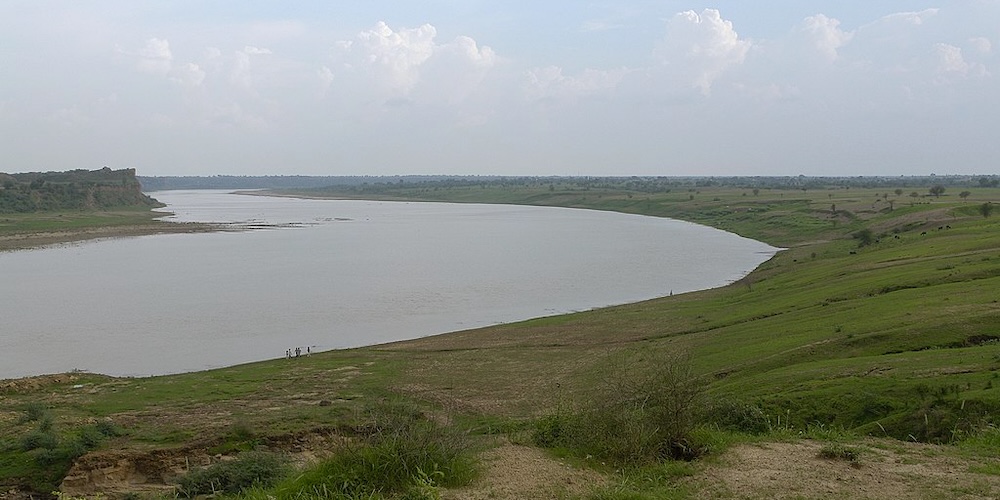
National Chambal Gharial Wildlife Sanctuary – © Yann Forget CC-BY-SA via Wikimedia Commons
The winter season starts in November. The temperature remains low in the northern parts of the state in comparison to the southern parts. The daily maximum temperature in most of the northern part of January remains between 15 and 18 °C. The climate is generally dry and pleasant with a clear sky. The average rainfall is about 47 inches. The southeastern districts have the heaviest rainfall, some places receiving as much as 85 inches, while the western and northwestern districts receive 40 inches or less. Rich in mineral resources, Madhya Pradesh has the largest reserves of diamond and copper in India. Fortunately, for visiting birders and conservationists, 30% of the state is still forested, covering an area of 94,689 km2 (36,560 square miles). That is c. 12% of the forested area of India as a whole. The forest cover is less dense in the northern and western parts of the state, which contain the major urban centres. Variability in climatic and soil conditions brings about significant difference in the forest types of the state. Based on composition, the teak and sal forests are the most important forest formations in the state. Bamboo-bearing areas are widely distributed. In January 2019 1.5 million volunteers in the state planted 66 million trees along the Narmada River in just 12 hours.
Birding Madhya Pradesh
Madhya Pradesh is home to eleven National Parks; Bandhavgarh National Park, Kanha National Park, Satpura National Park, Sanjay National Park, Madhav National Park, Van Vihar National Park, Mandla Plant Fossils National Park, Panna National Park, Pench National Park and Dinosaur National Park, Dhar. There are also a number of nature reserves, including Amarkantak, Bagh Caves, Balaghat, Bori Natural Reserve, Ken Gharial, Ghatigaon, Kuno Palpur, Narwar, Chambal, Kukdeshwar, Chidi Kho, Nauradehi, Pachmarhi, Panpatha, Shikarganj, Patalkot, and Tamia. Pachmarhi Biosphere Reserve in Satpura Range, Amarkantak biosphere reserve and Panna National Park are three of the 18 biosphere reserves in India. Most of them are located in eastern Madhya Pradesh near Jabalpur.
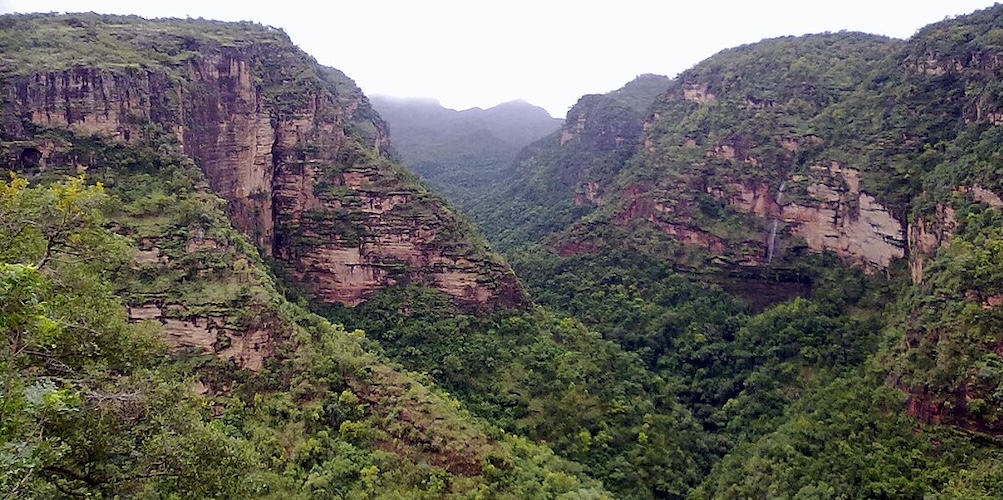
Pachmarhi Biosphere Reserve – ©Abhayashok CC BY-SA 3.0 via Wikimedia Commons
Kanha, Bandhavgarh, Pench, Panna, and Satpura National Parks are managed as Project Tiger areas. The National Chambal Sanctuary is managed for conservation of gharial and mugger, river dolphin, smooth-coated otter and a number of turtle species. Ken-gharial and Son-gharial sanctuaries are managed for conservation of gharial and mugger.
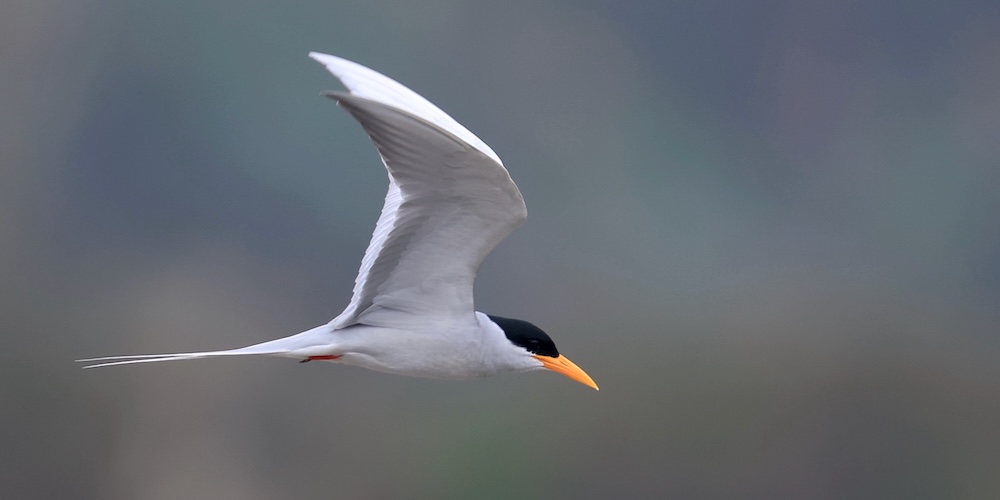
River Tern Sterna aurantia – ©Bird-Photo-Tours ASIA
There is no doubt that the natural splendour of Madhya Pradesh includes a wide spectrum of wildlife inhabiting this land ranging from tigers and leopards to antelopes and gazelles, other mammals and reptiles and an abundance of bird life.
Of the two bio-geographic zones, the semi-arid zone has two subdivisions – Malwa plateau and fragmented wetlands. Madhav National Park and about nine of the wildlife sanctuaries in Madhya Pradesh are located in this zone. The second zone, the Deccan Peninsula includes both the Vindhya and the Satpura hill ranges. Popular tiger reserves like Kanha, Bandhavgarh, Pench, Satpura, Panna, the three National Parks and a score of wildlife sanctuaries are located in this zone. Madhya Pradesh has an effective protected area network of about 10,860 km2 and these reserves continue to harbour their original resident and migrant species.
Forests were nurtured carefully by the royal families to preserve the Tiger’s habitats so they could hunt them. There was a population of around 40,000 tigers in the 1940’s. By 1970, the population of tigers in India perilously declined to about 2000 individuals as the result of the loss of hunting preserves and widespread habitat destruction. Project Tiger was launched in 1973 because of their likely extinction if nothing was done. The objective was to ensure the maintenance of a viable population of the tiger in India and to preserve for all time, such areas for the benefit, education and enjoyment of future generations, which had the added bonus of preserving many areas for other wildlife too. The Project Tiger Directorate provides assistance for scientific management, protection, communication, habitat improvement, water and soil conservation, research, infrastructure etc. Kanha in Mandhya Pradesh was among the first nine reserves designated. Panna, Bandhavgarh, Pench and Pachmarhi were later inclusions. By 2000 estimates of the Madhya Pradesh tiger population was 709 tigers (235 in tiger reserves, 143 in protected areas and 331 tigers in general forest areas) – almost 20% of India’s tigers. The state, therefore, is rightly called the Tiger State.
The state encompasses a breath-taking wilderness along with extensive flora and fauna and rich biodiversity. There are countless variety of plants and animals in a state of interdependence.
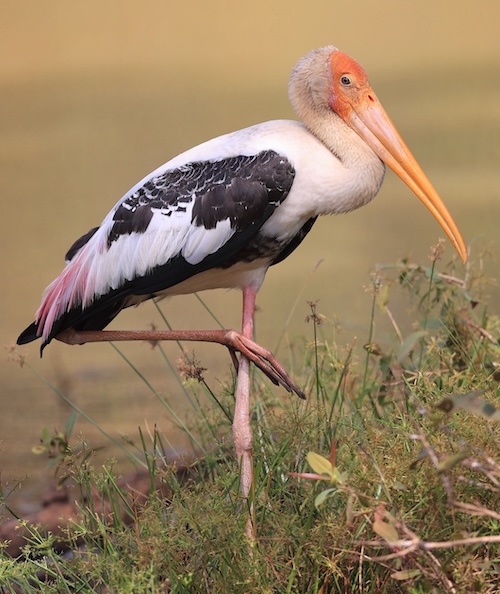
Painted Stork Mycteria leucocephala – Bird-Photo-Tours ASIA
There are more than 1000 species of flowering plants, ferns, orchids, aromatic and medicinal plants. More than half of the forests of the state lie in the eastern region and are tropical. The grasslands along the plateaux and the streams in the valleys are good during the monsoon season but fade away during the hot months of summer. The faunal wealth is equally rich and diverse. Inhabitants include species of cat, antelopes, gazelles and canines, many other species of mammals and reptiles as well as birds. Crocodiles and gharyal inhabit the rivers and lakes. The heavily forested regions and marshes and wetlands create a natural habitat for birds and support a wide variety of birdlife. Some of the best parks and reserves are described in the ‘Top Sites’ section below.
-
Bandhavgarh National Park
WebsiteSatellite ViewOnce the personal hunting ground of the Maharajas of Rewa, Bandhavgarh is famous as the original home of the white tiger. It became a national park in 1965. The national park covers an area of 1161.47 sq km with a core area of 624.75 sq km dominated by extremely rugged terrain with many hills. The adjoining Panpatha wildlife sanctuary created in 1983 has an area of245.84 sq kill. The park is located in the eastern Satpura hill range of Umaria and Katni districts among the outlying hills of the Vindhya range. Many hills and hillocks dot the area amidst valleys, meadows and marshes. There are a number of old tanks, water holes to provide for water sources and Charanganga river is the prominent river flowing through the park. With tropical dry and moist deciduous forests interspersed with grasslands, the vegetation is chiefly of sal forest in the valleys and on the lower slopes with bamboo found in abundance almost throughout. Bandhavgarh has an abundance of tigers and other wildlife species. The reserve is rich in birds, some 250 species are found in the park. The Tala range rich in water and food resources harbours most of the wildlife. The main entry to the park is through Tala, 35 km north of Umaria. Nearest rail heads are Jabalpur (170 km), Katni (102 kill) and Satna (112 kill) on the central railway and Umaria (35 km) on the Katni Bilaspur route. From the Umaria railway station it is an hour`s drive to Tala. State, private transport buses and taxis ply between Katni and Umaria, and from Satna and Rewa to Tala. Khajuraho (210 km) is the nearest airport from where it is a 5 hours drive to Bandhavgarh. The ideal time to visit would be the period between November & June. The park is closed from July to October inclusive. Jeep safaris are available from dawn until about 1000 and from 1600 hours until dark, when the animals are most active. A forest department guide accompanies the visitors. Elephants are also used by the forest department for tiger tracking. The sprawling meadows of Chakradhara, Bhaitari Bah, Raj Bahera, Sehra are rich in avifauna. -
Kanha Tiger Reserve
InformationSatellite ViewKanha Tiger Reserve, also called Kanha National Park, is one of the tiger reserves of India and the largest national park of Madhya Pradesh, state in the heart of India. -
NP Van Vihar
InformationSatellite ViewIt is located in Bhopal, the capital city of Madhya Pradesh. Declared a national park in 1979, it covers an area of about 4.45 km2. Although it has the status of a national park, Van Vihar is developed and managed as a modern zoological park, following the guidelines of the Central Zoo Authority. The animals are kept in their near natural habitat. The wilderness of park offers an ideal habitat for a number of avian fauna. Till now about two hundred species of birds have been listed in different parts of Van Vihar. Large number of birds frequent this park, especially during winter the migratory waterfowl alight in great numbers in the adjoining extensive wetland of big lake. In the 2010s, the park developed a vulture breeding centre which initially focused on restoring populations of Oriental white-backed vultures (Gyps bengalensis), and long billed vultures (Gyps indicus). -
Panna Tiger Reserve
InformationSatellite ViewLocated in the north central part of Madhya Pradesh, the park is spread over an area of 66,640 sq km within the districts of Panna and Chhatarpur. Panna National Park was constituted in 1981 and declared a tiger reserve in 1994 and has an area of 542.69 sq km, Gangau Wildlife Sanctuary 8,753 sq km and Ken Gharial wildlife sanctuary at a distance of about 30 km from Panna national park, an area of 4,520 sq km. The main forest types are southern tropical dry teak forest and northern tropical dry deciduous mixed forest and the reserve is rich in fodder grasses. The lifeline of the park is the Ken River which meanders for about 55 km through the tiger reserve from south to north. Springs and gorges along the course of Ken River offer magnificent sights. Springs (locally called jhirias) are the major water sources available during the months of summer. Regular sightings of Tiger are reported [population is c.32]. Leopard is more common. More than 200 species of birds including a host of migratory birds have been sighted in the park, including Paradise Flycatcher, Indian Pond Heron, Quail, Parakeets, Mynas, Bulbuls, Cuckoos, etc. Khajuraho, the nearest airport is just 25 km from Panna. Satna (70 km) is the nearest railhead for those travelling from Delhi. Varanasi and Kolkata, Katni (130 km) for those travelling from Mumbai, Nagpur and Chennai and Jhansi (194 km) for those travelling from Mumbai, Delhi and Chennai. Madia and Hinouta are the two entry gates to the park, The park is closed between July & September inclusive, the best time to visit is between December to March. Only four wheel drive petrol vehicles are allowed to watch wildlife and to go around the tiger reserve. -
Pench Tiger Reserve
WebsiteSatellite ViewNamed after the river Pench, the Pench Tiger Reserve is located in the southern reaches of the Satpura hill ranges and was constituted in 1992 with a total area of 75,790 sq km out of which 29,286 sq km is the core area of the reserve, 11,830 sq km of Pench wildlife sanctuary and 3,467 sq km of area is the buffer zone. The river Pench meandering through the park divides it between Chhindwara and Seoni districts. The forest cover belongs to southern tropical moist teak and dry teak forests and the southern dry mixed deciduous forest. The ground is covered with a maze of grasses, plants, bushes and saplings. Bamboo is restricted to some valleys, dazzling white kulu (sterculia urens) trees scattered around singly in the forest stand out conspicuously among the various hues of green. The flow of the Pench river stops by December. But a number of water pools serve as water holes for the wild animals. There are a few perennial springs and tanks in this tract. At the southern border of the park at Totladoh, a dam has been constructed on the Pench river which creates a huge 54 sq km reservoir in this part of the park. The Pench Tiger Reserve is 12 km away from Khawasa town on NH 7 between N agpur and Jabalpur. Nagpur is the nearest rail head and airport. Khawasa is just 80 km from Nagpur on NH 7. Jabalpur is 203 km from the park. It is en route to Kanha from Nagpur. The population of tigers is estimated at 40 individuals. Pench boasts of more than 250 species of birds including several migratory ones. Visitors can use their own or hired 4 wheel petrol vehicles. Diesel vehicles and walking on road is not permitted inside the park. Totaladoh Dam, the highest hills in the park, Kalapahad, the place to see a large bison herd, Bison Camp (10 km from Karmajhiri), the Bison Retreat (close to Rukhad) and the watchtowers of Raikassa and Golpahari are the sites which promise a different experience. -
Satpura National Park
WebsiteSatellite ViewSatpura National Park is cradled in the rugged hills of the Satpura range in the Hoshangabad district of Madhya Pradesh. The national park is spread over an area of 142,787 sq km together with the wildlife sanctuaries of Pachmarhi and Bori. Rich in biocultural diversity, the park was established in 1981 and harbours some of the most critically endangered animal and plant species. The terrain is generally hilly with precipitous slopes, deep and narrow gorges ravines sheltered valleys and dense forests with many water falls. Tawa reservoir created on the Tawa River extending over an area of 200 sq km is the main water source along with channels of Soubhadra, Nalni, Denwa and Wagdwari rivers. The area is uniquely diverse ranging from dry thorn forest to tropical dry deciduous, moist deciduous and semi evergreen forests. Teak, sal and mixed forest are the major compositions. The Bori wildlife sanctuary is rich in Bamboo. Over 1200 varieties of flowering and non flowering plants are found in this area. The Tiger is found in good number but is confined to dense forest areas. 35 tigers were recorded in 2001 census. Panthers are found all over the park. The area has a wide spectrum of bird life. Among the birds represented are Jungle Fowl, Quail, Patridges, Bee-eaters, Eagles, Malabar Pied Hornbill, Vultures etc. One is also attracted by a large variety of colourful butterflies, moths and other insects. Madai, Churna, Bori, Dhal and Paraspani are some of the areas of viewing wildlife. The national park is easily accessible by road from Bhopal (210 km), Jabalpur (240 kill), Nagpur (250 kill) and Chhindwara (85 kill). Pipariya (52 km) is the closest railhead and ltarsi is the closest rail junction. Pachmarhi is the closest bus stand and the gateway to this reserve. The best time to visit the park is between November & June. Most of the roads in the park are only passable from December. The park is closed during the monsoon season. Also see: http://www.tribes.co.uk/India/Central-Reserves/satpura-national-park
-
Neelesh Agrawal
Jabalpur, Madyha Pradesh | indiafootprints@hotmail.com
https://indiafootprints.com
-
Number of bird species: 590
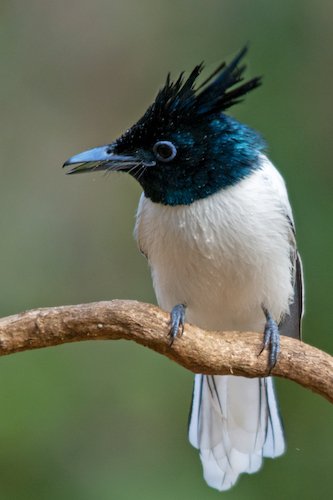
(As at June 2025)State Bird - Indian Paradise Flycatcher Terpsiphone paradisi
-
Avibase
PDF ChecklistThis checklist includes all bird species found in Madhya Pradesh , based on the best information available at this time. It is based on a wide variety of sources that I collated over many years. I am pleased to offer these checklists as a service to birdwatchers. If you find any error, please do not hesitate to report them. -
Bubo Birding
PDF ChecklistThis checklist includes all species that have been reported in Madhya Pradesh in eBird, but updated to IOC taxonomy, together with the likelihood of seeing each species for each month of the year. -
E-Bird
PDF ChecklistThis checklist is generated with data from eBird (ebird.org), a global database of bird sightings from birders like you. If you enjoy this checklist, please consider contributing your sightings to eBird. It is 100% free to take part, and your observations will help support birders, researchers, and conservationists worldwide.

-
Birds of Madhya Pradesh
| By Satish Pande, Niranjant Sant, Kailash Chandra, Pramod Deshpande & Narmada P Shukla | Ela Foundation | 2009 | Paperback | 234 pages, colour photos, colour illustrations, 1 colour map | Out of Print | ISBN: 9788190695527 Buy this book from NHBS.com -
Birds of the Indian Subcontinent
| By Richard Grimmett, Carol Inskipp & Tim Inskipp | Helm | 2025 | Edition 2 | Paperback | 544 pages, 240+ plates with colour illustrations; colour distribution maps, b/w illustrations | ISBN: 9781472984777 Buy this book from NHBS.com -
Threatened Birds of Madhya Pradesh
| By Asad R Rahmani, Arun MK Bharos, Ajay Gaikar & Praver Mourya | The Nature Volunteers Indore | 2021 | Paperback | 215 pages, colour photos, colour distribution maps | ISBN: 9789393215000 Buy this book from NHBS.com
Birds of the Indian Subcontinent
Apple iOS | AndroidThe eGuide to Birds of the Indian Subcontinent is an interactive companion to Birds of the Indian Subcontinent – the definitive guide for birdwatchers visiting the region. It covers India, Pakistan, Nepal, Bhutan, Bangladesh, Sri Lanka and the Maldives. This application has specific features that will enhance your birding experience.
Indian Birds
Apple iOS | AndroidPioneers in bringing Indian Birding to the smart phone generation - Introducing Indian Birds, the time-honoured and cherished birding companion for India. Established in 2010, it proudly remains the sole mobile app available on App Store, offering bird enthusiasts the ability to explore bird namesUseful Information-
Top 5 Bird Sanctuaries in Madhya Pradesh
InformationMadhya Pradesh, the "Heart of India," is a treasure trove of natural beauty and biodiversity.
Organisations-
Bhopal Birds
WebsiteBhopal birds are emerging group of enthusiastic people with a love of nature, a flair for identifying its different components and eager to do something for its conservation. It is registered under the Societies registration act. -
Birds of Madhya Pradesh & Chattisgarh
Facebook PageOrganised Study of Bird Species of MP & CG Regions or Birds Species Migrated in these regions during different seasons. -
Indore Birding Club
Facebook PageThe Indore Birding Club (IBC) is an independent, educational organization dedicated to fostering a love for birdwatching and nature conservation. As a thriving community of bird enthusiasts, photographers, and conservationists, IBC promotes the study, appreciation, and protection of birds and their habitats. -
Ujjain Birding Club
Facebook PageThe primary objective of making this group is to enjoy bird watching & photography of birds near Ujjain and also meet up of members on weekends and holidays.
Reserves-
*List of Protected areas of Madhya Pradesh
InformationSatellite ViewProtected areas in Madhya Pradesh include 12 National Parks, 22 Wildlife sanctuaries and 3 Biosphere Reserves. -
BR Achanakmar-Amarkantak Biosphere Reserve
InformationSatellite ViewThe Achanakmar-Amarkantak Biosphere Reserve is a biosphere reserve in India that extends across the states of Madhya Pradesh and Chhattisgarh, covering a total area of 383,551 hectares (3835.51 km2). Besides the rich variety of mammal fauna species, the reserve also provides natural habitat to 170 bird species belonging to 51 families -
NP Bandhavgarh
InformationSatellite ViewThe Bandhavgarh National Park is located within the district of Sahdol in the central Indian state of Madhya Pradesh. This forest nestled among the Vindhya hills came into existence in 1968 when the Maharaja of Rewa handed over the area to the government for it's formation. At the time when it was handed over to the government, the fauna was not faring too well due to the difficulty in the control of poaching. Once this became a protected area, the animal population took a drastic turn and began to flourish. -
NP Kanha
InformationSatellite ViewKanha has a huge variety of birds for birdwatchers to see. Over 300 different species have been reported here. Some of the more interesting ones for bird lovers to look out for are Pied or Marsh Harriers, Red Jungle Fowls, Painted Spur Fowls, Lesser Whistling Teals, Common Teals, Pintails, Cotton Teals, Shovelers, Peafowls, Indian Rollers, Racket Tailed Drongos, Red Wattled Lapwings, Brown Fish Owls, Nightjars, Laggers, Shaheen Falcons, Kestrels, Barn Owls, White Eyed Buzzards, Black Winged Kites, Shikras, Crested Serpent Eagles, Crested Honey Buzzards, Yellow Wattled Lapwings, Green Bee-eaters, Doves, Black Vultures, Scavenger Vultures, Long Billed Vultures, White backed Vultures, gray Hornbills, Tree Pies, Mynahs, Munias, Bushchats, Warblers, Flycatchers, Babblers, Woodpeckers, Black Headed Orioles, Golden Orioles, Paradise Flycatchers, Pied Malabar Hornbills, Indian Pittas, Indian Stone Curlews, Common Gray Partridges, Painted Partridges, Green Pigeons, Black Ibis, White Necked Storks, Lesser Adjutant Storks, White breasted Kingfishers, Pied Kingfishers, Egrets and Cormorants. -
NP Kuno
InformationSatellite ViewKuno-Palpur Wildlife Sanctuary has been shortlisted by Wildlife Institute of India (WII) and Wildlife Trust of India (WTI) as one of the last remaining habitats of the cheetah (Acinonyx jubatus) in India and is proposed as one of the sites for the reintroduction of the species in India.[19][20][21] Asiatic cheetahs (Acinonyx jubatus venaticus) that used to occur here are now locally extinct in India and elsewhere, except a very small critically endangered and fragmented population of last few, estimated to be below 100, thought to be surviving only in the central desert of Iran. -
NP Madhav
InformationSatellite ViewMadhav National Park is equally rich in avifauna. The artificial lake, Chandpatha, is the winter home of migratory geese, pochard, pintail, teal, mallard and gadwall. A good site for bird watching is where the forest track crosses the rocky stream that flows from the waste weir. Species that frequent this spot are red-wattled lapwing, large pied wagtail, Indian pond heron and white-breasted kingfisher. The park's avifauna also includes the cormorant, painted stork, white ibis, laggar falcon, purple sunbird, Asian paradise flycatcher and golden oriole… -
NP Pench
WebsiteSatellite ViewPench National park, nestling in the lower southern reaches of the satpuda hills is named after Pench river, meandering through the park from north to south. It is located on the southern boundary of Madhya Pradesh, bordering Maharashtra, in the districts of Seoni and Chhindwara.Pench National Park, comprising of 758 SQ Kms, out of which a core area of 299 sq km is the national park and and remaining 464 sq km is the buffer area. -
NP Sanjay National Park
InformationSatellite ViewIt covers an area of 1,674.55 km2 (646.55 sq mi) and is a part of the Sanjay-Dubri Tiger Reserve. -
NP TR Panna
InformationSatellite ViewIt is notable that by 2009, the entire tiger population had been eliminated by poaching with the collusion of forest department officials! Panna National Park and the surrounding territorial forest area of North and South Panna forest division is the only large chunk of wildlife habitat remaining in North Madhya Pradesh in the otherwise fragmented forest landscape of the region. The park is home to more than 200 species of birds including the bar-headed goose, honey buzzard, king vulture, blossom-headed parakeet, changeable hawk-eagle and Indian vulture. -
NP TR Satpura
InformationSatellite ViewThe terrain of the national park is extremely rugged and consists of sandstone peaks, narrow gorges, ravines and dense forests. The altitude ranges from 300 to 1,352 metres (984 to 4,436 ft). It has Dhoopgarh peak as high as 1,350 metres (4,430 ft) and the almost level plains of Churna. Satpura National Park is rich in biodiversity. he fauna of Satpura National Park is a stunning jungle treat for wildlife enthusiasts as we can find about 50 species of mammals, 254 species of birds, 30 species of reptiles, 50 species of butterflies here. Beautiful birds species including Malabar whistling Thrush, Paradise Fly-catcher, Honey Buzzard, Malabar pied Hornbill etc. are present in large numbers. -
NP Van Vihar National Park
InformationSatellite ViewIt has the status of a national park, but is developed and managed as a modern zoological park, following the guidelines of the Central Zoo Authority. Animals are kept in near natural habitats. Most animals are either orphaned and brought from various parts of the state or are exchanged from other zoos. No animal is deliberately captured from the forest. The wilderness of park offers an ideal habitat for a number of avian fauna. Till now about two hundred species of birds have been listed in different parts of Van Vihar. Large number of birds frequent this park, especially during winter the migratory waterfowl alight in great numbers in the adjoining extensive wetland of big lake. In the 2010s, the park developed a vulture breeding centre, which initially focused on restoring populations of white-rumped vulture (Gyps bengalensis), and long billed vultures (G. indicus). -
WS Bori
InformationSatellite ViewThe sanctuary covers an area of 518 km2 (200 sq mi), located in the northern foothills of the Satpura Range. It is bounded by the Satpura National Park to the north and east, and by the Tawa River to the west. The sanctuary, together with Satpura National Park and the Pachmarhi Sanctuary, forms the Pachmarhi Biosphere Reserve. -
WS Ghatigaon Bustard Sanctuary
InformationSatellite ViewGhatigaon Sanctuary (also known as the Great Indian Bustard Sanctuary) is a wildlife sanctuary situated near Gwalior in Madhya Pradesh, India. The sanctuary has a significant population of the great Indian bustard. -
WS National Chambal Gharial
InformationSatellite ViewThe large area of National Chambal park is shared by the three states of Rajasthan, Madhya Pradesh and Uttar Pradesh. This sanctuary is famous for the rare gangetic dolphin. -
WS Veerangana Durgavati
InformationSatellite ViewThe sanctuary is home to 177 species of birds., covering an area of only 24 sq km. -
WS karera
InformationSatellite ViewThe bustard, locally known as son chidiya or the golden bird and the blackbuck are the two important faunal species at the park, although bustards have not been spotted here since 1994. The Dihaliya lake within the park hosts migratory birds and the initial approval for denotification of the sanctuary required the establishment of a sanctuary consisting of the lake and the government land around it. 245 migrant species of avifauna including pintails, terns, spoonbills and teals have been recorded at Karera.
Sightings, News & Forums-
eBird
SightingseBirding This Month
Guides & Tour Operators-
Asian Adventures
Local Tour OperatorSatpura Tiger Reserve (STR) also known as Satpura National Park is located in Madhya Pradesh. The terrain of the national park is extremely rugged and consists of sandstone peaks, narrow gorges, ravines and dense forests. Satpura National Park is rich in biodiversity. The animals here include Leopard, Sambar, Chital, Indian Muntjac, Nilgai, Four-horned Antelope, Chinkara, Wild Boar, Bear, Black Buck, Fox, Porcupine, Flying Squirrel, Mouse Deer, and Indian Giant Squirrel. There are a variety of birds. Hornbills and Peafowl are common birds found here. The flora consists of mainly Sal, Teak, Tendu, Phyllanthus Emblica, Mahua, Bel, Bamboo and Grasses and Medicinal Plants. -
BirdQuest
Tour OperatorNorthern India: Day 11 This morning, we will visit the National Chambal Sanctuary on the border between Uttar Pradesh and Madhya Pradesh states... -
Bubo Birding
Tour OperatorThis tour to Central India covers two reserves, Bandhavgarh and Kanha, with excellent populations and reliable sightings of tigers. -
HeatherLea
Tour OperatorWe visit the most reliable places for Tigers, taking a total of twelve game drives in three key Reserves, Bandhavgarh, Kanha and Pench... -
India Birdwatching
Local Tour OperatorBirding in Bandhavgarh & Panna... -
India Footprints Adventure
Local Tour OperatorBirding in Central India Itinerary Bird Tour in Madhya Pradesh -
Tropical Birding Tours
Tour OperatorAfter arrival in the early morning of day 7, we will have the remainder of that day, and the next five full days to explore this fascinating tiger park. Located in the state of Madhya Pradesh in central India, we will enjoy African-style adventures in Bandhavgarh, the world’s premier tiger reserve, boasting some of the highest density of Bengal Tigers on Earth. With plenty of time in the park we hope to have multiple chances to photograph this magnificent and fierce beast from open-top jeeps. Aside from India’s flagship animal, plenty of other Asian animals roam the park, from “holy” Hanuman Langurs to spritely Chital Deer and Golden Jackals.
Trip Reports-
2019 [02 February] - Narendra Malik
PDF ReportMy wife and I planned a trip in India to try to complete the decade of annual holidays spent on a list of “bigger cats”, having previously seen the Puma and Jaguar in Bolivia, the Cheetah, Leopard and Lion in Tanzania and the Sunda Clouded Leopard in Born -
2022 [04 April] - Ravi Kailas
ReportA brief visit to Central India’s Panna NP, on the cusp of an early summer heat wave proved somewhat more productive (both in terms of abundance and diversity of wildlife) than envisaged, from a dry deciduous forest ecosystem in the peak of the dry season. -
2023 [12 December] - Jannis Göttling
Report...highlights from here included Grey-headed Fish Eagle, Brown-cheeked Fulvetta, Oriental Scops Owl and Lesser Adjutant, among a representation of forest and wetland birdlife typical of Central Indian forests...
Places to Stay-
Bandhavgarh Jungle Lodge
AccommodationA two-star property recognized by Deptt. of Tourism, BANDHAVGARH JUNGLE LODGE is walking distance form the Park -
Chitvan Jungle Lodge
Facebook PageChitvan is the most discreet of the Jungle and Safari Lodges in India. It blends into the surrounding landscape, while providing a stunning viewpoint for observing the area's wealth of Wildlife. Chitvan blends perfectly with the surrounding countryside. The surrounding hills are wooded, and the open grassland in front is interspersed with some Sal trees, whistling thorns, and some scrub. You will be captivated by this unspoiled corner of Kanha National Park, spread in about 14 acres of land… -
Kanha Jungle Lodge
AccommodationKanha Jungle Lodge is just a short walk from Kanha National Park, Mukki entrance gate. It provides visitors with a truly exciting and rewarding jungle experience. The lodge nests in an 11 acre estate of thick mature Sal forest providing a ideal setting for bird watching for a natural history oriented traveller -
Ken River Lodge - Panna National Park
AccommodationThe lodge is set in a forested estate of 50 acres and has been built with natural materials sourced mostly from neighboring villages and surrounding areas. The forested estate is home to many mammals, birds and reptiles. -
Pench Jungle Camp
AccommodationThe Pench Jungle Camp, nestling among 12 acres of lush foliage, sprawling lawns, and untouched landscape is a perfect getaway for nature lovers! It is aptly named as a Jungle Camp.... that provides an unqualified jungle experience! Although the resort is unparalleled in its luxury and comforts. The Resort accommodation comprises of 13 Deluxe Air conditioned Safari tents, 3 Deluxe Air- Conditioned cottages, 4 Premier Air-Conditioned Rooms and a spacious family suite. We have a pool villa coming up very soon.
Fatbirder - linking birders worldwide...
Skip to content