

Jammu and Kashmir
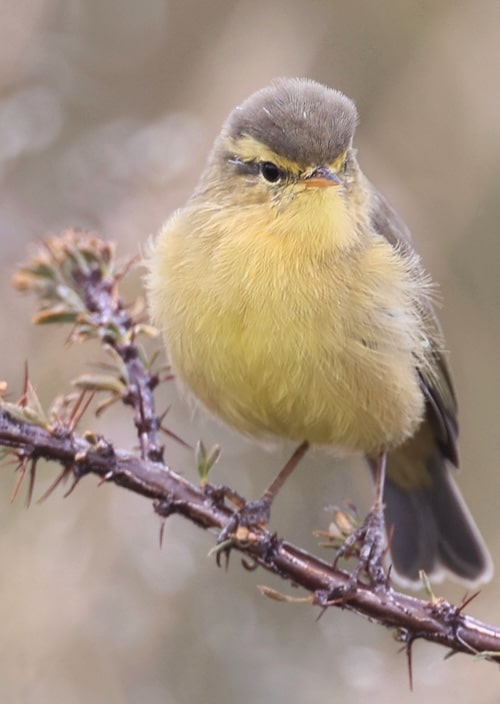
Jammu and Kashmir is a region administered by India as a union territory and consists of the southern portion of the larger Kashmir region, which has long been the subject of a dispute between India and Pakistan and China. The Line of Control separates Jammu and Kashmir from the Pakistani-administered territories of Azad Kashmir and Gilgit-Baltistan in the west and north. It lies to the north of the Indian states of Himachal Pradesh and Punjab and to the west of Ladakh which is also administered by India as a union territory. It has a total area of 42,241 km2 (16,309 square miles) with a populations of over 12 million people.
Srinagar and Jammu jointly serve as the capital of the region, which is divided into two divisions and 20 districts. The area holds substantial mineral deposits, including sapphire, borax, and graphite. Agriculture and services drive the economy, with major contributors being horticulture, handicrafts, and tourism. Apple cultivation is one of the largest industries, employing 3.5 million people and producing 10% of the gross state domestic product. Despite these activities, over 10% of the population are under the national poverty line.
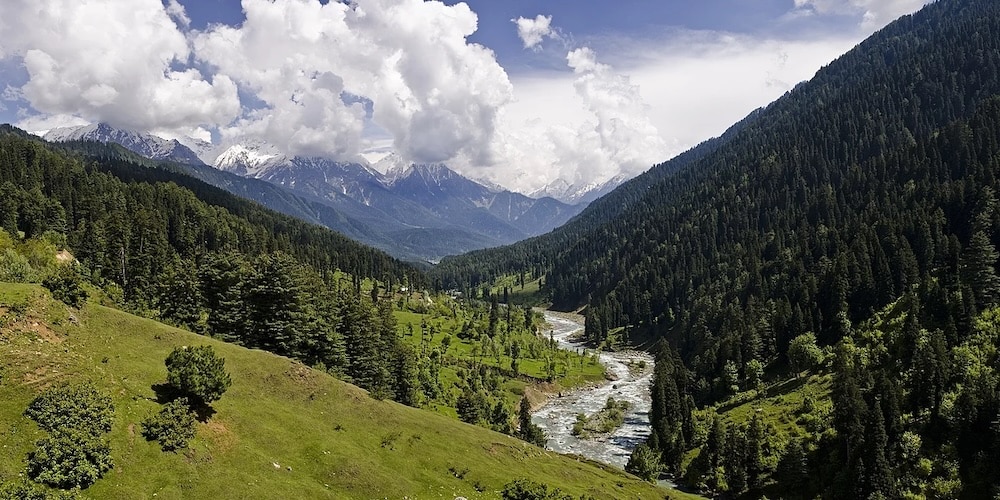
Lidder Valley – ©KennyOMG via Wikimedia Creative Commons
Jammu and Kashmir is home to several valleys such as the Kashmir Valley, Tawi Valley, Chenab Valley, Poonch Valley, Sind Valley, and Lidder Valley. The Kashmir valley is 100 km (62 miles) wide and 15,520.3 km2 (5,992.4 square miles) in area. The Himalayas divide the Kashmir valley from the Tibetan plateau while the Pir Panjal range, which encloses the valley from the west and the south, separates it from the Punjab Plain of the Indo-Gangetic Plain. Along the northeastern flank of the Valley runs the main range of the Himalayas. This valley has an average height of over 6,000, but the surrounding Pir Panjal range has an average elevation of 10,000 feet. The Jhelum River is the major Himalayan river which flows through the Kashmir valley. The southern Jammu region is mostly mountainous, with the Shivaliks, the middle and the great Himalayas running parallel to each other in a southeast–northwest direction. A narrow southwestern strip constitutes fertile plains. The Chenab, Tawi and Ravi are important rivers flowing through the Jammu region.
Jammu and Kashmir’s economy is primarily services-based and agriculture-oriented. The Kashmir Valley is known for its sericulture (silk production) and cold-water fisheries. Wood from Kashmir is used to make high-quality cricket bats, popularly known as Kashmir Willow. Major agricultural exports from Jammu and Kashmir include apples, pears, cherries, plums, saffron and walnuts. The apple industry is a significant source of employment in Jammu and Kashmir, generating the highest number of jobs. It supports a workforce of 3.5 million people. Moreover, it contributes approximately 10 per cent to the Gross State Domestic Product. The traditional Kashmiri handicrafts industry employs a large workforce of around 340 thousand artisan. Small-scale cottage industries include carpet weaving, silks, shawls, basketry, pottery, copper and silverware, papier-mâché and walnut wood. The horticulture sector is the next biggest source of income in the economy. The temperature of Jammu and Kashmir is also suited to floriculture and can support various species of flora.
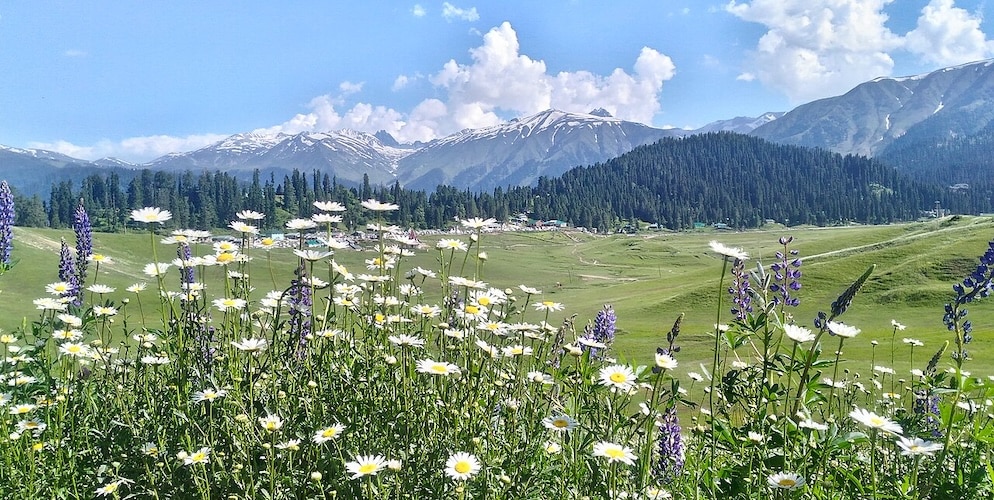
Gulmarg Wildlife Sanctuary – ©Tanujdogra CC BY-SA 4.0 via Wikimedia Commons
The climate of Jammu and Kashmir varies with altitude and across regions. Southern and southwestern areas have a sub-tropical climate, with hot summers and cool winters. This region receives most of its rainfall during the monsoon season. In the east and north, summers are usually pleasant. The effect of the monsoon diminishes in areas lying to the leeward side of the Pir Panjal, such as the Kashmir valley, and much of the rainfall happens in the spring season due to western disturbances. Winters are cold, with temperatures reaching sub-zero levels. Snowfall is common in the valley and the mountain areas.
Birding Jammu & Kashmir
Jammu and Kashmir is a state in northern India, often denoted by its acronym, J&K. It is located mostly in the Himalayan mountains, and shares borders with the states of Himachal Pradesh and Punjab to the south and Ladakh to the northeast. The Line of Control separates it from the Pakistani-administered territories of Azad Kashmir and Gilgit-Baltistan in the west and north respectively. A part of the former princely state of Jammu and Kashmir, the region is the subject of a territorial conflict among India, Pakistan and China. Jammu and Kashmir consists of two regions: Jammu, the Kashmir Valley. Srinagar is the summer capital, and Jammu is the winter capital. Jammu and Kashmir is the only state in India with a Muslim-majority population. The Kashmir valley is famous for its beautiful mountainous landscape, and Jammu’s numerous shrines attract tens of thousands of Hindu pilgrims every year.
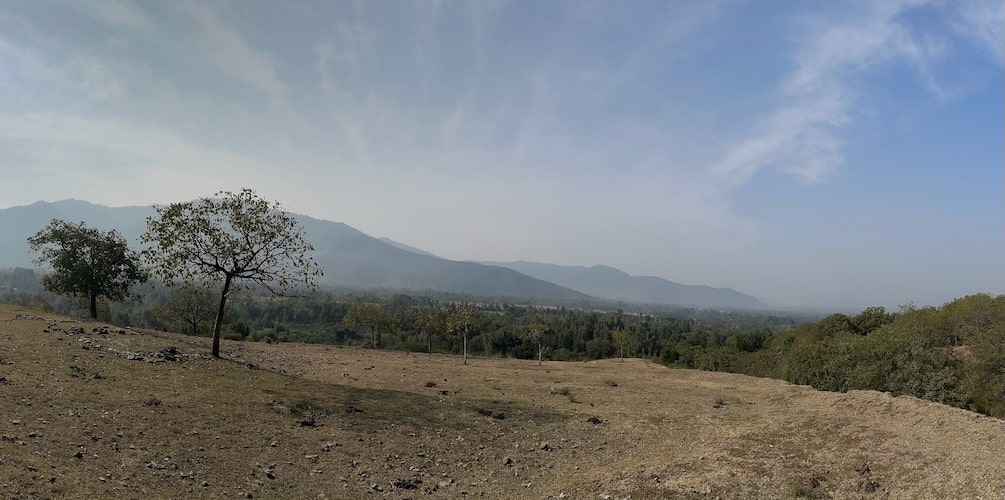
Anantnag District – ©Bird-Photo-Tours ASIA
Because of Jammu and Kashmir’s wide range of elevations, its biogeography is diverse. Northwestern thorn scrub forests and Himalayan subtropical pine forests are found in the low elevations of the far southwest. These give way to a broad band of western Himalayan broadleaf forests running from northwest-southeast across the Kashmir Valley. Rising into the mountains, the broadleaf forests grade into western Himalayan subalpine conifer forests. Above the tree line are found northwestern Himalayan alpine shrub and meadows. The northeast edge of the state is part of the Karakoram-West Tibetan Plateau alpine steppe. Around the highest elevations, there is no vegetation, simply rock and ice.
In the west Kashmir is a beautiful Himalayan valley with breath-taking mountain scenery, clear lakes, lush vegetation and magnificent forests. The capital city Srinagar is famous for its canals, houseboats and Mughal gardens. India’s best-known ornithologist Salim Ali once called Kashmir a heaven on earth for migratory birds. Indeed, the local folk are much more aware of the migratory visitors rather than the resident species and organised birding in the Valley is virtually non-existent even though it is home to a rich biodiversity which includes a large number of bird species, many of which are unique to Kashmir.
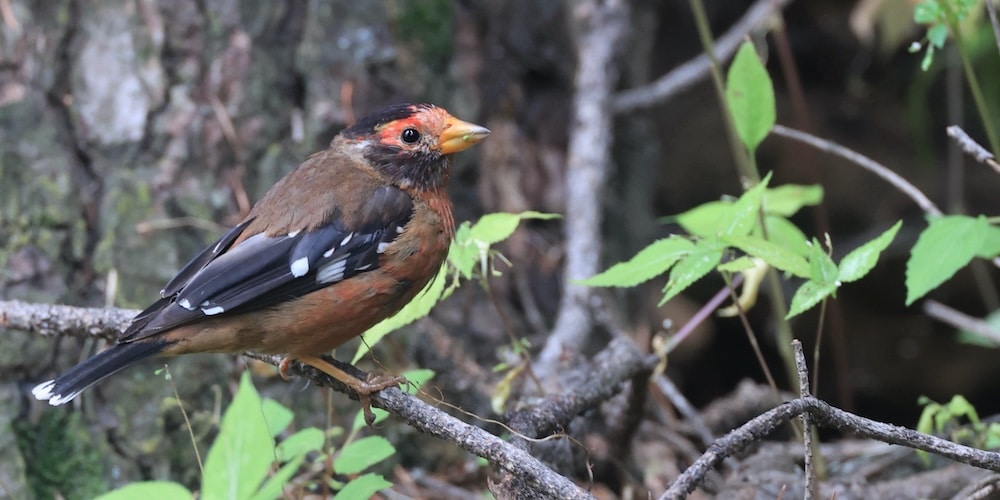
Spectacled Finch Callacanthis burtoni – ©Bird-Photo-Tours ASIA
Target species include: Spectacled Finch, Orange Bullfinch, Scaly-bellied, Brown-fronted and Himalayan Woodpeckers and a chance of a close encounter with the Himalayan Rubythroat. Kishtwar District is the spot for the near endemics Kashmir Nutcracker and Rufous-naped Tit as well as Bar-tailed Treecreeper. Some of the very best birding locations are listed below. Anantnag District is good for the near endemics Spectacled Finch, White-cheeked Nuthatch, Kashmir Nuthatch and Himalayan Rubythroat as well as Rock Bunting and Lemon-rumped Warbler.
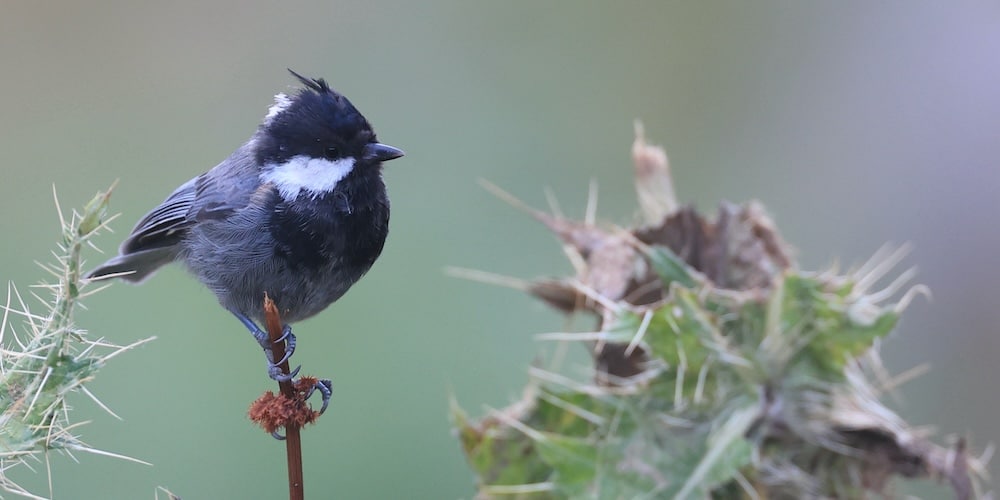
Rufous-naped Tit Periparus rufonuchalis – ©Bird-Photo-Tours ASIA
Nearby Ladakh has a number of high-altitude lakes and is the only breeding ground for the black-necked crane outside of China.
This page is sponsored by Bird-Photo-Tours ASIA

-
Dachigam National Park
InformationSatellite ViewThis one-time exclusive hunting preserve of the Maharaja of Kashmir was declared a national park in 1951. Dachigam contains the last viable population of Hangul or Kashmir Stag in the world. The two sectors of the Park - Upper and Lower Dachigam are spread over an area of 141-sq-km. and altitudes vary between 1,700 and 4,300m. Two steep ridges enclose the Park with its great topographical variety - deep ravines, rocky outcrops, steep wooded slopes and rolling alpine pastures. The Dagwan stream flows from the Marsar Lake (4,300m) through Lower Dachigam. Avifauna: Over 150 species of birds have been reported including Crimson Tragopan, Monal Pheasant, Blood Pheasant, Koklas Pheasant, Golden Eagle, Lammergeier etc. Status: Theatened by human encroachment. -
Dal Lake
InformationSatellite ViewThe famous Dal Lake of Srinagar has been described as hardly what one would expect a lake to be like - it's a maze of intricate waterways and channels, floating islands of vegetation, houseboats that look so firmly moored they could almost be islands and hotels on islands which look like they could simply float away. The famous Dal Lake has shrunk from an area of 16 sq. kms in the 1980s to about 9 sq. kms today. -
Gulmarg Biosphere Reserve
Webp[ageSatellite ViewGulmarg is located at a distance of 48-km to the south-west of Srinagar. It is a major tourist destination and a world-class Ski resort.Avifauna includes pheasants and upland birds amongst other resident and migratory species. Avifauna: Griffon Vulture, Monal Pheasant, Snow Cock, Koklas Pheasant, Blue Rock Pigeon, Kashmir Roller, Eurasian Hoopoe, Jungle Crow etc. I have observed the Himalayan Greenfinch and Yellow-billed Blue Magpie. Status: Theatened by increased tourism. -
Tso Morari Lake, Ladakh
InformationSatellite ViewThis freshwater to brackish lake lying at 4,595m above sea level is the world's highest Ramsar site. Avifauna: The lake is the only breeding ground outside of China for one of the most endangered cranes, the Black-necked crane Grus nigricollis, and the only breeding ground for Bar-headed Geese in India. A small northern offshore island forms the main nesting site for the Bar Headed Geese and the Brown Headed Gull. Status: Threatened by increased tourism. A Tso Morari Conservation Trust has been recently formed with the help of the World Wide Fund For Nature (WWF) Leh office for conservation of the lake.
-
Dr. Bakshi Jehangir
Srinagar - Kashmir | vagrantbirder@gmail.com
Birds of Kashmir
-
Number of bird species: 592
(As at April 2025)State Bird: <>b>Kalij Pheasant Lophura leucomelanos
-
Avibase
PDF ChecklistThis checklist includes all bird species found in Jammu and Kashmir , based on the best information available at this time. It is based on a wide variety of sources that I collated over many years. I am pleased to offer these checklists as a service to birdwatchers. If you find any error, please do not hesitate to report them. -
Department of Wildlife Protection
ChecklistCheck List of the Birds of Kashmir -
E-Bird
PDF ChecklistThis checklist is generated with data from eBird (ebird.org), a global database of bird sightings from birders like you. If you enjoy this checklist, please consider contributing your sightings to eBird. It is 100% free to take part, and your observations will help support birders, researchers, and conservationists worldwide.

-
Birds of the Indian Subcontinent
| By Richard Grimmett, Carol Inskipp & Tim Inskipp | Helm | 2025 | Edition 2 | Paperback | 544 pages, 240+ plates with colour illustrations; colour distribution maps, b/w illustrations | ISBN: 9781472984777 Buy this book from NHBS.com -
Important Bird Areas of Jammu & Kashmir
| By Asad R Rahmani, M Zafar-ul Islam, Khursheed Ahmad, Intesar Suhail, Pankaj Chandan & Ashfaq Ahmed Zarri | Oxford University Press | 2013 | Paperback | 151 pages, colour photos, colour distribution maps, colour tables | ISBN: 9780198092186 Buy this book from NHBS.com -
Threatened Birds of Jammu & Kashmir
| By Asad R Rahmani, Intesar Suhail, Pankaj Chandan(, Khursheed Ahmad & Ashfaq Ahmed Zarri | Oxford University Press | 2015 | Paperback | 144 pages, 73 colour photos, 24 colour maps | ISBN: 9780199452699 Buy this book from NHBS.com
Birds of the Indian Subcontinent
Apple iOS | AndroidThe eGuide to Birds of the Indian Subcontinent is an interactive companion to Birds of the Indian Subcontinent – the definitive guide for birdwatchers visiting the region. It covers India, Pakistan, Nepal, Bhutan, Bangladesh, Sri Lanka and the Maldives. This application has specific features that will enhance your birding experience.
Indian Birds
Apple iOS | AndroidPioneers in bringing Indian Birding to the smart phone generation - Introducing Indian Birds, the time-honoured and cherished birding companion for India. Established in 2010, it proudly remains the sole mobile app available on App Store, offering bird enthusiasts the ability to explore bird namesUseful Information-
Jammu & Kashmir Checklist
PDF BookletA checklist of the birds of Jammu & Kashmir, India
Festivals & Bird Fairs-
J&K Bird Festival
Facebook Page
Organisations-
Kashmir Birdwatch
Facebook PageThe group is the official page of 'Kashmir Birdwatch', the first and only birdwatchers' club in Jammu & Kashmir and aims at portraying the bird life of Himalayas in general and Jammu & Kashmir in particular. -
Kashmir Birdwatchers Club
Facebook PageEstablished in 2017, we are one of Kashmir's oldest birding clubs, dedicated to fostering a responsible and thriving birdwatching culture. -
Sanctuary Nature Foundation
WebsiteThe group is the official page of 'Kashmir Birdwatch', the first and only birdwatchers' club in Jammu & Kashmir and aims at portraying the bird life of Himalayas in general and Jammu & Kashmir in particular.
Reserves-
NP Dachigam
InformationSatellite ViewColourful pheasants include the crimson tragopan, the iridescent monal pheasant with its glittering plumage, blood pheasant and koklass pheasant. Golden eagles and bearded vultures or lammergeier are seen circling the brilliant blue skies. -
NP Kazinag
InformationSatellite ViewKazinag National Park or Qazinag National Park is a commissioned future national park in the Baramulla district in the Indian state of Jammu and Kashmir. It is part of a proposal for a trans-Karakoram peace park with Pakistan. It is home to about 120 species of birds including the golden eagle (Aquila chrysaetos), Impeyan or monal pheasant (Lophophorus impejanus), cheer pheasant (Catreus wallichii), sparrow hawk (Accipiter nisus melaschistos), snow pigeon (Columba leuconota), cuckoo (Cuculus canorus), Himalayan pied kingfisher (Ceryle lugubris), lesser pied kingfisher (Ceryle rudis), nutcracker (Nucifraga caryocatactes), jackdaw (Corvus monedula), long tailed minivet (Pericrocotus flammeus), sooty flycatcher (Muscicapa infuscata), Kashmir red breasted flycatcher (Ficedula subrubra) and yellow throated martin (Martes flavigula) -
NP Kishtwar
InformationSatellite ViewKishtwar National Park is a national park located in the Kishtwar district of Jammu and Kashmir, India. It is bounded to the north by Rinnay river, south by Kibar Nala catchment, east by main divide of Great Himalaya and west by Marwa river. It is a wonderful place. -
NP Salim Ali National Park
InformationSatellite ViewThe park features wildlife species such as the hangul, musk deer, Himalayan black bear, leopard, Himalayan serow and 70 species of birds, including the paradise flycatcher, Himalayan monal, and Himalayan snowcock. -
WS Overa-Aru Wildlife Sanctuary
InformationSatellite ViewThe Overa-Aru Wildlife Sanctuary has a recorded 117 bird species of which 89 species – including eight species of sympatric warblers – breed within the sanctuary. The globally threatened bird species found in the sanctuary are endangered Egyptian vulture (Neophron percnopterus), vulnerable Kashmir flycatcher (Ficedula subrubra), and near-threatened European roller (Coracias garrulus) and Tytler's leaf warbler (Phylloscopus tytleri). -
WS Gulmarg Wildlife Sanctuary
InformationSatellite ViewThe Gulmarg Wildlife Sanctuary has a recorded 95 bird species of different families including Kashmir flycatcher (Ficedula subrubra), Himalayan snowcock (Tetraogallus himalayensis), Impeyan monal (Lophophorus impejanus) and Koklass pheasant (Pucrasia macrolopha). There are 31 butterfly species reported from the sanctuary. -
WS Hirpora Wildlife Sanctuary
InformationSatellite ViewHirpora Wildlife Sanctuary or Heerpora Wildlife Sanctuary is located in Shopian district of Kashmir, 70 kilometers south of Srinagar.[1] It spreads over an area of 341 km2.[2] It is bounded to the north by Lake Gumsar, northeast by Hirpora village, east by Rupri, south by Saransar and to the west by the Pir Panjal pass. -
WS Jasrota
InformationSatellite ViewJasrota Wildlife Sanctuary has an area of 10 sq km, it houses an appreciable variety of bird and animal life, most notably cheetal or axis deer. -
WS Limber Wildlife Sanctuary
InformationSatellite ViewThe sanctuary is a conservation ground for Markhor wild goats. Apart from other species of goats, Limber Wildlife Sanctuary also is home to Himalayan musk deer, leopards and brown bears. 120 different species of birds and 20 species of mammals are found here as well. -
WS Rajparian Wildlife Sanctuary
InformationSatellite ViewThe Rajparian Wildlife Sanctuary is abode to many species of animals including the Himalayan black bear, hangul, and musk deer.
Sightings, News & Forums-
eBird
SightingseBirding This Month
Guides & Tour Operators-
Asian Adventures
Local Tour OperatorKashmir's position means that, particularly in winter and during migration, birds from the northern Palearctic turn up as vagrants, and there are a number of sightings of species not recorded elsewhere in India. In spring and summer, however, we see peak avian activity with a number of local breeding specialties. -
Bird Photo Tours ASIA
Tour OperatorKashmir is recognised in India as a ‘paradise’ for its incredible scenic beauty. The Himalayas borders both the north and east of Kashmir. Bird photography in this environment brings with it the perk of being in some of the most beautiful landscapes of the Western Himalayas with the added bonus of some very special birds such as the Spectacled Finch, Orange Bullfinch, Scaly-bellied, Brown-fronted and Himalayan Woodpeckers and a chance of a close photographic encounter with the Himalayan Rubythroat. -
BirdQuest
Tour OperatorNORTHWEST INDIA – Specialities of Punjab, Rajasthan, Gujarat, Maharashtra & Kashmir -
Bubo Birding
Tour OperatorKashmir and Ladakh at the northern extreme of the Indian Subcontinent, across the Himalayas, offer a stark contrast to the rest of the country, in landscape and culture as well as birds and wildlife. -
India Birding Tours
Local Tour OperatorEach region has its own specialties. Orange Bulfinch, Kashmir Nutcracker, Kashmir Nuthatch, Spectacled Finch, Pink-browed Rosefinch and Black-and-yellow Grosbeak are some of the local beauties to chase while on a Kashmir birding tour. -
Journeys
Local Tour OperatorAbout 674 species of birds have been observed in Jammu, Kashmir and Ladakh, but the checklist keeps expanding and changing every few years. The latest estimates suggest that the count of the bird species of Jammu, Kashmir and Ladakh could be as high as 715, which includes 31 globally threatened species and many exotic birds that draw in thousands of curious birders to North India birding trips every year. -
Jungle Lore
Local Tour OperatorKashmir and Ladakh Birding Tour -
Kashmir Traveler
Local Tour OperatorThis place is a delight for birding lovers, with awesome landscapes and diverse ecosystems. -
Zoothera Birding
Tour OperatorAnd now for something completely different, as we explore the vastly underrated Indian state of Jammu and Kashmir in search of some very special birds.
Trip Reports-
2015 [08 August] - Simon Colenutt - Rajasthan & Kashmir
Report...We birded the first 300-400m of the track which led through thorn scrub, wet grassland and a Water Hyacinth choked lagoon. Birds here included Greater Coucal, Indian Spot-billed Duck, Asian Openbill Stork, Red-naped Ibis, smart Pheasant-tailed Jacana, Purple Gallinule and Grey Francolin. -
2016 [03 March] - James Eaton - Kashmir, Andamans & Western Ghats
PDF ReportFrom the north-westernmost tip of the subcontinent to the south-east islands of the Andamans and finishing offin the southwest of the peninsula, this custom tour covered a vast area of India in search of some of the mostsought-after endemics. -
2016 [07 July] - James Eaton - Ladakh, Kashmir & Rajasthan
PDF ReportOur Pre-tour Ladakh extension had the primary goal of locating Tibetan Sandgrouse and we ended up havingsplendid views of a pair feeding amidst the magnificent scenery of Tso Kar, high on the plateau. Great Rosefinch,Mountain Chiffchaff, Sulphur-bellied Warbler, Red-fronted Serin, Ground Tit, Black-necked Crane and Blanford’sSnowfinch were also recorded. The main tour began in Leh with Ibisbill, Mountain Chiffchaff and Hume’sWhitethroat the main birds recorded as we drove west to Kargil, then south towards Srinagar. With ‘unrest’ aroundSrinagar making life difficult for us, we made base up the valley at our fine ‘glamp’, taking in large numbers ofSpectacled Finch, Black-and-yellow Grosbeak, Pink-browed Finch, Rufous-naped Tit, Kashmir and White-cheekedNuthatches, Himalayan Parakeet, Tytler’s Leaf Warbler and, eventually, Kashmir Nutcracker. -
2021 [06 June] - Arjun Basandrai
Report...After the beautiful valleys of north Kashmir, the next destination in our Kashmir bucket list was Gulmarg, We reached there late in the evening so there wasn’t much for us to do there at that time, so we just went straight to our hotel and called it a day... -
2022 [08 August] - Ann Gifford
PDF ReportWe spent the whole morning looking for Tibetan sandgrouse in various areas, starting over by the freshwater lake. Another stunningly beautiful day and equally as warm as yesterday. Even better reflections of the scenery in the still lakes... -
2023 [03 March] - Aseem Kumar Kothiala
ReportKashmir is one of the most scenic and also the most controversial tourist destinations in India. Many refer to it as the Alps of India and the Valley of Paradise! The region boasts of some exotic locations including the serene Dal Lake in Srinagar, the summer capital of the state Jammu and Kashmir. Hemmed in by the western Himalayan range and the Pir Panjal Mountains surely the region is closer to a few neighbouring countries than to some of the states in India. In the north, Gulmarg and Pahalgam are attractions for skiers and trekkers who travel in from far and wide during winters. -
2023 [11 November] - Brian Stretch & Deepak Kumar
ReportIf the Himalaya represents the crowning glory of Indian birding then surely Kashmir is the jewel in that crown. Located at a crossroads between the Palearctic and Indomalayan biogeographic realms it plays host to an interesting and varied mix of bird species. Furthermore it is blessed with stunning scenery and it’s impossible not to be captivated by the clean mountain air, beautiful vistas and friendly people...
Other Links-
A Birder’s Haven - A Definitive Guide To Birding In Jammu And Kashmir
WebpageJammu and Kashmir make birding look easy, writes Saurabh Sawant, ace birder and wildlife photographer, whose love for this stunning Union Territory is a never-ending affair. -
All Trails
WebpageBest bird watching trails in Jammu and Kashmir -
Go2Kashmir
WebpageThe Gharana and the Surinsar wetlands are a bird watchers paradise. These wetlands attract thousands of migratory birds every winter like mallards, coots, pintails, cormorants, terns, egrets etc.
Photographers & Artists-
Bird Photographs - Dr. Bakshi Jehangir
Gallery
Fatbirder - linking birders worldwide...
Skip to content