

National Capital Territory of Delhi
Delhi is the largest and most populous city in India. It is officially the National Capital Territory (NCT) of Delhi, is a city and a union territory of India containing New Delhi, the capital of India. Straddling the Yamuna River, but spread chiefly to the west, or beyond its right bank, Delhi shares borders with the state of Uttar Pradesh in the east and with the state of Haryana in the remaining directions. The NCT covers an area of 1,484 km2 (573 square miles). Delhi’s urban agglomeration, which includes the satellite cities Ghaziabad, Faridabad, Gurgaon, Noida, Greater Noida and YEIDA city located in an area known as the National Capital Region (NCR), has an estimated population of about 30 million, making it the largest metropolitan area in India and the second-largest in the world (after Tokyo). Delhi ranks fifth among the Indian states and union territories in human development index, and has the second-highest GDP per capita in India (after Goa). Although a union territory, the political administration of the NCT of Delhi today more closely resembles that of a state of India, with its own legislature, high court and an executive council of ministers headed by a chief minister. New Delhi is jointly administered by the federal government of India and the local government of Delhi, and serves as the capital of the nation as well as the NCT of Delhi. Delhi is also the centre of the National Capital Region.
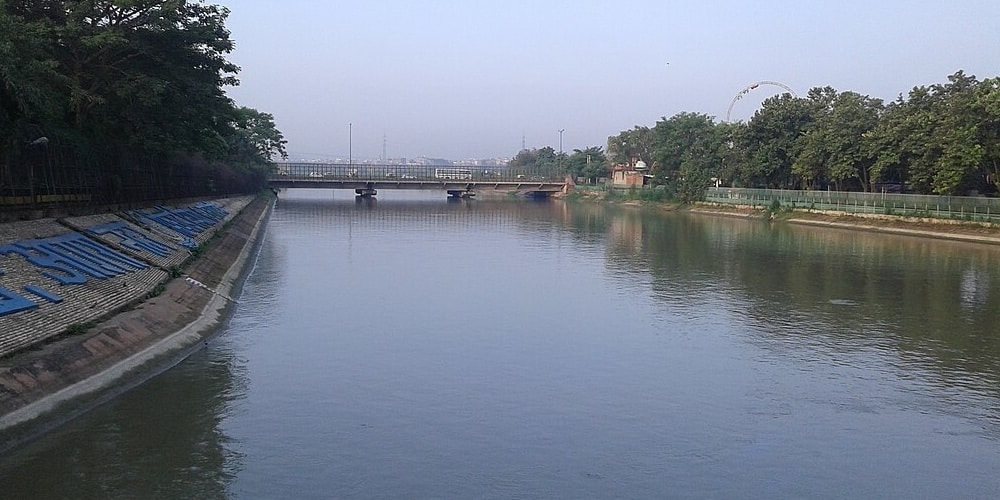
Yamuna River – ©Sidheeq CC BY-SA 4.0 via Wikimedia Commons
Two prominent features of the geography of Delhi are the Yamuna flood plains and the Delhi ridge. The Yamuna River was the historical boundary between Punjab and UP, and its flood plains provide fertile alluvial soil suitable for agriculture but, are prone to recurrent floods. The Yamuna, a sacred river in Hinduism, is the only major river flowing through Delhi. The Hindon River separates Ghaziabad from the eastern part of Delhi. The Delhi ridge originates from the Aravalli Range in the south and encircles the west, northeast, and northwest parts of the city. It reaches a height of 1,043 feet and is a dominant feature of the region.
In addition to the wetlands formed by the Yamuna River, Delhi continues to retain over 500 ponds that in turn support a considerable number of bird species. Delhi’s ponds, despite experiencing ecological deterioration due to garbage dumping and concretisation, support the largest number of bird species known to be using ponds anywhere in the world. Existing policy in Delhi prevents the conversion of wetlands and, quite inadvertently, has led to the city’s ponds becoming invaluable refuges for birds.
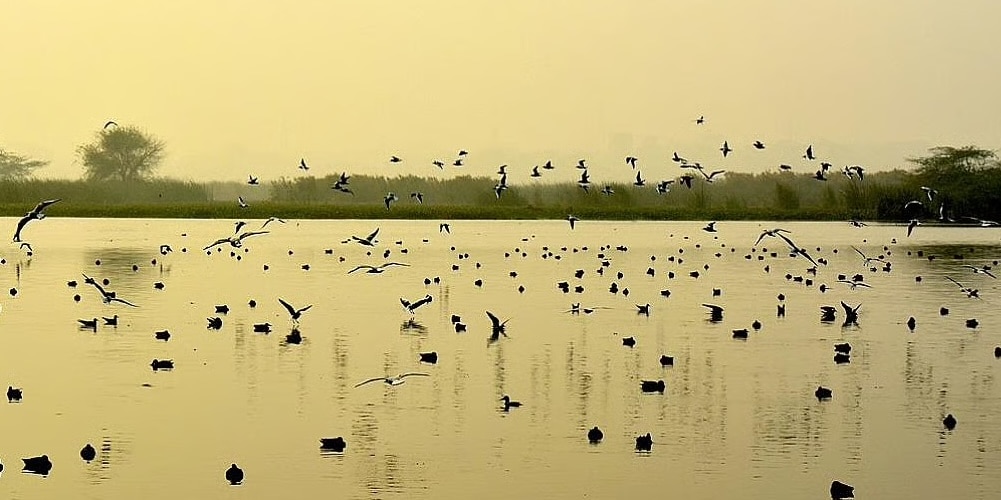
Okhla Bird Sanctuary, Noida – (Image Source: ©Awankanch via Wikimedia Commons)
Delhi features a dry winter humid subtropical climate bordering a hot semi-arid climate. The warm season lasts from c.21st March to c.15th June with an average daily high temperature above 39 °C. The hottest day of the year is usually between 26th and 30th May, with an average high of 42 °C and low of 27 °C. The cold season lasts from c. 26th November to 9th February with an average daily high temperature below 20 °C. The coldest day of the year is usually between 1st and 10th January, with an average low of 6.9 °C and high of 19.3 °C. In early March, the wind direction changes from north-westerly to south-westerly. From April to October the weather is hot. The monsoon arrives at the end of June, along with an increase in humidity. The brief, mild winter starts in late November, peaks in January and heavy fog often occurs. Delhi receives an average annual precipitation of c.30 inches. As recently as 2022, data from the WHO and IQAir, alongside comprehensive research, ranked Delhi as the fourth most polluted city globally.
Birding Delhi
Almost any open space on the Delhi map is worth exploring. The campuses of the big academic institutions notably Delhi (north and south campus); IIT and JNU in south Delhi can be very productive. If you feel a bit adventurous travel north to explore the remnant marshes around the lonely Coronation Pillar (many wetland species including bitterns and Painted Snipe). Or take any track along the Najafgarh Canal in extreme west Dehli (best take the Mehrauli Najafgarh Road south of the IGI Airport till you cross the canal). This has a wealth of species. And if your sense of smell is subdued try Okhla Sewage Works (gateway on your left off the Mathura Road past CRRI and before Apollo Hospital). Drive through and stop where the road right angles. The marshy and muddy settling pools are full of wagtails, egrets and waders in winter and in summer Black-winged Stilts, Painted Snipe and Pheasant-tailed Jacanas breed there. It is one of the best places to get close views of waders.
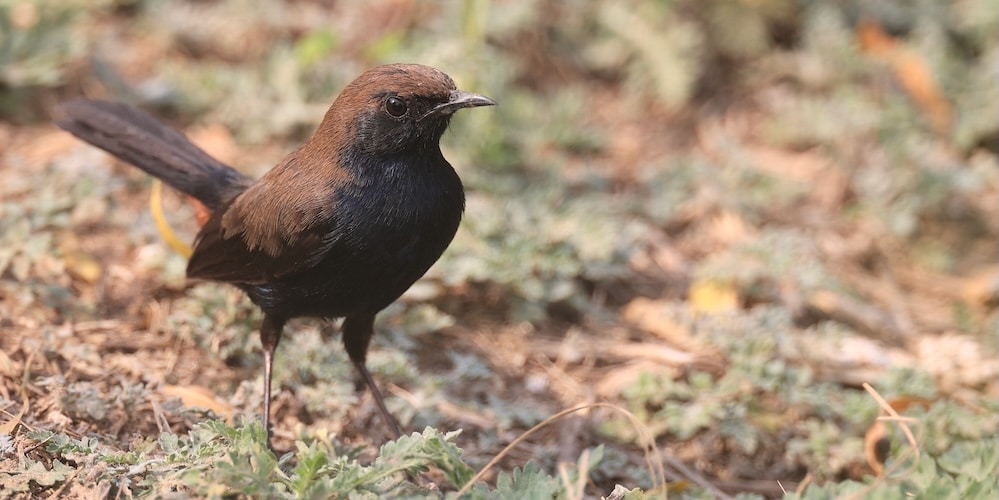
Indian Robin Copsychus fulicatus – ©Bird-Photo-Tours ASIA
Below are brief introductions to the most productive birding sites in Delhi and how to get to them. Although a city of over 35 million people Delhi has a remarkable number of interesting sites within its 500 or so square kilometres. It has a birdlist of over 450 species making it, after Nairobi, probably the second richest city in the world for birds. We strongly recommend you use the latest edition of the Eicher City Map to find your way around.
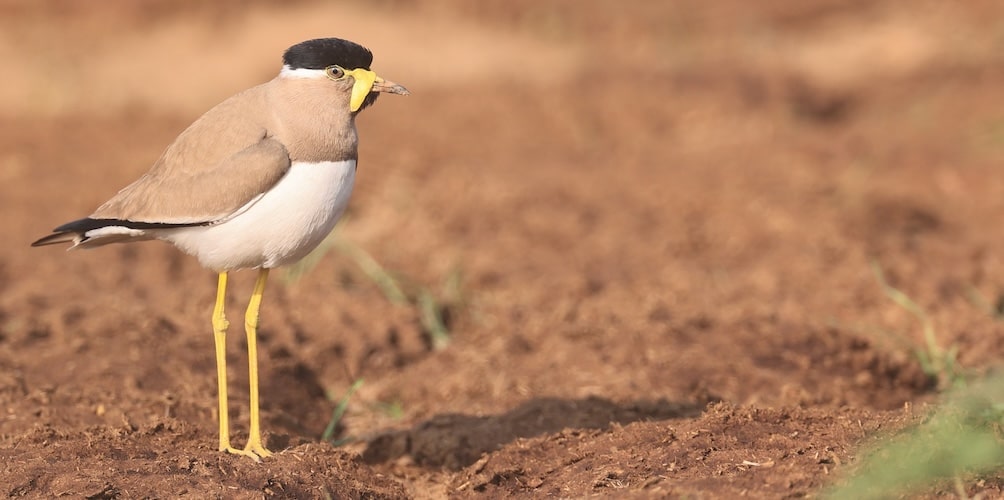
Yellow-wattled Lapwing Vanellus malabaricus – ©Bird-Photo-Tours ASIA
Nikhil and others once guided me to the ‘barrage’ on the Yamuna where there is agriculture amid the city and wetlands and Okhla, which are full of birds in great variety – Fatbirder
This page is sponsored by Bird-Photo-Tours ASIA

-
Delhi Parks
Delhi is full of parks of all sizes and they are easily located on most maps. Some in the centre, such as the Lodi Gardens, are well manicured but contain many old indigenous trees. Pay particular attention to Peepul, Banyan and Neem trees for Yellow-footed Green Pigeons, three species of parakeet and both Coppersmith and Brown-headed Barbet. These parks as well as large gardens, including hotel grounds, are usually rich in birds. As indeed are almost all the environs of the ancient monuments, big institutions, the Delhi Golf Course (if you can gain access) and the riverside ghats. Such places are a good to wander in, to see the commoner north Indian species, often at close quarters. Most older buildings have Dusky Crag Martins, Brown Rock-chats and nesting parakeets, Rock Pigeons and Mynahs and Wall Creepers have wintered on some of them. The large Deer Park at Hauz Khas and the nearby Siri Fort Park are both historically significant and ornithologically interesting because there is still fairly wild vegetative cover. In winter several species of warbler and birds of prey can be found. To find the parks take Aurobindo Marg south from the Inner Ring Road and they are both located close to the Outer Ring Road. -
Delhi Ridge
Satellite ViewThis famous area, studied intensively by Tony Gaston 30 years ago, is now rather fragmented and degraded in parts. But what remains is in theory protected and still holds some interesting birds. It is a combination of thick thorn scrub and rocks (less open than Asola) and patches of woodland. Most of Delhi's land birds can be found here with effort and it can be excellent for overhead raptors including vultures, Booted Eagles and breeding Oriental Honey-buzzards. More local species include Grey-breasted Prinias, Small Minivets, Common Wood-shrike, Paradise Flycatcher plus barbets and woodpeckers. In winter Olive-backed Pipits are regular in several places and several buntings (notably White-capped) have been recorded. This is one of the few sites in India where the enigmatic Brook's Leaf-warbler is regularly reported. Peafowl and Grey Francolin are numerous and Eurasian Thick-knees breed in good numbers. Look out for Yellow-wattled Lapwing and Long-billed Pipit on the Polo Ground. The Central Ridge is the last known site in Delhi for the very local and apparently rapidly declining Marshall's Iora but it hasn't been seen or heard there for several years.The easiest way to access this area is by the first road on your left off Willingdon Crescent and soon after the Sardar Patel Road junction (by the Gandhi Murti). Drive or better walk straight through to the Polo Clubhouse. You can park there and (after checking the field) take one of the paths into the jungle. The best (which leads to mature Ridge woodland) is right at the end of the Polo Ground and usually deeply littered with stable refuse. Watch out for polo horses exercising at speed! The up hill tracks take you to the Buddha Jayanti Smarak Park which is also worth a visit and another way in (from Vandemataram Marg) but the fence has few gaps in it! We welcome advice on good places in the Pusa and Northern Ridge Forests, which seem to be rarely looked at by birders. Another option is in the southern part of the Ridge, the Sanjay Van Park which lies south of IIT to the south of the Qutab Institutional Area. Take Tara Crescent Road off the New Mehrauli Road and just past the new DFIDI (old USAID) office you'll see a gate. Excellent footpaths take you through a range of habitats including small lakes along the dammed stream (where it is worth sitting for a while; watch for Bluethroats emerging from the bushes along the water and crakes in the reed edges). 70 species in 2 hours is well possible in winter here. -
Delhi Zoo
Satellite ViewMost city zoos are well worth a visit and Delhi's is no exeption. In the monsoon a significant colony of wild egrets, cormorants and ibis nests in trees on islands in the lakes to be replaced by Painted Storks in the autumn. Eurasian Thick-knees breed in several enclosures, the Nilgai one appropriately being the most popular. In winter Chiffchaffs, Lesser Whitethroats, Hume's Warblers, Bluethroats and Olive-backed Pipits are usually easy to find. Blyth's Reed and Greenish are numerous on passage. Next door is the Sundar Nursery, reknowned in the past for migrants. The Zoo is between the Mathura Road and the Ring Road south of Purana Quila and east of the Golf Course. It is closed on Fridays. -
Khader
Satellite ViewThis area is the southern extension of the west bank of the Yamuna south of the barrage. The bird list is similar (though numbers are generally lower) but there are more reliable wader sites and the cultivated fields add a new dimension. Black Ibises are almost guaranteed and dry land species such as Sand, Crested and Oriental Sky Larks breed while Hume's Short-toed Lark winters. The best way to enter this area is by the narrow unmetalled, tree-lined road that turns south from the main barrage (Noida) road just before the barrage on the Delhi side. Follow this for about 2kms where you meet a T-junction with a metalled road. Turning left you will quickly see a track off to the left again. This is passable by car and takes you almost to the Yamuna bank. You have to walk the last 100m. This area can be very good for waders if water levels are not too high but this is unpredictable as it depends on the opening of the barrage; if the river floods it will be very muddy! The sandy, tamarisk scrub, and elephant-grasslands have larks, chats and prinias. Look for Brown Crakes in the stream alongside the road and River Lapwings, terns and pratincoles on the sand bars. Returning to the road you can continue south for 3 kms and explore other left branching tracks to the river as well as scanning the vegetable fields and trees.If you go back to the T-junction and head west you will see a track going off to your left after less than 50m. Park here then walk down through some houses and you come to a small, remnant reedbed and marshy fields. The reedbed has all the local species and the fields are good for waders, Purple Gallinules and Pheasant-tailed Jacanas in their season. Ahead of you, you will see the high bank that surrounds the fly ash pit of the power station. You can climb this and walk round a huge hyacinth choked lake. Although this rarely has much of interest except Darters, Purple Herons and Spotbills the walk round can be very productive and gives you an excellent vantage point. The smaller ponds at the southern end are the most regular site for Bronze-winged Jacanas in Delhi and often have Cotton Pygmy-geese. -
Tughlaqabad-Asola
Satellite ViewThis historic area of south Delhi is rich in dry country species. Much of it is thorn scrub and trees on undulating rocky hills and almost anywhere is worth a look. Characteristic birds include Black-shouldered Kite, Jungle Bush-quail, Indian Bush Lark, Indian Robin, Large Grey Babbler, Long-billed Pipit and Rufous-fronted Prinia while wintering warblers include Orphean, Sulphur-bellied and both Common and Hume's Lesser Whitethroats. Painted and Chestnut-bellied Sandgrouse are still around in small numbers (look out for parties flighting to water around 0930am) and birds of prey in winter could include almost anything. The waste field just south of the main fort is the most reliable site in Delhi for Yellow-wattled Lapwings and up to 10 pairs breed there. It is also good for larks and pipits (including Tawny and Blyth's) and sometimes has a few wheatears.Tughlaqabad is on the west-east Mehrauli-Badarpur Road and well marked on all maps. The field (which can be driven into) is between the Adilabad Fort ruins (look for Eagle Owls and Kestrels here) and Ghiyauddin Tughlaq's Tomb. A road by this tomb to Surajkund takes you to the entrance to Asola Wildlife Reserve, about 2kms down on your right. There is no entrance charge and the best thing to do is park by the gate and walk round on the numerous paths. Unfortunately it doesn't open til 0830hrs and closes at 1800hrs. There are Nilgai and Jackal here and a Blackbuck breeding scheme. -
Yamuna River
Satellite ViewUndoubtedly both banks of the Yamuna and its associated wetlands are the most productive places. At the peak season over 150 species in a day is possible. The area is justly famous for huge duck and goose flocks (up to 20,000 of 20 species) and roosting gulls (10,000) in winter but a wide range of wetland species including most herons and egrets and migrant waders should be seen. The winter roosts of mynahs and starlings probably exceed a lakh and are a wonderful spectacle at dusk, especially if they are being harried by falcons or Marsh Harriers. As the Yamuna is a major north-south migration flyway almost any migratory species could turn up; the rarity list grows annually with Baer's Pochard and Mountain Chiffchaff being 2001 additions.The area is good for wintering passerines including Common Starlings, several warblers, Bluethroats, Rosy Pipits, Citrine Wagtails and Common Rosefinch. In summer the sandbanks attract terns, two species of pratincoles, plovers and thick-knees while the reedbeds are alive with bitterns (3 species); crakes, warblers etc. Specialities include the now regular flock of Greater Flamingoes (up to 500); Black Ibis, resident Red-headed Falcons, reed bed nesting Black Francolins, White-tailed Stonechats, Striated Babblers and Grassbirds and Yellow-bellied Prinias. Bristled Grassbird and White-capped Penduline Tit have been recorded in the recent past.The best area is between the new Flyover and the Barrage. From Okhla village take the river road from the great sand mound and view the river and marshes from the several small tree-lined bunds that strike out eastwards. This area is really only good in winter and best in the evening. At the eastern end of the Barrage you will notice a narrow curved spit that strikes out northwards. There is a footpath on it and from the end it is often possible to have excellent views of the duck and flamingo flocks. A little further on towards Noida, a narrow road branches north following the river. If the water is reasonably high and not too clogged with water hyacinth, this can give excellent views of many species especially in the morning. At the end, at the start of the flyover, a raised bund heads westwards to the Temple exactly opposite the Okhla sand mound). This is probably the most productive walk of all for variety with some very extensive reedbeds to look over. If the water isn't too high you can walk on buffalo paths into the reeds, round the damp fields or along the river edge. If it is high sit on the Temple mound and the birds will fly past. And if it is non-existent, walk out over the great sandbanks.
-
Nikhil Devasar & Bill Harvey
Delhi | nik@delhibird.org; bill@delhibird.org
Facebook Page
-
Number of bird species: 469
(As at June 2025)State Bird: House Sparrow Passer domesticus
-
Avibase
PDF ChecklistThis checklist includes all bird species found in Delhi , based on the best information available at this time. It is based on a wide variety of sources that I collated over many years. I am pleased to offer these checklists as a service to birdwatchers. If you find any error, please do not hesitate to report them. -
E-Bird
PDF ChecklistThis checklist is generated with data from eBird (ebird.org), a global database of bird sightings from birders like you. If you enjoy this checklist, please consider contributing your sightings to eBird. It is 100% free to take part, and your observations will help support birders, researchers, and conservationists worldwide.

-
Birds about Delhi - A Field Guide
| By Nikhil Devasar & Rajneesh Suvarna | 2018 | Dorling Kindersley India | Paperback | 312 pages, 800+ colour photos, colour maps | ISBN: 9780241316290 Buy this book from NHBS.com -
Birds and Butterflies of Delhi
| By Mehran Zaidi | India Research Press | 2008 | Paperback | 241 pages, 115 colour illustrations | ISBN: 9788183860550 Buy this book from NHBS.com -
Birds of Delhi
| By Ranjit Lal | Oxford University Press | 2004 | Paperback | 150 pages, 55 colour plates | Out of Print | ISBN: 9780195672190 Buy this book from NHBS.com -
Birds of the Indian Subcontinent
| By Richard Grimmett, Carol Inskipp & Tim Inskipp | Helm | 2025 | Edition 2 | Paperback | 544 pages, 240+ plates with colour illustrations; colour distribution maps, b/w illustrations | ISBN: 9781472984777 Buy this book from NHBS.com -
The Birds of the Delhi Area
| By Sudhir Vyas | Juggernaut | 2023 | Paperback | 320 pages, colour photos | ISBN: 9789353451646 Buy this book from NHBS.com
Birds of the Indian Subcontinent
Apple iOS | AndroidThe eGuide to Birds of the Indian Subcontinent is an interactive companion to Birds of the Indian Subcontinent – the definitive guide for birdwatchers visiting the region. It covers India, Pakistan, Nepal, Bhutan, Bangladesh, Sri Lanka and the Maldives. This application has specific features that will enhance your birding experience.
Indian Birds
Apple iOS | AndroidPioneers in bringing Indian Birding to the smart phone generation - Introducing Indian Birds, the time-honoured and cherished birding companion for India. Established in 2010, it proudly remains the sole mobile app available on App Store, offering bird enthusiasts the ability to explore bird namesUseful Information-
Birding in Delhi
WebpageAs a birding venue the city has a remarkable number of interesting sites. In spite of the population density, there is a surprising number of green open spaces. Apart from resident species Delhi has a number of interesting summer visitors that move north out of the peninsula to breed before and during the summer monsoon. More striking is the number of winter visitors and passage migrants, for Delhi is well positioned on the north-south flowing Yamuna, on one of the major Asian flyways.
Museums & Universities-
National Museum of Natural History
WebsiteNational Museum of Natural History Ministry of Environment, Forest and Climate Change, Government of India
Organisations-
Delhibird Foundation
WebsiteOne day, Nikhil Devasar who was born and brought up in Delhi, decided to take a closer look at nature and wildlife. This enchanted journey was the beginning of a new relationship with birds and nature. Which eventually led to the creation of delhibird. -
New Delhi Nature Society
Website...Our beloved Delhi has been hit with hazardous air quality yet again, which has become a trend in winter months. AQI and Symptoms of Air Pollution Air Quality Index -used for reporting daily air quality ranks Delhi in the Hazardous Category...
Reserves-
BS Najafgarh Drain Bird Sanctuary
InformationSatellite ViewThe Najafgarh drain or Najafgarh nalah, which also acts as Najafgarh drain bird sanctuary, is another name for the northernmost end of River Sahibi, which continues its flow through Delhi, where it is channelized, and then flows into the Yamuna. -
BS Okhla Bird Sanctuary
WebsiteSatellite ViewOkhla Bird Sanctuary is a bird sanctuary at the Okhla barrage over Yamuna River. It is situated in Noida, Gautam Buddh Nagar district, on Delhi-Uttar Pradesh state border and known as a haven for over 300 bird species, especially waterbirds. -
NR Dhirpur Wetland
WebpageSatellite View -
WR Aravalli Biodiversity Park
WebpageSatellite ViewThe Aravalli Biodiversity Park (ABP) is being developed on 699 acres of land located at northwest of Vasant Vihar. The area is highly degraded due to past mining and infested with Prosopis juliflora (Vilayati kikar). The biodiversity of Delhi is nearly extinct. The prime objective of ABP is to bring back the lost biodiversity of Delhi Aravallis. -
WR Yamuna Biodiversity Park
WebpageSatellite ViewThe trail leads to the Bambusetum, the Nature interpretation Centre, the Conservatory of fruit yielding species, the Migratory duck’s wetland and the Nature Reserve area. On the left, the landscaping provides two shallow valleys representing rangelands with 10 mounds representing different ecosystems present from the foothills of the Himalayas (Siwaliks) through the Yamuna basin, till the point of confluence of the Yamuna and Ganga. -
WS Asola Bhatti Wildlife Sanctuary
WebpageSatellite ViewThe sanctuary covers an area of 32 sq kms and this urban sanctuary could be a role model for all the conservation work undertaken by the Department of Forests & Wildlife GNCT of Delhi.
Sightings, News & Forums-
DelhiBird
Facebook PageNow more of an ID resource -
eBird
SightingseBirding This Month
Guides & Tour Operators-
Bird-Photo-Tours ASIA
Tour OperatorBird-Photo-Tours ASIA is the specialists in bird photography tours on the Asian continent with a portfolio of 50 bird photography tours across 26 countries and a particular specialism in bird photography in India including its capital Delhi. -
Birding Ecotours
Tour Operator...After lunch we will spend the first afternoon of the tour birding at a fantastic wetland site near New Delhi, where we could see some interesting species such as Painted and Black-necked Storks, Bar-headed Goose, Knob-billed Duck, Indian Spot-billed Duck, Northern Shoveler, Garganey, Ferruginous Duck, Eastern Imperial, Indian Spotted, and Booted Eagles, Brook’s Leaf Warbler, Sind Sparrow, Striated Babbler, Citrine Wagtail, Baillon’s Crake, Spotted Owlet, and Moustached Warbler... -
Odin Tours
Local Tour OperatorOdin Tours offers custom made birding tours in Delhi and surrounding areas. The expert knowledge is combined with client requirements and a private guided tour is arranged for our clients. Given below is the list of areas covered in Delhi NCR for bird photography tours. -
Okhla Tours
Local Tour OperatorOkhla Bird Sanctuary tour in Delhi -
Wildnest
Local Tour OperatorMeet Wildnest expert, visit to Yamuna Ghat to see Gulls through boat safari. Our expert will also take you for a small tour of Yamuna ghat and people settlement around ghat.
Trip Reports-
* Many more trip reports available
While few trips deliberately target Delhi as a birding destination the vast majority of International forays for northern Indian birding will start with a flight to Delhi. Very often there will be time on arrival or departure for at least a half day visiting some of the birding sites within the city that not only give a great introduction to the sub-continents common birds but holds several species harder to find elsewhere such as black-necked ibis and affords the opportunity to 'get your eye' in especially for wetland species. -
2016 [05 May] - Stuart Vine - Delhi, Agra & Ranthambore
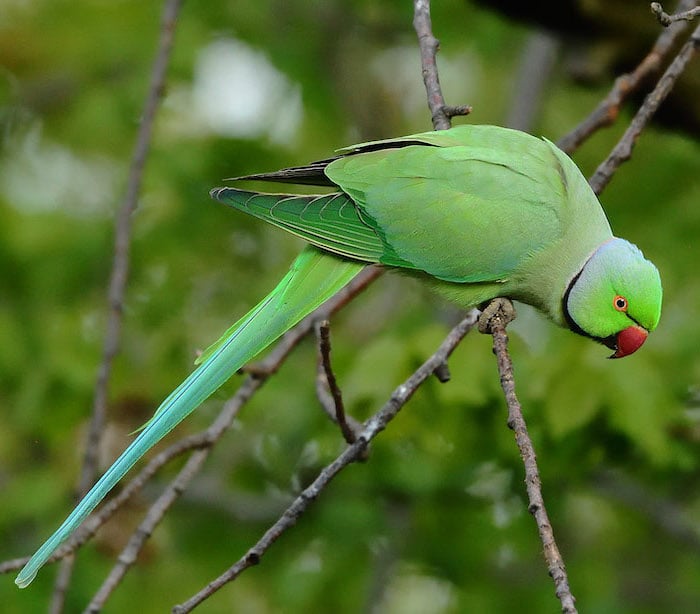
PDF Report...Before exiting the airport we started the score with Red-wattled Lapwings and a couple of Bank Mynahs. Driving out into the traffic, three things became rapidly apparent. Firstly, Indian roads seem utterly chaotic. Secondly, the pollution levels are off the scale. Thirdly, there are an enormous number of Black Kites in town. We were staying at the Suryaa Hotel, pretty good, with an excellent roof terrace for watching the Black Kites and the flocks of Little Swifts. Feral Pigeons were everywhere. In the late afternoon, we headed out to the Qutb Minar (fabulous minaret and other interesting ruins set in a nice park). Here we added House Crows, Jungle Crows, Common Mynahs, Rose-ringed Parakeets, Alexandrine Parakeets, House Sparrows, Collared Doves and Palm Squirrels to the list... -
2018 [08 August] - Graham Talbot
PDF ReportThe Florican’s breed at Sokhaliya which is about 50km south of Ajmer and a seven hour drive from Delhi. As we wanted to make it a short trip but didn’t want to risk missing the Florican we decided to make it a three day trip and include an attempt at the Bristled Grassbird which can be seen in the Delhi area. -
2022 [02 February] - Trevor on Tour
ReportThe historic palace in Lodhi Gardens – popular place with Delhi residents after work – formed a spectacular birding backdrop
Fatbirder - linking birders worldwide...
Skip to content