

Kingdom of Cambodia
Cambodia, also called Kampuchea, is a country located in the southern portion of the Indochina peninsula in Southeast Asia. It covers over 181,000 km2 (nearly 70,000 square miles) and is bordered by Thailand to the northwest, Laos to the northeast, Vietnam to the east and the Gulf of Thailand to the southwest. It has a population of over 17 million people and its capital and largest city and port, with around 2,350,000 inhabitants is Phnom Penh, followed by the cities of Siem Reap and Battambang. Cambodia’s landscape is characterised by a low-lying central plain that is surrounded by uplands and low mountains and includes the Tonle Sap (Great Lake) and the upper reaches of the Mekong River delta. Extending outward from this central region are transitional plains, thinly forested and rising to elevations of about 650 feet above sea level. It is dominated by a tropical climate and is rich in wildlife and biodiversity. Forest, almost all publicly owned, still covers 46% of the land.
To the north the Cambodian plain abuts a sandstone escarpment, which forms a southward-facing cliff stretching more than 200 miles (320 kilometres) from west to east and rising abruptly above the plain to heights of 600 to 1,800 feet (180–550 metres). This cliff marks the southern limit of the Dângrêk Mountains.
Flowing south through Cambodia’s eastern regions is the Mekong River. East of the Mekong the transitional plains gradually merge with the eastern highlands, a region of forested mountains and high plateaus that extend into Laos and Vietnam. In southwestern Cambodia two distinct upland blocks, the Krâvanh Mountains and the Dâmrei Mountains, form another highland region that covers much of the land area between the Tonle Sap and the Gulf of Thailand.
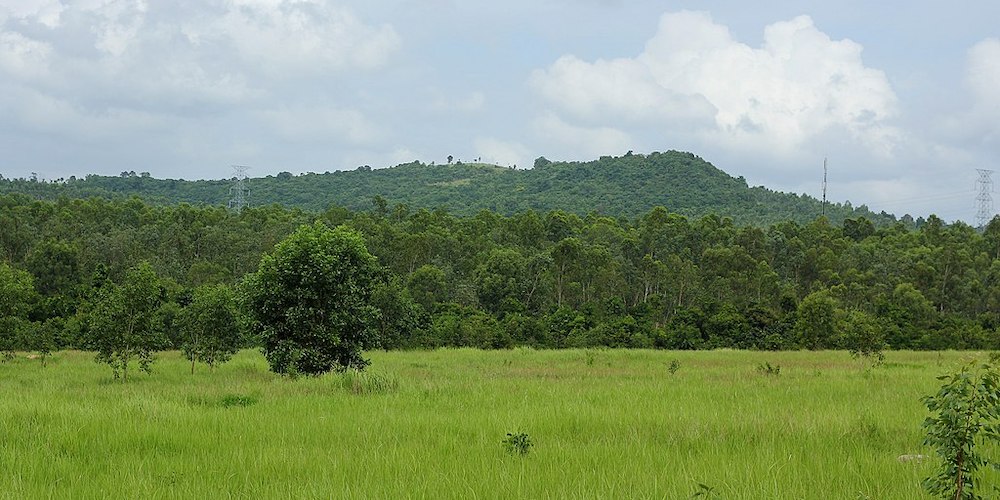
Cambodia Highlands – ©Dmitry Makeev CC BY-SA 4.0 via Wikimedia Commons
In this remote and largely uninhabited area, Phnom Aural, Cambodia’s highest peak rises to an elevation of 5,949 feet. The southern coastal region adjoining the Gulf of Thailand is a narrow lowland strip, heavily wooded and sparsely populated, which is isolated from the central plain by the southwestern highlands. The most distinctive geographical feature is the inundations of the Tonle Sap, measuring about 2,590 km2 (1,000 square miles) during the dry season and expanding to about 24,605 square kilometres (9,500 square miles) during the rainy season. This densely populated plain, which is devoted to wet rice cultivation, is the heartland of Cambodia. Much of this area has been designated as a biosphere reserve.
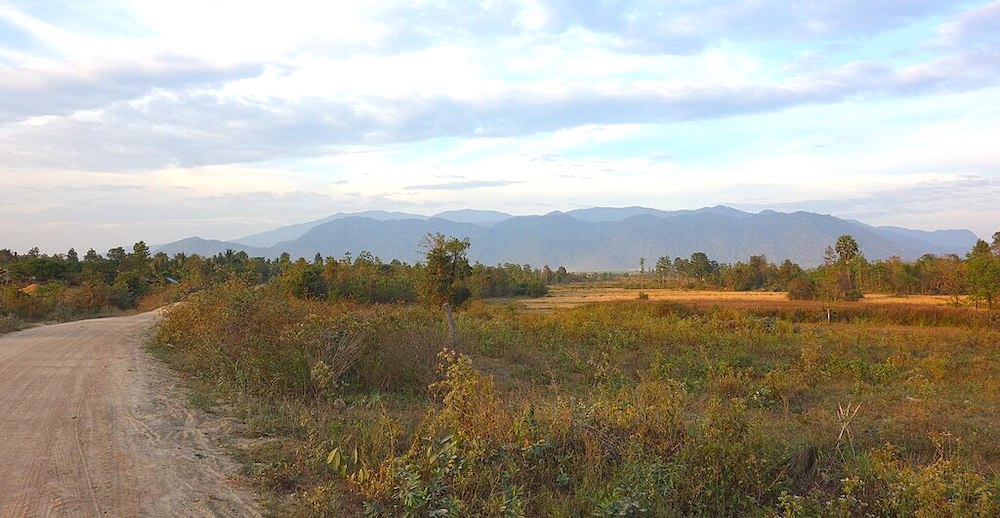
Phnom Aural Wildlife Sanctuary – ©Boroli CC BY-SA 4.0 via Wikimedia Commons
Cambodia has a temperature range from 21 to 35 °C and experiences tropical monsoons. Southwest monsoons blow inland bringing moisture-laden winds from the Gulf of Thailand and Indian Ocean from May to October. The northeast monsoon ushers in the dry season, which lasts from November to April. The country experiences the heaviest precipitation from September to October with the driest period occurring from January to February. Climate change has also had a major impact on water levels, ecology and productivity of the Tonlé Sap in recent years, affecting the food security and agriculture of a large proportion of Cambodia’s population. Agriculture accounts for 90 per cent of GDP and employs c.80 per cent of the workforce. Rice is the principal commodity. Major secondary crops include maize, cassava, sweet potatoes, groundnuts, soybeans, sesame seeds, dry beans, and rubber. The principal commercial crop is rubber.
Birding Cambodia
There are six distinct terrestrial eco-regions in Cambodia – the Cardamom Mountains rain forests, Central Indochina dry forest, Southeast Indochina dry evergreen forest, Southern Annamite Range tropical forest, Tonle Sap freshwater swamp forest, and Tonle Sap-Mekong peat swamp forest. About two-thirds of the country is forested, however the more accessible areas have been degraded by slash and burn agriculture and logging. Cambodia’s tropical climate has a wet and a dry season of equal length; temperature and humidity are normally high throughout the year.
East of the Mekong Cambodia’s biodiversity is largely founded on its seasonal tropical forests, containing some 180 recorded tree species, and riparian ecosystems. There are 212 mammal species, 672 bird species, 240 reptile species, 850 freshwater fish species (Tonle Sap Lake area), and 435 marine fish species recorded by science. Just two bird species are endemic. Much of this biodiversity is contained around the Tonle Sap Lake and the surrounding biosphere reserve.
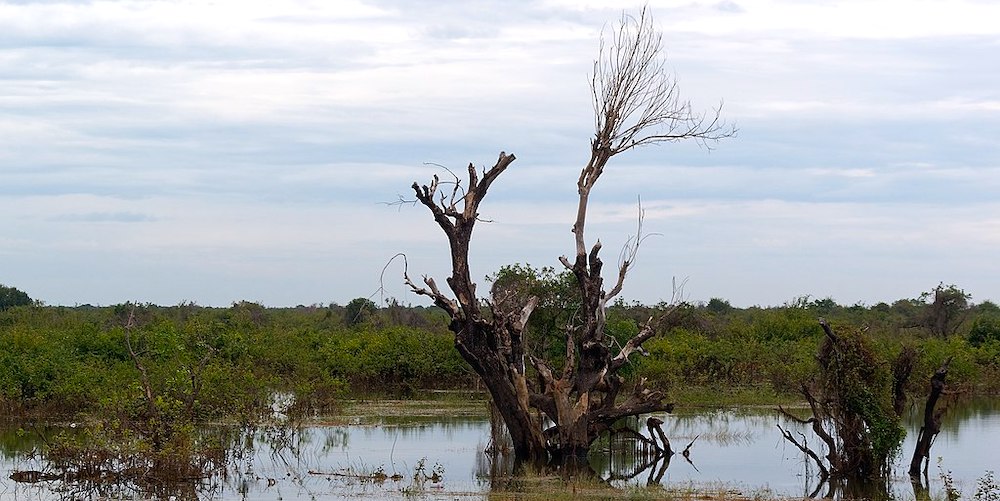
Tonle Sap Lake – ©Jakub Hałun CC BY-SA 4.0 via Wikimedia Commons
It encompasses the lake and nine provinces: Kampong Thom, Siem Reap, Battambang, Pursat, Kampong Chhnang, Banteay Meanchey, Pailin, Oddar Meanchey and Preah Vihear.
Other key habitats include the evergreen and dry Dipterocarp forests of Mondolkiri province, protected by Keo Seima Wildlife Sanctuary, Phnom Prich Wildlife Sanctuary, and Srepok Wildlife Sanctuary, as well as Ratanakiri province, and the Cardamom Mountains ecosystem, including Preah Monivong National Park, Botum-Sakor National Park, and the Phnom Aural Wildlife Sanctuary and Phnom Samkos Wildlife Sanctuary.
This page is sponsored by Bird-Photo-Tours ASIA

-
Ang Tropaeng Thmor
InformationSatellite ViewThe 12,500 ha Ang Trapeang Thmor (ATT) Sarus Crane Reserve was gazetted by Royal Decree in February 2000. The artificial reservoir, built with forced labor during the Pol Pot regime, provides wetland habitat for 40% of the non-breeding population of the Globally Threatened Sarus Crane and numerous other threatened species of wildlife. The site is particularly good for birds of prey, starlings, ducks and large water and grassland birds, depending on the season.ATT can boast a list of 198 bird species, the high diversity being due to the quality and variety of its natural habitats: rice paddies, trapeang and nearby deciduous dipterocarp forest. SVC usually takes birders to the site from Siem Reap, leaving at 5 a.m. and birding until lunch time. We also visit the local village silk weavers for local, hand-made souvenirs. Overnight visits can be arranged.Birding Destinations in the Northern Plains
The deciduous dipterocarp forests that once spread across much of Indochina and Thailand were formerly home to the greatest aggregation of large mammals and water birds that have existed beyond the savannas of Africa. These forests have largely disappeared from Thailand and Vietnam; currently, the Northern and Eastern Plains of Cambodia form the largest remaining contiguous block of this unique and critically important habitat. Much of the Northern Plains is still covered in intact habitat – extensive areas of deciduous dipterocarp forest, with scattered seasonal wetlands (called trapeangs in Khmer) and large grasslands (veals), which flood during part of the wet season (June-October). Dense evergreen forest is found along water-courses and in the more fertile soils of the upland regions.Tmatboey VillageWildlife Conservation Society (WCS) has established a pilot ibis ecotourism project at Tmatboey in Kulen Promtep Wildlife Sanctuary, Preah Vihear province, the only known site where both Giant and White-shouldered Ibises breed and can be reliably seen. The birds are found in the forests surrounding the village, which are a mosaic of seasonally inundated dipterocarp deciduous trees.Sam Veasna Center (SVC) for Wildlife Conservation has the responsibility to promote this project, which actively involves the local community in conservation. Tourism visits are linked to community conservation agreements, whereby income from visits supports local development and engagement in conservation activities. Local site tourism is managed by an elected village ecotourism committee. This committee is responsible for enforcement of the community conservation agreements, managing tourist visits, and ensuring that the benefits of tourism are distributed throughout the village.Trips are usually for three nights and visitors stay in a communally-run basic wooden guesthouse with limited hours of electricity and dormitory-style beds. A separate toilet and shower facility is located behind the building. Simple but good Khmer food is prepared by the local cooks’ group using western hygiene standards. Packed lunches are available for groups staying out all day. Cold beer soft drinks and other items are available for sale at a concession stand run by the women’s group. Local villagers serve as guides to the birds.Vulture RestaurantThe Northern Plains also support one of the last remaining populations of Asian vultures. Populations of three species (White-rumped, Slender-billed and Red-headed vultures) have declined by over 97% in South Asia in the last decade due to poisoning by veterinary use of the drug diclofenac, and are now threatened with local extinction. Cambodia is of global importance for conservation of these species as diclofenac is not available; hence these birds have an excellent chance of long-term survival. The Cambodian populations are primarily threatened by like of available food sources. Consequently semi-permanent feeding stations have been established across the vulture range to provide a safe, reliable, source of carrion.Two-night trips to one of the vulture restaurants, at Chhep in the Northern Plains, can be arranged through the SVC. The site is very remote – requiring a 4-6 hour drive from Tmatboey on forest trails. All three species of vultures can be seen, in addition to Giant Ibises, Greater Adjutant, Sarus Cranes, Black-necked Stork and many deciduous dipterocarp forest specialties. Accommodation at the restaurant is in a basic wooden house in the forest with basic toilet and washing facilities. Food is provided by the Tmatboey cooks’ group.Florican Grasslands
The Tonle Sap Great Lake floodplain once supported several thousand square kilometers of seasonally inundated grassland. These support more than half of the world population of a highly endangered bird, the Bengal Florican. There are also many other threatened or important species including Sarus Crane, White-shouldered Ibis (infrequent), Greater Adjutant (seasonal), rare turtle species and a high diversity of fish. A new land-use designation - Integrated Farming and Biodiversity Areas (IFBAs) has recently been set up to protect existing grassland management systems. This will benefit both threatened wildlife and local communities, and is expected to bring wider benefits by maintaining land-use diversity in these districts, leading to better ecological and economic stability.Trips to see the Floricans at Stoung, Kruos Kraom or Chong Doung can be combined with travel to or from Tmatboey or as a stand-alone day trip or, when visiting several sites, an overnight trip and staying at a nice hotel in Kompong Thom.Contributors-
Karen Wachtel Nielsen
Sam Veasna Center for Wildlife Conservation
https://samveasna.com
Number of Species-
Number of bird species: 684
(As at May 2026)National Bird: Giant Ibis Thaumatibis gigantic
EndemicsNumber of endemics: 3
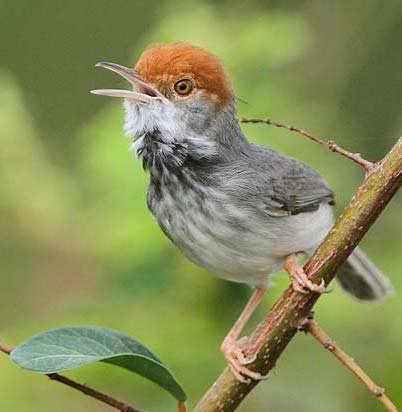
Cambodian Tailorbird Orthotomus chaktomuk
Cambodian Laughingthrush Garrulax ferrarius
Cambodian Flowerpecker Dicaeum cambodianum
Checklist-
Avibase
PDF ChecklistThis checklist includes all bird species found in Cambodia , based on the best information available at this time. It is based on a wide variety of sources that I collated over many years. I am pleased to offer these checklists as a service to birdwatchers. If you find any error, please do not hesitate to report them. -
Wikipedia
Annotated ListThis is a list of the bird species recorded in Cambodia. The avifauna of Cambodia include a total of 672 species, of which 2 have been introduced by humans. 2 species are endemic to Cambodia. -
eBird
PDF ChecklistThis checklist is generated with data from eBird (ebird.org), a global database of bird sightings from birders like you. If you enjoy this checklist, please consider contributing your sightings to eBird. It is 100% free to take part, and your observations will help support birders, researchers, and conservationists worldwide.
Useful Reading
-
Birds of Cambodia
| By Cambodia Bird Guide Association (CBGA) | Lynx Edicions | 2019 | Flexibound | 1300+ colour illustrations, 600+ colour distribution maps | ISBN: 9788416728213 Buy this book from NHBS.com
Birding Aps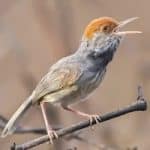
Cambodia Birds
AndroidThis application aim in deliver bird knowledge by a short description of birds and photographic illustration to everyone that interested on birdsOrganisations-
Birdlife News
WebpageBirdLife International Cambodia Programme -
Birds of Cambodia Education & Conservation
Facebook PageThis group is to promote the conservation idea to everyone in the world and to plant the conservation thought to Cambodians via Bird Education. -
Cambodia Bird Club
Facebook PageHaving Fun and Enjoying Birds Watching and Photography -
Cambodia Bird Guide Association
WebsiteBased in Siem Reap, the Cambodia Bird Guide Association is an NGO which provides birding tours and natural heritage tours across Cambodia. We are committed to the preservation of wildlife, nature and developing the livelihoods of people in conservation areas. We work closely with the provincial Department of Environment, in this regard, to raise awareness and educate local people on avian and environmental issues. -
NatureLife Cambodia Organization
Facebook Page -
Oriental Bird Club
WebpageCambodia covers an area of 181,035 square km of continental South-East Asia bordered by Thailand, Laos and Vietnam.
Reserves-
*List of protected areas of Cambodia
InformationSatellite ViewA total of 8 forms of protected areas are recognized under the Cambodian Protected Area Law of 2008... -
BR Tonle Sap Great Lake
InformationSatellite ViewThe Tonle Sap Great Lake consists of the lake and a flood plain of interconnected streams, ponds, flooded forests and wetland vegetation that supports a rich biodiversity of species including; aquatic plants, fish, birds, mammals, reptiles, amphibians, insects and microorganisms… -
BS Ang Trapeang Thmor Sarus Crane Reserve
InformationSatellite ViewAng Trapaing Thmor is a 129.06 km2 (49.83 sq mi) protected forest in northwestern Cambodia. The sarus crane, Grus antigone is an all-year resident breeding bird in northern Pakistan and India (especially Central India and the Gangetic plains), Nepal, Southeast Asia and Queensland, Australia. It is a very large crane, averaging 156 cm (5 ft) in length, which is found in freshwater marshes and plains. -
BS WII Prek Toal
InformationSatellite ViewPrek Toal is a bird sanctuary and Ramsar site located within the Tonlé Sap Biosphere Reserve, at the north-west corner of the Tonlé Sap.[1] It is a popular area for ecotourism and birdwatching given the area's rich biodiversity and rare waterbirds, particularly abundant during the dry season. -
NP Botum Sakor
InformationSatellite ViewSituated on the coast of the Gulf of Thailand, Botum Sakor (or Botumsakor) is a peninsula projecting southwest from the Cardamom Mountains. The national park comprises an area of 1,825.85 km2 (704.96 sq mi) and spans three districts of Koh Kong Province: Kiri Sakor, Botum Sakor and Koh Kong. There are several hundred species of birds to be found within the park area, but only preliminary research has been carried out so far. Of particular interest to conservationists is the white-winged duck (Cairina scutulata), which is endangered and one of the rarest waterfowl in Asia. There are a number of other threatened or near-threatened birds here too, like green peafowl (Pavo muticus), lesser adjutant (Leptoptilos javanicus), Oriental darter (Anhinga melanogaster), great hornbill (Buceros bicornis) and grey-headed fish eagle (Icthyophaga icthyaetus). -
NP Cardamom Mountains
InformationSatellite ViewThe mountain range extends along a southeast-northwest axis from Koh Kong Province on the Gulf of Thailand to the Veal Veang District in Pursat Province, and is extended to the southeast by the Dâmrei (Elephant) Mountains. While the forests are habitat for more than 450 bird species, half of Cambodia’s total of which four, the chestnut-headed partridge, Lewis's silver pheasant (Lophura nycthemera lewisi), the green peafowl (Pavo muticus) and the Siamese partridge (Arborophila diversa) are endemic to these mountains. -
NP Cardamom Mountains
InformationSatellite ViewThe mountain range extends along a southeast-northwest axis from Koh Kong Province on the Gulf of Thailand to the Veal Veang District in Pursat Province, and is extended to the southeast by the Dâmrei (Elephant) Mountains. While the forests are habitat for more than 450 bird species, half of Cambodia’s total of which four, the chestnut-headed partridge, Lewis's silver pheasant (Lophura nycthemera lewisi), the green peafowl (Pavo muticus) and the Siamese partridge (Arborophila diversa) are endemic to these mountains. -
NP Cardamom Mountains
InformationSatellite ViewThe mountain range extends along a southeast-northwest axis from Koh Kong Province on the Gulf of Thailand to the Veal Veang District in Pursat Province, and is extended to the southeast by the Dâmrei (Elephant) Mountains. While the forests are habitat for more than 450 bird species, half of Cambodia’s total of which four, the chestnut-headed partridge, Lewis's silver pheasant (Lophura nycthemera lewisi), the green peafowl (Pavo muticus) and the Siamese partridge (Arborophila diversa) are endemic to these mountains. -
NP Cardamom Mountains
InformationSatellite ViewThe mountain range extends along a southeast-northwest axis from Koh Kong Province on the Gulf of Thailand to the Veal Veang District in Pursat Province, and is extended to the southeast by the Dâmrei (Elephant) Mountains. While the forests are habitat for more than 450 bird species, half of Cambodia’s total of which four, the chestnut-headed partridge, Lewis's silver pheasant (Lophura nycthemera lewisi), the green peafowl (Pavo muticus) and the Siamese partridge (Arborophila diversa) are endemic to these mountains. -
NP Kep
InformationSatellite ViewKep National Park is a national park in Cambodia's Kep Province that was established in 1993 and covers an area of 66.64 km2 (25.73 sq mi). The nearest town lies at Krong Kaeb. -
NP Kirirom
InformationSatellite ViewPreah Suramarit-Kossamak Kirirom National Park is a national park in Cambodia. It is located mostly in Phnom Sruoch District, Kampong Speu Province, while a smaller section is in neighboring Koh Kong Province. The park extends over the eastern part of the Cardamom Mountains. It is located 112 km from Phnom Penh of National Highway 4 on the road to Sihanoukville. -
NP Phnom Kulen
InformationSatellite ViewPreah Cheyvaraman-Norodom Phnom Kulen National Park is located in the Phnom Kulen mountain massif in Siem Reap Province. -
NP Preah Monivong
InformationSatellite ViewIt is a national park in southern Cambodia's Kampot Province and covers 1,423.17 km2 (549.49 sq mi). It is located in the Dâmrei Mountains, forming the southeastern parts of the Cardamom Mountains. Most of the park is about 1,000 metres above sealevel and the highest peak is Phnom Bokor at 1,081 metres, also referred to as Bokor Mountain. -
NP Ream
InformationSatellite ViewPreah Sihanouk Ream National Park is a national park of Cambodia located 18 km (11 mi) from Sihanoukville city in the Prey Nob district of the Sihanoukville Province in south-eastern Cambodia. The national park's biological value is defined by its combination of rivers, forests, mangroves, estuaries, beaches, coral reefs, wildlife, and marine life. -
NP Virachey
InformationSatellite ViewThe park overlaps Ratanakiri and Stung Treng Provinces. Located in some of the most deep and isolated jungles of Cambodia, Virachey is largely unexplored and holds a large assortment of wildlife, waterfalls and mountains. The park comprises dense semi-evergreen lowlands, montane forests, upland savannah, bamboo thickets and occasional patches of mixed deciduous forest. Most of the area lies above 400 meters up to 1,500 meters. -
NR Boeng Tonle Chhmar
InformationSatellite ViewBoeng Tonle Chhmar is a 145.6 km2 (56.2 sq mi) large multiple use management area in Cambodia bordering Tonlé Sap lake. It is home to important colonies of numerous globally or regionally threatened bird species including the brahminy kite (Haliastur indus), painted stork (Mycteria leucocephala), black-necked stork (Ephippiorhynchus asiaticus), lesser adjutant (Leptoptilos javanicus), greater adjutant (Leptoptilos dubius), spot-billed pelican (Pelecanus philippensis), Indian cormorant (Phalacrocorax fuscicollis) and the Oriental darter (Anhinga melanogaster). -
NR Prey Lang
InformationSatellite ViewThe Prey Lang Forest, also known as the Prey Long Forest, is a nature reserve forest in Kampong Thom, Preah Vihear, Kampong Cham, Kratie and Stung Treng Provinces in Northern Cambodia.[1] The forest covers an estimated 3,600 square kilometres (1,390 square miles). It is one of Southeast Asia’s last remaining lowland evergreen woodlands. -
WS Beng Per (aka Boeng Peae)
InformationSatellite ViewBeng Per Wildlife Sanctuary is a 2,494.08 km2 (962.97 sq mi) large protected area in northern Cambodia. It hosts wild cattle and deer, large water birds and elephants. -
WS IBA Phnom Samkos
InformationSatellite ViewPhnom Samkos Wildlife Sanctuary is a 3,307.56 km2 (1,277.06 sq mi) large protected area in western Cambodia that was established in 1994. It borders Thailand in the north. -
WS IBA Snoul
InformationSatellite ViewSnoul Wildlife Sanctuary was located in eastern Cambodia on the border to Vietnam. It is classified as part of an Important Bird Area. -
WS Kulen Promtep
InformationSatellite ViewThe Kulen Promtep Wildlife Sanctuary is the largest protected area in Cambodia and was set aside to protect the critically endangered, possibly extinct Kouprey (species of wld cattle). It is located in the northern plains of Cambodia, near the border to Thailand. The sanctuary contains lowland forest as well as the largest swamp in the country. It is part of the Northern Plains Dry Forest Priority Corridor. -
WS Mondulkiri
InformationSatellite ViewMondulkiri Protected Forest is a 3,720.54 km2 (1,436.51 sq mi) large protected forest in eastern Cambodia. It is part of the largest protected area complex in Southeast Asia. -
WS Peam Krasaop
InformationSatellite ViewThe area is known for its mangroves and numerous islands separated by a maze of bays and channels. -
WS Phnom Aural
InformationSatellite ViewPhnom Aural Wildlife Sanctuary is a 2,544.85 km2 (982.57 sq mi) large protected area in central Cambodia -
WS Phnom Prich (aka Phnum prech)
InformationSatellite ViewPhnom Prich Wildlife Sanctuary is a 2,218.18 km2 (856.44 sq mi) large protected area in eastern Cambodia. -
WS Stung Sen
InformationSatellite ViewStung Sen is a protected multiple use management area and wildlife sanctuary in the Kampong Thom Province of Cambodia. It is located near the south-eastern tip of the Tonlé Sap, one of three wildlife sanctuaries around the lake, including Boeng Tonlé Chhmar and Prek Toal -
Wetlands
WebpageSatellite ViewCambodia currently has 5 sites designated as Wetlands of International Importance (Ramsar Sites), with a surface area of 85,235 hectares.
Sightings, News & Forums-
eBird
SightingsCambodia Rare Bird Alert
Guides & Tour Operators-
Angkor Focus Travel
Local Tour OperatorSpend a fantastic day in rural Siem Reap observing Cambodia's diverse bird life. Start with a visit to the Sam Veasna Centre, which promotes and develops bird watching sites, before heading to an area of protected wetland. Your expert guide will help you spot some of the 200 species of birds in the area, including Sarus Cranes and other endangered birds. -
Bird Photo Tours ASIA
Tour OperatorOur comprehensive Bird-Photo-Tour of Cambodia targets six Critically Endangered species that are best photographed in this country namely, Bengal Florican, Slender-billed Vulture, Red-headed Vulture, White-rumped Vulture, Giant Ibis and White-shouldered Ibis. -
BirdQuest
Tour OperatorCAMBODIA & LAOS – from Giant and White-shouldered Ibises and Milky Stork to Bare-faced Bulbul and Cambodian Laughingthrush -
Birdfinders
Tour OperatorAlthough Cambodia has only one endemic species – the recently discovered Cambodian Tailorbird – this trip also targets a wealth of rare and range-restricted species including Milky Stork, Giant and White-shouldered Ibises, Bengal Florican and Mekong Wagtail. We will also pay a visit to the world-famous Angkor Wat temple complex to combine birding with culture. An extension to Laos for Bare-faced Bulbul is also available. -
Birding Ecotours
Tour OperatorOur Cambodia birding tours offer the best opportunities for seeing several most-wanted birds for world birders. Top birds possible on birding tours to Cambodia include Giant Ibis, White-shouldered Ibis, Bengal Florican, Milky Stork, Greater Adjutant, White-rumped Falcon, Mekong Wagtail, and Cambodian Tailorbird. -
Calidris Birding Tours
Tour OperatorCambodia birding tour highlights include Giant Ibis, Greater Adjutant, Black-headed Woodpecker, Milky Stork, Rufous-bellied Woodpecker, White-shouldered Ibis, Mekong Wagtail, Cambodian Tailorbird... -
Cambodia Bird Guide Association
WebsiteWelcome to Cambodia Bird Guide Association (CBGA) Based in Siem Reap, the Cambodia Bird Guide Association is an NGO which provides birding tours and natural heritage tours across Cambodia. We are committed to the preservation of wildlife, nature and developing the livelihoods of people in conservation areas. We work closely with the provincial Department of Environment, in this regard, to raise awareness and educate local people on avian and environmental issues. CBGA tours are led by professional local bird guides to 17 different destinations. These range from half a day tour in Siem Reap, to a full three-week tour across Cambodia. Contact us and we can help plan a perfect birding itinerary and an unforgettable holiday. -
Eagle-Eye Tours
Tour OperatorRich and diverse birdlife incorporating avifaunas of the Himalayas, Malaysia and China... -
FieldGuides
Tour OperatorA "last chance" destination for some of the large, rare Asian waterbirds now extinct in neighboring countries, plus additional regional specialties and world-famous Angkor Wat... -
Merry Travel
Tour OperatorA 7-day Cambodia birding tour, you will be landing and take off from Siem Reap International Airport. Great tour with Merry Travel Asia Birding guide to take you visit many spicies of water bird in Prek Taol, Ang Trapaeng Thmor, and birds in the Angkor -
NatureTrek
Tour OperatorThe Best of Cambodia - Birds, Mammals & Temples -
Rockjumper
Tour OperatorCambodia - Angkor Wat, Giant Ibis & Rare Vultures -
Sam Veasna Conservation Tours
Tour OperatorAs Cambodia’s first ever bird tour operator, we’ve been running custom birding tours in Cambodia since 2006, with the most passionate and experienced guides in the region. We take you to the most breathtaking and biologically diverse places in the country. SVC manages wildlife viewing trips with exclusive access to Wildlife Conservation Society sites across Cambodia. We were registered as a local NGO with the Ministry of Interior in 2006. Our goal is to provide an alternative sustainable livelihood from ecotourism for the local communities at the sites that WCS prioritises for conservation. -
WINGS
Tour OperatorCambodia’s expansive forests and untouched wetlands support some of the rarest birds and mammals in the region.... -
WildBirdEco
WebsiteWild Bird Eco Tour was established in since 1998 by Mr.Panuwat Sasirat, the founder. The head office is located in Bangkok Thailand. Our business has been known in the group of bird watcher and the conservative tourism companies in Thailand. Nowadays, the first class tourism companies and the local guides from nationwide and foreign countries participate and join with us. -
Zoothera Birding
Tour Operator...Arriving at dawn we will take advantage of the cool hours of the day to enjoy some birds among the forest which surrounds the temple complex with key species being White-throated Rockthrush, Hainan Blue Flycatcher, Pale-legged Leaf Warbler and Forest Wagtail...
Trip Reports-
2017 [02 February] - Phil Gregory & Doug Gochfeld
Report...Baeng Toal vulture restaurant got off to a flying start, with a great show of gluttony by the regular trio of Critically Endangered (CR) vulture species (White-rumped, Slender-billed, and Red-headed). All were excellent and gave wonderful views, with the new, much closer, well-camouflaged blind enabling crippling views as the birds fed on the nearby carcass.... -
2017 [05 May] - Matthew Kwan - Cambodia
ReportHowever, when birders speak of Cambodia, the first thing that comes to mind is "last chance to see", as this country holds several critically endangered species that is now extremely difficult to find elsewhere, such as the mythical Giant Ibis, the equally mysterious White-shouldered Ibis, the very rare Bengal Floricans and many more... -
2018 [02 February] - Mike Nelson - Cambodia & Laos
PDF ReportThe dry deciduous forests, open grasslands, marshy wetlands and limestone karst of Cambodia and Laos make for some brilliant birding. Some of South-east Asia’s most sought-after rarities reside here like Giant and Whiteshouldered Ibis, Greater Adjutant, Milky Stork, Bengal Florican, Cambodian Laughingthrush and recently described Bare-faced Bulbul, and these were just a few of the mouthwatering species we encountered on this tour. -
2018 [02 February] - Phil Gregory
ReportThe first morning of the tour saw us getting right into a dizzying array of birds at the Phnom Krom rice paddies to the south of town. Not only were some more birds with a strong southeast Asian flavor, such as Chestnut-capped Babbler, Oriental Darter, and Pheasant-tailed Jacana, but we also had a great showing of migrant shorebirds which were wintering in the area, including such locally scarce birds as Temminck’s and Long-toed Stints. We also had a surprise “Chinese” White Wagtail. The afternoon brought us to the high quality locally made crafts at Artisans Angkor, and then onto the Royal Gardens park where we got to observe the large daytime roost of several hundred Lyle’s Flying-Foxes. We were also treated to a great comparison of Asian Brown and Taiga flycatchers interacting with each other. -
2019 [02 February] - Craig Robson
PDF ReportThis year’s tour saw several additions to the itinerary, with Okoki, Phnom Aural and Pursat Grasslands. The main highlights amongst our total of 331 Species were: Chestnut-headed Partridge, Siamese Fireback, Milky Stork at the nest, Greater Adjutant, Giant and White-shouldered Ibises, White-rumped Vulture, Bengal Florican, Oriental Bay Owl, Blyth’s Frogmouth, White-rumped Falcon, Bamboo Woodpecker, Bare-faced Bulbul, Cambodian Tailorbird, Cambodian Laughingthrush, Sooty Babbler, Chinese Grassbird, Green Cochoa, Jerdon’s Bush Chat, Asian Golden Weaver, and Mekong Wagtail. Irrawaddy Dolphin headed-up the mammal list as usual. -
2020 [02 February] - Mike Nelson
PDF ReportResiding in the old heartland of the Khmer Empire, Cambodia boasts some of the world’s most stunning temples. It is also home to several of Asia’s most desirable species that include Giant and White-shouldered Ibis, White- rumped Falcon, White-winged Duck, Mekong Wagtail, Bengal Florican, Cambodian Tailorbird and Chinese Grassbird. -
2022 [12 December] - Sam Veasna
ReportWINGS Birding Tours International trip report of a 14-day Cambodia birding tour in November and December 2022 with Sam Veasna Conservation Tours (SVC). -
2023 [01 January] - Sam Veasna
ReportCambodia birding trip report of a 7-day Cambodia birding tour in January 2023 with Sam Veasna Conservation Tours (SVC). -
2023 [02 February] - Sam Veasna
ReportWild Cambodia and Chinese Grassbird Report covers an 11-day Cambodia birding tour in February 2023 with Sam Veasna Conservation Tours (SVC). -
2023 [03 March] - Nick Upton
ReportCambodia Birding Highlights: This list represents species that were exciting or of interest to the group due to their rarity, visual impact, notable behaviour, quality of the view, difficulty in observing or were highly anticipated due to some personal reason. -
2023 [03 March] - Sam Veasna
ReportGiant Ibis Birding Tour with Prek Toal Bird Sanctuary Report covers a 4-day Cambodia birding tour in March 2023 with Sam Veasna Conservation Tours (SVC). -
2023 [03 March] - Sam Veasna - Northern Cambodia
ReportNorthern Cambodia birding trip report of a 6-day Cambodia birding tour in February 2023 with Sam Veasna Conservation Tours (SVC). -
2023 [08 August] -
Report...I am soon reaching a pond and I see a group of Lesser Whistling Duck and there is one white bird among them and I think that it might be a Cotton Pygmy Goose but it looks exactly like the ducks, except for the colour. So, I post a question at www.birdforum.net... -
2023 [12 December] - Mony Sang
PDF Report...Tonle Sap Great Lake Prek Toal Waterbird Breeding Colony, to the Prolay- Bengal Florican Grassland then Prey Veng Ecolodge, visited the Giant & White-shouldered Ibises site- Tmatboey Ecolodge, went to see the Asian Vultures species in the Beong Toal- Vulture Feeding Station... -
2024 [01 January] - Sam Veasna
Report15-day Cambodia Birding Tour Report covers a 15-day Cambodia birding tour in January 2024 with Sam Veasna Conservation Tours -
2024 [02 February] - Paul Varney
PDF ReportAngkor Wat, Giant Ibis & rare vultures -
2024 [02 February] - Phil Gregory
Report...We began in Siem Reap and used various vans to get round the sites, with a morning out at Phnom Krom as an introduction, with a new colony of Asian Golden Weaver as a very good sighting. We had a very successful day trip to the blind at Changkran Roy ecotourism reserve, where we saw a fantastic Coral-billed Ground Cuckoo after a protracted wait of 4 hours, and heard Green-legged Partridge, and a frustratingly invisible Bar-bellied Pitta... -
2024 [03 March] - Bram Vogels
PDF Report...The ricefields were busy and we noted the following birds Amur stonechat, Brown shrike, Barn swallow, House sparrow, White-shouldered starling, Black drongo, Plain prinia, Siamese pied starling, Yellow-vented bulbul, Dusky warbler, Plainbacked sparrow, Golden-bellied gerygone, Medium egret, Eastern cattle egrat and Great myna.... -
2024 [03 March] - Craig Robson
PDF ReportA tough pre-tour extension to Mount Aural in Cambodia reaped rewards with superb close views of Chestnut-headed Partridge and Cambodian Laughingthrush. The cream of the crop during the main tour in Cambodia were a fantastic Coral-billed Ground Cuckoo (at a new site for us), Pale-capped Pigeon, the imperious Giant and White-shouldered Ibises, Milky Stork, Greater Adjutant, Bengal Florican, a stunning male Bar-bellied Pitta, Blue Pitta, White-rumped Falcon, Siamese Pied Myna, Cambodian Tailorbird, Chinese Grassbird, Manchurian Reed Warbler, Asian Golden Weaver, Mekong Wagtail, and Cambodian Flowerpecker. Irrawaddy Dolphin headed-up the mammal list as usual. -
2024 [03 March] - Rob Jansen
PDF ReportThis trip report covers our trip to Laos & Cambodia. We travelled there from the 18th of February until the 15th of March 2024... -
2024 [11 November] - Bent Otto Poulsen
PDF Report...Our trip to Cambodia was part of a four month nature and wildlife trip to Asia (N India, SW India, Vietnam, Taiwan & NE India)... -
2026 [03 March] - Chris Lotz
PDF ReportCambodia is a remarkable birding destination, as six extremely rare species can usually be seen with remarkable ease here. These Critically Endangered (IUCN designation) birds are Bengal Florican, two ibises and three vultures. As we expected, we did see all six of these birds, very nicely. White-rumped Pygmy Falcon is also a major target in Cambodia, and we enjoyed seeing it a couple of times on this trip...
Other Links-
Cambodia Bird
InformationCheck out our seventeen birding sites across Cambodia. Eight of these birding hotspots are within driving distance of Siem Reap, with another nine scattered across the country. The total number of bird species recorded is around 647, which includes many rare and endangered species. From Giant Ibis (national bird of Cambodia) and the White-shouldered Ibis; to Cambodian Tailorbird and Milky Stork. There is an abundance of avian life which it would be difficult (if not impossible) to find in other countries. Cambodia is indeed a paradise for the twitcher.
-
Fatbirder - linking birders worldwide...
Skip to content