

Republic of Senegal
Senegal is the westernmost country in West Africa, situated on the Atlantic Ocean coastline. It borders Mauritania to the north, Mali to the east, Guinea to the southeast and Guinea-Bissau to the southwest. Senegal nearly surrounds The Gambia, a country occupying a narrow sliver of land along the banks of the Gambia River, which separates Senegal’s southern region of Casamance from the rest of the country. It also shares a maritime border with Cape Verde. It covers an area of almost 197,000 km2 (c.76,000 square miles) with a population of around 19 million people, of whom about 3,660,000 live in Senegal’s largest metropolitan area, he economic and political capital and port city of Dakar. The second most populous city is Touba, a rural community with around three-quarters of a million inhabitants.
The Senegalese landscape consists mainly of the rolling sandy plains of the western Sahel which rise to foothills in the southeast. Here is also found Senegal’s highest point, Baunez Ridge 2,126 feet. The northern border is formed by the Senegal River; other rivers include the Gambia and Casamance Rivers. The four major rivers, the other being the Saloum River, drain westwards into the Atlantic Ocean. The Lac de Guiers is a large freshwater lake in the north of the country while Lake Retba, near Dakar, is saline. The capital Dakar lies on the Cap-Vert peninsula, the westernmost point of continental Africa.
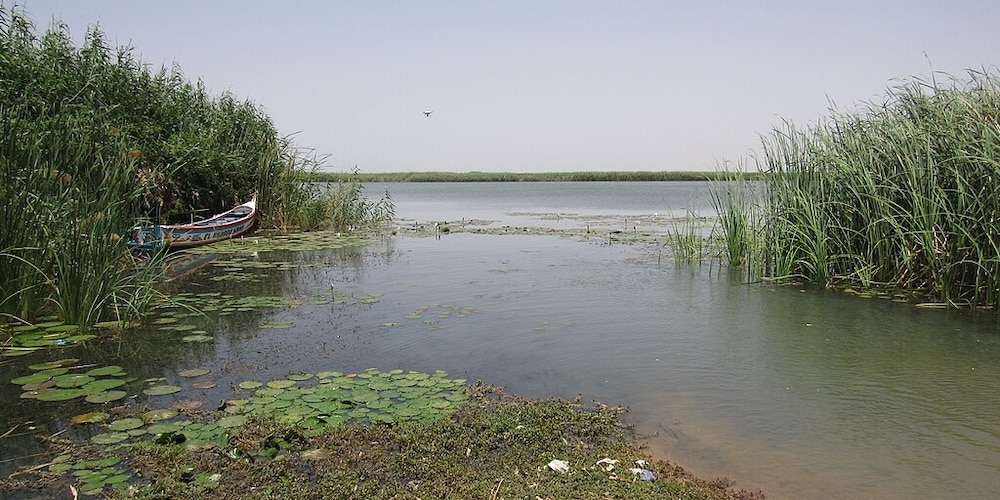
Lac de Guiers – ©chelsealwood CC BY-SA 2.0 via Wikimedia Commons
Senegal has a tropical climate with pleasant heat throughout the year with well-defined dry and humid seasons that result from northeast winter winds and southwest summer winds. The dry season (December to April) is dominated by hot, dry, harmattan wind. Dakar’s annual rainfall of about 24 inches occurs between June and October when maximum temperatures average 30 °C and minimums 24.2 °C. December to February maximum temperatures average 25.7 °C and minimums 18 °C. Interior temperatures are higher than along the coast (for example, average daily temperatures in Kaolack and Tambacounda for May are 30 °C and 32.7 °C respectively, compared to Dakar’s 23.2 °C), and rainfall increases substantially farther south, exceeding 59 inches annually in some areas.
In Tambacounda in the far interior, particularly on the border of Mali where desert begins, temperatures can reach as high as 54 °C. The northernmost part of the country is the Lompoul desert that has a near hot desert climate, the central part has a hot semi-arid climate and the southernmost part has a tropical wet and dry climate. Senegal is mainly a sunny and dry country.
Birding Senegal
Senegal contains four terrestrial eco-regions: Guinean forest-savanna mosaic, Sahelian Acacia savanna, West Sudanian savanna, and Guinean mangroves.
It has a long Atlantic coastline and a range of habitat types, with a corresponding diversity of plants and animals. About 5,213 species, subspecies and varieties of vascular plants had been recorded in Senegal by the end of 2018, of which 515 were trees or woody plants. There have been 188 species of mammals and 698 species of bird recorded.
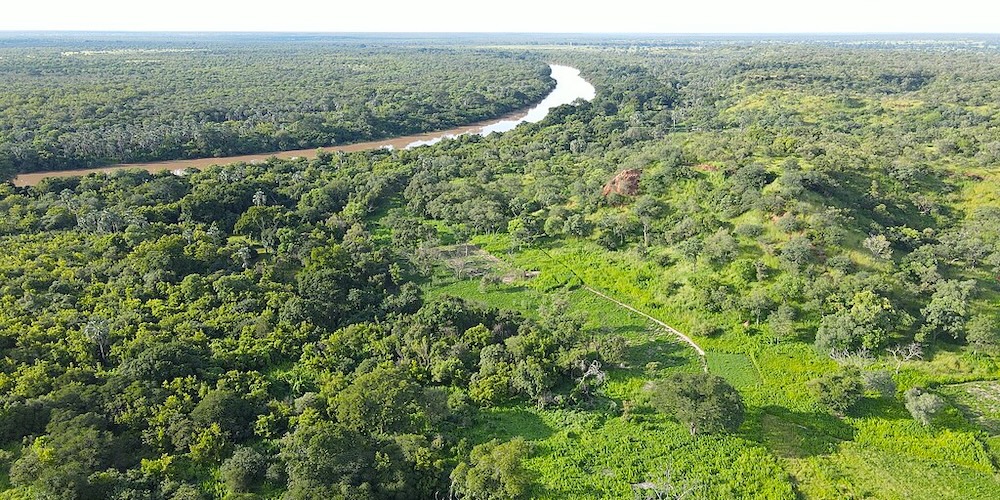
Niokolo-Koba National Park – ©Massowka Public Domain via Wikimedia Commons
The Niokolo-Koba National Park is a World Heritage Site and large natural protected area in southeastern Senegal near the Guinea-Bissau border. The park is typical of the woodland savannah of the country. About thirty species of tree are found there, mainly from the families Fabaceae, Combretaceae and Anacardiaceae, and about one thousand species of vascular plant. The drier parts are dominated by the African kino tree and Combretum glutinosum, while the gallery forests beside rivers and streams (many of which dry up seasonally) are largely formed from Erythrophleum guineense and Pseudospondias microcarpa, interspersed with palms and bamboo clumps. Depressions in the ground fill with water in the rainy season and support a wide range of aquatic vegetation. In the coastal zone of Niayes, a coastal strip of land between Dakar and Saint Louis where a line of lakes lie behind the coastal sand dunes, the predominant vegetation is the African oil-palm, along with the African mesquite and Cape fig. Many of the larger animals of Senegal that used to have a widespread distribution have suffered from loss of habitat, persecution by farmers, and hunting for bushmeat, and are now largely restricted to the national park. The Guinea baboon is one of these, as are the Senegal hartebeest, the western hartebeest, the scimitar oryx, the roan antelope and several species of gazelle. Habitat degradation has caused populations of western red colobus, elephants, lions, and many other species to decrease heavily.
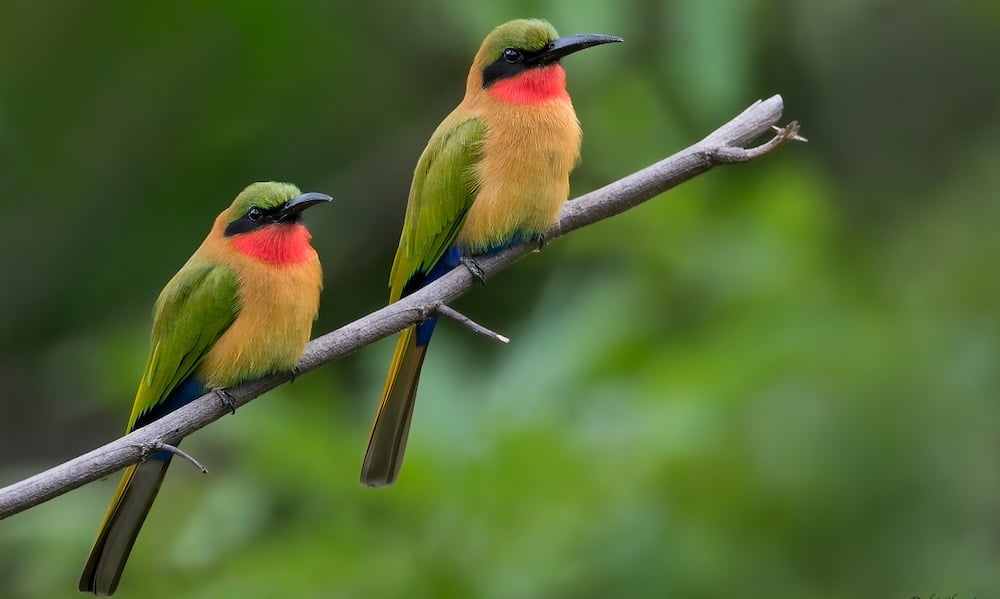
Some of the more spectacular and sought-after birds include Red-billed Tropicbird, Arabian Bustard, Egyptian Plover, Golden Nightjar, Red-throated Bee-eater, Chestnut-bellied Starling, Cricket warbler, Kordofan Lark and the Sudan Golden Sparrow.
The Djoudj National Bird Sanctuary on the south side of the Senegal River Delta is an important site for migrating and overwintering waterfowl. About three million migratory birds spend the winter there. Breeding birds in the delta include Great White Pelican, Lesser Flamingo, Marbled Duck, African Spoonbill, Purple Heron and Black-crowned Crane.
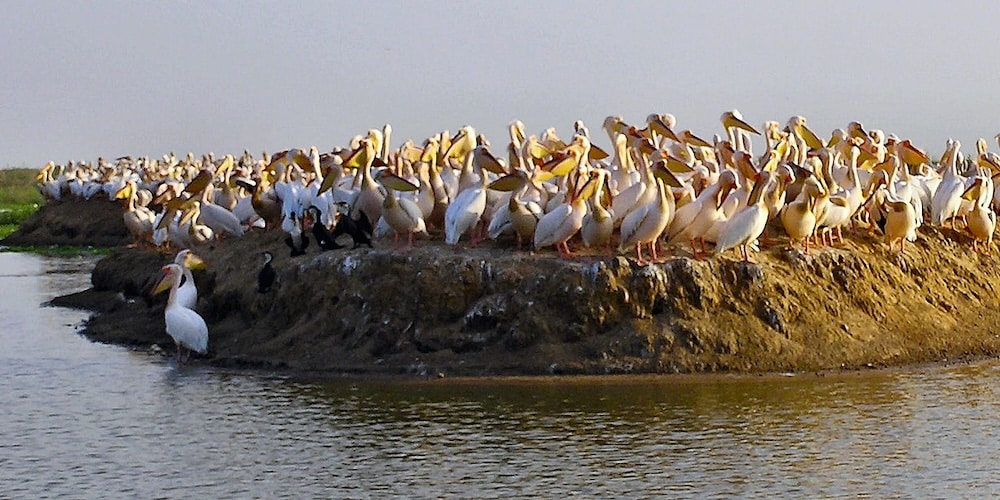
Pelican Island, Djoudj National Bird Sanctuary – ©Manu 25 Public Domain via Wikimedia Commons
Further south is the Saloum Delta National Park which lies on the East Atlantic Flyway, along which about 90 million birds migrate annually. Breeding and wintering birds in the park include Royal Tern, Greater Flamingo, Eurasian Spoonbill and Little Stint. Another important wetland area is the Niayes, which is an important centre for waterbirds and raptors; large numbers of Black Kites are a feature there.
-
Wikipedia
GNU Free Documentation License
https://en.wikipedia.org/wiki/Senegal
-
Number of bird species: 698
(As at February 2025)
-
Avibase
PDF ChecklistThis checklist includes all bird species found in Senegal , based on the best information available at this time. It is based on a wide variety of sources that I collated over many years. I am pleased to offer these checklists as a service to birdwatchers. If you find any error, please do not hesitate to report them. -
E-Bird
PDF ChecklistThis checklist is generated with data from eBird (ebird.org), a global database of bird sightings from birders like you. If you enjoy this checklist, please consider contributing your sightings to eBird. It is 100% free to take part, and your observations will help support birders, researchers, and conservationists worldwide. -
Senegambia Birding
PDF ChecklistDownload and print the Senegambia Birding Checklist for birds in Senegal & The Gambia (PDF) A handy checklist to take along on tour. Sequence based on the bird guide Birds of Senegal and The Gambia. -
Wikipedia
Annotated ListThis is a list of the bird species recorded in Senegal. The avifauna of Senegal include a total of 698 species. One of these species has been introduced by humans. Eight other species are rare or accidental. One species listed is extirpated in Senegal.

-
Birds of Senegal and The Gambia
| By Ron Demey & Nik Borrow | Helm | Edition 2 | 2023 | Paperback | 360 pages, 149 plates with colour illustrations; colour distribution maps, 3 colour maps | ISBN: 9781399402200 Buy this book from NHBS.com -
Birds of Western Africa
| By Nik Borrow & Ron Demey | Helm | 2014 | Edition 2 | Paperback | 592 pages, 266 plates with colour illustrations; colour distribution maps | ISBN: 9781472905680 Buy this book from NHBS.com -
Birds of Western and Central Africa
| By Ber van Perlo | Princeton University Press | 2003 | Paperback | 384 pages, 109 plates with colour illustrations; colour & b/w illustrations, 1500+ b/w distribution maps, colour maps | Out of Print | ISBN: 9780691007144 Buy this book from NHBS.com -
Oiseaux du Sénégal [Birds of Senegal]
| By Jean-Marie Dupart | Amalion Publishing | 2017 | Paperback | 124 pages, colour photos, 3 colour maps, 2 tables | French Text | ISBN: 9782359260748 Buy this book from NHBS.com

Birds of Africa
Apple iOS | AndroidBirds of Africa was developed as an aid to conservation and is an asset of The African Bird Club. It is a guide to more than 2300 species of birds in 43 countriesOrganisations-
African Bird Club
WebsiteWith good travel connections, a tourist infrastructure and a list of over 600 bird species, one might expect that more birders would visit Senegal. There have been fairly thorough surveys of most of the coastal areas, the Niokolo-Koba National Park and the large Ferlo reserves. However, some other parts of the country remain relatively unknown in ornithological terms, and there are good opportunities for the independently minded birder to explore this interesting country -
LPO
WebpageEngager et renforcer les organisations de la société civile dans la gestion intégrée des ressources naturelles tout en préservant la biodiversité et en assurant le développement local au Sénégal. -
Ornithologie, Conservation et Développement
WebsiteL’organisation d’un Master « Ornithologie Conservation Développement » a été proposée en raison de l’intérêt croissant d’étudier la biodiversité aviaire en Afrique de l’ouest. -
West African Ornithological Society
WebsiteThe West African Ornithological Society grew out of the Nigerian Ornithologists
Reserves-
*Protected areas of Senegal
InformationSatellite ViewInteractive list of Biosphere, National Parks & Reserves etc. -
AR Kalissaye
InformationSatellite ViewThe reserve was created in 1978 to protect sea turtle and seabird colonies. There were more than 10,000 Caspian terns (Sterna caspia) in the reserve during the 1980s, and there are also many royal terns (Thalasseus maximus) and great white pelicans (Pelecanus onocrotalus)... -
IBAs
WebsiteSatellite ViewThere are no endemic species in Senegal and no primary Endemic Bird Area, although species representative of Sahel, Sudan-Guinea Savanna and Guinea-Congo Forests biomes occur in the country. There is one EBA secondary area for Mali Firefinch, Lagonosticta virata in the Upper Niger Valley and contiguous with that in Mali. Of particular note are the huge concentrations of migrant and resident waterbirds for which the wetlands in the floodplain of the Senegal river are of vital importance. It is estimated that 3 million migrant birds pass through the protected areas in the Senegal river each year. The importance of the coastline for resident and passage seabirds has become apparent in recent years with observations of tens of thousands of migrant terns, gulls and shearwaters moving along the coast -
L'Île de Kousmar
WebpageSatellite ViewLa LPO s’intéresse depuis plusieurs années au Sénégal, plus spécifiquement à l'Île de Kousmar qui constitue un écosystème riche en biodiversité faunique et qui abrite les plus grandes concentrations de faucons crécerellette connues à ce jour en Afrique de l’Ouest. -
NBS Djoudj
WebsiteSatellite ViewIt provides a range of wetland habitats which prove very popular with migrating birds, many of which have just crossed the Sahara. Of almost 400 species of birds, the most visible are pelicans and flamingos. Less conspicuous are the aquatic warblers migrating here from Europe; for these, the park is the single most important wintering site yet discovered. -
NP Basse Casamance
InformationSatellite ViewThere are 200 species of birds and 50 species of mammals, including African forest buffalo, African leopard, Campbell's mona monkey, Prince Demidoff's bushbaby and western red colobus. -
NP Langue de Barbarie
InformationSatellite ViewThe Langue de Barbarie National Park (French: Parc National de la Langue de Barbarie) is located at the southern edge of the peninsula. Covering an area of 2,000 hectares (4,900 acres), it is home to an abundant variety of bird species and three species of turtle, including the critically endangered hawksbill sea turtle. -
NP Niokolo-Koba
WebsiteSatellite ViewBirds include Denham's Bustard Neotis cafra denhami, Ground Hornbill Bucorvus abyssinicus, Violet Turaco Musophaga violacea, Spur-winged Goose Plectropterus gambensis, White-faced Tree Duck Dendrocygna viduata, Martial Eagle Polemaetus bellicosus and Bateleur Terathopius ecaudatus. -
NP Saloum Delta
InformationSatellite ViewSaloum Delta National Park or Parc National du Delta du Saloum in Senegal, is a 76,000-hectare (190,000-acre) national park. The bird species that breed or winter in the area include royal tern, greater flamingo, Eurasian spoonbill, curlew sandpiper, ruddy turnstone, and little stint. -
NP Îles de la Madeleine
InformationSatellite ViewThe islands are known for their birds, fish and plant life. The cliffs are steep, and had been carved by the sea over millions of years -
NR Ferlo Nord
InformationSatellite ViewThe Ferlo Nord Wildlife Reserve (Réserve de Faune du Ferlo-Nord), established in 1971, is a 6,000 square kilometres (2,300 sq mi) IUCN habitat and species protected nature reserve. It is bordered by the Ferlo Sud Wildlife Reserve to the south. -
NR Guembeul
InformationSatellite ViewThe park is home to many species of birds, reptiles and mammals. The site is also the center for reintroduction programs of three species of gazelles and is home to the African Spurred Tortoise. -
Senegal Parks
WebsiteSatellite Viewe.g. Parc National du Djoudj - Riverine habitat on the Senegal River. Access by road from St Louis. Open all year round. Reasonable accommodation or camping available. Viewing by foot, vehicle or pirogue (canoe). Important resting place for migratory birds, over 300 species recorded.
Sightings, News & Forums-
eBird
SightingseBirding This Month
Guides & Tour Operators-
BirdFinders
Tour OperatorBirdfinders have been in Senegal preparing a new tour to this rarely-visited destination... -
BirdQuest
Tour OperatorSENEGAL – Sahel specialities, including Golden Nightjar and Egyptian Plover -
Birding Ecotours
Tour OperatorBirding Tour Senegal: Supreme West African Birding... -
Birding The Strait
Tour OperatorWelcome to the new Birding The Strait Senegal Tour, a comprehensive 15-day exploration of the birds of Senegal and an excellent introduction to the birdlife of Western Africa. -
Birds, Wildlife & Nature
Tour OperatorThis exciting trip covers a wide range of the Sahel habitats giving the best chance possible of seeing all the target Sahel specialised species. -
Boletas
Tour OperatorSenegal is one of the most fantastic birdwatching countries of West Africa. -
Ebrima Sidibeh
Local Tour OperatorI offer tailor made bird, photography and wildlife tours throughout The Gambia and Senegal, visiting numerous high quality birding sites to suit your needs, the species you'd like to see, and the habitats you'd like to experience. -
Excursions Djoudj - Mohamedine Seck
Local GuideExcursion Djoudj is at your disposal to discover in every nook and cranny the Djoudj bird park in Senegal. -
Gambia Bird Tour
Local Tour OperatorI offer tailor made bird, photography and wildlife tours throughout The Gambia and Senegal, visiting numerous high quality birding sites to suit your needs, the species you'd like to see, and the habitats you'd like to experience. -
Limosa
Tour OperatorAn all new small group tour focusing on seeing some of the special birds of sub-Saharan Africa -
Morgan Kunda Lodge
Local Tour OperatorMorgan Kunda Lodge offers new bird tours to Senegal -
NatureTrek
Tour OperatorA 15-day holiday exploring the Sahel region in search of specialities such as Golden Nightjar, Arabian Bustard and Quail-plover. -
Ornis Birding Expeditions
Tour OperatorOn this very comprehensive tour to one of the safest and most welcoming countries in West Africa, we will visit a variety of habitats in search of a number of Sahelian specialities. -
Rockjumper
Tour OperatorSenegal - Birding the Sahel -
Senegal Wildlife
Facebook PageA site for the study and enjoyment of the fauna of Senegal. -
Senegambia Birding
Local Tour OperatorSenegambia Birding organises budget-friendly group tours and individual tours for photographers, birdwatchers and nature lovers. Book in confidence -
Sogui Tours
Local Tour Operator15 Days Birding Tour -
Teranga Birding
Local Tour OperatorWelcome to your next adventure! Whether you’re a bird enthusiast looking to spot rare species or a nature lover wanting to immerse yourself in the beautiful landscapes of Senegal and Gambia, we’ve got just the experience for you. -
The Gambia & Senegal Bird Watching
Tour OperatorSenegal is one of West Africa’s most stable countries with a heavy French influence dating back to colonial days. The coastline has two important wetlands of international importance which are protected in the form of national parks… -
Travelling Naturalist
Tour OperatorSenegal offers a wide variety of habitats and pristine environments, from mangroves and freshwater pools to savannah lands and forests. -
Tropical Birding Tours
Tour OperatorSenegal: Birding Sahelian Specialties with a French Twist -
WINGS
Tour OperatorAfrica’s Sahel region is sandwiched between the Sahara Desert to the north and the lush forests of Upper Guinea to the south.... -
Wise Birding
Tour OperatorSENEGAL: Scissor-tailed Kites, Quail Plover & Golden Nightjar
Trip Reports-
2018 [02 February] - Chris Kehoe
PDF ReportOur second Senegal only tour (earlier tours combining with either The Gambia or Cape Verde) was a huge success in which all of our top targets, particularly several Sahelian endemics, were found and showed extremely well. Bird of the trip was the amazing Quail-Plover and we chanced upon four of these enigmatic birds at a single site where they gaveamazing close views. Golden Nightjars were found at day roosts to allow perfect looks of their exquisitely intricate markings while both Saville’s and Arabian Bustards showed well... -
2018 [12 December] - Ralf Jahraus
PDF ReportThis report is based on a 1 month trip to Senegal and Gambia on which I was joined by my friend Andreas Schoch in Senegal. Sites visited were Niokolo Koba, Wassadou and Djoudj in Senegal and Tendaba Camp, Sita Joyeh, Marakissa, Tanji, Tujering and Abuko in Gambia. -
2019 [01 January] - Richard Webb
PDF ReportWith Northern Cameroon effectively remaining off-limits due to ongoing security issues Senegal is fast becoming the best country to visit in search of most of the Sahel region specialties. Roads are generally in good condition other than in the extreme south-east and reasonable accommodation is available in all the main areas. -
2019 [02 February] - Benoit Verbruggen
PDF ReportOur Belgian Birders Quartet (BBQ…) was back for this 12th trip, much needed as it became over the years some kind of holy ornitho-break. A -
2019 [02 February] - Nik Borrow
PDF ReportOur third Senegal only tour (earlier tours combining with either The Gambia or Cape Verde) continued the run of success of previous tours and firmly establishes the country as a premier West African birding destination for those wishing to see some very special Sahelian endemics. -
2020 [01 January] - David Van den Schoor
PDF Report...Senegal has only recently become a popular destination for bird watchers since some mythical species such as Quail-plover, Golden Nightjar, White-crested Tiger Heron and the very local Mali Firefinch are regularly seen at well-known places... -
2022 [11 November] - Ralf Jahraus
PDF ReportThis report is based on a 1 month trip to Senegal and Ivory Coast (Cote d`Ivoire) on which I was joined by my wife Veronique Sylva. Only part of the trip was bird watching. Interesting sites visited in Ivory Coast where Banco NP, Lamto and Assinie. In Senegal we spent few days in the Sine Saloum Delta (Mar Lodj). -
2022 [12 December] - Dylan Vasapolli - Senegal & Gambia
PDF ReportMore specifically, this tour was designed to give us the best possible chances for many of the iconic Sahelian specials, like Quail-plover, Golden Nightjar, Cricket Warbler and Egyptian Plover, amongst others, while also trying for some local regional specials like White-crested Tiger Heron and enjoying the massive Scissor-tailed Kite roost in southern Senegal. -
2022 [12 December] - Max Berlijn - Northern Senegal
PDF ReportDiary and annotated list -
2023 [01 January] - Bent Otto Poulsen
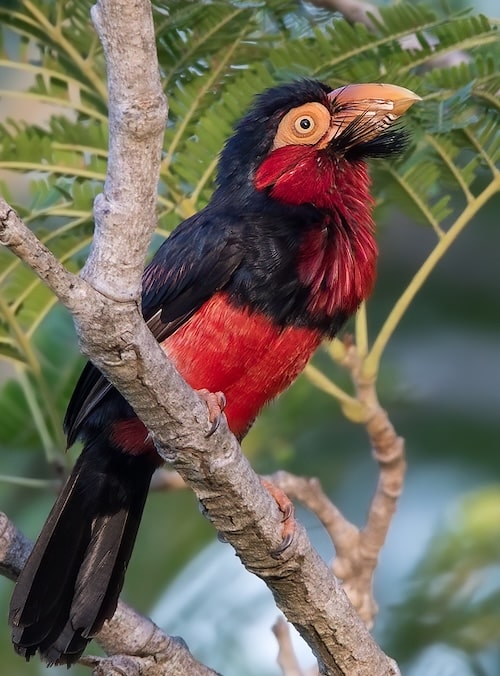
PDF ReportThe six colourful species on the cover of ‘Birds of Senegal and The Gambia’: Egyptian Plover, Bearded Barbet, Oriole Warbler, Blue-bellied Roller, Violet Turaco and Green Turaco. Other jewels were African Finfoot, White-backed Night Heron, White-crested Tiger Heron, Scissor-tailed Kite, Grey Kestrel, Red-necked Falcon, White-spotted Fluff-tail, Temminck’s Courser, Greater Painted Snipe, Four-banded Sandgrouse, Yellowbill, Greyish Eagle-Owl, Northern White-faced Owl, Longtailed Nightjar, Grey-headed Kingfisher, Blue-breasted Kingfisher, Red-throated Bee Eater, Whitefronted Bee Eater, Blue-naped Mousebird, Abyssinian Ground Hornbill, Capuchin Babbler, Yellow Penduline Tit, White-shouldered Black Tit, Pygmy Sunbird, Beautiful Sunbird, Yellow-crowned Gonolek, Chestnut-bellied Starling, Western Bluebill, Black-faced Quailfinch and Sahel Paradise Whydah. -
2023 [02 February] - Nik Borrow
PDF Report...The two most-wanted birds for our group were probably the truly enigmatic Quail-plover and the beautiful Golden Nightjar both of which surrendered to our quest and allowed amazing closeup views. For the Golden Nightjar we headed up to the northern border of the country with Mauritania where we found a pair after dark illuminated by the torch beam... -
2023 [03 March] - Hans Matheve
Report...his report covers a ‘classic’ itinerary of Senegal, with some extra birding in the Casamance and Gambia. While most birders visit Gambia in order to see West-African / Sahelian bird species, almost all of those are present in Senegal as well, with the addition of... -
2023 [04 April] - Daniel López-Velasco
PDF Report...We had an early breakfast and drove straight towards our Quail-Plover site near Mbacke. Once at the right spot, we started walking in a line until, only 15 minutes later, we flushed our key bird, showing its striking black-and-white upperwing pattern and tiny size... -
2023 [04 April] - SafariTalk
Report...Sandwiched between the dry Sahara Desert and the wet Guineo-Congolian Rainforest, this Africa, too, aided by the tweener climate, produces African savanna... -
2023 [11 November] - Andrew Slater
PDF ReportAnnotated list and diary -
2024 [01 January] - Chris Townend
PDF ReportGolden Nightjar: A fantastic start to the tour with a day roosting bird in wonderful evening light near Podor on our first evening... -
2024 [02 February] - Hans Christophersen
PDF Report...Under the trees we found many roosting Long-tailed Nightjars. Perhaps more than 30. It was nice to be able to see these nightjars within few meters in full daylight... -
2024 [02 February] - Nik Borrow
PDF ReportOur eighth Senegal ‘only’ tour (earlier tours combining with either The Gambia or Cape Verde) continued the run of success we have previously enjoyed and firmly establishes the country as a premier West African birding destination for those wishing to see some very special Sahelian endemics... -
2025 [12 December] - Andrew Slater
PDF Report...Early departure from hotel and take ferry from Banjul across the mouth of River Gambia to Barra on the north shore. Cross the border into Senegal at noon. Head north on route N5 towards Kaolack. Leave main road at Ndiaffate and drive north across sandy roads towards the Saloum River for some birding. Overnight Hotel Keur-Niaye in Toubakouta.... -
2025 [12 December] - Pierre Joste
PDF Report...I chose Senegal as a birdwatching destination for several reasons, which apply to anyone. First was the high possibility of observing some top African and global species such as Pel's Fishing-Owl, Egyptian Plover, and African Finfoot, as well as West African specialties like White-crested Tiger Heron, Four-banded Sandgrouse, Yellow Penduline-Tit and Dybowski's Twinspot. Also, Senegal is currently the most accessible territory in the Sahelian zone...
Other Links-
Birds of The Gambia and Senegal
Website…this photo group started with the intent of promoting responsible birding in The Gambia and Senegal, and sharing information for birders visiting The Gambia, Senegal, or West Africa. Of the 660+ species listed (Clements) for Senegambia, we have pictures of over 495 now: 73%. Also, discussion of trip reports, subspecies, and more. Non-profit, volunteer - with contributors from all over the world…
Blogs-
Ornithondar
BLOGLes oiseaux à Saint-Louis et au nord du Sénégal - About birds and others in the Senegal delta and the sahelian area in north Senegal… -
Senegal Wildlife
BLOGWildlife BLOG from Bram Piot, Paul Robinson & Simon Cavaillès with entries in English or French. This blog and associated web pages soon to be launched grew out of a desire to exchange information on sightings of birds and occasionally other fauna in Senegal and interesting places to see birds, fulfilling a gap for resident and visiting birders.
-
Fatbirder - linking birders worldwide...
Skip to content