

Federal Republic of Nigeria
Nigeria is a country in West Africa. It is situated between the Sahel to the north and the Gulf of Guinea in the Atlantic Ocean to the south. It covers an area of almost 924,000 km2 (nearly 357,000 square miles). With a population of more than 236 million, it is the most populous country in Africa, and the world’s sixth-most populous country. Nigeria borders Niger in the north, Chad in the northeast, Cameroon in the east, and Benin in the west. It is a federal republic comprising 36 states and the Federal Capital Territory, where its capital, Abuja, is located. The largest city in Nigeria by far is Lagos, a megacity it is one of the largest metropolitan areas in the world and the largest in Africa with over 17 million inhabitants. There are a dozen other cities more than or close to a million inhabitants with Kano, Ibadan and Benin City ranking next after Lagos. At least fifty cities have more than 200,000 people.
Nigeria is a multinational state inhabited by more than 250 ethnic groups speaking 500 distinct languages, all identifying with a wide variety of cultures. The three largest ethnic groups are the Hausa in the north, Yoruba in the west, and Igbo in the east, together constituting over 60% of the total population. The official language is English, chosen to facilitate linguistic unity at the national level. Nigeria’s constitution ensures de jure freedom of religion and it is home to some of the world’s largest Muslim and Christian populations. Nigeria is divided roughly in half between Muslims, who live mostly in the north part of the country, and Christians, who live mostly in the south. It is a regional power in Africa and a middle power in international affairs. Nigeria’s economy is the fourth-largest in Africa.
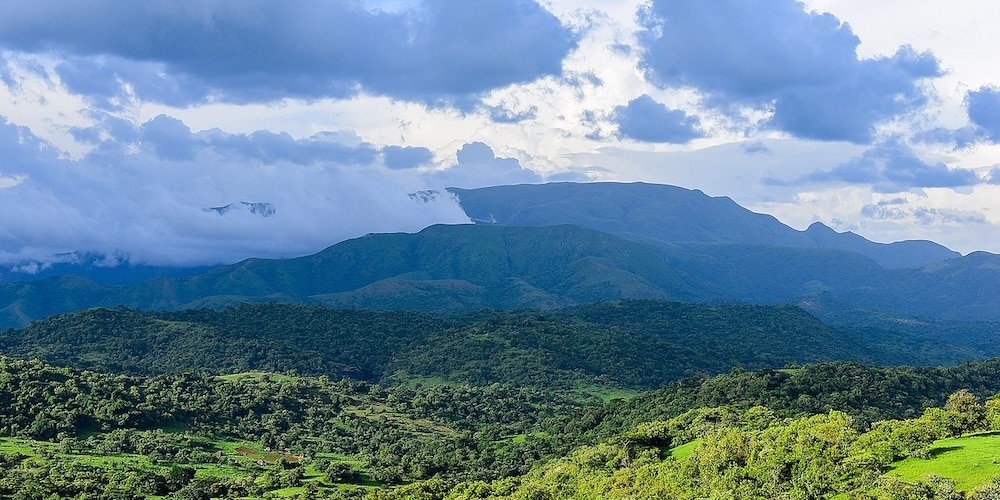
Chappal Waddi – ©Dotun55 CC BY-SA 4.0 via Wikimedia Commons
The highest point in Nigeria is Chappal Waddi at 7,936 feet. The main rivers are the Niger and the Benue, which converge and empty into the Niger Delta. This is one of the world’s largest river deltas and the location of a large area of Central African mangroves. The most expansive topographical region is that of the valleys of the Niger and Benue river valleys (which merge and form a Y-shape). To the southwest of the Niger is a rugged highland. To the southeast of the Benue are hills and mountains, which form the Mambilla Plateau, the highest plateau in Nigeria. This plateau extends through the border with Cameroon, where the montane land is part of the Bamenda Highlands of Cameroon. The far south is defined by its tropical rainforest climate, where annual rainfall is up to 80 inches per year. In the southeast stands the Obudu Plateau. Coastal plains are found in both the southwest and the southeast. Mangrove swamps are found along the coast.
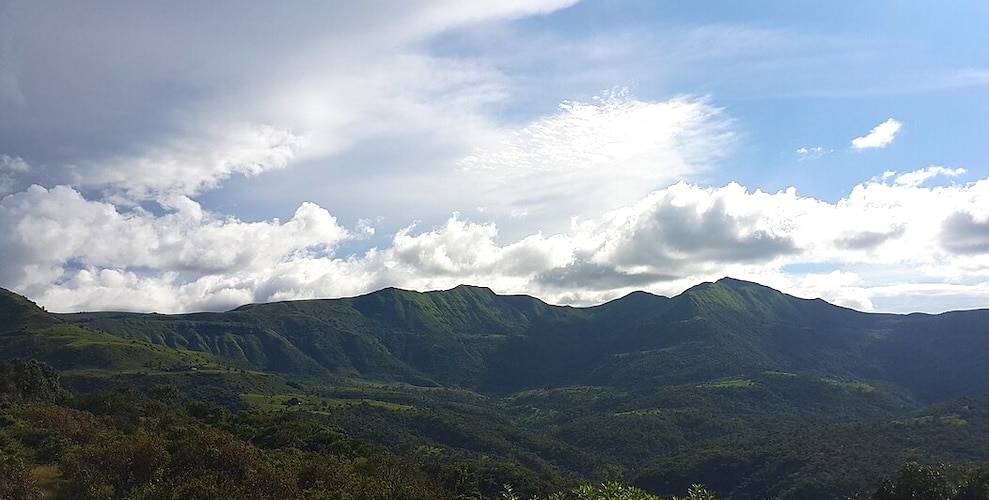
Mambilla Plateau – ©Ebere Jude Ekemezie CC BY-SA 4.0 via Wikimedia Commons
The area near the border with Cameroon close to the coast, is rich rainforest and part of the Cross-Sanaga-Bioko coastal forests ecoregion, an important centre for biodiversity. It is a habitat for the drill primate, which is found in the wild only in this area and across the border in Cameroon. The areas surrounding Calabar, Cross River State, also in this forest, are believed to contain the world’s largest diversity of butterflies. The area of southern Nigeria between the Niger and the Cross Rivers has lost most of its forest because of development and harvesting by increased population and has been replaced by grassland. Everything in between the far south and the far north is savannah (insignificant tree cover, with grasses and flowers located between trees). Rainfall is more limited to between 20 and 60 inches per year. The savannah zone’s three categories are Guinean forest-savanna mosaic, Sudan savannah, and Sahel savannah. Guinean forest-savanna mosaic is plains of tall grass interrupted by trees. Sudan savannah is similar but with shorter grasses and shorter trees. Sahel savannah consists of patches of grass and sand, found in the northeast.
Nigeria is divided into two main catchment areas – that of Lake Chad and that of the Niger. The Niger catchment area covers about 63% of the country. The Niger and Benue and their tributaries extend beyond into Cameroon into Chad and the Sharie catchment area. In the Sahel region, rain is less than 20 inches per year, and the Sahara Desert is encroaching. In the dry northeast corner of the country lies Lake Chad, on a shared water boundary delimitation with Niger, Chad and Cameroon. The Chad Basin is fed from the north-eastern quarter of Nigeria. The Bauchi Plateau forms the watershed between the Niger/Benue and Komadugu Yobe river systems. The flat plains of north-eastern Nigeria are geographically part of the Chad Basin, where the course of the El Beid River forms the border with Cameroon, from the Mandara Mountains to Lake Chad.
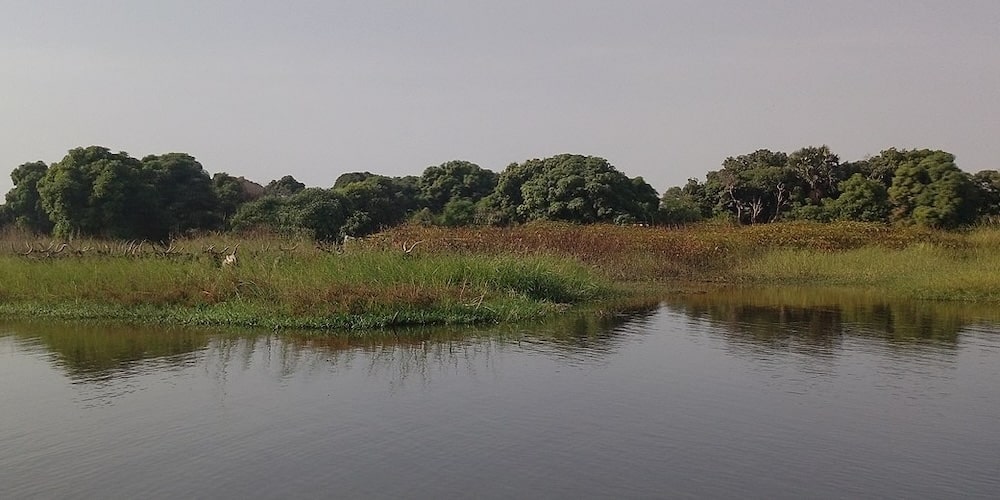
Lake Chad – ©Coolthoom1 CC BY-SA 4.0 via Wikimedia Commons
The Komadugu Yobe river system gives rise to the internationally important Hadejia-Nguru wetlands and Ox-bow lakes around Lake Nguru in the rainy season. Other rivers of the northeast include the Ngadda and the Yedseram, both of which flow through the Sambisa swamps, thus forming a river system. There is also a major river system in the northeast. In addition, Nigeria has numerous coastal rivers. Over the last million years, Lake Chad in the far north-east of Nigeria has dried up several times for a few thousand years at a time and, just as often, grown to many times its current size. In recent decades the surface area has been reduced considerably, which may also be due to humans taking water from the inlets to irrigate agricultural land.
Nigeria is covered by three types of vegetation: forests (where there is significant tree cover), savannahs (insignificant tree cover, with grasses and flowers), and montane land (least common and mainly found in the mountains near the Cameroon border). Both the forest zone and the savannah zone are divided into three parts. Some of the forest zone’s most southerly portion, especially around the Niger River and Cross River deltas, is mangrove swamp.
North of this is a freshwater swamp, containing different vegetation from the saltwater mangrove swamps, and north of that is a rainforest. The savannah zone’s three categories are divided into Guinean forest-savanna mosaic, made up of plains of tall grass which are interrupted by trees, the most common across the country; Sudan savannah, with short grasses and short trees; and Sahel savannah patches of grass and sand, found in the northeast.
Birding Nigeria
Nigeria is Africa’s most populous nation, although travelling along the arterial roads, east to west and north to south, one might doubt it. One appears to move along a tiny corridor barely touching the apparently primary forest through which one travels in the southern half of Nigeria. In reality the vegetation is almost all secondary growth and primary forest can be found only in the SE of the country and along the Nigeria-Cameroon border.
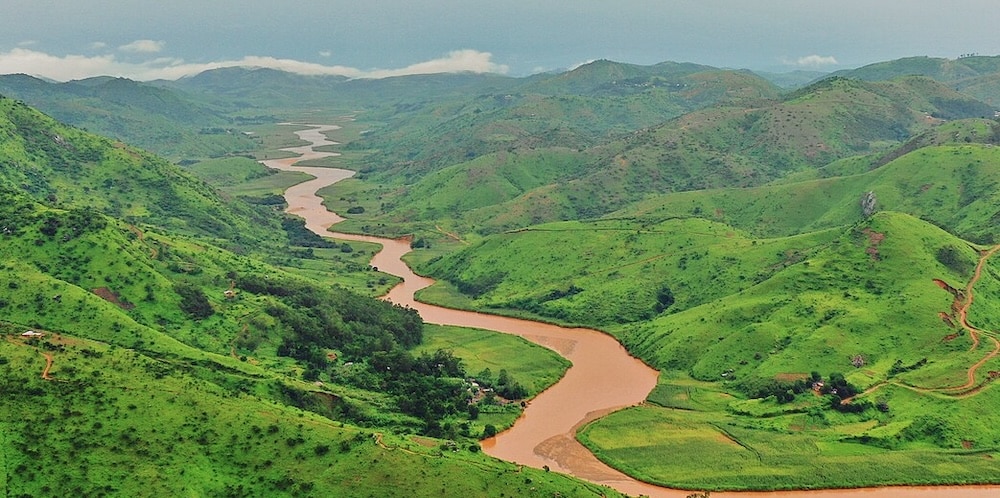
River Donga – ©Abubakar Oshomah Abdulwahab CC BY-SA 4.0 via Wikimedia Commons
From the Mangrove swamp along almost all of Nigeria’s coastline we move north through the forest belt. The forest exists where the rainfall is high and is distributed evenly throughout the year. As the rainfall diminishes so the forest gives way to Savanna, trees becoming scarcer as a definite dry season develops. In the dry far north the land is red; mud-built palaces, mosques and houses create a biblical town and landscape.
Each bio-geographic region has its unique avifauna – few bird species are found in both forest and Savanna. Typical birds of the dry lands are: Hooded Vulture, Stone-partridge, Guinea fowl, Black-billed Wood-dove, Black Cuckoo, Blue-naped Mousebird and Abyssinian Roller.
Oyo State in the Yoruba heartlands of Southwest Nigeria is the area with which I am most familiar. The ‘top sites’ described below are typical of secondary forest growth with some notable waterfowl. They are on the outskirts of the state capital, Ibadan, and are accessible. While I would not give them Top Site status they do represent the only area I know where one of our very few endemics, the illusive Ibadan Malimbe may be found.
Across the country there are 27 important bird areas including Cross River National Park, Cross River National Park, Gashaka Gumti National Park in the Mambilla Plateau, LUFASI Nature Park, Emerald Forest Reserve, Omo Forest (Biosphere) Reserve, Yankari Game Reserve, Lake Chad Basin & Hadejia-Nguru Wetlands and Kainji Lake National Park.
Oyo State in the Yoruba heartlands of Southwest Nigeria is the area with which I am most familiar. The sites described below are typical of secondary forest growth with some notable waterfowl. They are on the outskirts of the state capital, Ibadan, and are accessible. While I would not give them Top Site status they do represent the only area I know where the illusive Ibadan Malimbe may be found.
-
Ibadan University
Satellite ViewFor a casual visitor the Campus of the University of Ibadan (UI) offers excellent birding opportunities; the campus is large, more than 500Ha, and has two prime sites – Oba Dam and the Botanical Gardens. The Campus is open and permission is not required for entry but if you can find a local enthusiast to accompany you then so much the better. -
Oba Dam
Satellite ViewThe Dam site has a wide variety of waterfowl including: Pigmy goose, Lily-trotter, Black-winged Stilt, Egyptian Plover, Black Crake and a dozen species of herons and egrets. At the right time of the year 10 or more species of swallow and swift can be seen including the uncommon Psalidoprocne obscura and Usher's Spine-tailed Swift. Giant Kingfishers and Ospreys are occasional visitors. A visitor in late September/October might be surprised by hearing the familiar song of a Willow Warbler. Great Spotted and Levaillant's Cuckoos with their allies the Coucals, Senegal (including the rare rufous phase bird, Centropus epomidis, as it was once styled) and the Yellowbill are not uncommon. -
The Botanical Gardens
Satellite ViewThis is secondary forest and harbours an ornithological gem. Square-tailed Drongo and the less frequent Glossy-backed Drongo can be found, the African and Black-headed Orioles, Painted Snipe, doves – Red-eyed, Mourning, Vinaceous, Laughing, Green Fruit; Klaas' and Didric cuckoos are heard more often than seen, the Long-tailed and the splendid Standard-winged Nightjars might be seen at dusk. Four or five kingfishers, European, White-throated and Little Bee-eaters together with Lilac-breasted Rollers very much brighten one's day. Lucky visitors might see a small flock of some of the unbelievably coloured Bush-shrikes such as the Fiery-breasted, Malaconotus cruentus. Many iridescent-plumaged starlings and a vast number of little brown jobs will round off a couple of hours in the gardens. Of the Ploceidae, the genus Malimbus is a West African speciality: the Red-vented, Blue-billed, Red-headed Malimbes are frequently encountered in the gardens but the gem is Malimbus ibadanensis, the Ibadan Malimbe, a little known local endemic found here and the adjoining land of IITA, the International Institute for Tropical Agriculture. If you can somehow get an invitation to IITA then treasure it – its woodland is less disturbed and its lake larger than UI's – Great White Egrets, Night Heron, Allen's Reedhen and the large Pied Kingfisher come to mind. Eight species of Plover and five Sandpipers were seen by the author in the space of half an hour. -
The Campus
The Lanner nests on the University Clock tower; the Barn Owl flies in and out of the Great Hall. On the telephone lines the Woodchat can be seen, the Lizard Buzzard is common and the lovely Black-shouldered Kite can often be seen; overhead the Palm-nut Vulture is the only one of its species you will find in Ibadan
-
Number of bird species: 975
(As at February 2025)National Bird: Black-crowned Crane - Balearica pavonia
Number of endemics: 3
Ibadan Malimbe Malimbus ibadanensis
Rock Firefinch Lagonosticta sanguinodorsalis
Jos Plateau Indigobird Vidua maryae
-
Avibase
PDF ChecklistThis checklist includes all bird species found in Nigeria , based on the best information available at this time. It is based on a wide variety of sources that I collated over many years. I am pleased to offer these checklists as a service to birdwatchers. If you find any error, please do not hesitate to report them. -
E-Bird
PDF ChecklistThis checklist is generated with data from eBird (ebird.org), a global database of bird sightings from birders like you. If you enjoy this checklist, please consider contributing your sightings to eBird. It is 100% free to take part, and your observations will help support birders, researchers, and conservationists worldwide. -
Wikipedia
Annotated ListThis is a list of the bird species recorded in Nigeria. The avifauna of Nigeria include a total of 975 species, of which one is endemic. Thirty-one species are globally threatened.

-
Birds of Western Africa
| By Nik Borrow & Ron Demey | Christopher Helm | 2014 | Edition 2 | Paperback | 592 pages, 266 plates with colour illustrations; colour distribution maps | ISBN: 9781472905680 Buy this book from NHBS.com -
Birds of Western and Central Africa
| By Ber van Perlo | Princeton University Press | 2003 | Paperback | 384 pages, 109 plates with colour illustrations; colour & b/w illustrations, 1500+ b/w distribution maps, colour maps | Out of Print | ISBN: 9780691007144 Buy this book from NHBS.com -
The Birds of Nigeria
| (An Annotated Checklist) | JH Elgood, JB Heignham, AM Moore, AM Nason, RE Sharland & NJ Skinner | British Ornithologists' Union | 1994 | 305 pages, colour plates, tables, maps | Out of Print | ISBN: 9780907446163 Buy this book from NHBS.com

Birds of Africa
Apple iOS | AndroidBirds of Africa is an identification guide which in time will cover all the birds and countries in Africa. This version includes more than 1,800 species and has all West African and 8 East African countries.Organisations-
African Bird Club
WebpageNigeria has a bird list of just over 900 species and this is increasing every year particularly since the establishment of the A. P. Leventis Ornithological Research Institute in Jos, Plateau State, in 2003. Prior to this, apart from a 3-year migration study at Lake Chad, there had been very little interest in Nigeria since the 1980s. Unfortunately, during the 1990s, Nigeria gained a very bad reputation worldwide for its political instability and this, coupled with widespread incidences of armed robbery especially on the main highways tended to put off all but the intrepid traveller from visiting Nigeria… -
Lekki Bird Club
WebpageThe first volunteer-based bird conservation group; Lekki Bird Club (LBC) was established in March 2009 to raise the stake of bird conservation in Nigeria. LBC is the first in the series of bird club that NCF plans to set up in major urban settlements across Nigeria and this stems from the overlooked unique bird associations an assemblages in the cities. -
Nigerian Conservation Foundation
WebsiteWe protect the environment and transform livelihood through our programmes -
Nigerian Conservation Foundation - BirdLife Partner
WebpageVictoria Island, P O Box 74638, Lagos, Mailto:info@ncfnigeria.org -
West African Ornithological Society
WebsiteThe West African Ornithological Society grew out of the Nigerian Ornithologists
Reserves-
*Protected areas of Nigeria
InformationSatellite ViewInteractive list of Forest Reserves, National Parks, Nature bReserves etc... -
IBA Hadejia-Nguru Wetlands
InformationSatellite ViewThe Hadejia-Nguru wetlands are on the List of Ramsar wetlands of international importance. Nguru Lake and the Marma Channel complex (58,100 ha) are designated a Ramsar Site. The wetlands are important for waterbirds, both for breeding species and for wintering and passage Palearctic waterbirds. The estimated waterbird population varies between 200,000 and 325,000. 377 bird species have been seen in the wetlands, including occasional sightings of the near-threatened pallid harrier and great snipe species -
IBAs
WebsiteSatellite ViewNigeria has only 4 endemic species, 2 of which occur only on the Jos Plateau, Rock Firefinch Lagonosticta sanguinodorsalis and Plateau Indigobird Vidua maryae. Of the other 2, Ibadan Malimbe Malimbus ibadanensis is restricted to a small area in the degraded forest belt of the south-west and the Anambra Waxbill Estrilda poliopareia is only found in the southern part of the Niger Delta. The only area protecting any of these is the small Amurum Reserve which surrounds the Ornithological Institute on the Jos Plateau -
NP Cross River
InformationSatellite ViewAlthough the park has been poorly explored, over 350 bird species have been recorded. It is one of the two parts of Nigeria where Xavier's greenbul is found. Other species unusual in Nigeria include bat hawk, Cassin's hawk-eagle, crested guineafowl, grey-throated rail, olive long-tailed cuckoo, bare-cheeked trogon, lyre-tailed honeyguide, green-backed bulbul, grey-throated tit-flycatcher and Rachel's malimbe. -
NP Gashaka Gumti
InformationSatellite ViewGashaka-Gumti National Park (GGNP) is a national park in Nigeria, It was gazetted from two game reserves in 1991 and is Nigeria’s largest national park. It is located in the eastern provinces of Taraba and Adamawa to the border with Cameroon. The avian fauna is very rich and diverse, there are stocks are up 1 million birds estimated. The park is officially labelled as one of Africa's "Important Bird Areas" - and with more than 500 species found, and visiting bird watching enthusiasts are constantly adding new species to the list. The red faced lovebird is only found here and in the Central African Republic's Bamingui-Bangoran National Park and Biosphere Reserve . -
NP Kainji
InformationSatellite ViewThe park includes three distinct sectors: a part of the Kainji Lake in which fishing is restricted, the Borgu Game Reserve to the west of the lake, and the Zugurma Game Reserve to the southeast. -
NP Kamuku
InformationSatellite ViewThe Kamuku National Park is a Nigerian national park in Kaduna State, Nigeria, with a total area of about 1,120 km2 (430 sq mi). The park has a typical Sudanian Savanna ecology. There are at least 177 species of birds, including migrants and residents. The park is important for species such as the secretarybird (Sagittarius serpentarius), Denham's bustard (Neotis denhami) and the Abyssinian ground-hornbill (Bucorvus abyssinicus) which are rare in other parts of Nigeria... -
NP Okomu
InformationSatellite ViewThe park is about 60 km north west of Benin City. The park holds a small fragment of the rich forest that once covered the region, and is the last habitat for many endangered species. About 150 species of birds have been identified.[6] These include Angolan pitta, grey parrot, wrinkled hornbill, fish eagle, hawks, woodpeckers, great owl, grey hornbill, cattle egret, black-casqued hornbill, yellow-casqued hornbill, Sabine's spinetail, Cassin's spinetail, black spinetail, white-breasted negrofinch, chestnut-breasted negrofinch, pale-fronted negrofinch and yellow-throated cuckoo... -
NP Old Oyo
InformationSatellite ViewThe park covers 2,512 km2, mostly of lowland plains at a height of 330 m and 508 m above sea level. The southern part is drained by the Owu, Owe and Ogun Rivers, while the northern sector is drained by the Tessi River. Outcrops of granite are typical of the north eastern zone of the park, including at Oyo-lle, with caves and rock shelters in the extreme north. -
NP Yankari
InformationSatellite ViewYankari National Park with an area of 24,410km is Nigeria's premier tourist resort and is also one of The most important conservation areas in the whole of West Africa. There are also over 350 species of bird found in the park. Of these, 130 are resident, 50 are Palearctic migrants and the rest are intra-African migrants that move locally within Nigeria. -
NR Andoni Elephant Park
InformationSatellite ViewAndoni Elephant Park or Andoni Elephant Sanctuary is a community forest located on the picturesque Andoni Island, one of the world's most biodiverse Barrier islands... -
NR Lekki Conservation Centre
InformationSatellite ViewThe foundation aims to preserve Nigeria's species and ecosystems, promote sustainability when using natural resources and advocates actions that minimise the impact on the environment and prevent resource wastage. NCF has worked tirelessly to raise environmental awareness and promote responsibility. The center is located along the Lekki-Epe Expressway in the Lekki Peninsula, opposite Chevron -
NrP Finima Nature Park
InformationSatellite ViewThe site of the nature park is the natural habitat of salt water hippopotamuses. The area is protected by park rangers and hunting is prohibited.
Sightings, News & Forums-
eBird
SightingseBirding This Month
Guides & Tour Operators-
Jos Plateau Birding Tours
Local Tour OperatorExperience the beauty of Birding in Nigeria! Our team of passionate birders and ornithologists offer tailored birdwatching adventures in Nigeria's Jos Plateau. You are sure to see a wide variety of birds from the common to the rare. -
Lekki Conservation Center Extraordinary Tour
Local TourEnoy the longest canopy walk in Africa. Explore Lagos biggest conservation center with raised walkways which enables viewing of animals like monkeys, crocodiles and various birds
Trip Reports-
2005 [07 July] - Stephen Greenfield
ReportGiven that Nigeria has such a terrible reputation among travelers, I should share that I had an enjoyable visit and did some exciting birding while there for a business trip recently. The people I worked with and met were delightful and, though one has to be aware of crime, I never felt threatened, and would eagerly take any opportunity to return… -
2013 [03 March] - Per Holmen
ReportHi all, somehow I ended up in Lagos, Nigeria early in March this year. As usual, when visiting a new country or city I did some research about the potential for birding. Lagos is not the safest city in the world, so the thought of rummaging the streets with an expensive camera and binoculars was not much appealing. However; some conservancy effort is even going on in Lagos and I managed to find a place called Lekki Conservation Center. I managed to schedule a few trips to this little fenced off and secure oasis. This is what I discovered...
Other Links-
Nigeria Bird Atlas Project (NiBAP)
WebsiteThe Nigeria Bird Atlas Project (NiBAP) aims to map all of Nigeria’s bird species and describe their status with the help of valued input from Citizen Scientists – volunteer members of the public who are keen to contribute through going birding and submitting their observations to the project.
-
Fatbirder - linking birders worldwide...
Skip to content