

Kingdom of Morocco
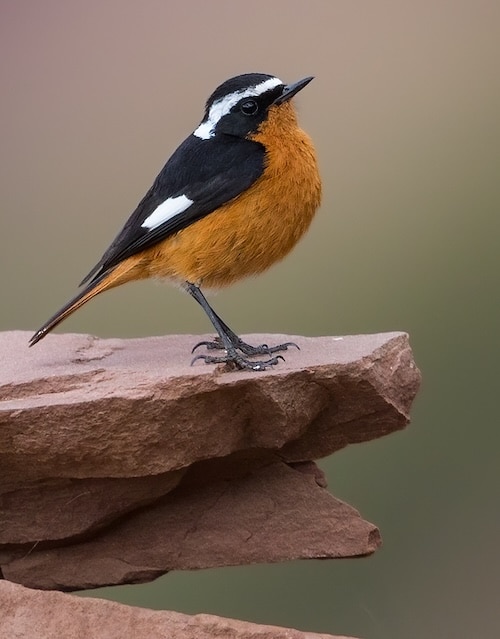
Morocco is a country in the Maghreb region of North Africa. It overlooks the Mediterranean Sea to the north and the Atlantic Ocean to the west, and has land borders with Algeria to the east, and the disputed territory of Western Sahara to the south. Morocco also claims the Spanish exclaves and several small Spanish-controlled islands off its coast. It covers an area of over 446,500 km2 (172,400 square miles) and has a population of approximately 38 million. Islam is both the official and predominant religion, while Arabic and Berber are the official languages. Additionally, French and the Moroccan dialect of Arabic are widely spoken. The culture of Morocco is a mix of Arab, Berber, African and European cultures. Its capital is Rabat with two million citizens, while its largest city with 3.7 million inhabitants is Casablanca.
The geography of Morocco spans from the Atlantic Ocean, to mountainous areas, to the Sahara Desert. A large part of Morocco is mountainous. The Atlas Mountains are located mainly in the centre and the south of the country. The Rif Mountains are located in the north. Both ranges are mainly inhabited by the Berber people. Morocco’s capital; Rabat, is situated beside the Oued Bou Regreg River; its largest city; Casablanca is a port on the Atlantic coast. Other large cities are Fes, Marrakesh, Meknes, Salé and Tangier.
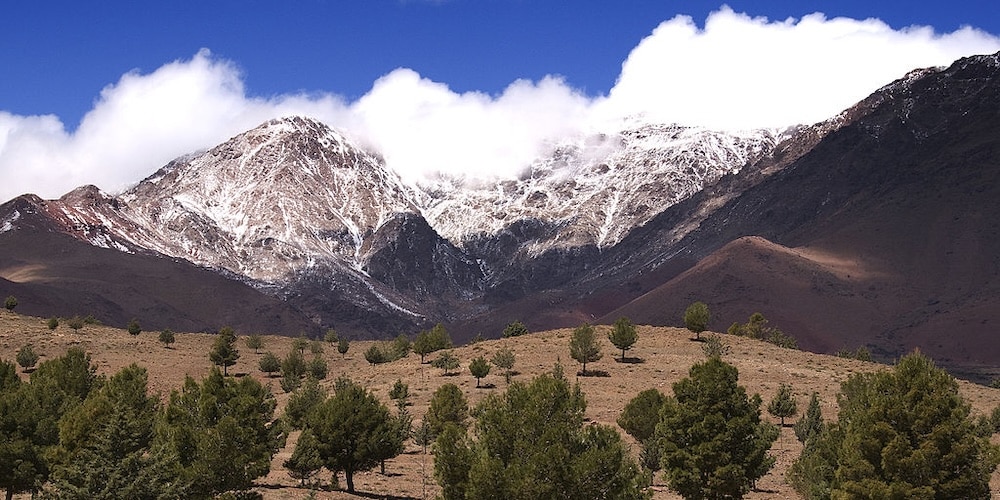
The Atlas Mountains – ©Michal Osmenda, Brussels CC BY-SA 2.0 via Wikimedia Commons
The Atlas Mountains run down the backbone of the country, from the northeast to the southwest. The Rif mountains stretch over the region bordering the Mediterranean from the northwest to the northeast. Most of the southeast portion of the country is in the Sahara Desert and as such is generally sparsely populated and unproductive economically. Most of the population lives to the north of these mountains, with Morocco’s largest cities encapsulated by the Middle Atlas and the High Atlas mountain range, while to the south lies the Western Sahara. It is a former Spanish colony that was annexed by Morocco and which it considers is part of its territory, referring to it as its Southern Provinces.
Spanish territory in Northwest Africa neighbouring Morocco comprises five enclaves on the Mediterranean coast: Ceuta, Melilla, Peñón de Vélez de la Gomera, Peñón de Alhucemas, the Chafarinas islands and the disputed islet Perejil. Off the Atlantic coast the Canary Islands belong to Spain, whereas Madeira to the north is Portuguese. To the north, Morocco is bordered by the Strait of Gibraltar, where international shipping has unimpeded transit passage between the Atlantic and Mediterranean.
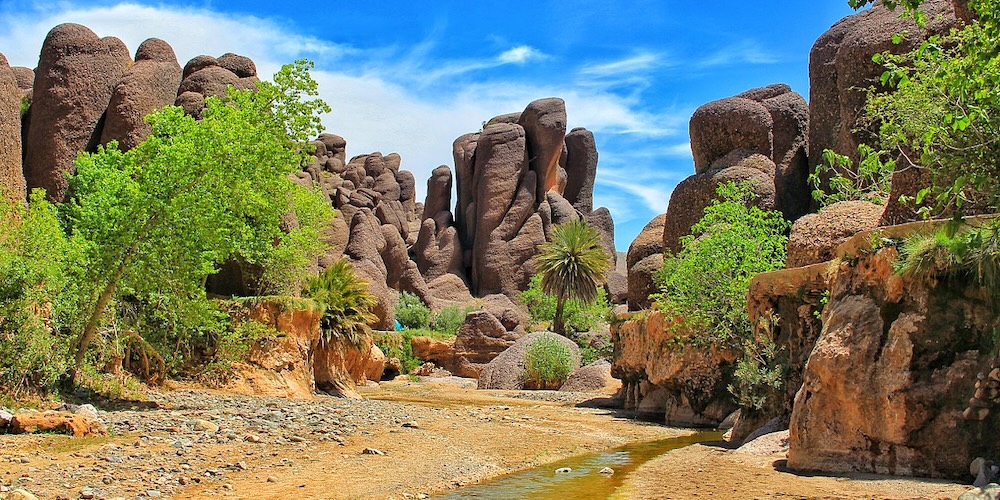
Tislit Gorge, Taliouine – ©Nawfal Kharbach CC BY-SA 4.0 via Wikimedia Commons
Morocco’s climate is mainly ‘hot summer Mediterranean’ and ‘hot desert’ zones. Central mountain ranges and the effects of the cold Canary Current, off the Atlantic coast, are significant factors in Morocco’s relatively large variety of vegetation zones, ranging from lush forests in the northern and central mountains, giving way to steppe, semi-arid and desert areas in the eastern and southern regions. The Moroccan coastal plains experience moderate temperatures even in summer. In the Rif, Middle and High Atlas Mountains, there are several different types of climates: Mediterranean along the coastal lowlands, giving way to a humid temperate climate at higher elevations with sufficient moisture to allow for the growth of different species of oaks, moss carpets, junipers, and Atlantic fir which is a royal conifer tree endemic to Morocco. In the valleys, fertile soils and high precipitation allow for the growth of thick and lush forests. Cloud forests can be found in the west of the Rif Mountains and Middle Atlas Mountains. At higher elevations, the climate becomes alpine in character, and can sustain ski resorts.
Southeast of the Atlas Mountains, near the Algerian borders, the climate becomes very dry, with long and hot summers. Extreme heat and low moisture levels are especially pronounced in the lowland regions east of the Atlas range due to the rain shadow effect of the mountain system. The southeasternmost portions of Morocco are very hot, and include parts of the Sahara Desert, where vast swathes of sand dunes and rocky plains are dotted with lush oases.
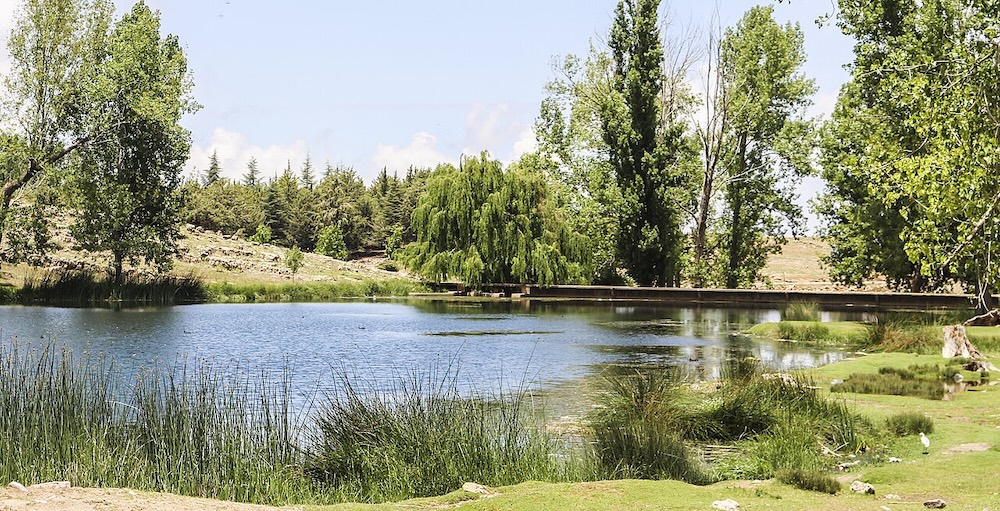
Lake Zerrouka – ©Mounir Neddi CC BY-SA 4.0 via Wikimdia Commons
In contrast to the Sahara region in the south, coastal plains are fertile in the central and northern regions of the country, and comprise the backbone of the country’s agriculture, in which 95% of the population live. Except for the extreme south that is part of the Sahara, rains fall mainly during the cool season (October to April) and the summers are hot and dry; drought prevails in the Saharan region throughout the year. The direct exposure to the North Atlantic Ocean, the proximity to mainland Europe and the stretched-out Rif and Atlas Mountains are the factors of the rather European-like climate in the northern half of the country. That makes Morocco a country of contrasts. Forested areas cover about 12% of the country while arable land accounts for 18%. Approximately 5% of Moroccan land is irrigated for agricultural use. South of Agadir and east of Jerada near the Algerian borders, arid and desert climate starts to prevail.
Birding Morocco
Friendly people, great scenery and bird specialities make Morocco one of the favourite destinations for birders in search of endangered or rare species such as Bald Ibis, Dark Chanting Goshawk, Tawny Eagle, Eleonora’s Falcon and African Marsh Owl, as well as other species such as Dupont’s Lark, Moussier’s Redstart, Desert Warbler, Black-crowned Tchagra, and Desert Sparrow.
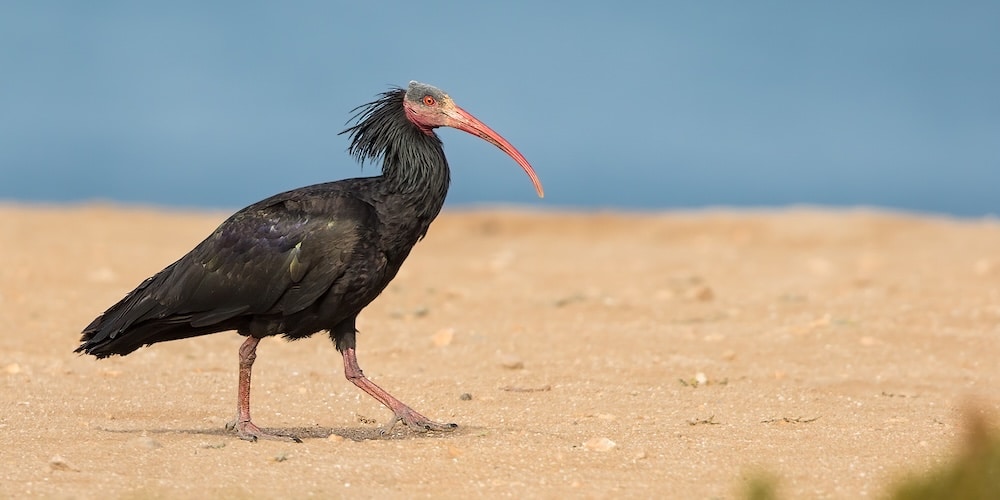
Bald Ibis – ©Dubi Shapiro
The Country divides into a number of geo-physical regions, and this influences the birds that are found there:
Mountains: 5 ranges are aligned along a NE – SW axis, and these include the Rif along the Mediterranean coast (2456m, Jbel Tidighine); the Central Plateau (1627m, Jbel Mtouzgane); the Middle Atlas (3340m, Jbel Bou-Naceur); the High Atlas (4167m, Jbel Toubkal) and the Anti-Atlas (3304m, Jbel Siroua). Despite high human and animal pressure, forests of broad-leaved and coniferous trees are still widespread.
Atlantic Morocco: This includes rich agricultural plains and more barren and dry plateaux. Most of the original forest has been turned into matorral or shrub-type vegetation after intensive cutting and grazing, but some has been well preserved (eg ‘Forêt de la Mamora’ with Cork Oak in the Rharb) however, large tracts of eucalyptus have been planted. The Souss valley, with its unique Argan woodland, lies between the High and Anti-Atlas.
Eastern Morocco: Except for the area adjacent to the Mediterranean coast, this is dry with especially hot summers and cold winters; the High Plateaux rise to over 1000m and are covered with a steppe type vegetation dominated by Artemisia herba-alba and Stipa tenacissima.
Saharan Morocco: This lies to the south of the High and Anti-Atlas. In the Eastern part, palm oases stretch along the rivers (Oueds) but the region is mainly large stony regalith (pebble desert) covered with Hammada scoparia; acacias thickets grow along the wadi bottoms. The drought is attenuated in a 15-200 km wide strip along the Atlantic coast, which receives moisture from the ocean; the coast is mainly rocky.
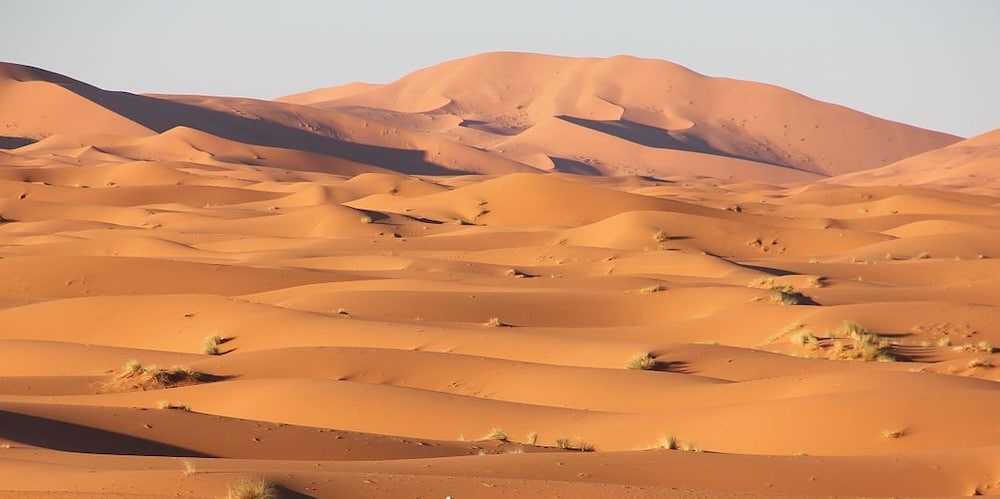
Oasis du Sud Marocain Biosphere Reserve – ©Lefidele CC BY-SA 4.0 via Wikimedia Commons
The Birds
515 species have been recorded in Morocco and over 200 regularly breed there. Most (c.85%) breed north of the Atlas Mountains, because of the moister climate and more diversified habitat, only about 35% breed in the Saharan region.
Every year, millions of West European migrants pass through Morocco, mainly from late July to early November in the autumn, and from March to May in the spring. Most, especially passerines, migrate by night or over-fly too high to be seen during the day; others, like waders and gulls, often stop at wetlands to refuel, and provide unforgettable sights. The Straits of Gibraltar is famous for concentrating soaring birds, especially storks and raptors.
120 species are regular winter visitors, including 34 that are at the southern limit of their wintering range. 120 or so other species have been recorded as accidental visitors, either from Europe and Asia (e.g. Great Knot and Pectoral Sandpiper); from Tropical Africa (e.g. Brown Booby and Lesser Flamingo); or from Northern America (e.g. Blue-winged Teal and Laughing Gull).
Birding hotspots
Several wetlands spread along the Atlantic coast that are rightly famous for their migrant and wintering waders and gulls. These include Merja Zerga, Lac de Sidi Bou-Rhaba, Sidi-Moussa-Oualidia lagoons, and the Souss and Massa estuaries along the North coast, Khnifiss lagoon and Dakhla and Cintra Bays along the Saharan coast. The islets off Essaouira shelter a colony of Eleonora`s Falcons. The Mediterranean coast includes two major wetlands: Sebkha Bou-Areg and the Moulouya estuary.
Mountains shelter a rich avifauna; this can be seen best on the Plateau des Lacs in the Middle Atlas (Crested Coot, Levaillant’s Woodpecker, etc.) and at Oukaimeden in the High Atlas (Atlas Shore Lark, Alpine Accentor, Rock Sparrow, & Crimson-winged Finch).
Many desert-living species, including larks, wheatears and sandgrouse, are widespread in desert Morocco; others are more restricted in range, and birding hotspots include the temporary lake of Merzouga near Erfoud (waders and ducks in the desert!) bordered by the only large Moroccan sand dunes, the so-called Erg Chebbi (Desert Warbler, Brown-necked Raven, Desert Sparrow et al); and the Barrage Mansour-Eddahbi near Ouarzazate.
The Souss valley is famous for Dark Chanting Goshawk and Tawny Eagle, and the Straits of Gibraltar for the impressive raptor migration.
Desert species are also seen in the far south (see the Western Sahara pages).
There are, of course, hundreds of other sites worth exploring for Ruddy Shelduck, Marbled Teal, Black-winged Kite, Booted and Bonelli’s Eagles, Lanner and Barbary Falcons, Double-spurred Francolin, Purple Gallinule, Houbara and Great Bustards, Cream-coloured Courser, Desert Eagle Owl, Plain Swift, Blue-cheeked Bee-eater, Scrub and Tristram’s Warblers, Fulvous Babbler, Black-crowned Tchagra and more… so, when you visit, its worth exploring other areas for yourselves.
-
Number of bird species: 518
(As at June 2026)
- Breeding Endemic: Bald Ibis Geronticus eremita was assumed to be a breeding endemic until other nest sites were found in the middle east.
-
Avibase
PDF ChecklistThis checklist includes all bird species found in Morocco , based on the best information available at this time. It is based on a wide variety of sources that I collated over many years. I am pleased to offer these checklists as a service to birdwatchers. If you find any error, please do not hesitate to report them. -
E-Bird
PDF ChecklistThis checklist is generated with data from eBird (ebird.org), a global database of bird sightings from birders like you. If you enjoy this checklist, please consider contributing your sightings to eBird. It is 100% free to take part, and your observations will help support birders, researchers, and conservationists worldwide. -
Wikipedia
Annotated ListThis is a list of the bird species recorded in Morocco. The avifauna of Morocco include a total of 562 species. Three of them have been introduced by humans.

-
A Birdwatcher's Guide to Morocco
| By Patrick Bergier & Fedora Bergier | Prion | 2003 | Paperback | 172 pages, 54 Maps, Line Illustrations | Out of Print | ISBN: 9781871104097 Buy this book from NHBS.com -
Birds of Morocco
| By Ignacio Yúfera | Lunwerg Editores | 2015 | Hardback | 264 pages, 331 colour photos | ISBN: 9788416489084 Buy this book from NHBS.com -
Birds of Morocco / Oiseaux du Maroc
| By Patrick Bergier, Michel Thévenot, Abdeljebbar Qninba & Jean-Roch Houllier | Societé d'Etudes Ornithologiques de France | 2022 | Flexibound | 1100 colour photos, colour illustrations , and colour distribution maps | ISBN: 9782916802060 Buy this book from NHBS.com -
Birdwatching Guide to Morocco
| By Peter Combridge & Alan Snook | Arlequin Press | 1997 | Paperback | 64 pages, 16 col plates, b/w illus, 17 b/w maps | Out of Print | ISBN: 9781900159654 Buy this book from NHBS.com -
Finding Birds in Morocco: Coast and Mountains
| By Dave Gosney | Easybirder | 2011 | DVD | Region 2 | Runtime 60 minutes | ISBN: 9781907316357 Buy this book from NHBS.com -
Finding Birds in Morocco: Coast and Mountains
| By Dave Gosney | Easybirder | 2011 | Paperback | 36 pages, b/w maps | ISBN: 9781907316340 Buy this book from NHBS.com -
Finding Birds in Morocco: The Deserts
| By Dave Gosney | Easybirder | 2009 | DVD | Runtime: 62 min | ISBN: 9781907316036 Buy this book from NHBS.com -
Finding Birds in Morocco: The Deserts
| By Dave Gosney | Easybirder | 2009 | Softcover Booklet | 32 pages, b/w maps | ISBN: 9781907316029 Buy this book from NHBS.com -
The Birds of Morocco
| By Michael Thévenot, Rae Vernon & Patrick Bergier | BOU | 2003 | Hardback | 594 pages, 32 colour photos | Out of Print | ISBN: 9780907446255 Buy this book from NHBS.com -
Where to Watch Birds in Morocco
| By Patrick Bergier & Fédora Bergier | Pelagic Publishing | 2017 | Paperback | 166 pages, b/w illustrations, b/w maps | ISBN: 9781784271442 Buy this book from NHBS.com
-
African Bird Club
WebsiteWith friendly people, great scenery, a good tourist infrastructure and excellent birding, Morocco is one of the favourite destinations for birders in North Africa and perhaps the best location to search for a number of rare and endangered species -
GOMAC - Groupe d'Ornithologie du Maroc
Facebook PageLe groupe d'ornithologie du Maroc (GOMAC) est une association scientifique marocaine à but non lucratif, créée en 1989 -
Moroccan Rare Birds Committee
WebsiteIndex of recent reports of the Moroccan Rare Birds Committee (MRBC). -
Save Moroccan Wetlands
WebsiteCampaigning for the conservation of wetlands and their wildlife in Morocco
-
*IBAs
WebsiteSatellite ViewMauritius supports one of the densest concentrations of threatened bird species in the world. All seven endemic land bird species are threatened. Three other species are shared only with La R -
*National Parks and Reserves of Morocco
InformationSatellite ViewThere are 11 national parks in Morocco. Toubkal National Park, established in 1942, is the oldest and by far the most visited. The parks are situated rather well in-line, so it already allows wildlife migration to some extent. -
*Protected areas of Morocco
InformationSatellite ViewInteractive list of Biosphere reserves, National Parks, Ramsar sites etc... -
BR Arganeraie
InformationSatellite ViewThe Arganeraie Biosphere Reserve covers over 2 560 000 hectares of terrain, of which some is inhabited and therefore it incorporates urban areas, forest areas and agricultural lands. -
BR Oasis Du Sud
InformationSatellite ViewThe Oasis Du Sud Marocain Biosphere Reserve spans over a region of seven million hectares and is vital in the battle against desertification. -
IBA
InformationSatellite ViewThe Massa lagoon, situated an hours drive south of Agadir, is normally counted as Morocco's best bird reserve. In the lagoon, which is to large extent a river that ends in wide lake before it is sealed off from the sea by sand banks, you will find numerous rare birds… -
NP Tazekka
InformationSatellite Viewhe Tazekka National Park is one of them. Created in 1950 with only 580 hectares of land, it was hoped that the park would help to protect the many natural resources that could be found at Jbel Tazekka in the Middle Atlas mountain range. The park has certainly proved to be a successful venture and today it covers an area of approximately 12,800 hectares of land. The interesting variety of altitudes and resulting flora is home to a variety of wildlife and the national park has become a haven for bird watchers. -
Souss-Massa National Park
InformationSatellite View0,000 ha of land near Aglou, south of the park, is also included in the site because it is sometimes used as a feeding area by the northern bald ibis. The habitat is grazed steppe with dunes, beaches and wetlands.
-
eBird
SightingseBirding This Month
-
Birdwatching Spain
Tour OperatorWelcome to our bird watching trip to Morocco. -
Atlas and Saharatours
Local Tour OperatorMorocco Birdwatching Tour Atlas & Sahara - 4 days -
Berber Treasures Morocco
Local Tour OperatorThe birds of Morocco are a rich blend of indigenous and migratory birds. You can enjoy birding in Morocco any time of the year with one of our Berber Treasures Morocco tours of Morocco... -
BirdFinders
Tour OperatorThe diversity of Morocco’s habitats is reflected in its list of desirable birds: Double-spurred Spurfowl, Northern Bald Ibis, Cream-coloured Courser, Pharaoh Eagle-owl... -
BirdQuest
Tour OperatorMOROCCO – The endemics of the ‘Maghreb’, from the Atlas Mountains to the Sahara and the Atlantic Coast -
Birding Ecotours
Tour OperatorThe Kingdom of Morocco (“Morocco” hereafter) is an underappreciated jewel for bird watching and a Morocco birding tour should feature high on your wish list of birding tours. -
Birding The Strait
Tour OperatorAre you a tour operator or a private group looking for an expert team of bird guides for Spain and Morocco? Contact us to design a tailor-made trip for you. -
Birding Toursa Morocco
Local Tour OperatorEmail:birdingtoursmorocco@gmail.com Phone / WhatsApp : +212 642 399 431Birding Tours MoroccoMerzouga centreMerzouga, 52202MoroccoBirding Tours Morocco - Made by Gomarnadhomeabout usbird watching toursdesert birding merzougaplaces to visitphoto gallerycontact usBirding Tours Morocco - Phone / WhatsApp : +212 642 399 431 birdingtoursmorocco@gmail.comOUR LOCATION:Phone: / WhatsApp+212 642 399 431Email:birdingtoursmorocco@gmail.comCONTACT DETAILS:We offer a variety of birding experiences.RESERVATION:Flag Counter Birding Tours Morocco & experiencesThere's a wealth of things to do and see in Morocco, and if you would like to get the most out of your birds watching tell us about your interests, what and where you'd like to go and we'll be able to suggest a tour tailored to suit you and your pocket.Otman elhourchemt, who has created birdingtourmorocco, was born in a small Berber town called " Merzouga", in south eastern Morocco. Raised in the Erg Chebbi of the Sahara Desert, he lead a nomadic life with camels,He has serval years of experience in birdingwatching distinations all over Morocco birdingtourmorocco;is based in the sahara desert of morocco.after many years of working for other company,Atman Oulhourchmti created the company in 2016 so as to offer his own tours and activities -
Birdwatching Morocco Tours
Local Tour OperatorBirdwatching Morocco tours is a Travel Agency based in Morocco... -
Calidris Birding Tours
Tour OperatorMorocco Autumn Birding Tour -
Days Morocco Tours
Local Tour OperatorThe North African country of Morocco is a birdwatcher’s and environmentalist’s dream. -
FieldGuides
Tour OperatorEndemic, rare, and specialty birds from coastal wetlands and towering cliffs to the Atlas Mountains and the northwest corner of the Sahara. -
Gayuin Birding Tours Agency
Local Tour OperatorTailor-made Birdwatching tours around Morocco & Western Sahara -
Heatherlea
Tour OperatorAn eleven-day delight in North Africa covering the birdlife of desert, mountain, coast and wetlands, plus the spectacle of spring migration from Africa to Europe. -
Lawrence of Morocco
Local Tour OperatorBird Watching in Morocco -
Meadowlark Birding Tours
Tour OperatorBirding in Morocco in April offers an exhilarating experience for keen birders. -
Naturalist Journeys
Tour OperatorNaturalist Journeys is excited to offer Morocco birding and nature tours. Our Morocco birding tours are typically designed to pair nicely with our Spain tours. Click one of the Morocco nature tours below to find out more. -
NatureTrek
Tour OperatorA 10-day birdwatching tour to the deserts, oases and mountains of southern Morocco's kasbah country. -
Oriole Birding
Tour OperatorEvery birder should visit Morocco. Apart from being a fascinating place with truly awe-inspiring scenery it is home to many species of birds that are difficult or impossible to see anywhere else in the Western Palaearctic... -
Rockjumper
Tour OperatorMorocco - Atlas & Sahara (Relaxed) -
The Sustainable Birding Company
Tour OperatorJoin us as we show you the very best of Morocco, a country celebrated for its diverse bird species and extraordinary scenery. -
The Travelling Naturalist
Tour OperatorHigh Atlas, Sahara & Atlantic Coast -
Tropical Birding Tours
Tour OperatorThis 9-day tour of Morocco has been specifically designed for birders with limited vacation time -
Whitehawk Birding & Conservation
Tour OperatorSpring is, without a doubt, the best season to go birding in Morocco. -
Wild Andalucia
Tour OperatorOur Morocco birding tour is designed for wildlife enthusiasts visiting Morocco for the first time. -
Wildlife Travel
Tour OperatorA birding exploration of the varied habitats of southern Morocco. -
Wildside Nature Tour
Tour OperatorBirding the Edge of the Sahara... -
Wise Birding Holidays
Tour OperatorMountains, Desert and Coast Birding Adventure
-
2018 [02 February] - Stefan Cherrug - Western Sahara and Morocco
PDF ReportOur primary goals were to visit Western Sahara to se Royal Tern, Sudan Golden Sparrow, Cricket Warbler, Golden Nightjar, African Dunn’s Lark and, for a few of us, Thick-billed Lark. Also to see Double-Spurred Francolin in the Sidi Yahia area ENE Casablanca for one in the group, to see African Crimson-winged Finch in Oukaimeden for some of us and to try for the mauritanicasubspecies of Tawny Owl in the Ourika valley nearbyand finally, for some of us, to see Brown-throated Martin at Oued Massa. One of us (SC) also tried to take notice of and photograph reptiles, mammals, butterflies, dragonflies and plants except all birds... -
2018 [03 March] - Mark Beevers
PDF ReportOur first stop was at Ait Ourir, where we sometimes find Western (Eurasian) Jackdaws, here at the southern end of their range. This wasn’t to be the case this year, but we did find 40 Cattle Egrets on the river, along with a female Common Stonechat. Our first stop on our ascent to Oukaiimeden produced a lovely pair of Moussier’s Redstart,along with a mixed flock of Crag and House Martinsand a pair of Cirl Buntings... -
2019 [03 March] - David Karr
PDF ReportI undertook a short three-day birding trip to Morocco with the objective of trying to find thirteen supraSahelian species that were of special interest to me (all potential lifers): -
2019 [03 March] - Gayuin Birding Tours
PDF ReportSo with a personal target of 24 Western Paleartic ticks off we went. A group of 6 Yorkshire Birders, we decided to use Gayuin Birding Tours who came highly recommended, (indeed they are who all the tour companies use) and we weren’t disappointed! -
2019 [04 April] - Stefan Schlick
PDF ReportPortland’s first trip to Morocco was a full success!! We enjoyed the culture, making stops in Volubilis and Marrakech, the food including the mandatory (almost) daily tajine, stayed in truly fabulous places that you would pay $250/per night in the US and saw some pretty neat birds. -
2022 [03 March] - Nature Travel Birding
ReportAs we got near the snow line we found Mistle Thrush, Red-billed Though, long-legged Buzzard, Barbary or Peregrine Falcon, Black Wheatear, White-throated Dipper, Black Redstart and Eurasian Coot. At Oukaimeden we saw Rock Sparrow, Horned Lark and our main target and the key reason for doing the trip in March; the African Crimson-winged Finch. -
2022 [04 April] - Brahim Mezane
PDF ReportWe then enjoyed breakfast on the patio – sitting under big flocks of Pallid, Common and Little Swifts that circled above, along with an impressive Booted Eagle. Then we met our local cultural guide Mustapha, who took us into the old part of the city, taking in various significant historical sites and a bit of the famous souk (market). For many of us, this was an introduction to life and history in a Moslem country... -
2022 [09 September] - Peg Abbott
PDF Annotated Species ListHighlights were seeing three species of sandgrouse including the beautiful Pin-tailed, Cream-colored Coursers with chicks, nesting Lanner Falcon, sorting out endemic and nearendemic larks, wheatears, and sparrows, watching electric-colored bee-eaters and rollers, finding Levaillant's Woodpecker, and learning so much from Peter about the wheatear taxonomy - 7 species, wow! This is a brilliant tour for those that love to frame their bird-finding with beauty... -
2023 [01 January] - Jens Stålberg
PDF Report...The target for the trip was a number of eastern Morocco specialities in the Atlas mountains and the western parts of the Sahara desert along with some common birds in the area and some migrants from Europe. For me personally the potential number of new lifers was about 30 with a few less probable... -
2023 [02 February] - Bob Bosisto & Pete Roseveare
Report...Once we had battled the chaotic traffic leaving the city, we entered the much calmer and greener outskirts and started to pick up a whole host of new species that included flocks of Spotless Starlings, our first Little Swifts of the trip and a flock of 87+ White Storks which was just incredible to see first-hand. However, the excitement didn’t stop there as the car was soon screeching to a halt as a Great Grey Shrike of the form “algeriensis” became obvious on a roadside bush. We were split between two cars and whilst both groups got great views of the Shrike, sadly Bob, Toby and Matt missed a cracking male Moussier’s Redstart that showed briefly to myself, Martin and Josh... -
2023 [03 March] - Carles Oliver & Sergi SalesCarles Oliver & Sergi Sales
Report...10th issue of our tour exploring Morocco in early spring. Arranged with the group months in advance, the tour was for 1 day in order to look for Dupont’s Lark... -
2023 [03 March] - Ed Tooth
PDF Report...The flock was also joined by a lovely male Brambling and a couple of Rock Sparrow, which were not easy to pick out at times. We walked further up the track to the sign for the Toubkal National Park, and a flock of 18 Alpine Chough cruised over, but it was otherwise quiet for birds and heavy on locals enjoying the last of the snow... -
2023 [04 April] - Birding Abroad
PDF Report...After a brief rest (including a dip in the outdoor swimming pool for some) and a pot of refreshing mint tea, we took a short late afternoon stroll onto barren land near to the hotel. Here a Little Owl sat quietly on a large boulder and several Thekla’s Larks were watched at close quarters allowing us to examine the finer points of their identification and distinguishing features from Crested Lark... -
2023 [05 May] - Brian McCloskey
PDF Report...The three of us and our guide Mohamed worked well as a team. Mohamed’s local knowledge combined with my weeks of work researching multiple reliable locations for each species led to an incredibly successful trip. We ended up completely cleaning up every one of our 48 target species... -
2023 [05 May] - Diedert Koppenol
PDF Report178 species were recorded of which 41 diamond birds and thus quite some range-restricted and endemic species. -
2023 [05 May] - Jaap Westra
PDF Report...For nature lovers like Tom and myself Imouzzer Kandar was the perfect base, especially since Dayet Aoua was only ten minutes to the south, a place where I succesfully targeted my lifers Maghreb Owl, Levaillant’s Woodpecker, Atlas Flycatcher and African Chaffinch (recently split by IOC). Dayet (or Lac) Aoua is certainly the most productive lake in the area, even when it has been completely dry for several years now... -
2023 [12 December] - Mark Beevers
PDF Report...Morocco is also home to numerous special birds with several North African endemics including the beautiful Moussier’s Redstart, Tristram’s Warbler, Barbary Partridge, Levaillant’s Woodpecker, Fulvous Babbler, African Blue Tit and African Crimson-winged Finch as well as several special desert species such as various Sandgrouse, Larks and Wheatears. Below is the account of our small group adventure to this wonderful part of the world... -
2024 [02 February] - Leif Bisschop-Larsen
PDF ReportSaturday Feb 3. In the morning, we left Marrakech and headed for the Atlas Mountains. On the way up to Oukaimeden we stopped to find the Levaillant's Woodpecker in a valley with trees and small fields. At Oukaimeden we were met with a big flock of Red-billed and Alpine Chough and on the slopes above the village we found the African Crimson-winged Finch after some search. Moussier's and Black Redstart, Black Wheatear and Rock Sparrow were seen around the houses. On a big stony plateau many Horned Lark were feeding. -
2024 [03 March] - Dave Gosney
PDF ReportWhat a trip! Apart from Houbara Bustard, which wasn’t present this year, Eastern (Saharan) Olivaceous Warbler which hadn’t yet arrived in the desert and Red-necked Nightjar which was only heard, we saw every one of our target birds with nearly everyone in the group getting good to fantastic views of all the key species. Most participants had 12-40 new birds, one had 74! -
2024 [03 March] - Stephen Blaber
PDF Report...This short trip to Morocco was aimed at finding 20 target species. We were very pleased to see 15 of them. Key species missed included Scrub Warbler, Desert Warbler, Desert Sparrow, Spotted Sandgrouse and Egyptian Nightjar... -
2024 [04 April] - Dougy Wright
PDF ReportIn the course of the journey we saw House Bunting, Collared Dove, Wood Pigeon, Raven, Kestrel, Pallid Swift, Red-rumped Swallow, Barn Swallow, Rock Bunting, Pied Flycatcher, House Sparrow, Sparrowhawk, Levaillant’s Green Woodpecker, Black Wheatear, White-crowned Black Wheatear, Common Redstart, African Chaffinch, Cettis warbler, Western Subalpine Warbler, Eurasian Blackbird, Cattle Egret, Melodious Warbler, Nightingale, European Bee Eater, Hoopoe, Great Tit, White Stork, Coal Tit, Spotted Flycatcher, Woodchat Shrike, Common Bulbul, Carrion Crow, Jackdaw, Rock Dove and Spotless Starling... -
2024 [05 May] - Bill Simpson
PDF Report...My main targets were NORTHERN BALD IBIS, MAGHREB OWL, PHARAOH EAGLE-OWL, AFRICAN DESERT WARBLER & MAGHREB WHEATEAR, and I also wanted to see and photograph Crested and Maghreb Larks, Western Scrub Warbler and Egyptian Nightjars at their daytime roost. Everything went well and was very easy and despite the long drives, still managed to keep the wife happy as Morocco is such an interesting place... -
2024 [05 May] - Dušan Brinkhuizen & David Hoddinott
PDF Report...Higher up, we sweetly connected with another Moroccan specialty, a male Levaillant’s Woodpecker! Eurasian Blackcap, Short-toed Treecreeper, and European Robin were other welcome additions to our list... -
2024 [05 May] - Menno van Duijn
Report...I got out before sunrise and it was a completely different world. An orchestra of singing Blackbirds, House Buntings, Common Bulbuls, Spotless Starlings and in the parcs African Blue Tits, African Chaffinch, Greenfinch, Sardinian Warblers and one Western Olivaceous Warbler... -
2024 [10 October] - BirdingBreaks - Southern Morocco
PDF ReportAnnotated List -
2025 [03 March] - Nature Travel Birding
ReportWe had a group of four participants for our annual Morocco tour. The group requested that we add a few days to Zeida, Middle Atlas and Tanger at the end as well as extra nights at Sous Massa and Merzouga for a more relaxed pace which gave us the chance to really explore the country and its rich birdlife. -
2026 [04 April] - Naturalist Journeys
PDF ReportOur Naturalist Journeys tour to Morocco took us through the dramatic and varied landscapes of this incredible country: from the bustling and colorful souk in Marrakech to the snow-capped mountains of the High Atlas, the rolling dunes of the Sahara to the ocean-side cliffs near Agadir.
-
Atlas Kasbah
EcolodgeOver forty species of bird nest near the Atlas Kasbah ecolodge in Agadir
-
Easybirder
WebsiteHi, I’m Dave Gosney, the author of the Finding Birds in… series of books. I‘m in the process of updating the books and producing DVDs to go with them to give you an even better idea of where and how to find the best birds when you go birding abroad…