

Republic of Burundi
Burundi is a small country in the Great Lakes region of Eastern Africa bordered by Rwanda to the north, Tanzania to the south and east, and the Democratic Republic of the Congo to the west. Although the country is landlocked, much of the southwestern border is adjacent to Lake Tanganyika. Poor land management has damaged the country’s environment. Overgrazing and the expansion of agriculture into marginal lands have contributed to severe soil erosion. It has a population of around 13.5 million people in an area of just under 28,000 km2.
One of the smallest countries in Africa, Burundi is landlocked and has an equatorial climate. It is a part of the Albertine Rift, the western extension of the Great Rift Valley. The country lies on a rolling plateau in the centre of Africa. The average elevation of the central plateau is 5,600 feet with lower elevations at the borders. The highest peak, Mount Heha at 8,810 feet lies to the southeast of the capital and largest city, Bujumbura. The Nile is the major river and Lake Victoria is also an important water source, which serves as a fork to the Kagera River. Another major lake is Lake Tanganyika, located in much of Burundi’s southwestern corner.
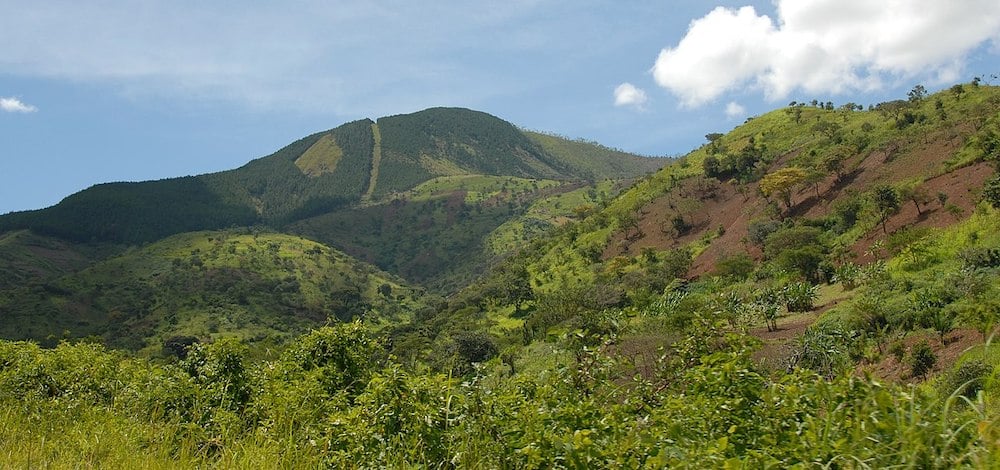
The Road to Bujumbura – ©Dave Proffer, CC BY 2.0 via Wikimedia Commons
Burundi is one of the poorest countries on the planet, owing in part to its landlocked geography, poor legal system, lack of access to education, and the proliferation of HIV/AIDS. Approximately 80% of Burundi’s population lives in poverty. Famines and food shortages have occurred throughout Burundi, most notably in the 20th century, and according to the World Food Programme, more than half of children under the age of five suffer from chronic malnutrition. One scientific study of 178 nations rated Burundi’s population as having the lowest satisfaction with life in the world. As a result of poverty, Burundi is dependent on foreign aid. Burundi’s largest industry is agriculture, which accounts for nearly 60% of the GDP. Within that, subsistence agriculture accounts for 90% of all agriculture. The nation’s largest source of revenue is coffee, which makes up 93% of Burundi’s exports. Other agriculture products include cotton, tea, maize, sorghum, sweet potatoes, bananas, manioc (tapioca); beef, milk, and hides.
Birding Burundi
Most of the country’s once extensive forests have been cleared for pastureland and farmland, and human settlements are encroaching upon the habitats of Burundi’s wildlife. Of the animal species that inhabit Burundi, 18 are threatened. Burundi has ratified an international agreement intended to protect endangered species. About 5.3 percent of the country’s total area is officially protected from development. The main protected areas are Kibira National Park, Ruvubu National Park, Ruzizi Nature Reserve, and Bururi Nature Reserve.

Kibira National Park – ©NZISABIRA Léopold, CC BY-SA 4.0 via Wikimedia Commons
Burundi’s lands are mostly agricultural or pasture. Settlement by rural populations has led to deforestation, soil erosion and habitat loss. Deforestation of the entire country is almost completely, with a mere 600 km2 remaining and an ongoing loss of about 9% per annum. There are just two national parks, Kibira National Park to the northwest (a small region of rain forest, adjacent to Nyungwe Forest National Park in Rwanda) and Rurubu National Park to the northeast (along the Rurubu River, also known as Ruvubu or Ruvuvu). Both were established in 1982 to conserve the dwindling wildlife populations.
-
Wikipedia
GNU Free Documentation License
https://en.wikipedia.org/wiki/Burundi
-
Number of bird species: 700
(As at August 2024)National Bird: Great Blue Turaco Corythaeola cristata
-
Avibase
PDF ChecklistThis checklist includes all bird species found in Burundi , based on the best information available at this time. It is based on a wide variety of sources that I collated over many years. I am pleased to offer these checklists as a service to birdwatchers. If you find any error, please do not hesitate to report them. -
Wikipedia
Annotated ListThis is a list of the bird species recorded in Burundi. The avifauna of Burundi include a total of 700 species, of which 3 have been introduced by humans. -
eBird
PDF ChecklistThis checklist is generated with data from eBird (ebird.org), a global database of bird sightings from birders like you. If you enjoy this checklist, please consider contributing your sightings to eBird. It is 100% free to take part, and your observations will help support birders, researchers, and conservationists worldwide.

-
Birds of East Africa
| (Kenya, Tanzania, Uganda, Rwanda, Burundi) | by Terry Stevenson & John Fanshawe | illustrated by Brian Small & John Gale | Helm | 2020 | Edition 2 | Paperback | 640 pages, 289 colour plates, colour distribution maps, colour & b/w maps | ISBN: 9781408157367 Buy this book from NHBS.com
Birds of East Africa
Apple iOS | AndroidThe eGuide to Birds of East Africa is an interactive companion to Terry Stevenson and John Fanshawe's Birds of East Africa field guide – the essential guide for birdwatchers visiting this spectacular region. It covers Kenya, Tanzania, Uganda, Rwanda and Burundi.Organisations-
African Bird Club
WebsiteGiven its recent history, few birdwatchers have been to Burundi for a decade or more and records are limited. With a species list of almost 600 in such a small country, one can only hope that travel possibilities improve in the not too distant future… -
Association Burundaise pour la Protection des Oiseaux
WebsiteThe mission of ABN is «to contribute to the conservation of Nature and to sustainable use of natural resources and ecosystem services for the great benefit of the Burundian population. ABN has the objective to promote love and conservation of Nature in all Burundian social categories through sensitisation, awareness raising, and environmental information dissemination.
Reserves-
*List of protected areas of Burundi
InformationSatellite View3 National Parks, 6 nature reserves -
IBAs
InformationSatellite ViewThis 2010 Status and Trend Report of Burundi’s IBAs has been produced with the financial support from the European Union (Europe Aid/ENV/2007/132-278) through the RSPB. The contents of this report are the sole responsibility of Association Burundaise pour la protection des Oiseaux (ABO) and can, no under normal circumstances, be regarded as reflecting the position of the European Union. -
NP Kibira
InformationSatellite ViewThe Kibira National Park is a national park in northwestern Burundi. Overlapping four provinces and covering 400 km2, Kibira National Park lies atop the mountains of the Congo-Nile Divide. It extends north from the provincial town of Muramvya to the border of Rwanda where it is contiguous with the Nyungwe National Park. Some of the important birds found here include the great blue turaco, mountain buzzard (Buteo oreophilus), white-spotted flufftail (Sarothrura pulchra), grey parrot (Psittacus erithacus), bar-tailed trogon (Apaloderma vittatum) and the black-and-white-casqued hornbill (Bycanistes subcylindricus). -
NP Rusizi National Park
InformationSatellite ViewRusizi National Park is a national park in Burundi, next to the Rusizi River. -
NP Ruvubu
InformationSatellite ViewLocated in north-eastern Burundi, the park extends south-westwards from the border with Tanzania along a 65km stretch of the valley of the Ruvubu river. Wildlife in the Ruvubu National Park consists of animals like hippopotamus, buffalo, crocodiles, leopard, monkeys, antelope and lion. Bird lovers will have a marvelous time in the Ruvubu National Park as more than 425 species of birds thrive in this park making it all the more attractive. -
NR Bururi Forest Nature Reserve
InformationSatellite View87 bird species have also been registered, including Apalis argentea which is common in some areas. -
NR Rumonge Nature Reserve
InformationSatellite ViewRumonge Nature Reserve is a protected area in Burundi covering 50 km2 -
NR Rusizi Delta Nature Reserve
Observatory WebsiteSatellite View -
NR Vyanda Forest Nature Reserve
InformationSatellite ViewCovers just This site is 6 km2
Sightings, News & Forums-
eBird
Sightings
Guides & Tour Operators-
Albertine Tours
Tour OperatorBurundi is a small but interesting country with over 600 bird species, this safari will lead you to bird hot spots of Burundi including Kibira forest and waterfall points. This 4 Days Burundi Birding Safari is filled with wildlife and visiting the lakes to experience the birdlife of Burundi. -
Gorilla Adventure Tours
Tour Operator4 Days Burundi Bird Watching Safari -
Intare Safaris
Tour Operator4 Days Burundi birding safari -
UgandaRwand Safaris
Tour Operator4 Days Burundi Birding Adventure
Trip Reports-
2014 [04 April] - Rhys Marsh - Kibira National Park
ReportI recently traveled to Burundi with a team from UNICEF to design a sustainable business model to bring electric lighting to some of the most impoverished communities in the world (shameless plug: visit here for more information). However, I wasn't going to travel all the way to one of the least-visited regions of the Albertine Rift without exploring the local avian fauna!
-
Fatbirder - linking birders worldwide...
Skip to content